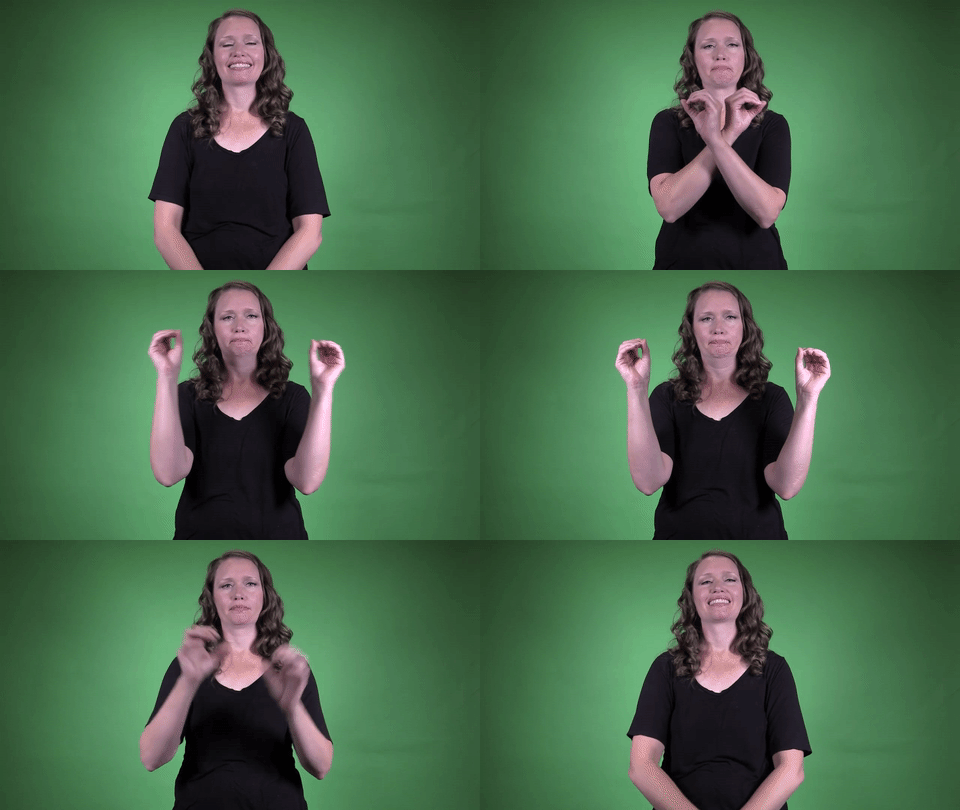
Definition: Not any; no part.
Sign for NONE in ASL
Practice Activities
Learning the sign for NONE in ASL requires consistent practice and a variety of methods to build muscle memory and fluency. Start with mirror work to ensure your handshape, movement, and facial expression match the correct form. The sign for NONE in ASL uses two “O” handshapes crossed in front of your body and moved outward, accompanied by a negative facial expression. Practicing this in front of a mirror helps reinforce both the physical and expressive components.
Another great technique is to record yourself signing. Set up a phone or webcam and sign short phrases or full sentences using the sign for NONE in ASL in context, such as “I have NONE” or “There are NONE left.” Play it back to evaluate your clarity, handshape accuracy, and expression.
Practice using the sign in real-world contexts. For example, during daily conversations or role-playing scenarios, integrate the sign for NONE in ASL to respond to statements or questions. You might say “I have NONE of that,” “NONE here,” or “There’s NONE available.” This not only reinforces vocabulary but also helps with fluid sentence structure.
For more advanced learners, try incorporating speed drills or receptive practice. Watch videos of native signers using the sign for NONE in ASL and try to recognize it at conversational speed. Then, repeat it back with accuracy, adjusting your pace as needed. You can also use flashcards with prompts that encourage you to use the sign in varied grammatical structures.
SEO Cultural Context
In Deaf culture, the sign for NONE in ASL is more than just a word—it conveys a complete concept of absence or lack. The sign is typically used when someone wants to express that there is absolutely nothing of something. For example, saying “I have NONE” in ASL is not just a factual statement; it often carries emotional or emphatic weight, depending on context and facial expression.
Facial expressions are crucial when signing NONE. A neutral face might indicate a simple absence, while a stronger negative expression could emphasize disappointment or frustration. This mirrors the emotional nuance that spoken languages convey through tone of voice.
Regional variation in the sign for NONE in ASL is minimal, though some signers may use slightly different motions or facial intensities based on local norms or dialects. However, the crossed “O” handshapes moving outward remain a clear and widely understood standard across the U.S. and in other ASL-using communities.
Deaf culture also places high value on clarity and visual grammar. The sign for NONE in ASL often appears in responses where directness is respected. For instance, instead of an indirect “not really,” a Deaf signer might simply say “NONE” to indicate absolute absence. This aligns with the visual and straightforward nature of ASL communication.
Extended Definition
The sign for NONE in ASL involves two “O” handshapes (like the letter “O” in ASL) crossing each other in front of the body and then moving outward as if sweeping something away. The motion is deliberate and is often accompanied by a slight shake of the head and a facial expression that signals negation or absence.
This sign functions as both an adjective and a pronoun in ASL grammar. You can use it to describe a quantity (“I have NONE of those”), as a reply to a question (“How many cookies are left?” “NONE”), or even as a standalone expression in conversation.
It’s important not to confuse the sign for NONE in ASL with related signs like NOTHING, which uses a different handshape and movement. NOTHING involves an “O” handshape that opens into a “5” handshape, usually combined with a facial expression of indifference or finality. Another common mistake is using the sign for ZERO, which looks similar but is more numerical and less expressive.
Understanding the grammatical context helps you choose the correct sign. While ZERO refers to the number 0, NONE implies the complete absence of something, especially in a more categorical or sweeping sense. For example, “There are ZERO apples” might be used in a math context, while “There are NONE” is more commonly used in everyday conversation.
Tips for Beginners
If you’re just beginning to learn the sign for NONE in ASL, don’t worry if your first attempts feel awkward. It’s completely normal. Pay special attention to your handshape—make sure your fingers are rounded into clear “O” shapes and that both hands match in form and motion.
Practice slowly at first. Many beginners rush through the movement, which can make the sign unclear or confusing. Take your time to cross your hands in front of your chest, then sweep them outward with intention. Pair this with a clear negative facial expression to reinforce the meaning.
Another common beginner mistake is forgetting to use facial expressions. In ASL, your face carries grammatical and emotional information. If you sign NONE with a blank expression, it may seem incomplete or ambiguous. Practice using a slight frown, a head shake, or raised eyebrows depending on the sentence context.
Don’t get discouraged if you confuse the sign for NONE in ASL with similar signs like NOTHING or ZERO. With repeated exposure and practice, especially in context, you’ll begin to distinguish their unique movements and when to use each correctly.
Take advantage of ASL learning apps, online dictionaries, and video demonstrations. Watching native signers use the sign for NONE in ASL in authentic dialogue will help reinforce both the meaning and the proper execution of the sign.
Connections to Other Topics
The sign for NONE in ASL connects closely with the sign for NOTHING. While both indicate absence, NOTHING often carries a more emotional or dismissive tone. Learning the difference between these two signs is essential for accurate and expressive communication.
Another related sign is ZERO, which specifically refers to the numeric value of 0. While it may appear similar, ZERO is used in mathematical or counting contexts, whereas NONE is more general and qualitative. Understanding the difference helps clarify your intent in conversation.
The sign for NO in ASL is a foundational negation sign that may appear in similar contexts. However, NO is often used in direct responses or as a standalone answer, while NONE functions within broader sentence structures. Knowing when to use each allows for more nuanced and grammatically correct statements.
You’ll also find connections with signs like EMPTY or GONE. EMPTY focuses on the state of a container or space having nothing inside, while GONE suggests the previous existence of something that is now absent. These signs complement the use of NONE and help expand your vocabulary around the concept of absence or negation.
Grammatically, the sign for NONE in ASL is part of a broader category of quantifiers and determiners. Learning signs like SOME, ALL, MANY, and FEW alongside NONE can provide a more complete understanding of how quantity and presence are expressed in ASL.
Lengthy Summary
Mastering the sign for NONE in ASL is a valuable step in becoming a more fluent and expressive ASL user. This sign plays a key role in communicating absence, negation, and categorical exclusion. Its clear movement, combined with expressive facial grammar, makes it both visually powerful and linguistically precise.
From a cultural standpoint, using the sign for NONE in ASL reflects the directness and clarity valued in Deaf communication. It’s more than just vocabulary—it’s a tool for expressing ideas in a way that resonates within the Deaf community. Understanding how and when to use it shows cultural respect and builds stronger conversational skills.
The sign itself uses two “O” handshapes that cross and then move outward, representing the sweeping away or removal of something. Paired with an appropriate facial expression, it fully conveys the concept of nothingness or total absence.
Beginners should focus on handshape precision and facial expression. Avoid rushing or using similar signs like NOTHING or ZERO unless you’re certain of the context. With regular practice—especially mirror work, recorded signing, and contextual use—you’ll gain confidence and fluency.
The sign for NONE in ASL also ties into a broader network of signs related to negation and quantity. Learning related concepts like NOTHING, ZERO, NO, EMPTY, and GONE will deepen your understanding and expand your ability to communicate complex ideas.
Overall, the sign for NONE in ASL is an essential part of everyday conversation. Whether you’re saying there’s no food left, no people in the room, or no interest in a topic, this sign helps you express that clearly and naturally. Keep practicing, keep watching native signers, and keep integrating this sign into your daily use. The more you use it, the more intuitive it will become.
Synonyms: zero, nothing, nobody, zilch, null
Educational resources: Find related learning materials in our course bank!
Want more? Check out some of our popular learning activities on the homepage!
Need to look up a sign? Use our highly rated dictionary: https://aslinteractive.com/best-asl-dictionary/
Follow us on tiktok: https://www.tiktok.com/@aslinteractive. More social media links at the bottom of this page!
Long-tail Keywords: what is the sign for none in ASL, how do you sign none in ASL, ASL sign for none
Categories:
tags: negation signs, basic ASL vocabulary, negative words in ASL, common ASL phrases, American Sign Language basics
Want more? Check out some of our popular learning activities!
ASL Interactive Resources
ASLInteractive YouTube Channel
Follow us on tiktok: @aslinteractive.com
Follow us on Instagram: aslinteractive
Facebook page: aslinteractive
Facebook group: aslinteractive
LInkedIn: ASL Interactive LLC
Twitter: @ASL_interactive
*Some information on this page is AI-generated. AI can make mistakes. Please check the information.


Responses