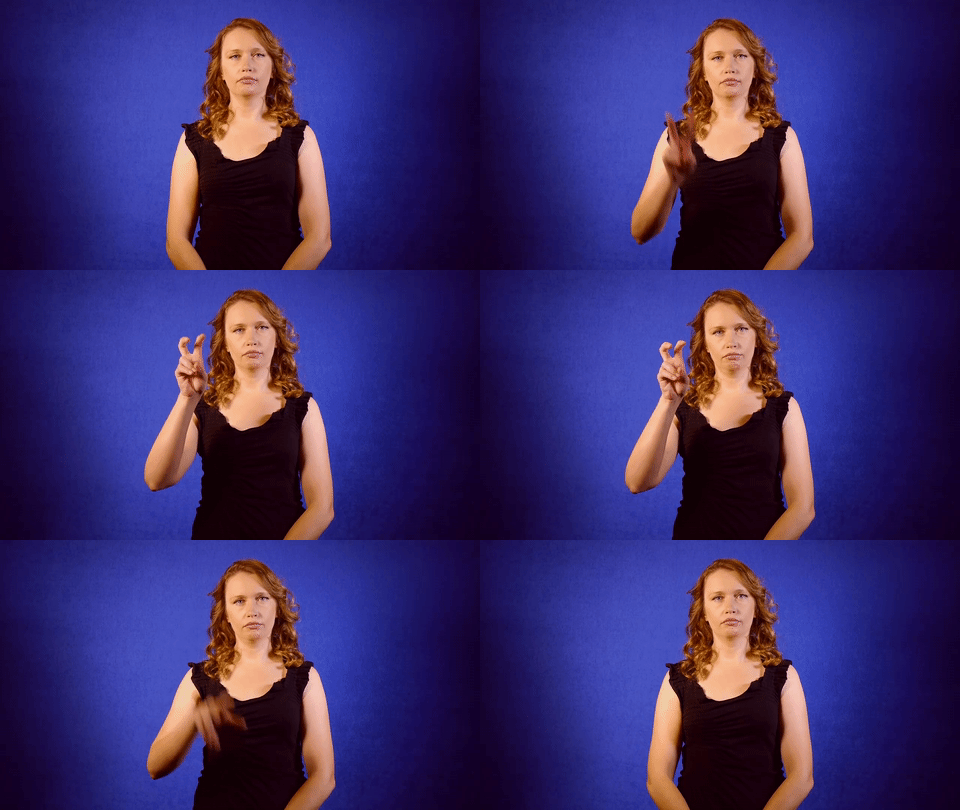
Definition: The number two hundred v2.
Sign for 200 V2 in ASL

Practice Activities:
To effectively learn the sign for 200 v2 in ASL, start by practicing it in isolation. Stand in front of a mirror and sign it repeatedly, ensuring your handshape, movement, and facial expression are accurate. Record a short video of yourself signing and compare it to a reference video to refine your technique.
Next, incorporate the sign for 200 v2 in ASL into number sequences. Count by hundreds up to a thousand or mix it with other numerical values, such as 150, 200, 250, and so on. This helps reinforce your ability to transition smoothly between numbers while signing.
Create sentences using the sign for 200 v2 in ASL to build fluency. For example, sign sentences like “The shirt costs 200 dollars” or “There are 200 students in the auditorium.” Mixing numbers with everyday vocabulary strengthens your expressive signing skills.
Engage in partner activities by practicing quiz-style number recall. One person signs a number randomly, and the other quickly identifies it. You can also play a shopping role-play game where one person is the cashier and the other a customer, incorporating 200 as a price.
For storytelling practice, describe real or fictional situations where 200 is significant. For example, “I ran 200 miles last year” or “My grandmother gave me 200 photographs from her travels.” Using this approach improves both storytelling skills and numerical fluency.
Finally, watch ASL videos that include number signs and observe how deaf signers integrate numbers naturally into conversations. Mimic their pacing and rhythm while using the sign for 200 v2 in ASL to ensure your signing appears fluid and natural.
Cultural Context:
The sign for 200 v2 in ASL reflects a unique way of expressing numbers within American Sign Language. ASL uses a combination of handshapes and movements to represent numerical values efficiently. Understanding the sign for 200 v2 in ASL helps learners communicate large numbers fluently.
Numbers in ASL often follow patterns that make them visually distinct yet easy to remember. The sign for 200 v2 in ASL may differ slightly from other variations of 200 due to regional influences or stylistic preferences. Learning the differences between versions helps improve overall ASL proficiency.
American Sign Language has evolved through natural language development and cultural influences. The sign for 200 v2 in ASL is part of this linguistic evolution, shaped by Deaf community preferences. Consistently practicing both traditional and variant number signs enhances communication skills.
The Deaf community values clarity and efficiency in number signs. The sign for 200 v2 in ASL reflects these priorities by maintaining a fluid and intuitive motion. Using the correct variation ensures seamless understanding in conversations involving numbers.
Math, finance, and daily life require clear numerical communication in ASL. The sign for 200 v2 in ASL enables users to discuss prices, dates, and statistics accurately. Mastering number signs boosts confidence in diverse social and professional settings.
ASL students often practice number signs repeatedly to achieve fluency. The sign for 200 v2 in ASL is an essential part of this practice, reinforcing number comprehension. Exposure to different numbering systems in ASL deepens understanding of linguistic nuances.
Numbers in ASL, including the sign for 200 v2 in ASL, follow structured patterns influenced by fingerspelling and numeric conventions. Learning these patterns helps users engage in mathematical discussions with ease. Recognizing multiplication, counting sequences, and large figures becomes second nature with practice.
Historical context may influence variations in number signs. The sign for 200 v2 in ASL may have developed from older forms of counting or linguistic adaptations. Exploring these changes highlights the dynamic nature of ASL within the Deaf community.
Teachers and interpreters emphasize the importance of correctly signing numbers. The sign for 200 v2 in ASL plays a role in educational environments where numerical precision is crucial. Learners benefit from repeated exposure and real-world application in conversations.
Regional dialects and signing styles may impact how numbers appear across different ASL users. The sign for 200 v2 in ASL may vary slightly depending on
Extended Definition:
The sign for 200 v2 in ASL is a variation of the standard way to express the number 200 in American Sign Language. This version may differ slightly in handshape or movement. Learning different variations helps improve signing fluency and understanding.
When signing 200 v2 in ASL, the movement typically starts with the number 2 handshape, followed by a transition to represent the hundred. The motion is smooth and clear to ensure proper recognition. Regional and stylistic differences may influence how signers use this version.
Numbers in ASL often have multiple ways to be signed, depending on context and signer preference. The sign for 200 v2 in ASL may be preferred in certain regions or by specific ASL communities. Exposure to these variations enhances signing skills and comprehension.
ASL numbers are an essential part of communication, and mastering them improves fluency. The sign for 200 v2 in ASL follows standard numbering conventions while allowing flexibility. Practice with native signers can help reinforce correct usage.
When learning the sign for 200 v2 in ASL, it’s helpful to watch videos or observe native users. Handshape, palm orientation, and movement all contribute to accuracy. Signing it correctly ensures clear communication in both casual and formal settings.
Historical influences and linguistic evolution contribute to variations in number signs. While the sign for 200 v2 in ASL may not be universally recognized, understanding different forms promotes better interaction. Familiarity with these differences can prevent misunderstandings.
In ASL, number signs often blend naturally into sentences. The sign for 200 v2 in ASL may occur in discussions about time, money, measurements, or other contexts. Recognizing it quickly helps maintain smooth conversation flow.
Fingerspelling is sometimes used when number signs are unclear or unfamiliar. However, using the correct sign for 200 v2 in ASL ensures efficient communication. Signing numbers fluently avoids unnecessary clarification and improves interactions.
Teachers and interpreters may introduce variations like the sign for 200 v2 in ASL to help students grasp different styles. Exposure to multiple forms enhances comprehension. This knowledge benefits both learners and experienced signers.
Mastering numbers in ASL, including the sign for 200 v2 in ASL, strengthens overall language skills. It encourages confidence in both signing and understanding others. Regular practice with different variations leads to more effective communication.
Synonyms: two hundred, 200, 2 hundred
Educational resources: Find related learning materials in our course bank!
Want more? Check out some of our popular learning activities on the homepage!
Need to look up a sign? Use our highly rated dictionary: https://aslinteractive.com/best-asl-dictionary/
Follow us on tiktok: https://www.tiktok.com/@aslinteractive. More social media links at the bottom of this page!
Long-tail Keywords: what is the sign for 200 in ASL, how do you sign 200 in American Sign Language, learn how to sign 200 in ASL
Categories: Numbers – Basics, hundreds, cardinal numbers
tags: Numbers, Counting, Mathematics, Educational, Language Learning
Parameters
*Handshape*:
the sign for 200 v2 in asl uses the number handshape. Begin with the number “2” handshape, where the index and middle fingers are extended while the rest of the fingers remain closed. Then, smoothly transition to a closed “C” or “O” shape to represent the double zero. This movement should be fluid to maintain clarity and natural flow. The sign for 200 v2 in asl is commonly used when signing numbers in financial or general counting contexts.
*Palm Orientation*:
The palm orientation for the sign for 200 V2 in ASL typically faces outward at the start of the movement. The dominant hand forms the number “2” with the palm facing forward before transitioning into “C” as it moves slightly downward. The palm remains forward or slightly angled as the handshape shifts, ensuring clarity in conveying the number in ASL.
*Location*:
The sign for 200 v2 in ASL is produced in the neutral space in front of the signer’s body, at approximately chest level. The hand moves slightly in this area to form the number sign. Since this is a number sign, it remains within signing space without touching the face or body. The location stays consistent to maintain clarity when conveying numerical information.
*Movement*:
The sign for 200 v2 in ASL starts by forming the number 2 with the dominant hand. The palm faces forward, and the index and middle fingers extend while the other fingers remain tucked in. The hand moves slightly forward before transitioning into a closed “C” or “O” handshape to represent the double zero. This smooth transformation ensures clarity when signing the sign for 200 v2 in ASL.
*Non-Manual Signals*:
Facial expressions remain neutral or slightly focused when demonstrating the sign for 200 v2 in ASL. If emphasizing the number, slightly raise your eyebrows to indicate importance. When signing quickly, a small nod can help clarify the movement. Keep a relaxed posture and ensure smooth transitions between handshapes. When using the sign for 200 v2 in ASL in context, matching your expression to the surrounding sentence enhances clarity and natural flow.
*Prosody, Dominant/Non-Dominant Hand*:
The sign for 200 V2 in ASL uses the dominant hand to form the number “2” with the index and middle fingers extended. The hand moves forward slightly as the handshape transitions into a loose “C” or “O” to represent “00.” This motion smoothly conveys the numerical concept while maintaining clarity. The non-dominant hand is not used in this version. The sign for 200 V2 in ASL should be fluid, ensuring the numeric transformation is visually distinct. ✋
Tips for Beginners:
When learning the sign for 200 V2 in ASL, focus on handshape and movement. This variation typically involves forming the number 2 with your dominant hand and smoothly transitioning into a zero. Keep your motion fluid to maintain clarity and prevent the sign from looking like two separate numbers.
A common mistake beginners make when signing the sign for 200 V2 in ASL is pausing between the 2 and 0, which disrupts the natural flow of the sign. Ensure that your fingers move efficiently from one number to the next without excess hesitation. Practice in front of a mirror to check that your movements are clear and distinct.
Finger dexterity plays an important role in signing the sign for 200 V2 in ASL accurately. Stretch and warm up your hands before practicing to improve flexibility. If transitioning from the 2 handshape to the 0 feels awkward, try slowing down and gradually increasing speed as you gain confidence.
Pay attention to palm orientation while signing the sign for 200 V2 in ASL. Your palm should remain forward during the transition to maintain visual clarity. If your hand twists or turns incorrectly, the sign may become difficult for others to recognize.
Consistent practice is key to mastering the sign for 200 V2 in ASL. Use repetition exercises to reinforce muscle memory and gain comfort with the motion. Watching native ASL signers demonstrate the sign can also help you refine your technique.
Connections to Other topics:
The sign for 200 V2 in ASL connects to broader numerical concepts in ASL, particularly how numbers change based on their context. Numbers in ASL can be modified when expressing quantities related to time, money, measurements, or rankings. The structure of the sign for 200 V2 in ASL follows ASL rules for signing hundreds, where the transition from the initial digit to the hundred marker mirrors other numbers like 300 or 400.
This sign also relates to larger numerical sequences in ASL, such as signing years, addresses, or page numbers. Numbers within these categories often differ in structure because ASL prioritizes clarity and efficiency in communication. The sign for 200 V2 in ASL follows similar patterns, reinforcing the logic behind numerical signing. Understanding this variation helps signers more effectively express other complex numbers, particularly in financial or academic settings.
Additionally, ASL incorporates numerical incorporation, where numbers become part of certain signs like minutes, hours, or dollars. While the sign for 200 V2 in ASL does not use numerical incorporation, recognizing this feature improves fluency by demonstrating how ASL modifies base signs to indicate quantity. For example, the signs for “three hundred dollars” or “four hundred years” follow similar transitions between the hundreds digit and the base sign.
Ordinal numbers, rankings, or labeling systems also connect to the sign for 200 V2 in ASL. When identifying numbered sequences such as “Room 200” or a “200-level college course,” ASL shifts slightly in presentation depending on context. These connections highlight the adaptability of ASL numbers, illustrating why knowing different sign variations enhances overall understanding of numerical structure in ASL.
Summary:
The sign for 200 V2 in ASL follows a numeral incorporation pattern, blending the number 2 with the hundred concept. This version of the sign offers an alternative to the standard method, which usually involves a direct movement or handshape modification. ASL allows multiple variations for numbers, offering signers different ways to express the same numerical value depending on context.
In the sign for 200 V2 in ASL, the number 2 handshape is initially formed. The movement transitions into a bent handshape akin to the typical hundred signs in ASL. This fluid transformation embodies how numbers are efficiently expressed within the language.
Handshape plays a crucial role in this sign, as the numeral 2 needs to be distinct before transitioning. The shift into the bent hand configuration represents the hundred concept concisely. By maintaining clarity in the transition, signers ensure accuracy in conveying the intended number.
Movement in the sign for 200 V2 in ASL is smooth and deliberate. The number 2 gradually folds into the bent hand, mirroring the structure used for other hundreds. This streamlined motion eliminates visual confusion and keeps the numerical idea intact.
Palm orientation remains stable throughout the execution of this sign. The initial positioning of the number 2 faces outward before the curling motion begins. Orientation consistency helps prevent misunderstandings, particularly when signing complex numbers.
Facial expressions typically remain neutral when signing numbers unless additional emphasis is needed. In specific contexts, a question or clarification might involve raised eyebrows or head tilts. However, the general use of this sign does not require marked facial grammar.
Numbers in ASL can have grammatical applications depending on how they function in sentences. The sign for 200 V2 in ASL is primarily quantitative and used for counting or identifying numerical values. When embedded in ASL discourse, it remains flexible to fit various linguistic constructs.
ASL users employ number signs in everyday contexts such as money, age, addresses, and ranking. The sign for 200 V2 in ASL could be encountered in situations involving pricing, measurements, or statistical data. Its usage makes numerical communication quick and intuitive in signed conversations.
The diversity of numeral signs in ASL shows how the language has evolved for efficiency. Some signs incorporate movement patterns that make transitions between digits smoother. The sign for 200 V2 in ASL exemplifies this adaptation by integrating movement and numerical representation seamlessly.
A key cultural aspect of ASL is its preference for visual economy—expressing ideas through minimal, yet effective, motion. The sign for 200 V2 in ASL reflects this principle by condensing two distinct numerical concepts into a single transition. This efficiency makes ASL well-suited for fast-paced and expressive communication.
Signed numbers are deeply embedded in Deaf culture and have historical significance in institutions like schools for the Deaf. Learning variations such as the sign for 200 V2 in ASL ensures fluency and comprehension in different signing communities. Regional and generational differences influence numeral representation within the ASL lexicon.
Comparing the sign for 200 V2 in ASL with other number signs reveals interesting linguistic insights. Some two-hundred signs use direct numeral sequencing instead of fused variations. ASL allows for flexibility, giving users options based on familiarity, region, or ease of movement.
While fingerspelling is common for proper nouns, number signs have their own set of consistent rules. The sign for 200 V2 in ASL does not rely on individual numerals being spelled out but instead follows a modeled numeral system. This technique ensures numbers remain visually distinct and effortlessly understood.
ASL linguists have studied numerical structures within the language to examine how numbers interact with grammar and syntax. The sign for 200 V2 in ASL showcases how numerical linguistics operates differently than spoken languages. By examining number signs, researchers gain insights into the cognitive processes of signed language users.
Applying linguistic concepts to the sign for 200 V2 in ASL highlights ASL’s visual-spatial nature. Signed numbers rely on shape transformation and directional movement rather than auditory phonetics. This principle distinguishes ASL from spoken numeration systems found in English or other spoken languages.
Number signs in ASL reflect sign language’s adaptation to real-world communication needs. The sign for 200 V2 in ASL represents a refined way to express numbers efficiently. By exploring variations, ASL learners become more adept at choosing the best forms for different interactions.
Many signed number systems follow patterns that align with cognitive ease. The sign for 200 V2 in ASL simplifies expressing large numbers without redundant gestures. This selection of optimal linguistic structures makes signed communication intuitive.
Technology and digital education have influenced how number signs are learned and documented. Various platforms ensure consistency in numerical representation, including different versions of signs like the sign for 200 V2 in ASL. Online resources help bridge generational gaps by standardizing and preserving number signs.
Instructor-led
Want more? Check out some of our popular learning activities!
ASL Interactive Resources
ASLInteractive YouTube Channel
Follow us on tiktok: @aslinteractive.com
Follow us on Instagram: aslinteractive
Facebook page: aslinteractive
Facebook group: aslinteractive
LInkedIn: ASL Interactive LLC
Twitter: @ASL_interactive
*Some information on this page is AI-generated. AI can make mistakes. Please check the information.


Responses