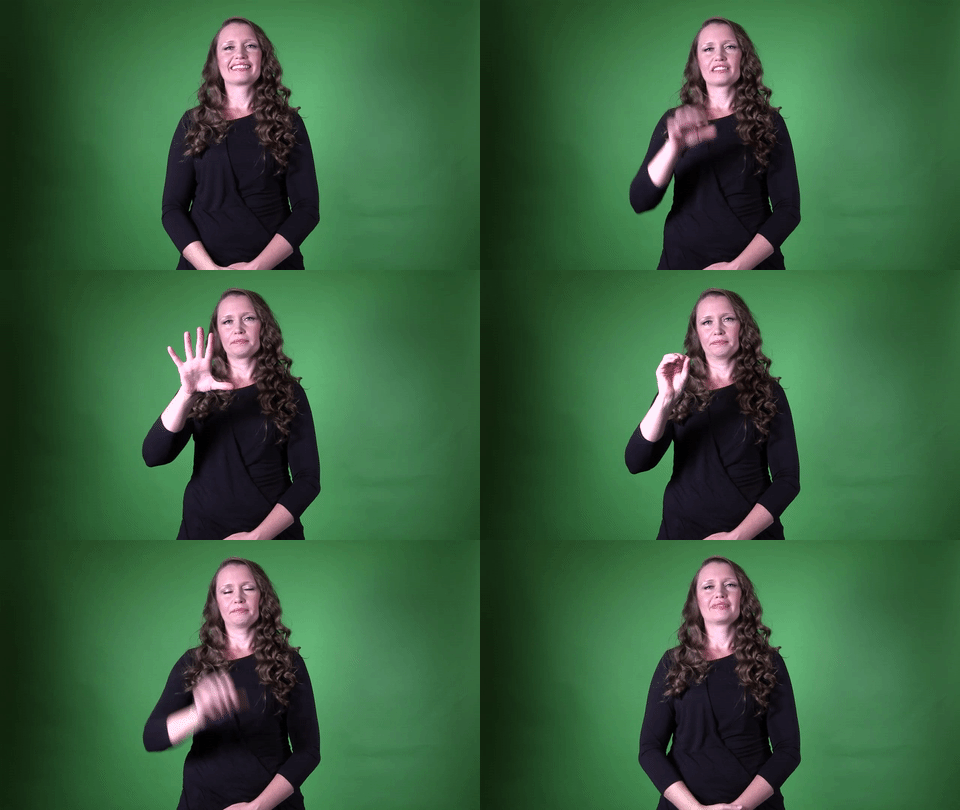
Definition: The number fifty.
Sign for 50 in ASL

Practice Activities:
Practicing the sign for 50 in ASL effectively requires repetition, visual recognition, and application in real-world contexts. Start by forming the number 5 with your dominant hand, fingers spread apart, then transition into a 0 by bringing your fingers together. Repeat this motion multiple times while looking in a mirror to ensure accuracy in both hand shape and movement.
Engage in number drills by signing 40 through 60 sequentially, paying extra attention to the transition when signing 50 in ASL. Mixing up numbers in a random order and signing them in response to written digits will improve recall. Try signing numbers quickly to simulate real conversational speed while maintaining clarity.
Use the sign for 50 in ASL in everyday situations to reinforce learning. Practice by signing different amounts such as 50 cents, 50 dollars, or 50 minutes. Create example sentences like “I read 50 pages today” or “There are 50 students in the class” to develop fluency. Writing down five numbered sentences and then signing them aloud can solidify memory.
Interactive activities with a partner or group will strengthen skills. One person can say a number at random while the other signs it. Another engaging exercise is a shopping role-play where one person acts as a buyer and the other as a cashier exchanging items with prices that include 50. Changing roles ensures a more well-rounded learning experience.
For storytelling, incorporate the sign for 50 in ASL within a short narrative. A possible prompt is: “Describe a day when you collected 50 of something: seashells, marbles, or stickers.” Adding context to number signs will help solidify them in memory. Finally, watch videos of fluent ASL users signing numbers to refine movement and mimic accurate hand shapes.
Cultural Context:
The sign for 50 in ASL is an essential part of numerical communication within the Deaf community. Numbers play a vital role in conversations, whether discussing age, money, measurements, or quantities. Knowing the sign for 50 in ASL helps ensure clear and efficient communication in various real-life situations.
Numbers in ASL follow a specific pattern, and the sign for 50 in ASL is made using a unique handshape. ASL numbers up to 100 have distinct movements that differentiate them from one another. Mastering these signs helps improve fluency and comprehension when signing larger numbers.
The sign for 50 in ASL is commonly used in everyday life, from discussing prices while shopping to talking about years and milestones. Within the Deaf community, numbers are frequently incorporated into casual and formal conversations. Accuracy in signing numbers ensures clarity, avoiding misunderstandings in personal or professional interactions.
When signing the number 50, proper hand shape and movement are necessary for correct expression. ASL relies on visual and spatial awareness, making number signs an integral part of effective communication. Learning the sign for 50 in ASL helps strengthen overall signing skills and supports engaging dialogues.
In Deaf culture, numbers like 50 are often used when discussing historical events, anniversaries, and significant achievements. Whether talking about a 50-year anniversary or celebrating someone’s 50th birthday, using the correct sign ensures meaningful interactions. Numeric literacy in ASL allows signers to fully participate in both social and academic discussions.
Many ASL students practice number signs to improve fluency and confidence in signing conversations. The sign for 50 in ASL is just one of many numerical signs that learners must master for everyday communication. Engaging in real-world situations where numbers are essential makes learning ASL more practical and enjoyable.
Technology and media have made learning ASL numbers even more accessible. Online courses, videos, and mobile apps provide visual demonstrations of the sign for 50 in ASL. These resources help students of all levels practice their skills and refine their signing technique.
Using the correct number signs enhances conversations and builds trust within the Deaf community. Whether signing a phone number, giving directions, or discussing finances, the sign for 50 in ASL is just one of many important numerical expressions. Developing accuracy in ASL numbers supports effective communication in both casual and professional settings.
Mastering the sign for 50 in ASL boosts overall comprehension and strengthens fluency in signing larger numbers. Many conversations
Extended Definition:
The sign for 50 in ASL is a combination of numerical handshapes that express the number clearly and efficiently. This sign is part of the American Sign Language number system, which uses distinct hand movements and formations to represent numerical values. Learning how to form the sign correctly ensures effective communication with deaf and hard-of-hearing individuals.
To make the sign for 50 in ASL, start by forming the number 5 with your dominant hand, extending all five fingers outward. Then, quickly transition into the number 0 by bringing your fingers together into an “O” shape. This movement is fluid, and maintaining a smooth transition helps convey the number accurately.
Mastering numbers like 50 in ASL is crucial for discussing ages, measurements, and financial amounts. Numbers are widely used in everyday conversations, and knowing them enhances fluency in ASL. Practicing regularly will help improve speed and accuracy when signing different numbers.
The sign for 50 in ASL follows the pattern used for other round numbers ending in zero. Many of these numbers involve a transition from an open five-handshape to a modified “O” handshape. Recognizing these patterns makes it easier to remember multiple number signs in ASL.
When signing 50 in ASL, facial expressions and clarity are important. While numbers are primarily conveyed through handshapes, context and expression help avoid misunderstandings. Signing too quickly or too small can make it harder for others to recognize the number correctly.
Different signers may have slight variations in how they sign 50 in ASL, but the core movement remains the same. Some people may use a sharper closure when forming the “O” shape, while others might sign it more fluidly. As long as the number is clear and recognizable, minor differences are acceptable.
Numbers in ASL, including the sign for 50, are used in various settings such as schools, workplaces, and social interactions. Knowing how to sign numbers properly is essential for both beginners and advanced ASL learners. Expanding number vocabulary strengthens overall communication skills in sign language.
When learning how to sign 50 in ASL, it’s helpful to practice with other numbers in the same series, such as 40 and 60. This reinforces the muscle memory needed to switch between similar numerical signs. Practicing with a mirror or a signing partner can also improve accuracy and confidence.
Understanding the sign for 50 in ASL is just one step in becoming proficient in
Synonyms: fifty, number fifty, number 50, the number 50, the number fifty
Educational resources: Find related learning materials in our course bank!
Want more? Check out some of our popular learning activities on the homepage!
Need to look up a sign? Use our highly rated dictionary: https://aslinteractive.com/best-asl-dictionary/
Follow us on tiktok: https://www.tiktok.com/@aslinteractive. More social media links at the bottom of this page!
Long-tail Keywords: what is the sign for 50 in ASL, how do you sign 50 in ASL, ASL sign for 50
Categories: Numbers – Basics, Numbers 41-50, cardinal numbers
tags: Numbers 41-50, Numbers, Math, Educational, Language Learning
Parameters
*Handshape*:
The sign for 50 in ASL uses the number 5 and the number 0 handshapes. Begin with your dominant hand in the number 5 handshape, with the palm facing forward. Then, smoothly transition by bringing your fingers together into the number 0 handshape. The movement should be fluid, as if the fingers are folding in naturally. The sign for 50 in ASL is commonly used in counting, age references, and numerical contexts.
*Palm Orientation*:
the palm orientation for the sign for 50 in ASL faces outward, away from the signer. The hand starts open with all five fingers extended, then quickly transitions into a relaxed “0” shape as the fingertips touch the thumb. The motion is fluid, ensuring a clear representation of the number. When performing the sign for 50 in ASL, keeping the movement smooth helps with clarity and recognition.
*Location*:
The sign for 50 in ASL is produced in the neutral space in front of the body, typically at chest level. The sign starts with the number 5 handshape, palm facing out, and then transitions into the number 0 handshape by bringing the fingers together. This movement occurs within the signing space without touching the body. Maintaining a steady hand position ensures clarity when signing the sign for 50 in ASL.
*Movement*:
To produce the sign for 50 in ASL, begin with your dominant hand in the number 5 handshape, palm facing outward. Quickly transition by bringing your fingers together into a 0 handshape, then open back to a 5. The movement should be fluid, as if the fingers are pinching in and then expanding. This action visually represents the number. Keep your hand steady in front of you at chest level.
*Non-Manual Signals*:
When signing the sign for 50 in ASL, keep a neutral or slightly attentive facial expression. The eyebrows can remain relaxed, and there is no exaggerated mouth movement needed. If emphasizing the number, slightly raise the eyebrows or nod to add clarity. For casual contexts, keep a natural flow without unnecessary tension in the face. Maintaining direct eye contact ensures clarity when using the sign for 50 in ASL during conversations.
*Prosody, Dominant/Non-Dominant Hand*:
The sign for 50 in ASL uses the dominant hand only. Start with the number 5 handshape, where all five fingers are extended. Then, quickly transition into the number 0 handshape by bringing the fingertips of all fingers together. This movement is fluid, with a slight bouncing motion between the two handshapes. The non-dominant hand is not used in the sign for 50 in ASL, keeping the focus on the dominant hand’s motion.
Tips for Beginners:
Mastering the sign for 50 in ASL takes practice, especially in smoothly transitioning between the two numbers. The sign for 50 in ASL starts with the number 5 handshape, where all five fingers are spread apart. Then, the fingers come together into a closed 0 handshape, similar to forming the number 0. This motion should be fluid and quick to maintain clarity.
One common mistake beginners make is forming the 0 handshape too slowly, which can make the sign look more like 5-0 instead of a single number. To avoid this, focus on making a crisp transition from 5 to 0 without hesitation. Practicing in front of a mirror can help you ensure that your fingers move smoothly and don’t pause awkwardly between the two shapes.
Another issue to watch for is finger stiffness. If your fingers are too rigid when forming the 0, your sign might look unnatural or inaccurate. Keep your fingers relaxed, and allow them to come together easily when forming the 0 shape. Try wiggling your fingers before signing to loosen them up and make the movement more fluid.
Hand positioning is key for accuracy. The palm should face outward throughout the movement so that the number is visible to the viewer. If your hand twists inward or downward, it can make the sign unclear. Keeping the motion steady and precise will prevent confusion and ensure that your sign for 50 in ASL is easily understood.
Lastly, practicing with number sequences can improve your speed and fluency. Try signing 40, 50, and 60 repeatedly to get comfortable with the transitions between numbers. The more you practice, the more natural the movement will feel, helping you confidently use the sign for 50 in ASL in everyday conversations.
Connections to Other topics:
The sign for 50 in ASL is part of the broader numbering system in ASL, which follows specific handshape patterns for different sets of numbers. Numbers in ASL are often categorized by how they are formed, such as with distinct handshapes or movement patterns. The sign for 50 in ASL follows the trend of incorporating the number five handshape, making it visually similar to other multiples of ten like 40, 60, and 70. Recognizing these patterns makes it easier for learners to quickly grasp and recall number signs in ASL.
Numbers play an essential role in many other ASL topics, including dates, ages, and measurements. The sign for 50 in ASL can appear in contexts such as discussing prices, temperatures, or percentages. Additionally, numbers are frequently combined with classifiers to describe amounts or quantities, like “50 people attending an event” or “50 dollars spent on groceries.” Becoming comfortable with number signs allows for greater fluency in everyday ASL usage.
Ordinal numbers, like 50th place or 50th anniversary, sometimes modify the structure of number signs by adding a small twist or movement. This is particularly useful in ranking systems, anniversaries, and sports standings. The sign for 50 in ASL might also combine with time-related signs, such as “50 minutes” or “50 years old,” demonstrating how numbers seamlessly integrate into ASL conversation. Learning these combinations enhances understanding of how ASL expresses numerical concepts efficiently.
A strong grasp of number signs also supports learning financial, mathematical, and statistical terms in ASL. In discussions about business, budgeting, or data analysis, users might sign “50 percent” or “50 units sold.” Recognizing how numbers integrate into various ASL topics ensures that signers can participate in conversations involving quantifiable information. Practicing the sign for 50 in ASL alongside related numbers improves confidence when discussing numerical data in ASL.
Summary:
The sign for 50 in ASL follows a common numerical pattern within American Sign Language, combining elements of the number 5 and the number 0. It begins with the number 5 handshape, where the fingers are spread out with the palm facing outward. The movement transitions from the extended five fingers to a closed fist, resembling the shape of a zero.
This transition from an open to a closed hand visually represents the combination of “five” and “zero,” making it both intuitive and efficient. The movement should be fluid yet distinct, allowing clear differentiation from similar number signs. Precision in finger positioning is crucial in avoiding confusion with other numerical values.
Numbers in ASL are an integral part of communication, significantly influencing time, age, quantities, and financial transactions. The sign for 50 in ASL fits within the numerical system based on handshape reductions, a characteristic feature in American Sign Language numbering conventions. Fluent signers utilize these natural patterns to maintain fluid expression when discussing numerical concepts.
When signing 50, context plays a crucial role in ensuring clarity. Numerical signs alone may be ambiguous if not accompanied by additional non-manual markers or contextual information. For example, a signer might need to specify whether 50 refers to dollars, percentages, or exact quantities.
The structure of ASL employs numerical incorporation when possible, where numbers merge with certain classifier systems or recurring movements. However, 50 itself does not typically follow an incorporated pattern but instead remains a standalone sign. The reduction from 5 to 0 aligns with similar patterns found in ASL numerical sequences, particularly other multiples of ten like 40 or 60.
Cognitively, number recognition in ASL involves not just hand configuration but also movement efficiency. The concise motion reducing five fingers to none encourages faster communication without unnecessary complexity. This efficiency is a hallmark of ASL’s numerical system and one of the many ways signers streamline communication.
For learners, practicing numerical transitions like the sign for 50 in ASL is essential for fluency and accuracy. Beginners often struggle with fluid reductions, leading to hesitation or unclear hand formations. Consistent repetition and visual feedback, such as signing in front of a mirror, help refine the fluency needed for natural ASL expression.
Those familiar with ASL numbering will recognize that distinctions between multiples of ten rely on movement changes rather than major handshape modifications. This pattern maintains consistency within ASL’s number lexicon, reducing cognitive load for both signers and viewers. The same principle applies across number signs, reinforcing the systematic nature of ASL.
In applied linguistics, the efficiency of ASL numerals, including the sign for 50 in ASL, illustrates principles of visual economy in signed languages. The reduction of movement while maintaining clarity aligns with linguistic theories of modality-specific grammar. These efficiency strategies highlight how signed languages adapt to human visual processing.
The meaning of 50 can also extend beyond the literal numerical value in everyday use. In discussions about age, history, or price, clear articulation of the number is key for facilitating accurate comprehension. Holding the sign slightly longer or repeating it may add emphasis, depending on the context.
Signing numbers like 50 follows general grammatical norms in ASL, where sequencing and spatial distribution can impact meaning. In certain contexts, number signs are placed before or after the noun they modify, following ASL syntax. Mastery of sign placement enhances clarity and reduces potential misunderstandings.
Related signs, such as 40 or 60, follow similar reduction principles, reinforcing consistency across numerical signs. These patterns demonstrate ASL’s structured and logical approach to numerical representation, making them easier to learn once the patterns are recognized. Recognizing these patterns helps signers quickly expand their numerical fluency.
Non-manual markers such as slight head nods or eyebrow movements can assist in clarifying meaning when using the sign for 50 in ASL. For example, raising the eyebrows slightly may indicate a question or confirmation, while subtle head tilts may suggest estimation. These additional cues enhance communication effectiveness.
Linguistically, the sign for 50 demonstrates ASL’s morphological strategies in number reduction. Unlike English’s spoken numerical system, ASL’s visual-gestural format allows immediate representation of numerical concepts without phonological constraints. This difference highlights the distinct structures of spoken and signed languages.
Comparing the ASL system to other signed languages reveals both similarities and differences in numerical conventions. While many signed languages employ similar reduction techniques for numbers, the exact execution of transitions and handshapes differs. This variation between signed languages emphasizes the importance of learning ASL-specific number signs correctly.
The sign for 50 in ASL is particularly relevant in financial matters, where precision in number signs is non-negotiable. Misrepresentation of numerical values could lead to significant misunderstandings in banking, business, or contract settings. Ensuring accurate signing maintains professionalism and effective communication in these instances.
ASL learners may
Want more? Check out some of our popular learning activities!
ASL Interactive Resources
ASLInteractive YouTube Channel
Follow us on tiktok: @aslinteractive.com
Follow us on Instagram: aslinteractive
Facebook page: aslinteractive
Facebook group: aslinteractive
LInkedIn: ASL Interactive LLC
Twitter: @ASL_interactive
*Some information on this page is AI-generated. AI can make mistakes. Please check the information.


Responses