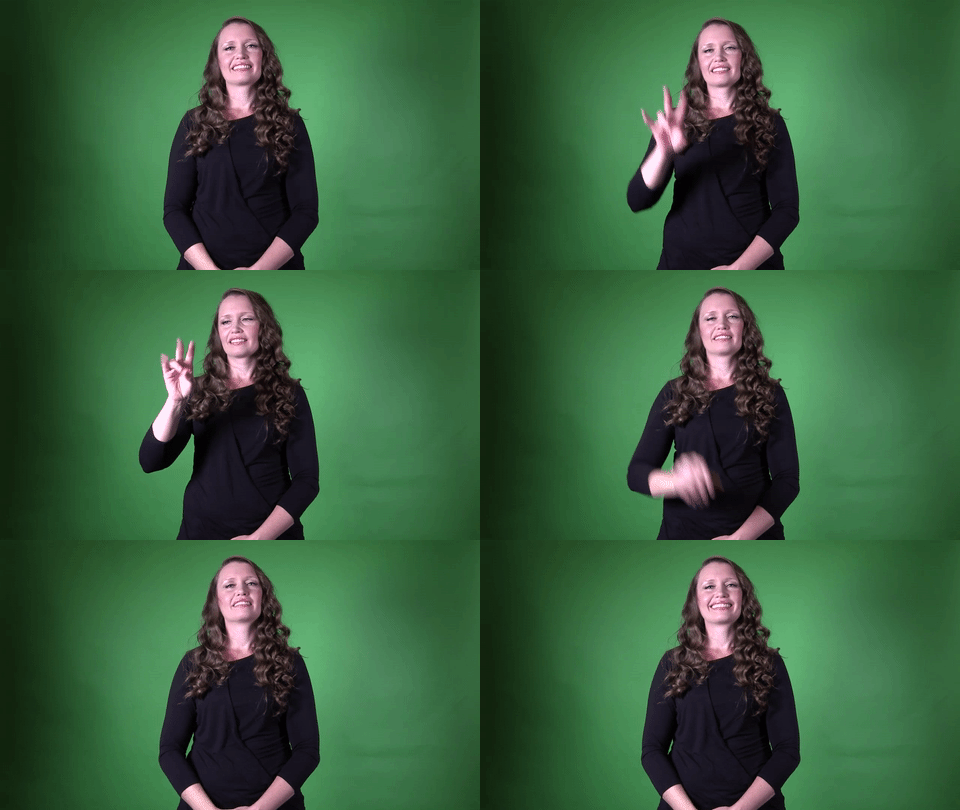
Definition: The number seventy.
Sign for 70 in ASL

Practice Activities:
To practice the sign for 70 in ASL, start by repeatedly forming the number while looking in a mirror to ensure handshape accuracy. Focus on maintaining smooth transitions between the digits and keeping your movements clear. Try signing it slowly at first, then gradually increase your speed while maintaining clarity.
Next, practice counting from 60 to 80 in ASL, ensuring that you transition smoothly into the sign for 70. Say the numbers aloud as you sign to reinforce the connection between the visual sign and its numerical value. If possible, record yourself and check for consistency in handshapes and movement.
Use the sign for 70 in ASL within real-world contexts, such as pretending to discuss someone’s age, money amounts, time, or addresses. For example, practice signing sentences like “My grandma is 70 years old” or “That costs 70 dollars.” This will help you understand how to integrate the number into everyday conversation naturally.
Try a group or partner activity where one person fingerspells a random two-digit number, and the other person signs it back. Include the sign for 70 in ASL frequently in this exercise to reinforce recognition. You can also quiz each other by flashing written numbers and signing them as quickly as possible.
Challenge yourself by practicing storytelling that includes the number 70. Imagine a scenario where someone is celebrating their 70th birthday, or make up a story about someone traveling 70 miles. Use expressive signing to bring your narrative to life while ensuring that your numbers are clear and precise.
Finally, watch ASL videos or attend a Deaf community event where numbers are used in conversation. Pay close attention to how native signers use the sign for 70 in ASL naturally and in context. Imitating fluent signers will help refine your accuracy and confidence.
Cultural Context:
American Sign Language (ASL) is a rich and visual language that conveys meaning through handshapes, facial expressions, and movements. Numbers play a crucial role in ASL communication, from counting and math to dates and ages. The sign for 70 in ASL follows a pattern used with other multiples of ten.
In ASL, numbers from 60 to 90 often follow a unique pattern that includes a twisting or flicking motion. The sign for 70 in ASL uses the number 7 handshape, followed by a movement that distinguishes it from other similar numbers. This number is commonly used in everyday conversations, such as discussing prices, ages, and historical dates.
In many cultures, turning 70 is a significant milestone and a time of celebration. Discussions about birthdays and anniversaries often require fluent number signing. The sign for 70 in ASL allows signers to participate in these cultural conversations easily.
The structure of ASL numbers, including the sign for 70 in ASL, follows a logical pattern that makes learning them easier for signers. Recognizing these patterns helps with fluency and comprehension. Whether discussing time, finances, or statistics, understanding number signs is essential in ASL communication.
ASL relies on clear and distinct handshapes to avoid confusion, especially with numbers that may look visually similar. Practicing the sign for 70 in ASL ensures clarity and helps avoid misunderstandings. Precision in signing numbers is necessary for effective communication in ASL.
When discussing age, decades, and financial amounts, using the correct number sign is important. The sign for 70 in ASL often appears in conversations about history, retirement, and personal milestones. Becoming comfortable with number signs improves communication and confidence in signing.
Deaf culture values expressive and accurate signing, making number signs an important part of daily interaction. Mastering the sign for 70 in ASL contributes to a signer’s overall fluency. Whether in classrooms, meetings, or casual interactions, knowing how to sign numbers enhances conversations.
Numbers in ASL reflect linguistic patterns found within the language, making them easier to learn once a signer recognizes the system. The sign for 70 in ASL is part of a broader number system that follows simple and recognizable patterns. With practice, number signs become second nature for ASL users.
Understanding ASL numbers makes it easier to communicate specific details in conversations. The sign for 70 in ASL is useful for discussing numerical
Extended Definition:
The sign for 70 in ASL is a combination of two distinct handshapes, forming a fluid movement often used in counting, addresses, and phone numbers. Learning this number sign is essential for those developing fluency in American Sign Language, as numbers play a vital role in everyday communication. Accurate hand placement and movement are key to ensuring clarity when using this sign.
To form the sign for 70 in ASL, start by shaping your dominant hand into the number seven, with your thumb and index finger extended while the other three fingers remain folded down. Then transition smoothly into a zero by closing your fingers into an “O” shape. This movement should be fluid and confident, maintaining a consistent motion to convey the number effectively.
Numbers in ASL can sometimes be modified based on context, such as for phone numbers or addresses, where pauses or repetitions might be used for clarity. However, the base sign for 70 in ASL remains the same regardless of variations in numerical contexts. Mastering this will help you communicate smoothly when dealing with numbers in conversations.
Numbers ending in zero follow a rhythmic pattern in ASL, which makes memorization easier when learning multiple numbers at once. Many learners find it helpful to practice signing 60–90 consecutively to recognize the patterns in movement. Understanding these patterns improves overall fluency in ASL number signs.
Hand orientation and palm direction matter when signing numbers, as subtle differences can affect meaning. The sign for 70 in ASL should be executed with the palm facing forward unless a specific variation is needed for visibility. Paying attention to these details ensures the sign is understood correctly.
Facial expressions and body language can also enhance clarity when using numbers in ASL. While signing 70, keeping a neutral or slightly engaged facial expression can make communication more natural. Context plays a big role in how numbers are perceived, so it’s helpful to indicate whether you’re referring to an amount, age, or a specific identifier.
Consistent practice is essential when learning number signs to improve speed and fluency. Watching native ASL users sign numbers can help you refine your technique and match the natural rhythm of signing. The sign for 70 in ASL is a fundamental part of communicating large numbers and counting sequences.
ASL numbers are widely used in educational settings, workplaces, and social interactions, making them an important skill for students of the language. The ability to sign numbers fluidly, including 70, enhances conversations and ensures
Synonyms: seventy, number seventy, number 70, the number 70, the number seventy
Educational resources: Find related learning materials in our course bank!
Want more? Check out some of our popular learning activities on the homepage!
Need to look up a sign? Use our highly rated dictionary: https://aslinteractive.com/best-asl-dictionary/
Follow us on tiktok: https://www.tiktok.com/@aslinteractive. More social media links at the bottom of this page!
Long-tail Keywords: what is the sign for 70 in ASL, how do you sign 70 in ASL, learn how to sign 70 in American Sign Language
Categories: Numbers – Basics, Numbers 61-70, cardinal numbers
tags: Numbers, Numbers 61-70, Language Learning, counting by 10s
Parameters
*Handshape*:
The sign for 70 in ASL uses a handshape that transitions between two distinct number formations. It begins with the number 7 handshape, where the thumb and ring finger touch while the other fingers extend outward. Then, the hand smoothly moves to a 0 handshape, forming a rounded shape with all fingertips touching the thumb. This transition happens fluidly to clearly represent the numerical value. The sign for 70 in ASL follows the pattern of other multiples of ten, maintaining consistency in number signs.
*Palm Orientation*:
The palm orientation for the sign for 70 in ASL starts with the dominant hand forming the number 7, with the palm facing outward or slightly angled forward. As the fingers transition to form a 0, the palm maintains a forward-facing position. The motion between 7 and 0 should be smooth and controlled, ensuring clarity when signing the sign for 70 in ASL. ✋
*Location*:
The sign for 70 in ASL is made in the neutral space in front of the body, slightly above waist level. The dominant hand forms the number 7 with the palm facing forward, then transitions into the number 0 in a fluid motion. This movement happens in one smooth transition to clearly indicate the number 70 in ASL without any pauses.
*Movement*:
To produce the sign for 70 in ASL, start with the number 7 handshape, where the thumb and ring finger touch while the other fingers remain extended. Then, transition smoothly into the number 0 handshape by bringing the fingertips together to form an “O” shape. The motion should be fluid and natural, ensuring clarity when expressing the sign for 70 in ASL. Keep the movement controlled to maintain accuracy.
*Non-Manual Signals*:
Facial expression remains neutral or slightly focused when performing the sign for 70 in ASL. The eyebrows may relax naturally, with the head maintaining a steady or slightly forward-tilted position, depending on the context. If emphasizing or clarifying the sign for 70 in ASL, a slight nod or a confirming facial expression, such as raised eyebrows, can be used to reinforce the number.
*Prosody, Dominant/Non-Dominant Hand*:
The sign for 70 in ASL uses the dominant hand in a “7” handshape. The palm faces outward, and the thumb and index finger are extended. The movement shifts smoothly into a “0” handshape by bringing the fingers together while maintaining a controlled motion. This transition is fluid and effortless, ensuring clarity when signing numbers. The non-dominant hand remains inactive unless used for additional emphasis or context.
Tips for Beginners:
The sign for 70 in ASL follows the common pattern for numbers in the seventies. To form this number, start with the handshape for 7, which involves extending the thumb and ring finger while keeping the rest of the fingers extended. Then transition smoothly into the handshape for 0 by bringing your fingers together into an “O” shape. Keep your movements fluid to ensure clarity and accuracy.
One common mistake when signing the sign for 70 in ASL is making the movement choppy or too slow. The transition between 7 and 0 should be smooth and natural. Beginners often hesitate or pause between digits, but practicing the movement repeatedly will help build confidence and fluidity.
Pay attention to palm orientation when signing the sign for 70 in ASL. Your palm should generally face outward while showing both digits. If you angle your palm too much toward your body or twist your wrist awkwardly, it can make the sign harder to read. Checking your palm orientation in a mirror or with a signing partner will improve your accuracy.
Finger dexterity is essential for signing numbers correctly. If it’s challenging to transition from 7 to 0, try warming up your fingers first with simple stretches or practicing smaller finger movements. Over time, muscle memory will help you sign the number quickly and efficiently.
Consistent hand positioning and movement speed are key to making the sign for 70 in ASL clear. Some learners make the mistake of over-exaggerating the hand motion or signing too fast. Instead, aim for a controlled, natural motion that ensures readability. With regular practice, this number will feel more natural in everyday use.
Connections to Other topics:
The sign for 70 in ASL connects closely to the numerical system, especially the pattern of signing multiple-digit numbers. In ASL, numbers in the 60s, 70s, 80s, and 90s typically follow a similar movement pattern, transitioning from one numerical handshape to another. The sign for 70 in ASL moves from a 7-handshape to a 0-handshape, which is similar to how other multiples of ten are signed but with distinct handshapes for each number.
Understanding the sign for 70 in ASL is also helpful when learning related number patterns such as phone numbers, addresses, and years. ASL users often sign numbers fluidly in real-life contexts, like stating someone’s birth year or reading off numerical information. The sign for 70 in ASL is particularly useful when discussing statistics, prices, or measurements where round numbers commonly appear.
This sign is also part of broader number-related discussions in ASL, such as percentages, fractions, and dollar amounts. When discussing monetary values, ASL often incorporates numbers with a quick modification to show dollars or cents, influencing how numbers like 70 are signed in context. Learning the sign for 70 in ASL along with other ten-based numbers makes it easier to develop fluency with larger numerical concepts.
Additionally, many signs include numerical incorporation, such as indicating a specific number of years when signing “years-old” or using numerical classifiers in storytelling. ASL relies on number-based classifiers to show quantities, rankings, or spatial relationships, and being comfortable with the sign for 70 in ASL strengthens a signer’s ability to describe numerical data effectively. Numerical fluency enhances overall ASL competency and ensures smoother communication in everyday interactions.
Summary:
The sign for 70 in ASL follows a structured numerical pattern commonly used for numbers in the tens series. It is formed using the dominant hand, beginning with the number 7 handshape. The fingers of the 7 handshape consist of the thumb and ring finger touching while the other fingers extend upwards.
After forming 7, the hand moves smoothly into the 0 handshape. The 0 handshape is made by touching the thumb and index finger together, forming a circular shape, while the other fingers remain extended or slightly relaxed. This transition from 7 to 0 should be fluid, without excessive motion or hesitation.
ASL numbers from 60 to 90 often follow a similar transformation pattern. The number shifts from its first digit to the 0 shape in a continuous gesture. This numerical system maintains consistency, making it easier for signers to recognize patterns quickly.
Understanding the sign for 70 in ASL requires familiarity with cardinal numbers in sign language. Each number in the tens sequence follows a structured transition, an essential aspect of ASL’s numerical system. These linguistic patterns help reinforce fluency and ease in communication.
When signing the number 70, hand positioning and clarity are crucial. The movement should be distinct without unnecessary exaggerations. Unclear handshapes may be misinterpreted as a different number, such as 17 or another tens number.
ASL uses precise movement to differentiate signs that may appear similar. Proper handshape, orientation, and transition ensure effective communication. This approach aligns with the visual nature of ASL, where clarity is a priority.
In casual conversations, the tens numbers are often signed quickly. This efficiency in signing speed develops naturally with practice and exposure. Fluent signers refine their movements to be both clear and rapid.
Some regional variations may slightly alter the motion used in signing numbers like 70. However, the basic structure remains consistent across different ASL-using communities. Understanding possible variations helps in recognizing different signing styles.
Cultural significance is essential in understanding the broader role of numbers in ASL. Numbers are frequently used in signing dates, prices, addresses, and quantities. Mastering numbers enhances a signer’s overall fluency and interaction.
The sign for 70 in ASL also connects to numerical patterns in deaf education. In educational settings, numbers are crucial in teaching basic math and numerical literacy. ASL users rely on numerical signs for academic and professional communication.
Linguistically, ASL numbers demonstrate the language’s tendency to use simultaneous manual features. The handshape, movement, and orientation all function together to create meaning. This multimodal aspect of ASL distinguishes it from spoken numerical systems.
Applied linguistics explores how numerical concepts are processed in signed languages. Researchers study how deaf individuals perceive and distinguish between numerical signs. Understanding these cognitive processes helps improve language teaching and interpretation.
Numbers play a significant role in interpreting contexts, especially in settings where accuracy is critical. Misinterpreting the sign for 70 in ASL could lead to numerical errors in financial or medical scenarios. For this reason, sign language interpreters emphasize clarity when working with numbers.
Within the deaf community, numbers are used frequently in both formal and informal interactions. From sports scores to discussing historical dates, numerical signs are ubiquitous. Mastering them supports effective communication in diverse social and professional settings.
Patterns in the tens numbers reinforce the ease of learning ASL numerical sequences. Recognizing the predictable nature of number formations aids new signers in acquiring fluency. These systematic principles make ASL numbers both logical and efficient.
The transition from one number to another within a single sign highlights ASL’s efficiency. It differs from languages that rely on spoken syllables for numerical articulation. The visual modality allows for quick and precise numerical representation.
Understanding the sign for 70 in ASL also supports learning larger numerical formations. Expanding knowledge to include hundreds and thousands builds comprehensive numerical literacy. These skills are applicable in everything from banking to measurements.
Number signs in ASL are often used alongside non-manual markers to add emphasis. Facial expressions may indicate uncertainty, estimation, or emphasis on a given number. In contexts where precision matters, facial expressions can reinforce meaning.
In some situations, numerical signs are incorporated with classifier structures. This happens in contexts such as measuring distances or counting people. The ability to integrate numbers into broader signed expressions enhances communication effectiveness.
Learning numerical signs like the sign for 70 in ASL also helps improve fingerspelling skills. Although numbers and fingerspelling are distinct, both rely on dexterity and clarity. Strengthening one skill set naturally enhances the other.
Deaf education incorporates signed numbers in early numeracy development. Teaching ASL numbers early helps deaf children engage fully with mathematical concepts. A strong foundation in numerical signing contributes to academic success.
Linguistic research indicates that ASL numbers follow systematic phonological rules unique to signed languages. Handshape transformations and movement
Want more? Check out some of our popular learning activities!
ASL Interactive Resources
ASLInteractive YouTube Channel
Follow us on tiktok: @aslinteractive.com
Follow us on Instagram: aslinteractive
Facebook page: aslinteractive
Facebook group: aslinteractive
LInkedIn: ASL Interactive LLC
Twitter: @ASL_interactive
*Some information on this page is AI-generated. AI can make mistakes. Please check the information.


Responses