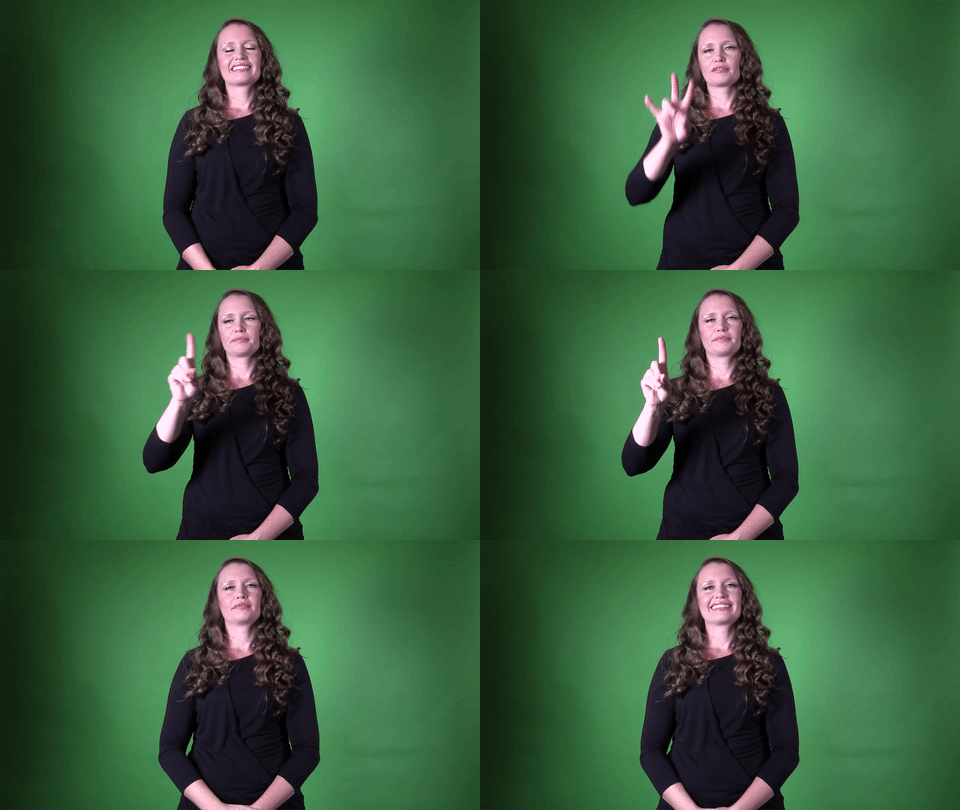
Sign for 71 in ASL | 🔢 ASL Dictionary

Definition: The number seventy-one.

Sign for 71 in ASL 

YouTube player

Practice Activities:

To practice the sign for 71 in ASL, begin by focusing on the movement and handshape. Start by forming the number 7 with your dominant hand, then smoothly transition into the number 1. Repeat this motion several times in front of a mirror to ensure clarity and accuracy. Pay close attention to the finger positioning and movement, making sure it is fluid and consistent.

Try using the sign for 71 in ASL in a counting sequence. Count from 60 to 80, making sure to accurately transition between each number. Say the numbers aloud while signing to reinforce both the visual and numerical associations. You can also mix the numbers randomly, signing them out of order to test recall and accuracy.

Create simple math problems that incorporate the sign for 71 in ASL. For example, sign “50 + 21 = 71” to help integrate the number into real-world contexts. Challenge yourself by asking a partner simple addition or subtraction problems and signing the answers. This helps solidify recognition while practicing quick responses.

Use the sign for 71 in ASL in everyday situations. Practice stating your age, telling someone an address, or using it in historical dates. For example, sign “In 1971, something important happened” or “My grandmother is 71 years old.” This helps make the sign meaningful and reinforces practical usage.

Engage in a speed practice game where you and a partner take turns signing different numbers quickly. The goal is to increase recognition and fluency with numbers. You can also time yourself signing from 1 to 100 to improve speed and accuracy. Practicing frequently in conversation and real-world applications will help reinforce the sign for 71 in ASL and enhance number fluency.

Cultural Context:

The sign for 71 in ASL follows a common pattern used for certain number signs in American Sign Language. Numbers in ASL often have unique movements or handshapes that differ from spoken languages, making them a vital part of communication for the Deaf community. The way the sign for 71 in ASL is formed reflects these linguistic rules and cultural influences.

In ASL, numbers like 71 are signed using a combination of finger movements that express numerical values clearly and efficiently. These movements are designed for visual clarity, ensuring that numbers are easily understood within conversations. The sign for 71 in ASL is used in daily interactions, from telling ages to sharing addresses or discussing prices.

Number signs in ASL are influenced by regional and generational variations, though most follow standardized forms. The sign for 71 in ASL may look slightly different depending on where and how someone learned ASL. Learning the correct number signs is essential for fluency and ensures effective communication in different social and professional settings.

The Deaf community relies on number signs for education, business, and everyday activities. The sign for 71 in ASL, like other numbers, is used in school settings, financial transactions, and casual conversations. Understanding how to sign numbers accurately is key to engaging fully in ASL discussions and interactions.

ASL numbers have evolved over time, shaped by historical influences and the needs of signers. The sign for 71 in ASL, like other number signs, follows specific grammatical structures that differ from English. Mastering number signs helps learners develop a deeper connection with ASL and its rich linguistic history.

Using the sign for 71 in ASL correctly enhances communication and cultural appreciation. Fluency in ASL numbers supports clear exchanges of information in personal and professional environments. As ASL continues to grow in recognition, knowing how to sign numbers like 71 remains an essential skill.

Technology and digital communication have also increased the importance of sign language, including number signs. The sign for 71 in ASL is valuable in online videos, virtual meetings, and educational content. Understanding ASL numbers expands accessibility and inclusion in both digital and real-world spaces.

The consistency and clarity of ASL numbers make them an essential part of sign language learning. The sign for 71 in ASL, like other numbers, plays a significant role in conversations about time, money, and quantities. Practicing number signs is crucial for those looking to improve their ASL proficiency and engage with

Extended Definition:

The sign for 71 in ASL follows a common pattern for two-digit numbers in American Sign Language. It combines the handshape for 7 and smoothly transitions to the handshape for 1. This movement follows the flow of ASL’s numerical system, making it easy to understand and recognize.

When signing 71 in ASL, hold up the number 7 with your dominant hand, then quickly shift to the number 1. This movement should be fluid and natural to ensure clarity. Proper hand positioning and movement will help avoid confusion with similar number signs.

Facial expressions and hand orientation play an important role in conveying the sign correctly. To sign 71 in ASL clearly, your palm should face outward, and your fingers should move with precision. Practicing in front of a mirror can help improve accuracy.

The American Sign Language number system follows a logical sequence that helps signers quickly understand numerical concepts. Numbers like 71 in ASL are commonly used in everyday communication, from giving addresses to discussing prices. Mastering number signs improves fluency in conversations that involve numerical details.

When learning numbers in ASL, it’s helpful to practice counting in sequence. Start with smaller numbers and gradually work up to larger ones like 71. This method reinforces muscle memory and helps with signing numbers effortlessly.

Some signers use slight variations depending on regional or personal style. While the general movement remains the same, hand positioning and speed may differ slightly. Understanding these variations can make communication smoother with different ASL users.

If you’re fingerspelling around numbers, make sure to pause slightly before and after signing 71 in ASL. This prevents misunderstanding between letters and numbers. Clear transitions between numbers and letters improve overall signing clarity.

ASL numbers are used in many contexts, including mathematics, phone numbers, and sports scores. Knowing how to sign 71 in ASL is useful in classroom settings, banking transactions, and even casual conversations. The more you practice number signs, the more confident you’ll become in everyday interactions.

Watching videos or practicing with a partner can help reinforce proper hand movements. Seeing the sign for 71 in ASL demonstrated by fluent signers can provide a clearer understanding. Repetition and real-life practice will make signing numbers second nature.

Signing numbers correctly is an essential part of becoming fluent in ASL. With regular practice, the sign for 71 in ASL becomes effortless and natural. Mastering numbers enhances overall communication skills in American Sign

Synonyms: seventy-one, number seventy-one, number 71, the number 71, the number seventy-one

Educational resources: Find related learning materials in our course bank!

Want more? Check out some of our popular learning activities on the homepage!

Need to look up a sign? Use our highly rated dictionary: https://aslinteractive.com/best-asl-dictionary/

Follow us on tiktok: https://www.tiktok.com/@aslinteractive. More social media links at the bottom of this page!

Long-tail Keywords: what is the sign for 71 in ASL, how do you sign 71 in ASL, learn how to sign 71 in American Sign Language

Categories: Numbers – Basics, Numbers 71-80, cardinal numbers

tags: Numbers 71-75, Numbers, Language Learning, Mathematics, Education

Parameters

*Handshape*:

the sign for 71 in ASL uses the dominant hand, forming the number 7 handshape with the palm facing outward. The thumb and ring finger touch while the index, middle, and pinky fingers remain extended. Then, transition smoothly into the number 1 handshape by folding all fingers down except for the index finger. This sign for 71 in ASL is a sequential movement that clearly distinguishes both numbers while maintaining fluidity.

*Palm Orientation*:

The palm orientation for the sign for 71 in ASL starts with the palm facing outward. The hand transitions smoothly between the number 7 and the number 1, maintaining a natural wrist position. Keep your fingers relaxed as you switch shapes, ensuring clarity in movement. Proper palm orientation ensures that others easily recognize the sign for 71 in ASL without confusion.

*Location*:

the sign for 71 in ASL takes place in the neutral signing space in front of the signer’s body. The dominant hand remains around chest level, ensuring visibility and clarity. Since numbers in ASL are signed with a single hand, the non-dominant hand is not used. The hand moves slightly as the numbers transition, maintaining a natural flow. This location keeps the sign clear and easily distinguishable within conversational signing space.

*Movement*:

To make the sign for 71 in ASL, start with the number 7 handshape, where the tip of the ring finger touches the thumb while the other fingers remain extended. Then, smoothly transition to the number 1 by raising the index finger while folding the remaining fingers down. The movement should be fluid and natural, emphasizing a clear shift from 7 to 1 without extra motion. Keep your palm facing outward throughout the sign for clarity.

*Non-Manual Signals*:

When signing the sign for 71 in ASL, maintain a neutral facial expression or slight focus to ensure clarity. Your eyebrows should remain relaxed since this is a straightforward numerical sign. Eye gaze should be steady, looking toward the person receiving the sign for clear communication. If emphasizing the number, a slight head nod can add emphasis. Keep your mouth relaxed, avoiding excessive movement that might distract from the sign for 71 in ASL.

*Prosody, Dominant/Non-Dominant Hand*:

The sign for 71 in ASL uses the dominant hand, forming a “7” with the index and thumb extended while the other fingers remain folded. Then, the hand shifts slightly, changing into a “1” by extending the index finger while folding the thumb back in. This movement is fluid and quick, ensuring a natural transition between the two numbers. Non-dominant hand remains inactive.

Tips for Beginners:

When learning the sign for 71 in ASL, focus on maintaining fluidity between the two digits. The number 71 is formed using a combination of the number 7 and the number 1 in a single motion. Make sure your dominant hand transitions smoothly from the initial “7” handshape to the “1” handshape without hesitation. Practice the movement slowly at first to ensure accuracy before increasing speed.

A common mistake beginners make with the sign for 71 in ASL is stiff or jerky transitions between numbers. To avoid this, keep your hand relaxed and aim for a natural flow. Be mindful of palm orientation—your palm should face outward, not inward. Watching native ASL signers demonstrate this number can help reinforce correct technique.

When signing the number 71, hand placement plays a crucial role in clarity. Keep your hand at chest level, slightly away from your body. If your hand is too close to your face or too low, the sign might not be as clear to the viewer. Spacing and precise movements ensure the number is easily distinguishable from similar numbers like 61 or 81.

Finger dexterity is key to mastering the sign for 71 in ASL, so dedicating time to finger exercises can help. Try wiggling your fingers before signing to loosen up stiffness. Using a mirror or recording yourself can pinpoint minor errors in execution. Consistency in practice will improve both confidence and speed over time.

Finally, remember that ASL numbers are used frequently in everyday conversations, so practicing with real-world scenarios can be beneficial. Use the number 71 when discussing ages, addresses, or prices with fluent signers. Integrating the sign into daily communication will solidify your comfort and accuracy over time.

Connections to Other topics:

The sign for 71 in ASL is part of a pattern for signing double-digit numbers in the 70s. This pattern involves a twisting or flicking motion that moves from one handshape to another, similar to other numbers in the same range, such as 72 or 73. Recognizing this pattern makes it easier to remember and quickly produce numbers in the 70s, as they follow a consistent shifting motion.

Numbers in ASL follow structured handshape changes that support efficient signing, which is particularly important for larger numbers and numerical concepts. The sign for 71 in ASL follows a similar format to the other numbers in this range, helping learners build fluency when counting and dealing with numerical data. This connection becomes especially useful in situations like discussing ages, addresses, or quantities where numbers frequently appear in daily conversation.

Many numerical signs in ASL build on general patterns that also apply to related concepts like ordinal numbers and money amounts. The way the sign for 71 in ASL is formed connects to how ASL users represent larger numbers as well—by adapting and extending existing number signs. This makes it easier to transition to higher numerical values, especially when discussing things like years, measurements, or statistics in ASL.

Understanding how to sign numbers effectively, including the sign for 71 in ASL, plays an important role in financial discussions, sports scoring, and phone numbers. Learning number signs also connects to time-related concepts, such as years and decades, where similar structuring of numbers applies. These connections show how numbers integrate into daily interactions in ASL, making them valuable for clear and efficient communication in a variety of settings.

Summary:

The sign for 71 in ASL follows a distinct pattern found in two-digit number signs. This number is typically produced using a combination of movements common in counting sequences. ASL numbers from 67 to 98 often require a flipping or twisting motion that distinguishes them from other numerical patterns.

When signing 71, the dominant hand is used, forming the number 7 with the fingers. The movement then transitions into the number 1. This shift happens fluidly, with a slight flick or pivot of the wrist.

The sign for 71 in ASL belongs to a broader category of numbers that share similar transformations. Numbers like 72, 73, and 74 follow the same transition format. The pattern helps maintain efficiency and reduces unnecessary hand movement in numerical communication.

ASL users rely on this signing structure as part of their everyday numbering system. Learning these number combinations enhances fluency in casual and formal contexts. The ease of production also supports rapid numerical exchanges, such as in addresses, dates, or financial transactions.

The structure of the sign for 71 in ASL aligns with ASL’s broader linguistic principles. The movement from one digit to the next follows phonological considerations in sign language. The numerical category contains similarities to sequential signing used in time-related concepts.

These dynamic transitions in numbers reflect ASL’s efficiency as a visual language. The number system incorporates logical movements that mimic typed or written numerical sequences. The flipping or twisting pattern enhances clarity while maintaining ASL’s spatial efficiency.

Cultural considerations also come into play when signing numbers like 71. Historically, deaf and hard-of-hearing individuals adapted numerical systems to fit handshape limitations. Over time, efficiency and clarity influenced number-signing conventions.

The sign for 71 in ASL is particularly useful in education, finance, and everyday conversation. Teachers reinforce these number transitions for students learning ASL as a primary or secondary language. A solid grasp of numerical signs helps in classroom settings and professional environments.

In applied linguistics, numerical signs provide insight into ASL’s systematic movement patterns. Research on number signs investigates language efficiency and memory recall in signers. The cognitive processing of numbers in ASL users reveals language-hand coordination mechanisms.

Related signs share the same underlying principles of transition and efficiency. Other signs following this format include numbers in the 70s and beyond. Understanding these patterns aids learners in mastering ASL number constructions.

The sign for 71 in ASL contributes to the natural flow of numerical sequences. Practicing these transitions leads to smoother signing and enhances comprehension for viewers. Clear execution ensures that communication remains accurate in numerical contexts.

Broader themes link number signs to mathematical concepts in ASL education. Deaf students benefit from structured number instruction that integrates sign language principles. Language and mathematics intersect through sign language-based numerical comprehension.

Numbers like 71 showcase ASL’s adaptability in conveying sequences quickly. This approach mirrors spoken language conventions where syllables blend fluidly. ASL’s ability to create smooth transitions highlights its efficiency as a visual-gestural language.

Variations in number-signing may occur due to regional or personal preferences. Some signers apply slight modifications in wrist movements when transitioning from 7 to 1. These minor variations do not typically impact understanding but reflect individual style.

The history of numerical signs in ASL ties to broader themes in Deaf culture. Numbers have influenced communication in education, trade, and daily life. ASL’s structured numbering system ensures accessibility and efficiency in conveying numerical information.

The sign for 71 in ASL represents more than just a number. It reflects ASL’s structured approach to combining digits efficiently. Mastering this sign enhances clarity in various signed interactions.

Individuals learning ASL should practice numerical transitions like 71 to ensure accuracy. The combination of visual recognition and muscle memory supports proficiency. Regular use in signed conversations reinforces fluency in numerical expression.

In professional settings, numbers like 71 are used in data reporting, statistics, and scheduling. Employers and employees utilizing ASL integrate number signs into workplace communications. Proper numerical signage contributes to effective collaboration and task management.

The visual nature of ASL numbers makes them accessible to a wide range of learners. Non-native signers can quickly grasp numerical signs due to their logical movement patterns. The sign for 71 in ASL exemplifies the clarity and efficiency embedded in ASL’s numerical system.

Linguistically, ASL numbers mirror some structural elements found in spoken English numbers. However, ASL relies on movement rather than vocal intonation to distinguish certain groups. The sequential nature of signing aligns with language processing in visual modalities.

When fingerspelling is unnecessary, ASL numbers provide a more streamlined approach to numerical representation. The movement-based system reduces the need for separate handshapes for each digit. This efficiency plays a key role in everyday ASL communication.

Deaf athletes, businesses, and educators regularly utilize ASL number signs like

Want more? Check out some of our popular learning activities!

ASL Interactive Resources

ASLInteractive YouTube Channel

Follow us on tiktok: @aslinteractive.com

Follow us on Instagram: aslinteractive

Facebook page: aslinteractive

Facebook group: aslinteractive

LInkedIn: ASL Interactive LLC

Twitter: @ASL_interactive

*Some information on this page is AI-generated. AI can make mistakes. Please check the information.

Sign for 71 in ASL 

Responses