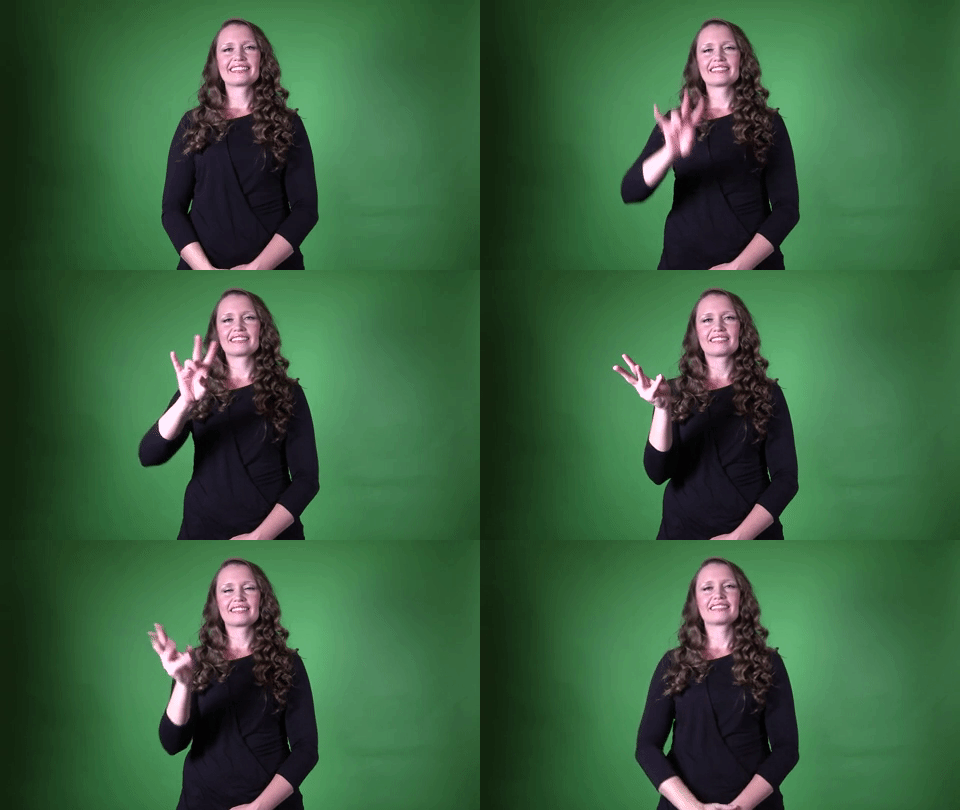
Definition: The number seventy-six.
Sign for 76 in ASL

Practice Activities:
To practice the sign for 76 in ASL, begin by signing the number in isolation multiple times while looking in a mirror. This will help ensure accuracy in handshape and movement. Try signing it at various speeds to build fluency and confidence.
Practice signing a sequence of numbers that includes 76, such as 70, 71, 72, 73, 74, 75, 76, 77, 78, and 79. Then, mix the numbers up to recognize and produce them in random orders. This will help reinforce the handshape transition when signing the sign for 76 in ASL.
Use the sign in age-related sentences, such as “My grandfather is 76 years old” or “That building has 76 floors.” Try incorporating it into different contexts such as sports scores, money amounts, or addresses. The more you use the sign for 76 in ASL in conversation, the more natural it will feel.
Create a math-based activity where you sign problems like “50 + 26 = ?” and then sign the answer. Engage a partner or group to challenge each other with similar problems. This will help strengthen number comprehension and production.
Practice storytelling with numbers by creating a short story that includes 76. For example, “I traveled 76 miles last weekend to visit family” or “There were 76 people at the event.” Telling stories with numbers helps reinforce recall in practical situations.
Engage in a partner activity where one person fingerspells a number-related word (like “seventy-sixth”), and the other responds with the corresponding number sign. Switch roles and challenge each other with different numeric references. This enhances recognition skills and fluency when signing.
Cultural Context:
Learning the sign for 76 in ASL is essential for anyone interested in American Sign Language, especially when communicating numbers in daily conversations. Numbers play a significant role in personal identification, addresses, phone numbers, and financial transactions, making them a crucial part of ASL fluency. Understanding how to correctly sign 76 in ASL ensures clarity when conveying information.
ASL numbers follow a logical system that makes signing them quick and efficient. The sign for 76 in ASL is part of the “rocking numbers” category, where the hand moves slightly during production. This rocking motion helps differentiate similar-looking number signs and enhances comprehension in both casual and formal settings.
Deaf culture places great importance on clear and accurate use of numerical signs. The sign for 76 in ASL is commonly used in discussions about prices, dates, and historical events. Mastering this sign allows for effective communication and a deeper connection within the Deaf and hard-of-hearing community.
Numbers in ASL often follow different structures depending on context, such as age, time, or math-related conversations. The sign for 76 in ASL is simple once you understand the movement pattern, making it easy to incorporate into everyday conversations. Practicing numerical signs regularly helps boost confidence and fluency in ASL.
Since ASL is a visual language, handshape, palm orientation, and movement all contribute to meaning. The sign for 76 in ASL requires precise finger placement, ensuring clear communication. Accuracy is key in avoiding misunderstandings, especially when discussing important numerical details.
Many learners struggle with larger numbers at first, but repetition and exposure make a difference. The sign for 76 in ASL can be mastered with practice and observation of fluent signers. Watching videos and practicing in front of a mirror can help improve accuracy.
Using ASL numbers correctly strengthens communication with native signers. The sign for 76 in ASL appears in various scenarios, including financial discussions, sports scores, and statistics. Becoming comfortable with numerical signs is crucial for anyone using ASL in professional or social settings.
Technology and media have made learning ASL numbers more accessible than ever. Videos, apps, and online resources provide demonstrations of the sign for 76 in ASL, making self-study convenient. Engaging with these tools enhances comprehension and retention of ASL numbers.
Fluency in number signs like the sign for 76 in ASL is valuable for both students and professionals. Whether discussing historical events
Extended Definition:
The sign for 76 in ASL follows a specific number pattern used in American Sign Language. This pattern is part of the larger numbering system, which includes unique movements for certain number combinations. Learning how to sign 76 correctly ensures clear communication with other ASL users.
To start, the sign for 76 in ASL begins with the number 7 handshape. The hand then changes smoothly to the number 6 handshape. This movement is quick and fluid, following the standard pattern for signing two-digit numbers in ASL.
Hand orientation and movement are key when signing 76 in ASL. The sign is typically produced with the palm facing outward to make the numbers clear. Proper finger positioning helps avoid confusion with similar numbers like 67 or 78.
Facial expressions and context also play a role when signing 76 in ASL. In conversation, the signerās facial expressions can help clarify if the number refers to an age, a quantity, or another numerical reference. When fingerspelling or signing numbers, accuracy is important for effective communication.
American Sign Language relies on number patterns that make signing multi-digit numbers efficient. The sign for 76 in ASL follows the same rules as other two-digit numbers that swap handshapes within one motion. Once this pattern is learned, recognizing and signing similar numbers becomes easier.
Practicing the sign for 76 in ASL can improve overall number fluency in ASL. Repeating the motion until it feels natural allows for more confident and faster signing. Watching native signers or video demonstrations can also help in mastering the number.
Numbers in ASL are an essential part of daily conversations. The sign for 76 in ASL may be used in various contexts, such as discussing ages, addresses, or prices. Knowing how to sign numbers effortlessly improves overall ASL communication.
Mastering the numbering system, including the sign for 76 in ASL, enhances a signerās ability to communicate effectively in many situations. Whether used in casual conversation or formal discussions, clear number signs are an important aspect of ASL fluency.
Synonyms: seventy-six, number seventy-six, number 76, the number 76, the number seventy-six
Educational resources: Find related learning materials in our course bank!
Want more? Check out some of our popular learning activities on the homepage!
Need to look up a sign? Use our highly rated dictionary: https://aslinteractive.com/best-asl-dictionary/
Follow us on tiktok: https://www.tiktok.com/@aslinteractive. More social media links at the bottom of this page!
Long-tail Keywords: what is the sign for 76 in ASL, how do you sign 76 in ASL, learn how to sign 76 in American Sign Language
Categories: Numbers – Basics, Numbers 71-80, cardinal numbers
tags: Numbers, Numbers 76-80, Numbers 76 78 79, Rocking Numbers, Language Learning
Parameters
*Handshape*:
The sign for 76 in ASL uses a combination of two distinct handshapes to represent the digits seven and six. Start with the number seven, forming a handshape with the index and middle fingers extended while the thumb touches the ring finger. Then, transition smoothly into the number six by bringing the pinky and thumb together while the other fingers remain extended. This movement should be fluid to clearly convey the sign for 76 in ASL.
*Palm Orientation*:
The palm orientation for the sign for 76 in ASL starts with the palm facing outward as the number 7 is formed using the index and middle finger extended. The thumb also extends, while the ring and pinky fingers stay folded. As the hand transitions to 6, the pinky touches the thumb while the index, middle, and ring fingers remain extended. Throughout the movement, the palm remains forward, ensuring clarity in finger positioning.
*Location*:
the sign for 76 in ASL is produced in the neutral space in front of the signer. The dominant hand forms the number 7 with the palm facing outward, then shifts slightly to form the number 6 in a smooth movement. This transition happens at chest level, keeping the hand within a comfortable signing space. The motion should be fluid for clarity and ease of understanding.
*Movement*:
To make the sign for 76 in ASL, start with the number 7 by extending the thumb and ring finger while keeping the other fingers folded. Then, smoothly transition to the number 6 by touching the thumb to the pinky while keeping the other fingers extended. The movement should be fluid and natural, with the hand staying in a consistent location. When signing 76 in ASL, ensure clarity in both handshapes to avoid confusion.
*Non-Manual Signals*:
When performing the sign for 76 in ASL, the facial expression is generally neutral, unless emphasis is needed. The eyebrows remain relaxed, and there is no significant mouth movement unless the number is being mouthed for clarity. Eye gaze stays natural, directed towards the conversational partner or slightly downward to maintain focus on the signing space.
If emphasizing the sign for 76 in ASL, slight eyebrow raising or a small head nod may be used to highlight importance. A furrowed brow might indicate questioning or uncertainty, shaping the context of the conversation. The overall non-manual signals remain subtle yet purposeful to ensure effective communication.
*Prosody, Dominant/Non-Dominant Hand*:
The sign for 76 in ASL uses the dominant hand. Start with the number 7, forming the “7” handshape with the thumb and ring finger touching. Then transition smoothly to the number 6, where the thumb and pinky finger touch while the other fingers remain extended. The movement should be fluid to maintain clarity. Ensure palm orientation remains forward to enhance visibility. This number transition is commonly used in counting and identifying numerical values.
Tips for Beginners:
When learning the sign for 76 in ASL, focus on smooth number transitions. The number 76 follows the common ASL pattern for signed two-digit numbers, where you start with the handshape for 7 and smoothly transition to the handshape for 6. Keep your palm facing outward to ensure clarity, and make sure both numbers are distinct without hesitation in movement.
A common mistake when signing the sign for 76 in ASL is flattening the numbers together or rushing the transition. Keep your fingers properly positioned for both 7 and 6, ensuring that the ring finger and thumb touch for 7 before smoothly shifting to the tip of the pinky touching the thumb for 6. If your transition feels awkward, slow it down at first, then gradually increase speed as you develop muscle memory.
For accuracy, keep your hand steady and avoid extra movement between digits. Some learners may accidentally twist the wrist or alter the finger positioning when switching to 6āpractice in front of a mirror to ensure everything remains consistent. Watching native signers can also help improve your fluency with the number system in ASL and reinforce proper hand positioning.
Another helpful tip is to practice signing multiple numbers in sequence to get comfortable with different transitions. For example, sign 75, 76, and 77 repeatedly to strengthen your understanding of how these numbers flow. Repetition builds confidence and makes signing numbers feel more natural in conversations.
If you struggle with the sign for 76 in ASL, break it down into smaller steps. Sign the number 7, pause slightly, then form 6 without rushing. Over time, the motion will become easier and more fluid. Keep your movements consistent and clear to ensure effective communication in ASL.
Connections to Other topics:
The sign for 76 in ASL follows the standard number pattern used in signing multi-digit numbers. It incorporates a combination of handshapes for 7 and 6, transitioning smoothly between them. This sign connects to other numbers in ASL, particularly those in the 70s series, where the first digit (7) remains constant while the second digit changes. Understanding this pattern helps learners recognize related numerical structures, reinforcing consistency in ASL number signs.
The sign for 76 in ASL is part of the broader category of cardinal numbers, which are commonly used in daily communication for addresses, prices, and counting. It connects to ordinal numbers when expressing sequences, such as “76th anniversary” or “76th page.” To modify a cardinal number into an ordinal form, slight changes in movement or facial expressions may be required. This adaptability showcases how numbers function differently depending on context in ASL.
In sports and history, the sign for 76 in ASL can appear in references such as the Philadelphia 76ers basketball team or historical events like the year 1776, which marks U.S. independence. Similarly, addresses, years, and statistics frequently require shifting among number signs quickly in conversation. Mastering smooth numeric transitions strengthens fluency in ASL by enhancing a signerās ability to convey dates, quantities, and other numeric details without hesitation.
When discussing money, time, or measurements, the sign for 76 in ASL may be modified by adding classifiers or context-specific movements. For example, signing ā76 dollarsā involves incorporating the dollar sign, while ā76 degreesā might be clarified with additional weather-related facial expressions. Being comfortable with numerical expressions helps with clarity in financial transactions, measurements, and schedules. These connections demonstrate how ASL number signs integrate seamlessly into everyday communication.
Summary:
The sign for 76 in ASL follows a common numerical pattern used in American Sign Language. It is a two-digit number that incorporates a fluid movement to transition between the numerals 7 and 6. This sign is typically performed with one hand and follows conventions for signing two-digit numbers greater than 69.
To begin signing 76, form the handshape for the number 7 by extending the index, middle, and ring fingers while the pinky and thumb touch. The palm should face outward, and the hand position should be at chest or shoulder level. After displaying the 7, smoothly transition to the 6 by bringing the pinky and thumb together while the other fingers remain extended.
The motion between the two numerals should be natural and slightly downward. This movement creates a visual flow that distinguishes it from numbers like 67 or 86. The palm orientation plays a crucial role in clarity, ensuring that each numeral is easily recognizable.
Numbers in ASL follow specific principles to maintain clarity and efficiency. The sign for 76 in ASL adheres to these principles by maintaining a consistent handshape transformation. It is important to avoid over-exaggerated movements, as ASL relies on natural and efficient signing.
Using appropriate facial expressions while signing numbers can enhance communication. Though numbers typically do not carry emotional expressions, context may require clarification. For example, if referring to a specific year or a quantity, slight facial adjustments may accompany the sign.
Numbers are integral to ASLās structure, influencing how time, quantities, and addresses are expressed. The sign for 76 in ASL can appear in various contexts, such as discussing an age, historical event, or a sports-related statistic. Understanding number structure is fundamental for fluency.
ASL numbers have variations based on regional influences or signer’s preferences. While the core movement for the sign for 76 in ASL remains consistent, slight differences in execution may occur. However, these variations should not interfere with overall comprehension.
ASL numbers exhibit linguistic properties similar to spoken languages. Numbers follow a grammatical and morphological system that ensures consistency. The transition from 7 to 6 in this case showcases morphological efficiency in ASL.
American Sign Language is a visually structured language that relies on handshape, movement, and orientation. The sign for 76 in ASL exemplifies these linguistic foundations through its transition between two distinct numerical handshapes. Understanding such structures enhances overall communication skills.
Numbers in ASL often reflect the decimal-based counting system found in many languages. Despite being a visual-gestural language, ASL adheres to patterns that make recognition and recall easier. Sequential numbers like 76 follow a predictable format that aids rapid understanding.
Historical influences can shape how numbers evolve in signed language. While ASL numerals have remained mostly stable, some adaptations have occurred due to technological and cultural shifts. The sign for 76 in ASL remains consistent across most dialects of ASL.
In educational and mathematical contexts, signing numbers clearly and distinctly is crucial. Teachers and interpreters often emphasize precise number formation to avoid ambiguity. Mastering the sign for 76 in ASL ensures smooth communication in academic and professional settings.
Numeric fluency in ASL enhances overall signing ability and comprehension. Practice helps signers develop quick and accurate number articulation. The sign for 76 in ASL benefits from repeated practice to achieve fluidity.
ASL numbers blend seamlessly into broader conversations without disrupting the languageās grammatical flow. Signers must be mindful of pace and clarity to ensure effective communication. The sign for 76 in ASL, like other two-digit numbers, is naturally integrated into daily discourse.
There are no significant cultural variations for the sign for 76 in ASL, but numbers can assume symbolic meanings in certain contexts. In American culture, 76 can reference events such as the U.S. Bicentennial celebration or the historical importance of 1776. Cultural awareness enhances linguistic competence.
When fingerspelling a number for emphasis, it is uncommon to fingerspell 76 unless referencing a proper noun such as a brand or title. Typically, the standard numerical sign is sufficient for everyday use. Learning the sign for 76 in ASL helps build comfort with numerical sequences.
Technology has influenced number use in ASL, particularly in digital communication and interpretation services. Online ASL resources and videos help individuals refine their numerical signing skills. Consistently practicing the sign for 76 in ASL contributes to greater fluency in digital and face-to-face interactions.
ASL learners should engage in active application, including fingerspelling drills and number recall exercises. Exposure to signed numbers in real conversations enhances retention. Mastering the sign for 76 in ASL is part of broader numerical fluency.
Interpreters must prioritize accuracy in numerical signs, as miscommunication can lead to significant misunderstandings. The sign for 76 in ASL may appear in financial
Want more? Check out some of our popular learning activities!
ASL Interactive Resources
ASLInteractive YouTube Channel
Follow us on tiktok: @aslinteractive.com
Follow us on Instagram: aslinteractive
Facebook page: aslinteractive
Facebook group: aslinteractive
LInkedIn: ASL Interactive LLC
Twitter: @ASL_interactive
*Some information on this page is AI-generated. AI can make mistakes. Please check the information.


Responses