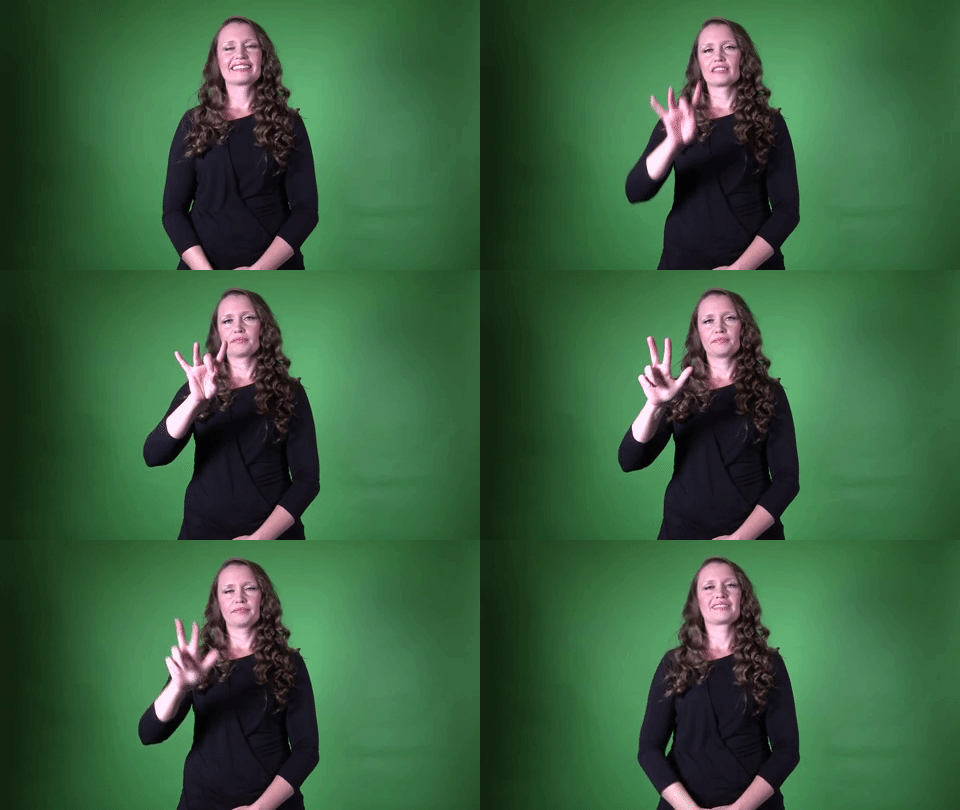
Sign for 83 in ASL | 🔢 ASL Dictionary

Definition: The number eighty-three.

Sign for 83 in ASL 

YouTube player

Practice Activities:

Practicing the sign for 83 in ASL can be an engaging experience with a variety of activities. Begin by signing the number repeatedly with both hands to develop muscle memory. Focus on the transition between the “8” and “3” handshapes, ensuring smooth movement. Try signing it while looking in a mirror to check formation and fluidity.

Use the sign for 83 in ASL in context to strengthen recall. Practice signing your age, street numbers, or years that contain 83. For example, sign the year 1983 by combining the signs for “19” and “83.” Create a list of random two-digit numbers and sign each one quickly to improve fluency.

Incorporate the sign into storytelling. Try telling a short story about a person born in 1983 or a time when 83 items were involved. For example, you could describe a shopping trip where someone buys 83 apples or a classroom with 83 students. Adding expressive facial communication will enhance the storytelling experience.

Work with a partner to reinforce learning. One person can fingerspell a two-digit number while the other signs it. Alternatively, set up a number recognition game where a partner shows written numbers and the other signs them quickly. Try a conversation where you exchange numerical information, such as discussing someone’s address or a historical event involving 83.

Challenge yourself by including the sign for 83 in ASL in daily conversations. Describe temperatures, distances, or scores in sports games. Look for real-world examples of 83 and sign them when you see them. With consistent practice, the sign will become second nature, allowing you to use it confidently in conversations.

Cultural Context:

The sign for 83 in ASL follows a common pattern used in number signs, incorporating the handshape transitions typical in American Sign Language. When signing 83 in ASL, the movement and hand configuration reflect natural number progression, making it intuitive for fluent signers. Understanding the sign for 83 in ASL helps learners build confidence in signing numbers accurately and fluidly.

Numbers in ASL are more than just gestures; they have cultural and linguistic significance within the Deaf community. The sign for 83 in ASL, like other numbers, is used in everyday conversations for age, addresses, and counting. Mastering numbers like 83 in ASL helps signers engage in real-world interactions with fluidity and confidence.

In Deaf culture, number signs, including the sign for 83 in ASL, are crucial for clear communication. Fluent signers use facial expressions and context to clarify the meaning when signing numbers like 83 in ASL. Developing number fluency is essential for participating in conversations, storytelling, and educational settings within the Deaf community.

Learning the sign for 83 in ASL also reinforces the importance of proper handshape and palm orientation. Beginners often struggle with number transitions, but regular practice makes signing 83 in ASL feel natural. Ensuring accuracy in number signs like 83 in ASL enhances overall comprehension and communication skills.

When discussing dates, addresses, or statistics, the sign for 83 in ASL is frequently needed. Signers use a smooth and consistent number system, ensuring clarity when conveying numerical information. Mastering the sign for 83 in ASL makes conversations more effective and precise in both casual and professional settings.

In ASL classes, students practice number signs, including the sign for 83 in ASL, to improve their skills. Teachers emphasize correct handshape and movement, helping learners recognize patterns in numbers. Gaining confidence in signing numbers like 83 in ASL allows for faster recognition and more natural conversations.

Number fluency in ASL helps signers navigate daily interactions, from banking to appointments. The sign for 83 in ASL ensures that Deaf and hard-of-hearing individuals communicate efficiently in numerical exchanges. Familiarity with the sign for 83 in ASL strengthens signing abilities and increases overall language competency.

By mastering numbers, students develop a deeper connection to ASL and the cultural nuances that shape the language. The sign for 83 in ASL is one small but crucial part of understanding the larger

Extended Definition:

The sign for 83 in ASL is a combination of handshapes and movements used in American Sign Language. It follows a structured pattern based on the ASL numbering system. Learning this number sign helps improve fluency in communicating numerical information.

To make the sign for 83 in ASL, start with the number 8 handshape, then transition smoothly into the number 3. This movement is natural and fluid, reflecting the way ASL numbers flow in sequence. Practice is key to making the transition appear effortless.

Using the sign for 83 in ASL is common in everyday conversations that involve numbers. It can be used for discussing ages, measurements, addresses, or financial figures. Understanding number signs ensures clear and effective communication in ASL.

ASL number signs follow a logical pattern, making it easier to remember them after practice. The handshape change in the sign for 83 in ASL is similar to other numbers in the 80s series. Recognizing this pattern helps learners build confidence in signing numbers correctly.

Numbers in ASL are often influenced by regional variations or signing speed. The sign for 83 in ASL may look slightly different depending on the signer’s fluency or signing style. However, the basic structure remains the same, ensuring comprehension across users.

Using facial expressions while signing numbers in ASL can add clarity to the message. The sign for 83 in ASL may be accompanied by a slight nod or emphasis on the movement. These non-manual signals help reinforce meaning and improve overall communication.

For beginners learning ASL, memorizing number signs like the sign for 83 in ASL can be challenging. Repetition and consistent practice can help reinforce muscle memory. Signing along with a fluent ASL user can also speed up the learning process.

In formal ASL settings, such as classrooms or signed presentations, using numbers correctly is crucial. The sign for 83 in ASL must be performed clearly and confidently to avoid misunderstandings. Accuracy in number signs is particularly important in academic and professional environments.

In ASL storytelling or casual conversations, number signs may appear more relaxed and fluid. The sign for 83 in ASL might be slightly modified in speed, depending on the context. Understanding these nuances can help signers adapt their signing style appropriately.

Using the sign for 83 in ASL in real-life scenarios like shopping, scheduling, or discussing statistics makes the language more practical. Practicing in everyday situations

Synonyms: eighty-three, number eighty-three, number 83, the number 83, the number eighty-three

Educational resources: Find related learning materials in our course bank!

Want more? Check out some of our popular learning activities on the homepage!

Need to look up a sign? Use our highly rated dictionary: https://aslinteractive.com/best-asl-dictionary/

Follow us on tiktok: https://www.tiktok.com/@aslinteractive. More social media links at the bottom of this page!

Long-tail Keywords: what is the sign for 83 in ASL, how do you sign 83 in American Sign Language, learn how to sign 83 in ASL

Categories: Numbers – Basics, Numbers 81-90, cardinal numbers

tags: Numbers, Numbers 81-90, Math, Language Learning, Educational Content

Parameters

*Handshape*:

The sign for 83 in ASL uses a fluid movement between two distinct handshapes. Begin with the number 8 handshape, where the thumb and middle finger touch while the other fingers extend. Then transition smoothly to the number 3 handshape, with the thumb, index, and middle fingers extended and separated while the ring and pinky fingers remain folded. This transition creates a dynamic visual representation of the sign for 83 in ASL, maintaining clarity and accuracy.

*Palm Orientation*:

the palm orientation for the sign for 83 in ASL starts with the palm facing outward as the signer forms the number 8 with their dominant hand. The thumb and middle finger touch while the other fingers remain extended. Quickly, the hand transitions into the number 3, with the thumb, index, and middle fingers extended while the ring and pinky fingers close. Throughout the motion, the palm continues to face forward, ensuring clarity in communication.

*Location*:

the sign for 83 in ASL is formed in the neutral space in front of the signer’s torso. Both hands usually remain at chest level while transitioning between the number 8 and the number 3. The dominant hand moves smoothly as the fingers change positions. The movement is subtle, ensuring clarity while keeping the sign fluid. Proper hand positioning and consistent location help maintain accuracy when signing the sign for 83 in ASL.

*Movement*:

To produce the sign for 83 in ASL, form the number 8 by touching the tip of your thumb to the tip of your middle finger while keeping the other fingers extended. Then, transition smoothly into the number 3 by extending your thumb, index, and middle fingers while folding the ring and pinky fingers down. The movement should be fluid without pauses, ensuring a natural flow between the numbers.

*Non-Manual Signals*:

Facial expressions remain neutral or slightly focused when forming the sign for 83 in ASL . Eyebrows may be slightly relaxed, and there is no extreme mouth movement necessary. If emphasizing the number in conversation, you might slightly nod or raise your eyebrows for clarity. Maintaining steady eye contact helps ensure the sign for 83 in ASL is understood easily within the context of counting or numerical discussions.

*Prosody, Dominant/Non-Dominant Hand*:

The sign for 83 in ASL is a two-handed number sign using the dominant hand. Begin with the number 8, where the thumb and middle finger touch while the other fingers extend. Then transition into the number 3 by extending the thumb, index, and middle finger while folding the ring and pinky fingers. This movement should be fluid and natural, ensuring clarity when signing the number. Always maintain good hand positioning for visibility.

Tips for Beginners:

When learning the sign for 83 in ASL, start by ensuring your handshape transitions smoothly between the numbers 8 and 3. Hold up your dominant hand with the number 8 handshape, where the tip of your thumb touches the tip of your middle finger. Then, seamlessly change to the number 3 handshape by extending your thumb, index, and middle fingers while folding down your ring and pinky fingers.

Practice moving between the two handshapes fluidly to keep the sign for 83 in ASL clear and natural. A common mistake beginners make is not fully forming the number 8 handshape before transitioning to 3, which can make the sign appear unclear. Pay attention to hand positioning and make sure your fingers are properly extended when signing the number 3.

Finger placement is key, so ensure your fingers are curved correctly in the 8 position and fully extended in the 3. Keep your movements small and controlled without unnecessary gestures, as excessive motion can make the sign look incorrect. Aim for a slight bounce or a smooth shift instead of a rigid or jerky transition between the numbers.

Consistent practice will help build muscle memory, making the sign for 83 in ASL feel natural over time. If you struggle with the transitions, try practicing in front of a mirror or recording yourself for self-review. Watching skilled signers demonstrate the movement can also help improve accuracy.

Always maintain a relaxed hand to avoid stiffness, which can slow down your movements. Fingerspelling numbers quickly and smoothly is a skill that takes time, so stay patient and keep practicing daily. With enough repetition, the motion will become second nature.

Connections to Other topics:

The sign for 83 in ASL connects to the broader system of number signs, which follow specific patterns in handshape and movement. Numbers in ASL generally follow a sequential pattern, making it easier to recognize digits quickly. The sign for 83 in ASL is part of the 80s series, which shares a common movement and structure with other numbers in that range, making it useful to learn them together.

Number signs play a vital role in daily communication, including phone numbers, addresses, and monetary values. The sign for 83 in ASL is particularly relevant in financial discussions, sports scores, and age representation. Recognizing the fluidity of number signs allows better comprehension of larger concepts like math, time, and measurement.

Numbers also integrate into various compound signs and commonly used expressions. For example, signing a number within a phrase, such as “83 years old,” combines number signing with the age sign. The structure of number incorporation in ASL follows logical handshape transitions, which helps make signing smooth and efficient. Learning the sign for 83 in ASL reinforces these general number patterns.

Additionally, number signs are often adapted to regional or stylistic variations, meaning some signers may use slightly different movements. The sign for 83 in ASL, like other multi-digit numbers, follows an expected transition, which makes it easier for fluent signers to recognize even when differences in signing speed exist. Mastering numbers builds a strong ASL foundation for discussing larger numerical topics, such as percentages, statistics, and rankings.

Summary:

The sign for 83 in ASL is a numerical sign, blending both the “8” and “3” handshapes in a fluid motion. This sign is one of the many two-digit numbers that follow a consistent numerical pattern in ASL numbering systems. To form the sign, you typically begin with the “8” handshape, then transition smoothly into the “3” handshape while keeping your palm facing outward.

ASL numbers from 80 to 89 generally follow a set pattern in which the first digit remains consistent before transitioning into the second. The sign for 83 in ASL follows this rule, relying on clear hand movement and positioning for clarity. Like all numbers above ten, it is crucial to execute transitions distinctly to prevent confusion with visually similar motions.

Numbers in ASL can carry multiple meanings depending on context. The sign for 83 in ASL may appear in discussions about age, dollar amounts, measurements, rankings, or other numerical references. The flexibility of number signs makes them a critical element of ASL grammar and communication, forming an essential part of daily conversations.

The clarity of number signs plays a significant role in effective ASL communication, especially in teaching, business, and informational exchanges. Since ASL is a visual language, movements must be precise to avoid misinterpretation. The sign for 83 in ASL, when done accurately, ensures that numerical information is conveyed efficiently.

ASL numbers are deeply intertwined with Deaf culture, as they support Deaf individuals in education, storytelling, and data-reliant discussions. The sign for 83 in ASL is not just a numerical representation; it reflects linguistic efficiency and the grammar rules of ASL. Learning number signs well helps build strong foundational skills in ASL fluency.

Historically, ASL has developed unique numerical patterns influenced by both French Sign Language (LSF) and American innovations. The sign for 83 in ASL follows the standard structure of two-digit numbers, helping unify numerical communication across various signing communities. This consistency aids in understanding even between signers from different regions.

Numbers play an important role in Deaf education and mathematics, making precision essential. The sign for 83 in ASL enables signers to discuss academic concepts, money, and statistics with ease. As ASL continues to evolve, numerical signs remain a core structure supporting diverse topics.

In nonverbal communication, gestures involving numbers tend to be universally understood, but ASL numbers follow a specific linguistic system distinct from general hand gestures. The sign for 83 in ASL is part of a well-established numerical framework that ensures seamless information exchange. Using it correctly helps maintain the integrity of ASL’s grammatical rules.

Mathematical literacy within the Deaf community depends on strong number sign proficiency. The sign for 83 in ASL is just one of many that enable discussions around equations, currency, and time-based concepts. Properly signed numerical values contribute to a clearer academic and professional experience for Deaf signers.

Number signs also influence rhythmic signing in performance arts, such as ASL storytelling and poetry. The sign for 83 in ASL may appear in a narrative describing a historical event, a mathematical puzzle, or an age-specific anecdote. These signs enhance storytelling by providing clear visual representations of numbers.

Technology has influenced the accessibility and use of numbers in ASL, especially in online education and digital learning tools. Video-based resources help reinforce number sign accuracy, ensuring clear interpretation of signs like the sign for 83 in ASL. ASL learners benefit greatly from digital resources that showcase numerical transitions in slow motion.

Because ASL is used in various fields, number signs like the sign for 83 in ASL are important for professional and technical settings. Areas such as finance, sports, and medical practice require clear numerical communication. Mastering number transitions supports career success within the Deaf and Hard of Hearing community.

Pattern recognition is an essential skill in ASL number learning. The sign for 83 in ASL follows a predictable sequence, helping learners anticipate and correctly process multi-digit numbers. Recognizing these patterns enhances speed and efficiency in everyday ASL communication.

The visibility and accuracy of signed numbers can be affected by rapid signing speeds. The sign for 83 in ASL should be articulated clearly, ensuring no confusion with similar-looking numbers. Practicing smooth transitions improves recognition and overall ASL fluency.

The use of handshape classifiers in ASL demonstrates the importance of distinct number signs. While the sign for 83 in ASL follows a numerical framework, classifiers may be used alongside it to describe dimensions, quantities, or ranking scenarios. Understanding how classifiers and numbers interact enriches ASL comprehension.

Facial expressions typically do not alter number signs, but in ASL, expressions may add emphasis or emotion. The sign for 83 in ASL remains structurally consistent, but a raised eyebrow or nod can indicate surprise or importance. Contextual non-manual

Want more? Check out some of our popular learning activities!

ASL Interactive Resources

ASLInteractive YouTube Channel

Follow us on tiktok: @aslinteractive.com

Follow us on Instagram: aslinteractive

Facebook page: aslinteractive

Facebook group: aslinteractive

LInkedIn: ASL Interactive LLC

Twitter: @ASL_interactive

*Some information on this page is AI-generated. AI can make mistakes. Please check the information.

Sign for 83 in ASL 

Responses