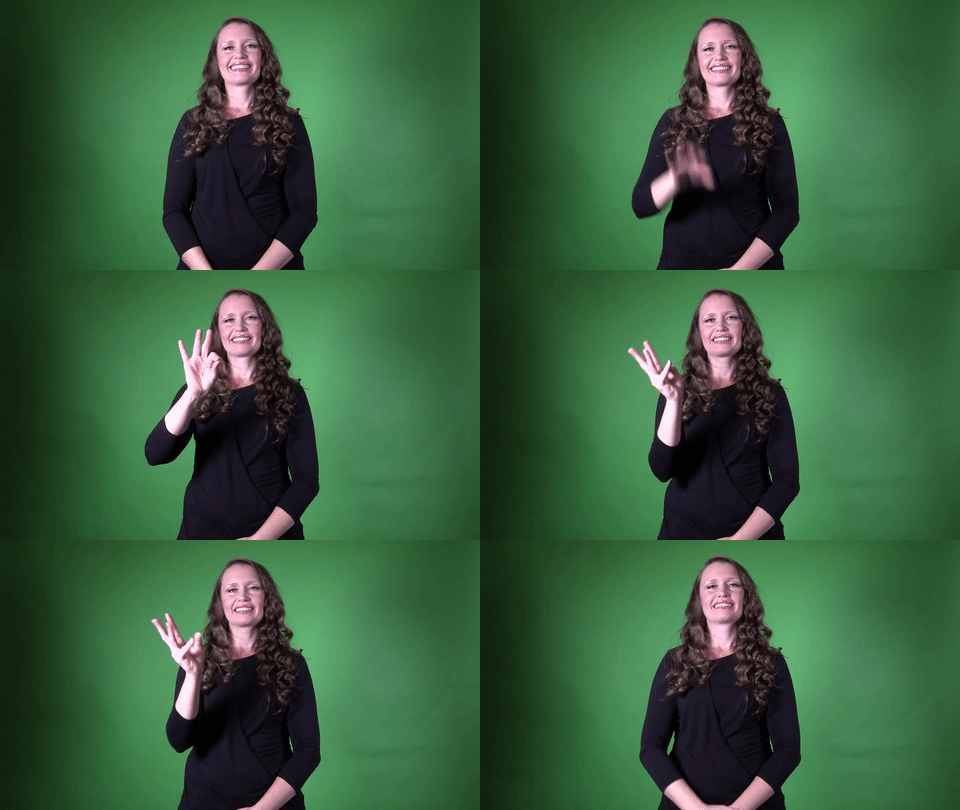
Definition: The number ninety-six.
Sign for 96 in ASL

Practice Activities:
To practice the sign for 96 in ASL, begin by signing the number slowly while watching your dominant hand’s movement. Repeat this several times to reinforce muscle memory. Use a mirror to check that your handshape and movement are accurate.
Try counting from 90 to 100 while emphasizing the sign for 96 in ASL. This helps reinforce its place within the numerical sequence. Then, practice backwards from 100 to 90, ensuring smooth transitions between each number.
Fingerspell random two-digit numbers after signing 96 to challenge recognition and recall. Mix it with number patterns, such as 95, 96, 97, to strengthen fluency. Sign different numbers to a partner and have them identify each one by writing it down.
Use the sign for 96 in ASL in storytelling practice. Describe a scenario where 96 is relevant, such as mentioning a baseball player’s jersey number, a historical year, or an amount of money. Have a friend guess what your story is about based on context clues.
Act out real-life applications by incorporating the sign into discussions about prices, ages, or statistics. For example, role-play a shopping scenario where an item costs $96, or discuss a historical event from 1996. This allows for meaningful practice in conversation.
Challenge yourself to recognize the sign for 96 in ASL when watching ASL videos. Pause the video, copy the sign, and verify accuracy using a dictionary or a fluent signer’s feedback. Record yourself signing numbers and play it back to look for any adjustments.
For a fun group activity, play a number recognition game. One person signs a random number between 90 and 100, and others race to recognize and fingerspell it. Continue practicing in different settings to improve adaptability and speed.
Cultural Context:
In American Sign Language, the sign for 96 in ASL follows the standard pattern for signing two-digit numbers. It combines the sign for 9 and the sign for 6 in a fluid motion. This helps maintain clarity and efficiency when expressing numbers in ASL.
Numbers play an important role in ASL, not just for counting but also for giving dates, addresses, and other essential information. The sign for 96 in ASL is used in everyday conversations, such as discussing years, prices, or sports scores. Understanding number signs ensures clear communication in both formal and casual settings.
ASL numbers follow a logical system that makes learning them easy with practice. The sign for 96 in ASL is part of this consistent structure, helping both beginners and advanced signers communicate effectively. Knowing these number signs is essential for fluent ASL conversations.
In Deaf culture, numerical precision is key, especially for concepts like age, time, and measurements. Signing numbers correctly, including the sign for 96 in ASL, ensures that information is shared accurately. Misunderstanding a number sign could lead to confusion, making proper number signing an important skill.
Numbers can also have cultural significance within the Deaf community, such as in historical dates and addresses of important institutions. Learning the sign for 96 in ASL allows signers to engage in discussions about these topics with accuracy. It also helps in discussing school grades, team scores, and financial transactions.
Technology has made learning ASL numbers easier through online resources and video demonstrations. Watching how the sign for 96 in ASL is performed can improve accuracy and confidence. Practicing number signs frequently helps reinforce this knowledge for everyday communication.
Fingerspelling is another important aspect of ASL, but numbers have their own unique signs to make communication faster. The sign for 96 in ASL is a quick and efficient way to express this number without relying on fingerspelling. This makes numerical conversation in ASL more natural and fluid.
In educational settings, students who learn the sign for 96 in ASL as part of their number study can use it in math lessons and discussions. Teachers often incorporate number signs into classroom activities to enhance learning. Mastering number signs provides a foundation for broader ASL fluency.
For social interactions, understanding the sign for 96 in ASL can be useful when discussing birthdays, historical events, or personal milestones. It allows Deaf and hard-of-hearing individuals to share personal experiences
Extended Definition:
The sign for 96 in ASL is a combination of numerical handshapes used in American Sign Language to represent the number ninety-six. Understanding number signs is essential for clear communication in ASL, especially when discussing dates, prices, ages, and other numerical information. Mastering number signs also helps improve fluency in conversations.
To form the sign for 96 in ASL, start by signing 9 with your dominant hand using the appropriate handshape. Then smoothly transition to the handshape for 6 without breaking the motion. This movement should be fluid and natural, maintaining the standard format used in ASL number signs.
Practicing the sign for 96 in ASL in front of a mirror can help with accuracy. Watching native ASL signers demonstrate the movement can also improve understanding. Repetition ensures the motion becomes second nature for everyday conversations.
Number signs, including the sign for 96 in ASL, are often used in various settings like school, business, and casual discussions. When combined with other signs, numbers help convey important details efficiently. They play a crucial role in describing quantities, addresses, years, and other numerical data.
The sign for 96 in ASL follows a pattern used for two-digit numbers in the language. Similar to other numbers in ASL, the transition should be smooth and visually clear. Maintaining clarity ensures effective communication between signers.
Like all ASL numbers, the sign for 96 in ASL may be adapted slightly depending on regional or stylistic variations. Some signers add small modifications based on preference or clarity. However, the core structure of the sign remains consistent, making it widely understood.
Beginners learning the sign for 96 in ASL should practice regularly to build confidence. Using the sign in real-life conversations helps reinforce memory and ensures correct hand positioning. Consistency in practice leads to mastery over time.
When signing any number, including the sign for 96 in ASL, facial expressions and hand positioning play an important role. Keeping movements sharp and distinct prevents miscommunication. Engaging with fluent ASL users provides valuable feedback for improvement.
Using proper finger placement for the sign for 96 in ASL is essential to avoid confusion with similar numbers. Paying attention to handshape differences ensures the number is clearly understood. Small mistakes in number signing can lead to misunderstandings in conversations.
Learning ASL numbers, including the sign for 96 in ASL, strengthens overall signing skills. Number
Synonyms: ninety-six, number ninety-six, number 96, the number 96, the number ninety-six
Educational resources: Find related learning materials in our course bank!
Want more? Check out some of our popular learning activities on the homepage!
Need to look up a sign? Use our highly rated dictionary: https://aslinteractive.com/best-asl-dictionary/
Follow us on tiktok: https://www.tiktok.com/@aslinteractive. More social media links at the bottom of this page!
Long-tail Keywords: what is the sign for 96 in ASL, how do you sign 96 in American Sign Language, learn how to sign 96 in ASL
Categories: Numbers – Basics, Numbers 91-100, cardinal numbers
tags: Numbers, Numbers 91-100, Math, Language Learning, Educational Content, 96 97 98 rocking numbers, rocking numbers
Parameters
*Handshape*:
The sign for 96 in ASL uses a two-handed number formation. Start by forming the number 9 with your dominant hand, where the thumb and index finger create an open circle while the other fingers extend upward. Then, smoothly transition to the number 6 by touching the pinky and thumb while keeping the middle three fingers extended. The motion is fluid, representing the sequence of numbers clearly in ASL.
*Palm Orientation*:
The palm orientation for the sign for 96 in ASL starts with the palm facing outward while forming the number 9 with the dominant hand. Then, the fingers transition smoothly into the number 6 while maintaining the same outward-facing palm orientation. The movement should be fluid and clear to ensure proper communication of the sign for 96 in ASL. Keep the hand steady and avoid unnecessary motion for better accuracy.
*Location*:
The sign for 96 in ASL takes place in the neutral space in front of the signer’s body. Both hands remain at chest level, ensuring clear visibility. The movement is fluid, transitioning smoothly from the number 9 to the number 6. While forming the numbers, the dominant hand stays in a comfortable, natural position. Maintaining proper handshape and location helps ensure accuracy when signing 96 in ASL.
*Movement*:
To produce the sign for 96 in ASL, begin with the number 9 handshape, where the thumb and index finger form a circle while the other fingers remain extended. Then, smoothly transition into the number 6 handshape by bringing the pinky and thumb together while the other fingers stay extended. This motion should be fluid without unnecessary pauses, ensuring a natural number transition. Keep the hands steady and at chest level for clarity.
*Non-Manual Signals*:
Facial expression remains neutral or slightly focused when demonstrating the sign for 96 in ASL. Eyebrows may stay relaxed unless the number is emphasized in conversation, in which case they may raise slightly. Mouth posture can be neutral or slightly open depending on context. Head movement is minimal, though slight nodding may occur for emphasis. If confirming or clarifying, non-manual signals may include an affirmative head nod or an inquisitive brow raise.
*Prosody, Dominant/Non-Dominant Hand*:
The sign for 96 in ASL uses the dominant hand only. Start by forming the number 9 handshape , with the index and thumb touching in a circular shape while the other fingers remain extended. Then, smoothly transition to the number 6 handshape , where the pinky and thumb touch while the other fingers are extended. This movement should be fluid, maintaining clarity in each number formation. The non-dominant hand remains inactive.
Tips for Beginners:
The sign for 96 in ASL is a combination of the numbers 9 and 6. Start with your dominant hand forming the number 9 by touching the tip of your thumb to the tip of your index finger while keeping the remaining fingers extended. Then smoothly transition into the number 6 by touching the tip of your pinky finger to the tip of your thumb while keeping the middle three fingers extended.
A common mistake when signing the sign for 96 in ASL is rushing the transition between numbers. Move fluidly but ensure each number is clear before switching. Avoid flipping your palm orientation or modifying finger positions incorrectly, as this can change the meaning of the sign. Practicing in front of a mirror helps you check your accuracy.
Finger dexterity is key when signing the sign for 96 in ASL. If your fingers feel stiff or uncoordinated, try hand exercises to improve flexibility. Wiggle your fingers, stretch them, and practice slowly before increasing speed. Over time, your hand movements will become more natural and precise.
Consistent palm orientation is essential. For the sign for 96 in ASL, your palm should face outward. If your palm faces the wrong direction, it may confuse your audience. Always be mindful of your hand position, especially when learning new number signs.
Practicing numbers in sequence is a great way to reinforce memory. Try signing 90 through 100 repeatedly to build confidence. The more comfortable you are with transitioning between numbers, the more naturally the sign for 96 in ASL will come to you. Watching others sign or using ASL learning apps can also provide helpful reinforcement.
Connections to Other topics:
The sign for 96 in ASL follows the pattern of other two-digit numbers in the 90s, demonstrating a consistent system in number signs. In ASL, numbers often share common movements or handshapes that make them easier to recognize and remember. The transition between the digits in the sign for 96 in ASL is fluid, reinforcing the linguistic efficiency of ASL’s numerical system.
Numbers play an essential role in daily conversation, from dates and times to measurements and addresses. Understanding the sign for 96 in ASL helps learners build confidence in recognizing patterns that apply to other numbers. Once familiar with number transitions, signers can quickly adapt to related numerical signs such as 97, 98, and 99, which follow a similar structure.
ASL number signs often interact with classifiers, a feature unique to signed languages. For instance, a CL:1 classifier can indicate a single object while adding a numerical sign like 96 can refine the meaning to reference an exact quantity. The sign for 96 in ASL can also be adapted for contexts like sports scores, money amounts, or times of the day, demonstrating its versatility in communication.
Ordinal numbers and ranking systems also connect with numerical signs. If referring to something like “96th place” or “the 96th anniversary,” the sign for 96 in ASL may be modified to indicate ordinal order. This flexibility enhances ASL’s ability to convey precise meanings using clear, efficient movements.
When learning numbers in ASL, it’s helpful to practice sequences and identify patterns in movements. The way the sign for 96 in ASL relates to other numbers encourages consistency, enabling signers to navigate numerical concepts with ease. By strengthening skills in number signs, learners improve their overall fluency in ASL communication.
Summary:
The sign for 96 in ASL follows the standard pattern for signing two-digit numbers in American Sign Language. This number is produced using two handshapes in quick succession, transitioning smoothly from one digit to the next. The signer forms the number 9 first and then shifts into the number 6 while maintaining a steady motion.
When signing the number 9, the dominant hand is used with the thumb and index finger touching to form a circular shape. The remaining fingers stay extended and slightly spread apart. This is a common handshape in ASL that appears in other signs and numbers, making it a foundational movement.
Immediately after forming the 9, the signer smoothly transitions to the number 6. The handshape for 6 involves touching the pinky finger to the thumb while the other three fingers remain extended. The motion between 9 and 6 happens fluidly without unnecessary pauses, ensuring clarity.
Number signs in ASL are often influenced by the broader numerical system of the language. The sign for 96 in ASL follows a logical pattern used for many two-digit numbers. The transition between these numbers should be clean and distinct to avoid confusion with similar numbers.
Hand orientation plays an essential role in ensuring the correct interpretation of numbers in ASL. The palm for both digits typically faces outward or slightly to the side. This presentation helps make the signs clearly visible to the person receiving the message.
The placement of the hand in signing space is generally in front of the chest or slightly lower. This allows the motion between the two numbers to be fluid and easily understood. Maintaining consistent placement is important for numbers to remain legible.
The speed of number signing varies slightly depending on fluency and context. A fluent signer may transition quickly between 9 and 6, while a beginner may require more deliberate movements. However, maintaining a natural rhythm ensures the number is not mistaken for something else.
Numbers in ASL are commonly used in daily interactions, including addresses, phone numbers, and prices. The sign for 96 in ASL might appear in discussions about years, ages, or financial figures. Ensuring accurate numerical representation is crucial for effective communication.
In a broader linguistic sense, ASL numbers demonstrate the efficiency of handshapes for conveying quantity. The sign for 96 in ASL follows a clear, predetermined structure rooted in ASL’s numerical system. The logic behind number formation showcases how ASL represents mathematical concepts visually.
Numerical signs in ASL also connect to visual-spatial cognition. The manual nature of sign language allows signers to represent numbers dynamically in space. The sign for 96 in ASL exemplifies how signed numbers adapt fluidly to ASL’s visual modality.
Cultural factors also influence how numbers are used in ASL. Some numerical signs carry specific connotations or are associated with important dates. While 96 itself may not have a specific cultural significance, numbers in ASL play an essential role in historical and social contexts.
ASL’s numerical system is different from other sign languages around the world. The sign for 96 in ASL may appear differently in British Sign Language or French Sign Language. This highlights the linguistic uniqueness of ASL’s number system and its structured formation.
Some signs in ASL incorporate numbers into their meanings. For example, age signs involve a numerical component combined with a specific sign for age-related concepts. The sign for 96 in ASL might appear when discussing an elderly person or a historical event from 1996.
ASL fingerspelling also plays a role in numerical communication when clarifications are needed. If a signer misunderstands the number, additional context or repetition can help reinforce comprehension. The sign for 96 in ASL can be paired with written or fingerspelled clarification if necessary.
Numbers in ASL sometimes integrate subtle variations in movement or emphasis based on regional and personal signing styles. While the standard sign for 96 in ASL follows an expected structure, minor differences can occur among signers based on fluency and comfort. These variations do not typically alter understanding but can reflect individual stylistic choices.
The efficiency of ASL numbers makes the language well-suited for expressing mathematical and quantitative concepts. The sign for 96 in ASL follows this principle, demonstrating the language’s capacity to communicate numerical information quickly and effectively. Understanding numerical structures is essential for clear ASL communication.
Technology has influenced ASL number use through digital devices and video communication. With the rise of video calls, ASL signers regularly sign numbers for addresses, codes, and identification. The sign for 96 in ASL remains an essential linguistic tool across various communication platforms.
Sports, business, and education often necessitate precise numerical signage. Whether referring to a jersey number, a budget figure, or classroom instruction, number signs appear frequently. The sign for 96 in ASL helps ensure numerical accuracy in diverse settings.
In storytelling and conversations, numbered sequences enhance descriptions of events and timelines. A signer might use the sign for 96 in
Want more? Check out some of our popular learning activities!
ASL Interactive Resources
ASLInteractive YouTube Channel
Follow us on tiktok: @aslinteractive.com
Follow us on Instagram: aslinteractive
Facebook page: aslinteractive
Facebook group: aslinteractive
LInkedIn: ASL Interactive LLC
Twitter: @ASL_interactive
*Some information on this page is AI-generated. AI can make mistakes. Please check the information.


Responses