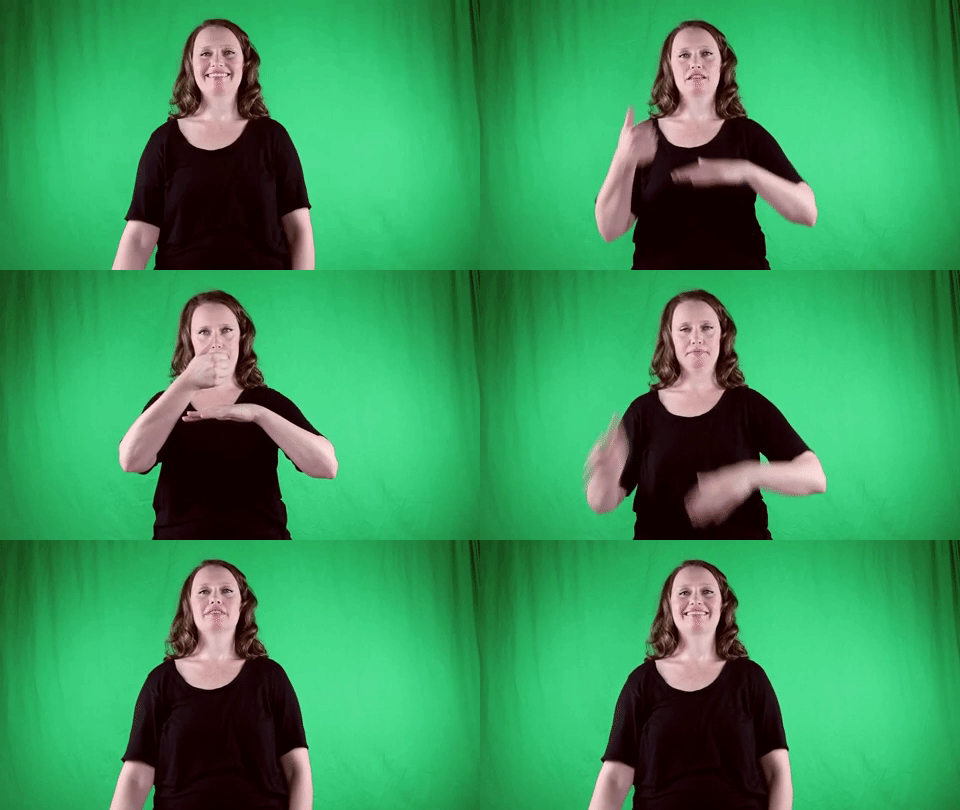
Sign for ABOVE in ASL | ☝️ ASL Dictionary

Definition: In or to a higher place.

Sign for ABOVE in ASL 

YouTube player

Practice Activities:

To practice the sign for above in ASL, start by signing it slowly in front of a mirror. Pay close attention to hand positioning and movement. Repeat the sign multiple times, ensuring accuracy and fluidity.

Use flashcards with images of objects in different spatial relations and sign whether one object is above another. For example, look at a picture of a bird above a tree and sign the correct spatial description. This will help reinforce understanding through visual learning.

Practice using the sign for above in ASL by incorporating it into simple sentences. Say and sign, “The sun is above the clouds,” or “My book is above the table.” Creating connections between visual concepts and the sign strengthens memory and recall.

Engage in partner activities by having one person describe a scene with objects placed at different heights. The other person will sign to describe their relative positions using the sign for above in ASL and similar directional signs. This exercise improves comprehension and interactive communication.

Tell a short story that involves placement or movement of objects in relation to each other. For instance, describe a balloon floating above a park or a bird flying above the water. These narratives help link the meaning of the sign with real-life action.

Use the sign in a game of Simon Says. Have one person give commands like, “Put your hand above your head,” while others sign and perform the movement accordingly. This makes learning fun and interactive.

Record yourself signing sentences that include the sign for above in ASL. Watch the video to check for correct hand positioning and movement. Comparing your sign to reference videos can help refine accuracy.

Cultural Context:

The sign for above in ASL is an essential concept in American Sign Language, frequently used to describe spatial relationships and hierarchical positions. In Deaf culture, clear visual communication is crucial, and signs like above in ASL help convey precise meanings without confusion. Expressing direction and placement accurately enhances storytelling and everyday conversations.

ASL is a visual language, and spatial references play a significant role in effective communication. The sign for above in ASL is often used when giving directions, describing objects in relation to others, or discussing rankings. Mastering this sign helps improve fluency and clarity in conversations.

In ASL storytelling and poetry, spatial markers like above in ASL add depth and dimension to signed narratives. Signers often use the physical space around them to depict movement, locations, and relationships between objects or people. Understanding how to position signs in relation to each other is fundamental for fluid expression.

Learning ASL involves more than just memorizing signs; it includes understanding cultural context and usage. The sign for above in ASL is not just a fixed motion but can vary slightly depending on the situation or emphasis. Deaf signers naturally incorporate spatial awareness in their signing, making communication more dynamic.

ASL grammar relies heavily on non-manual signals, facial expressions, and positioning. When signing above in ASL, slight variations in movement or additional facial expressions can help clarify meaning. Communicating effectively in ASL requires attention to these subtle details.

Fluency in ASL means being able to describe relationships between objects in three-dimensional space, which is why learning concepts like the sign for above in ASL is essential. Whether discussing locations or abstract ideas, proper spatial placement ensures clear understanding. Practicing these variations leads to more confident signing.

ASL instructors often emphasize classifiers that can incorporate movement for signs like above in ASL. These classifiers allow for more depth in descriptions, making interactions richer and more detailed. Understanding classifiers helps signers express ideas more naturally.

In everyday conversations, the sign for above in ASL is used to describe height differences, object placements, and even figurative meanings like superiority or status. Just like spoken languages use prepositions, ASL signers rely on spatial referencing to convey meaning effectively. This enhances the language’s visual nature.

Using the sign for above in ASL correctly helps signers communicate with clarity and precision. Whether in casual conversation, storytelling, or formal discussions, understanding spatial relationships enhances overall ASL proficiency. Practicing frequently improves

Extended Definition:

The sign for above in ASL is a simple and clear way to express the concept of higher position or elevation. This sign is used to indicate something that is physically or metaphorically higher than something else. It is commonly used in conversations to describe location, ranking, or status.

To make the sign for above in ASL, position your non-dominant hand flat with the palm facing down. Then, place your dominant hand flat and hover it above the non-dominant hand. Move the dominant hand slightly upward to show elevation or a higher level.

This sign for above in ASL can be used to describe the placement of objects, such as “the book is above the shelf.” It can also refer to status, like “my manager is above me at work.” The sign adapts well to different sentence structures based on the context.

When signing, facial expressions can add emphasis to indicate how much higher something is. A raised eyebrow or widened eyes can convey surprise or significance. ASL relies on these non-manual signals to enhance meaning and clarity.

There are other signs that may relate to above, such as “over” or “on top of,” depending on the meaning you wish to express. Context determines the best choice between these similar ASL signs. Using the right hand movement ensures clear and accurate communication.

Understanding the sign for above in ASL helps improve fluency in conversations about locations, heights, and comparisons. This common sign is useful in daily discussions, whether describing physical spaces or metaphorical hierarchies. Practicing it helps build confidence in ASL communication.

Synonyms: higher, over, atop, on top of, upward

Educational resources: Find related learning materials in our course bank!

Want more? Check out some of our popular learning activities on the homepage!

Need to look up a sign? Use our highly rated dictionary: https://aslinteractive.com/best-asl-dictionary/

Follow us on tiktok: https://www.tiktok.com/@aslinteractive. More social media links at the bottom of this page!

Long-tail Keywords: What is the sign for Above in ASL, How do you sign Above in ASL, ASL sign for Above

Categories:

tags: above, directions, positioning, language learning, spatial awareness

Parameters

*Handshape*:

The sign for above in ASL uses a flat ✋ handshape for both hands. The non-dominant hand remains steady in a horizontal position, palm facing downward. The dominant hand, also flat, hovers above the non-dominant hand and makes a slight upward movement. This indicates a position higher than the baseline hand. The sign for above in ASL clearly shows spatial positioning, making it visually effective in communication.

*Palm Orientation*:

The palm orientation for the sign for above in ASL involves both hands, with the dominant hand positioned above the non-dominant hand. The dominant hand is flat, with the palm facing downward, while the non-dominant hand is also flat and positioned below, with its palm facing downward or slightly to the side. The dominant hand moves upward in a small, repeated motion, emphasizing the concept of being higher or above.

*Location*:

The sign for ABOVE in ASL is produced in the neutral signing space in front of the body. The dominant hand is positioned above the non-dominant hand, both in flat B-handshapes with palms facing downward. The dominant hand moves upward in a small arc, illustrating the concept of one object being higher than another. This placement emphasizes spatial relationships, reinforcing the meaning of the sign for ABOVE in ASL.

*Movement*:

To produce the sign for above in ASL, position your non-dominant hand flat with the palm facing downward. Then, place your dominant hand flat above it, also with the palm facing downward. Move the dominant hand slightly upward in a small arc, indicating a higher position. Ensure a smooth and controlled movement to clearly convey the concept of above. This motion visually represents one object being positioned higher than another.

*Non-Manual Signals*:

When using the sign for above in ASL, the eyebrows may be raised slightly to indicate emphasis, particularly if comparing heights or levels. The head may tilt slightly upward while the eyes follow the movement of the dominant hand. If used in a question, the eyebrows may furrow to express inquiry. Mouth movements may include a slight “oh” shape to emphasize the spatial relationship conveyed in the sign for above in ASL.

*Prosody, Dominant/Non-Dominant Hand*:

The sign for above in ASL uses both hands. The non-dominant hand is held flat in a horizontal position, palm facing down. The dominant hand is also flat with the palm facing down and starts just above the non-dominant hand. The dominant hand moves upward in a small arc, showing the concept of being positioned higher. This movement visually represents the meaning behind the sign for above in ASL. ✋⬆

Tips for Beginners:

When learning the sign for ABOVE in ASL, focus on keeping your hand movements smooth and controlled. The top hand should hover slightly over the bottom, making a small upward motion to indicate the concept of “above.” Avoid making the movement too exaggerated; a small, clear motion is enough to convey the meaning effectively.

Hand positioning is important for accuracy when signing ABOVE. Keep your non-dominant hand flat and steady, creating a base for the dominant hand to move above it. If the dominant hand moves too far away or too high, the sign might become unclear or mistaken for a different meaning. Keep the movement concise and natural for a more visually clear representation.

Consistent repetition helps in developing muscle memory for signing ABOVE smoothly. Practice slowly at first, ensuring each movement is deliberate and precise. As you gain confidence, increase speed while maintaining clarity. Watching native ASL signers and practicing in front of a mirror can help refine your accuracy.

One common mistake beginners make when signing ABOVE is forgetting to keep their palm orientations correct. The non-dominant hand should remain stable, while the dominant hand makes a small upward motion without twisting unnaturally. Over-exaggerating or rushing the movement can make the sign confusing, so take your time to practice at a comfortable pace.

In real-life ASL conversations, context will help reinforce the meaning of ABOVE. Signing it alongside other directional or spatial signs will ensure clarity for the viewer. Try incorporating it into basic sentences to improve fluency, such as describing objects in relation to one another. The more you use it in context, the easier it will become to sign ABOVE naturally in ASL conversations.

Connections to Other topics:

The sign for ABOVE in ASL connects to many spatial and comparative concepts. It relates closely to signs like OVER, HIGH, and GREATER, which indicate position, hierarchy, or superiority. Many comparative adjectives in ASL rely on spatial positioning, making ABOVE useful when discussing height, ranking, or levels of understanding.

This sign also appears in compound concepts such as ABOVE AVERAGE, where it is paired with AVERAGE to indicate excellence or exceeding expectations. Similarly, ABOVE NORMAL can be used to describe higher-than-expected values, like temperature or performance. These combinations demonstrate how spatial concepts translate into broader meanings in ASL.

The sign for ABOVE in ASL also contrasts with BELOW, creating clear visual relationships between different positions. For example, when comparing two objects, a signer might use ABOVE to show that one is physically higher than another. This spatial usage extends to abstract ideas, such as being “above the law” or “rising above a challenge.”

This sign plays a role in directional phrases like ABOVE ME or ABOVE YOU, which help give clear spatial context. It’s also useful in academic and work conversations, such as discussing a supervisor being “above” an employee in a hierarchy. In storytelling, ABOVE can indicate the location of objects in the sky, higher levels of a building, or abstract ideas like mental elevation.

Since ASL often simplifies complex concepts into movement and placement, ABOVE contributes to meaningful expressions about relationships, rankings, and comparisons. It also plays a key role in emphasizing elevation, whether physical or metaphorical. Understanding this sign helps build a signer’s ability to describe spatial and hierarchical relationships effectively.

Summary:

The sign for above in ASL is a spatial concept conveyed through hand positioning. It involves placing the dominant flat hand above the non-dominant flat hand, with the dominant hand moving slightly upward. This movement visually represents one object being positioned higher than another.

This sign aligns with ASL’s use of space to convey relationships between objects or concepts. ASL frequently uses spatial modifications to indicate relative positioning, which makes the sign for above in ASL an intuitive representation. Because ASL is a visual language, spatial relationships are fundamental to its grammar and structure.

The concept of above is widely used in both concrete and abstract ways. It can indicate physical positioning, such as placing an object above another. It can also represent metaphorical ideas, such as status, ranking, or superiority.

When using the sign for above in ASL, facial expressions can modify meaning. A neutral expression typically conveys a simple spatial relationship. A raised eyebrow or a slight head tilt can emphasize contrast or comparison.

In ASL grammar, the placement of objects in space follows a logical structure. The sign for above in ASL aligns with this system by visually demonstrating a higher position. ASL classifiers can further enhance clarity by representing objects and their positioning.

This sign is commonly used in descriptions, directions, and comparisons. If giving directions, it might indicate a floor above or an object on a shelf. In comparisons, it may suggest superiority, hierarchy, or prioritization.

Related signs include below, under, and over. The sign for below is similar but moves downward instead of up. The sign for over can sometimes resemble the sign for above, depending on context.

Understanding the nuances of the sign for above in ASL helps in describing three-dimensional space. ASL users frequently incorporate directional signs to clarify spatial relationships. This enhances the visual and contextual nature of signed communication.

ASL allows for modifications to signed placement for storytelling. If narrating events, signing above in varying locations can establish different referents. This is especially useful when discussing stacked objects or multi-level spaces.

Children learning ASL often acquire spatial concepts early. They use signs like above to describe everyday interactions with objects. Mastering spatial vocabulary helps develop strong linguistic foundations in ASL.

Culturally, ASL speakers rely heavily on space representation in communication. The sign for above in ASL follows this principle by depicting relative heights. This method of signing aligns with Deaf visual-spatial processing strengths.

The concept of above appears in idiomatic and poetic ASL expressions. Signing above with exaggerated movement may symbolize lofty goals or aspirations. In storytelling, it can depict characters in elevated positions or unreachable places.

The sign for above in ASL can also be modified for emphasis. A slower, deliberate upward movement may indicate a noticeable height difference. A quick, small flick upward may suggest a minor difference in height.

Linguistically, this sign demonstrates ASL’s reliance on visual-spatial relationships. Unlike spoken languages that use prepositions, ASL uses direct representation. This reinforces the efficiency and clarity of sign language communication.

ASL educators emphasize spatial signs early in instruction. Teaching above helps students grasp placement concepts that appear in daily signing. Mastering it also supports understanding of directional and descriptive signs.

Signed narratives often incorporate the sign for above in ASL when describing sequences. This creates a clear visual structure for storytelling. ASL literature often relies on such spatial distinctions for clarity and engagement.

The sign for above in ASL exemplifies how ASL conveys meaning through movement and space. Unlike spoken languages, this sign does not require additional words for clarification. The visual structure naturally represents the concept of height.

When signing above, hand dominance is generally preferred. The dominant hand moves while the non-dominant hand remains relatively stationary. This follows ASL’s conventions for establishing clear movement contrasts.

This sign is highly intuitive for visual learners. New ASL users can often guess its meaning based on the hand movement alone. This emphasizes ASL’s inherent visual nature and intuitive grammar.

In practical use, this sign often appears in daily conversations. Describing stacked items, shelf placements, or directional indications frequently requires it. Its versatility makes it a fundamental ASL vocabulary word.

In academic ASL settings, spatial concepts like above are essential. Discussions involving hierarchies, spatial positioning, or scientific concepts rely on it. Mastering spatial terminology facilitates precise academic discourse in ASL.

Storytelling in ASL benefits greatly from spatial arrangements. Characters, actions, and settings gain visual clarity when positioned accurately. The sign for above in ASL helps establish relationships within a story’s space.

Some variations of the sign exist depending on regional ASL dialects. However, the general upward motion remains consistent. These slight variations demonstrate the dynamic nature of ASL usage.

When fingerspelling a word that includes above, signers generally use a brief pause. This ensures clarity between fingers

Want more? Check out some of our popular learning activities!

ASL Interactive Resources

ASLInteractive YouTube Channel

Follow us on tiktok: @aslinteractive.com

Follow us on Instagram: aslinteractive

Facebook page: aslinteractive

Facebook group: aslinteractive

LInkedIn: ASL Interactive LLC

Twitter: @ASL_interactive

*Some information on this page is AI-generated. AI can make mistakes. Please check the information.

Sign for ABOVE in ASL 

Responses