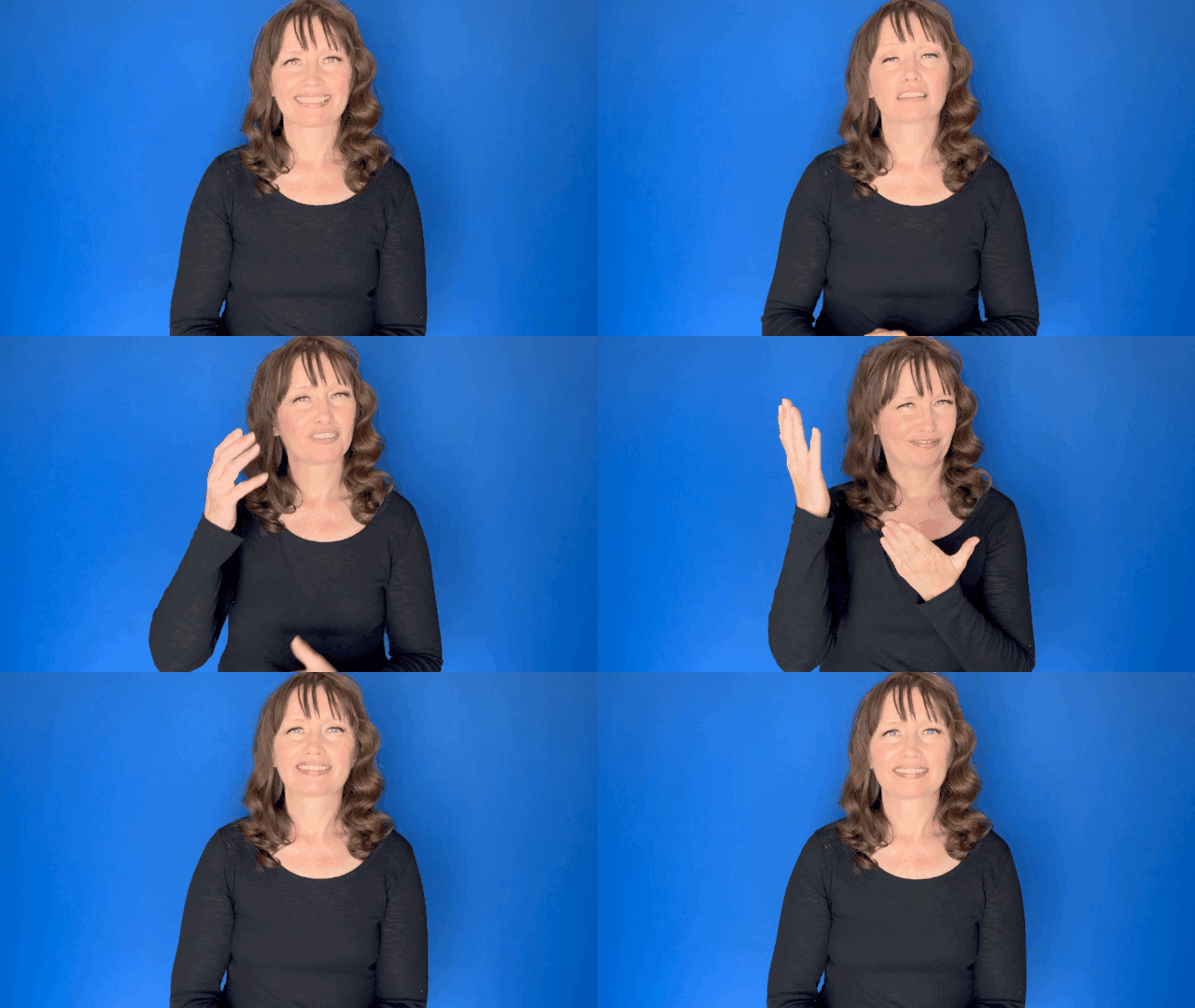
Definition: Services designed for the disabled.
Sign for ACCESSIBILITY SERVICES DISABILITY SERVICES in ASL

Practice Activities:
To practice the sign for accessibility services disability services in ASL, begin by signing it slowly and carefully in front of a mirror. Pay close attention to hand placement, movement, and facial expressions. Repeat the sign multiple times to build muscle memory and fluency.
Next, incorporate the sign into simple sentences. Try signing phrases like “My school provides accessibility services disability services” or “I need accessibility services disability services at work.” Practicing these sentences will help connect the sign with real-life usage.
Practice with a partner by creating a conversation about disability services. One person can ask, “Does this place offer accessibility services disability services?” while the other responds with different answers. Switch roles and add new questions to expand the dialogue.
Storytelling is another great way to reinforce learning. Create a short story about a person using accessibility services disability services at a university, hospital, or workplace. Sign the story to a friend or record yourself to review your accuracy and clarity.
Use role-playing activities to enhance practical application. Pretend you are at a doctor’s office or talking to a school counselor, asking about accessibility services disability services. This will help you gain confidence using the sign in real-life situations.
Lastly, watch videos of fluent ASL signers using the sign naturally within conversations. Try to copy their movements, speed, and expressions. Practicing regularly in these varied ways will ensure you become comfortable and proficient in signing accessibility services disability services in ASL.
Cultural Context:
Accessibility services and disability services play a crucial role in ensuring equal opportunities for everyone, regardless of ability. In the Deaf and hard-of-hearing community, access to communication and resources is essential for full participation in education, employment, and daily life. Learning the sign for accessibility services disability services in ASL helps promote inclusivity and advocacy within various spaces.
Many accessibility services and disability services focus on breaking down barriers that limit communication. These services include sign language interpreters, captioning, assistive technology, and visual alerts designed to create an accessible world for Deaf and hard-of-hearing individuals. Knowing the sign for accessibility services disability services in ASL can help spread awareness and encourage greater accessibility in public and private settings.
The need for strong accessibility services and disability services is recognized in legal frameworks such as the Americans with Disabilities Act (ADA). This law ensures that businesses, schools, workplaces, and public institutions provide accommodations that enhance accessibility for Deaf individuals. Using the sign for accessibility services disability services in ASL when discussing these topics fosters better understanding and support within the community.
Workplaces and educational institutions benefit greatly from accessibility services and disability services that promote clear communication. Providing ASL interpretation, video relay services, and text-based communication tools allows Deaf employees and students to excel in their fields. Learning and using the sign for accessibility services disability services in ASL reinforces the importance of equitable access.
Cultural understanding plays a significant role in the implementation of accessibility services and disability services. The Deaf community values linguistic and cultural access as a fundamental right rather than a courtesy. Incorporating the sign for accessibility services disability services in ASL into conversations about inclusion demonstrates respect and allyship.
Advocacy for comprehensive accessibility services and disability services requires collaboration between Deaf individuals, interpreters, policymakers, and service providers. Ensuring that these services are both available and effective demands continuous effort and awareness. Using the sign for accessibility services disability services in ASL can help bridge communication gaps and advocate for necessary improvements.
Technology has expanded the reach of accessibility services and disability services in ways that were unimaginable decades ago. Video relay services, real-time speech-to-text applications, and mobile ASL dictionaries have all improved daily life for Deaf and hard-of-hearing individuals. Learning the sign for accessibility services disability services in ASL encourages digital inclusivity and tech-driven solutions.
Public spaces and businesses that prioritize accessibility services and disability services create welcoming environments for everyone. From hospitals to government offices, having ASL interpreters available
Extended Definition:
accessibility services and disability services in ASL refer to vital resources and accommodations that support individuals with disabilities. These services ensure that people who are deaf or hard of hearing can fully participate in education, employment, healthcare, and daily life. Learning the sign for accessibility services disability services in ASL helps promote inclusion and equal access.
Understanding how to sign accessibility services and disability services in ASL is essential for interpreters, educators, and advocates. These signs help bridge communication gaps and ensure that individuals with disabilities receive the support they need. Using the correct ASL sign ensures clarity when discussing disability rights, accommodations, and available programs.
Many accessibility services include sign language interpreters, captioning, assistive listening devices, and technology that enhances communication access. Disability services cover a broader range of accommodations, including mobility support, accessible transportation, and workplace modifications. Signing accessibility services disability services in ASL makes it easier to request or discuss these necessary supports.
ASL plays a crucial role in ensuring that people with hearing loss can easily access the services they need. By knowing how to sign accessibility services disability services in ASL, individuals can effectively advocate for themselves or others. Clear communication about resources helps remove barriers and promotes independence.
In educational settings, accessibility services and disability services provide students with the tools they need to succeed. Schools and universities offer accommodations like note-taking assistance, ASL interpreters, and extended test time. Using the ASL signs for these services empowers students to seek and receive the support they deserve.
Workplaces also offer disability services to create an inclusive environment for employees with disabilities. Employers may provide accommodations such as video relay services, ergonomic workspaces, and flexible schedules. Signing accessibility services disability services in ASL helps employees and employers communicate about necessary workplace adjustments.
Healthcare providers must also ensure accessibility services for patients with disabilities. Many hospitals and clinics offer ASL interpreters, visual alert systems, and digital communication tools for deaf and hard-of-hearing patients. Knowing the sign for accessibility services disability services in ASL makes it easier to request these essential accommodations.
Public spaces, transportation systems, and government agencies provide disability services to improve accessibility for all individuals. These services may include ramps, braille signage, and visual communication tools for people who are deaf. Using ASL to discuss accessibility services disability services ensures that these accommodations are well understood.
Community organizations often advocate for improved disability services and accessibility services to support equal access rights. These groups work to implement policies and promote
Synonyms: accessible assistance, disability support, access services, inclusive assistance, impairment services
Educational resources: Find related learning materials in our course bank!
Want more? Check out some of our popular learning activities on the homepage!
Need to look up a sign? Use our highly rated dictionary: https://aslinteractive.com/best-asl-dictionary/
Follow us on tiktok: https://www.tiktok.com/@aslinteractive. More social media links at the bottom of this page!
Long-tail Keywords: what is the sign for accessibility services disability services in ASL, how do you sign accessibility services disability services in ASL, ASL sign for accessibility services disability services
Categories:
tags: accessibility services in ASL, disability services in ASL, ASL resources for accessibility, American Sign Language disability services, inclusive communication in ASL
Parameters
*Handshape*:
The sign for accessibility services disability services in ASL uses a combination of handshapes to convey the concept clearly. Typically, both hands form an open “A” or “C” shape, depending on regional variation, to signify accessibility. The movement involves a circular or forward motion to indicate services being provided, emphasizing support and inclusion.
For disability-related concepts, the dominant hand may form a “D” shape while tapping or moving near the shoulder or chest. This reinforces the meaning of accessibility within disability services. The handshapes used in the sign for accessibility services disability services in ASL create a visual representation of assistance and inclusion, making it an essential concept in ASL communication.
*Palm Orientation*:
The palm orientation for the sign for ACCESSIBILITY SERVICES DISABILITY SERVICES in ASL varies depending on the specific signs used. For “ACCESSIBILITY” and “DISABILITY,” hands typically face outward or inward depending on regional variations. When signing “SERVICES,” both hands face upward or slightly outward, moving in a side-to-side motion. Throughout the sign for ACCESSIBILITY SERVICES DISABILITY SERVICES in ASL, hand positioning remains stable to ensure clarity and accuracy in communication.
*Location*:
The sign for accessibility services disability services in ASL is produced in the neutral signing space in front of the body. The hands move in a controlled and deliberate manner, ensuring clarity. Depending on regional or organizational variations, some signers may use initialized signs or fingerspelling to indicate specific terminology.
When signing accessibility and disability, the dominant hand often makes references to movement, support, or physical condition. For services, the hands move in a symmetrical pattern to convey assistance or provisions. The sign may vary slightly based on context, ensuring accuracy for different accessibility services disability services in ASL.
*Movement*:
To sign for accessibility services disability services in ASL, begin with both hands forming the “A” handshape. Place them near the chest and move them outward in a circular motion, symbolizing accessibility. Then, for services, use the dominant hand in an open “B” shape, sweeping above the non-dominant palm, indicating assistance or provision. For disability services, fingerspell “D-I-S-A-B-I-L-I-T-Y” followed by the same movement for services. Repeat smoothly to ensure clarity. ✋
*Non-Manual Signals*:
Facial expression plays a key role when signing the sign for accessibility services disability services in ASL. A neutral or slightly positive expression is ideal, reflecting professionalism and inclusivity . For emphasis, slightly raise your eyebrows to show engagement, especially when clarifying specific services.
Body posture remains open and receptive, reinforcing the concept of accessibility. A slight forward lean can indicate attentiveness while maintaining fluid transitions between signs. This enhances the overall clarity of the sign for accessibility services disability services in ASL.
*Prosody, Dominant/Non-Dominant Hand*:
The sign for accessibility services disability services in ASL involves both hands working together to represent access and support. The dominant hand, in an open position, moves forward while the non-dominant hand remains steady, symbolizing assistance. Some variations may include modifying the motion to emphasize specific services. Facial expressions can strengthen meaning, showing emphasis or inclusivity. This sign effectively communicates concepts related to accessibility and disability services in ASL.
Tips for Beginners:
When learning the sign for accessibility services disability services in ASL, focus on maintaining clear hand shapes and smooth transitions. Many signs for disability and accessibility in ASL involve classifiers or initialized movements using the letter “A” or “D.” Keeping your hand movements controlled and intentional ensures clarity, preventing miscommunication.
Beginners often struggle with hand dominance, so always use your dominant hand consistently. If the sign involves both hands, make sure one remains stationary while the other moves unless both are required to move symmetrically. Switching dominant hands mid-sign can make the sign confusing or incorrect.
Facial expressions play a key role in ASL and should match the context of accessibility services disability services in ASL. If discussing the availability of services, a neutral or engaged expression is appropriate. If mentioning a lack of accessibility, using a concerned or negative expression reinforces meaning.
Make sure to keep your hand positioning within the typical signing space, ensuring visibility. Signs performed too low may not be noticed, while those too high can seem unnatural. Practicing in front of a mirror can help maintain proper placement and fluidity.
Common pitfalls include mixing up similar signs or over-exaggerating movements. Some signs for accessibility may resemble those for help or support, so pay attention to the subtle differences in movement and hand orientation. Over-exaggeration can lead to an unnatural signing style, so aim for natural, efficient movements.
When fingerspelling related terms, such as “ADA” for accessibility laws, keep your hand steady and your fingers clearly shaped. Speed is less important than clarity when fingerspelling. Watching fluent ASL users and practicing regularly will help you become more comfortable with these signs.
To reinforce learning, try using accessibility services disability services in ASL in real-life conversations with Deaf individuals or interpreters. Signing in context helps make the vocabulary more natural and ingrained in your memory.
Connections to Other topics:
The sign for accessibility services disability services in ASL is closely related to signs representing inclusion, support, and equal access. Many signs related to disability services stem from the core concepts of ability, assistance, and modifications, allowing for meaningful communication about resources available to individuals with disabilities. In discussions about accessibility, signs such as accommodate, inclusive, and equal often appear, enhancing the ability to discuss policies and real-world applications of these services.
This sign connects to broader discussions in ASL regarding advocacy and rights, including concepts like interpreter services, legal accommodations, and workplace accessibility. For example, the sign for accessibility services disability services in ASL may be paired with the sign for law or support to indicate disability law or support services. Additionally, terms like ADA (Americans with Disabilities Act) are often fingerspelled in these discussions, reinforcing legal protections regarding accessibility.
Compound signs can develop to clarify services related to accessibility. For example, disability benefits might combine the sign for disability and the sign for money or support. Similarly, accessible technology could link technology to accessible to emphasize innovations designed for equitable use. These combinations help provide clarity when expressing various aspects of disability services in ASL.
This sign also connects with community inclusion and social equity conversations, highlighting topics such as education, transportation, and employment resources for people with disabilities. When discussing these issues, related signs like equal rights, assist, and modifications are frequently used. The sign for accessibility services disability services in ASL helps structure conversations about creating more inclusive environments where all individuals can participate fully.
Summary:
The sign for accessibility services disability services in ASL reflects the importance of inclusive support systems for individuals with disabilities. ASL often conveys complex concepts through a combination of separate signs rather than a single, universal sign. To sign accessibility, the handshapes and movements relate to the idea of easy physical or digital access.
For accessibility, a common approach is to sign “access” using an open hand moving towards a barrier, symbolizing overcoming obstacles. Some signers incorporate the concept of “available” to imply ease of entry. The way the sign is executed can depend on the context, whether referring to physical spaces, communication methods, or digital inclusion.
For services, ASL users typically use a sign that represents assistance or facilitation, performed with both hands moving in a balanced motion. One hand, often dominant, moves parallel to the other, emphasizing the idea of providing aid. The movement reflects the structured nature of services as a form of support or assistance.
For disability, there are multiple sign variations depending on regional and personal preferences. A common approach is to fingerspell “D” and “A” to represent “disabled.” Another method is the sign for “handicap,” which uses an “H” handshape moving forward. Some prefer alternative signs that reflect identity-first language rather than a medical model.
Context and emphasis matter when signing accessibility services disability services in ASL. Depending on the conversation, signers may modify the movement, speed, or facial expressions to indicate urgency or specificity. The discourse surrounding accessibility and disability has evolved, and ASL signs often reflect shifts in cultural conversations.
The sign for accessibility services disability services in ASL might also incorporate classifiers to provide further context. Classifiers allow for spatial representation to illustrate physical accessibility or policy-related discussions. For example, a classifier might indicate a ramp, an interpreter, or assistive technology.
Beyond the mechanics of these signs, cultural significance plays a crucial role. The Deaf and disability communities emphasize the importance of autonomy and accessibility within society. ASL serves as a tool to advocate for inclusion, making signs like accessibility services disability services in ASL key to conversations about equity.
The evolution of the sign for accessibility services disability services in ASL illustrates the linguistic flexibility of the language. As societal attitudes toward disability shift, ASL signs can adapt to reflect contemporary perspectives on inclusion. This adaptability showcases ASL’s visual and dynamic nature, allowing for precise and nuanced communication.
When signing about accessibility and disability services, facial expression is vital in conveying attitude and emotion. A signer can demonstrate enthusiasm, frustration, or urgency depending on their facial expressions and body language. This makes ASL a holistic language that integrates physicality and emotion into communication.
Linguistically, accessibility services disability services in ASL incorporates aspects of applied linguistics, particularly in the classification and interpretation of inclusion-based language. ASL provides a unique way to discuss accessibility and support in ways that other languages may not capture as visually. This enhances communication within disability rights advocacy and access coordination.
Within Deaf culture, the concept of accessibility extends beyond physical modifications. It also involves language access, such as sign language interpreters, captioning, and visual alerts. ASL signs for accessibility services disability services in ASL are essential when advocating for equal participation.
The conversation on accessibility services disability services in ASL includes elements of intersectionality. Different individuals experience accessibility in unique ways based on factors like race, gender, socioeconomic status, and disability type. ASL allows for nuanced discussion of multiple perspectives within accessibility discourse.
Another linguistic feature of the sign for accessibility services disability services in ASL is its potential for combination. Skilled ASL users may sequence related signs fluidly, incorporating signs like “equal” or “fair” to emphasize equitable access. This highlights the language’s efficiency and expressive capacity.
Modifiers like intensity, speed, and repetition in ASL influence the meaning of accessibility services disability services in ASL. An aggressive or fast motion might indicate urgency or frustration with accessibility issues. A deliberate and smooth signing style communicates a general discussion or explanation.
Technology has influenced how accessibility services disability services in ASL is expressed. With the rise of digital accessibility conversations, signers may include additional descriptions for screen readers, alt text, and web barriers. ASL continues to expand alongside technological advancements.
Social movements for disability rights have shaped the discourse around accessibility services disability services in ASL. Activists within the Deaf and disability communities use ASL to advocate for policy changes, reinforcing the importance of clear and visually accessible language. These advocacy efforts emphasize systemic improvements rather than individual accommodations.
Classifiers in ASL provide an essential tool in explaining different forms of accessibility within a given context. A classifier might indicate a wheelchair, a ramp, or even an interpreter facilitating communication. This enhances precision when discussing specific accommodations.
The broader significance of the sign for accessibility services disability services in ASL extends into law and policy. Many legal definitions of accessibility
Want more? Check out some of our popular learning activities!
ASL Interactive Resources
ASLInteractive YouTube Channel
Follow us on tiktok: @aslinteractive.com
Follow us on Instagram: aslinteractive
Facebook page: aslinteractive
Facebook group: aslinteractive
LInkedIn: ASL Interactive LLC
Twitter: @ASL_interactive
*Some information on this page is AI-generated. AI can make mistakes. Please check the information.


Responses