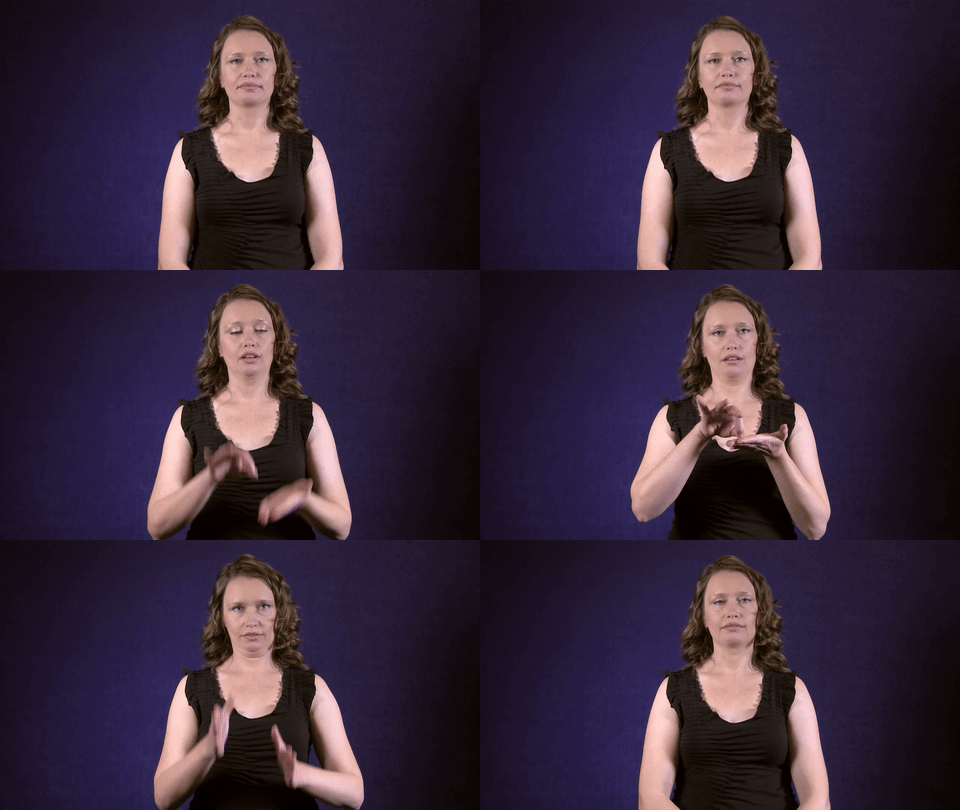
Definition: A person who manages financial accounts.
Sign for ACCOUNTANT in ASL

Practice Activities:
Start by practicing the sign for accountant in ASL in isolation. Repeat it multiple times while looking in a mirror to check accuracy. Use slow and deliberate motions, ensuring the movement and handshape remain consistent. Gradually increase speed while maintaining precision.
Next, fingerspell “account” and then sign the suffix by using the agent marker, which creates the meaning of “accountant.” This will help reinforce how job titles are formed in ASL. Compare this sign with other profession signs that use the same marker, like teacher or doctor.
Create example sentences using the sign for accountant in ASL. Some possible sentences include: “My sister is an accountant.” “The accountant works at the bank.” “I want to become an accountant.” Sign these sentences slowly at first, then increase fluidity and speed.
For storytelling practice, imagine you are describing a person’s career path as an accountant. Include details like where the person studied, how they got their first job, and what kind of work they do daily. Use classifiers and role-shifting where appropriate to enhance the description.
For a partner activity, one person can act out different professions while the other signs the correct job name in ASL. This will help reinforce the distinction between accountant and other job-related signs. Switch roles to ensure both partners get practice recognizing and signing professions.
To practice signing in a real-world scenario, role-play an interaction where you are asking someone about their occupation. Use signs related to accountants, like money, business, and office, to make the conversation more dynamic. Try responding with follow-up questions related to the accounting field.
End your practice session by watching videos of native signers using the sign for accountant in ASL in conversation. Observe their fluency and try to mimic their natural signing style. This will help you refine your movement and gain confidence in your signing skills.
Cultural Context:
The sign for accountant in ASL reflects the profession’s connection to money and financial records. This sign is closely related to the sign for accounting, emphasizing the role of an accountant in managing finances . Understanding this sign is essential for anyone discussing financial careers in ASL.
In the Deaf community, accountants play a vital role in ensuring financial stability for individuals and businesses. Knowing the sign for accountant in ASL can make professional conversations more accessible. Whether discussing taxes, bookkeeping, or financial planning, this sign helps bridge communication gaps.
ASL often incorporates conceptual meanings into signs, making the sign for accountant in ASL intuitive. Since accountants work with money and records, the sign visually represents these functions. Learning this sign helps improve fluency when discussing career paths and job responsibilities.
Professionals in financial fields, including accountants, frequently interact with Deaf clients and colleagues. Using the sign for accountant in ASL ensures clear communication in workplace settings. Accessibility in financial services is crucial, and using the correct signs can make interactions smoother.
Financial literacy is important for everyone, including members of the Deaf community. Learning the sign for accountant in ASL supports better discussions on budgeting, investments, and tax preparation . This sign is useful for students, professionals, and anyone interested in finance.
For Deaf individuals pursuing careers in accounting, knowing this sign reinforces their professional identity. The sign for accountant in ASL makes it easier to discuss job responsibilities and career opportunities. Using ASL in workplaces creates more inclusive environments for Deaf professionals.
Students learning career-related vocabulary will benefit from learning the sign for accountant in ASL. Finance-related signs help expand ASL vocabulary for both Deaf and hearing learners. Incorporating career signs into learning supports better discussions about future goals.
Interpreters working in business settings should be familiar with the sign for accountant in ASL. Understanding financial terminology in ASL ensures effective interpreting for client meetings and professional discussions. Fluency in specialized vocabulary enhances communication accuracy.
Communication in financial settings improves when professionals know the sign for accountant in ASL. Whether working in an office, attending business meetings, or discussing personal finance, this sign is useful. Expanding career-related ASL vocabulary helps create more inclusive workplaces.
Accounting is a field that requires precision and clear communication, making this sign essential. The sign for accountant in ASL helps individuals navigate discussions about audits, taxes, and financial management. Learning this sign strengthens ASL fluency in professional contexts.
Extended Definition:
The sign for accountant in ASL is closely related to the sign for money and bookkeeping. It typically involves a movement that represents counting or keeping financial records. This sign is widely used in business and financial conversations within the Deaf community.
To sign accountant in ASL, start with the sign for finance or money, followed by a movement that represents keeping track of numbers. The motion can vary slightly depending on regional sign variations. This ASL sign makes it easy to express the profession clearly and efficiently.
An accountant is responsible for managing financial records, taxes, and budgets. In both personal and business settings, an accountant ensures that money is tracked accurately. This profession is essential for financial planning and decision-making.
Learning how to sign accountant in ASL can be helpful for those working in banking, finance, or business-related fields. Deaf professionals and business owners often rely on this sign in professional settings. It is also useful for students studying finance or accounting.
Using the correct ASL sign for accountant improves communication when discussing financial matters. Whether in a business meeting or talking about personal finances, signing the term correctly ensures clarity. It allows for smooth conversations about budgeting, taxes, and financial planning.
There are variations in signing accountant in ASL depending on location and personal sign preferences. Some might incorporate a classifier to show additional meaning. When signing unfamiliar terms, fingerspelling can also be an option.
Practicing the sign for accountant in ASL with native signers helps improve fluency. Watching video demonstrations and using the sign in real conversations reinforces learning. Consistent practice ensures effective communication in financial discussions.
Understanding ASL vocabulary related to finance, like accountant, can enhance communication in work environments. Learning related signs such as money, budget, and tax can make conversations more natural. Expanding financial vocabulary in ASL helps with professional and personal interactions.
ASL provides an efficient way to describe financial roles, including accountants. Professionals who work with Deaf clients or colleagues benefit from learning this sign. It fosters inclusivity and accessibility in financial discussions.
Using ASL to discuss financial topics ensures that Deaf and hard-of-hearing individuals receive accurate information. Accountants who know ASL can better serve Deaf clients and provide essential financial guidance. This enhances trust and understanding in financial services.
Mastering the ASL sign for accountant is valuable for interpreters working in business settings. Interpreters who specialize in financial terminology improve accessibility. They help bridge communication gaps in tax preparation services and
Synonyms: accounting professional, CPA, bookkeeper, financial auditor, fiscal officer
Educational resources: Find related learning materials in our course bank!
Want more? Check out some of our popular learning activities on the homepage!
Need to look up a sign? Use our highly rated dictionary: https://aslinteractive.com/best-asl-dictionary/
Follow us on tiktok: https://www.tiktok.com/@aslinteractive. More social media links at the bottom of this page!
Long-tail Keywords: what is the sign for accountant in ASL, how do you sign accountant in American Sign Language, ASL sign for accountant
Categories:
tags: Accountant, Employment Status, Professions, Numbers, Education
Parameters
*Handshape*:
The sign for accountant in ASL begins with both hands forming an “F” handshape . The dominant hand moves along the edge of the non-dominant flat hand, mimicking the movement of a ledger or financial record. This sign builds from the sign for “account” and adds the “person” suffix by moving both hands downward in a parallel motion. The sign for accountant in ASL visually represents someone who manages financial records.
*Palm Orientation*:
The palm orientation for the sign for accountant in ASL starts with both hands in a neutral position. The dominant hand is in an “F” handshape with the palm facing sideways, moving across the non-dominant hand, which is open with the palm facing upward. After this motion, both hands form parallel open hands and move downward to mimic the action of a ledger or book, reinforcing the financial meaning of the sign. ✋
*Location*:
The sign for accountant in ASL is produced in the neutral space in front of the body, typically at chest level. The dominant hand initially moves in a way that mimics counting or calculating, using the F-handshape. After this motion, both hands form flat palms and move downward, as if denoting a formal title or role. This sign incorporates elements of “account” and the agent suffix, indicating a profession.
*Movement*:
To produce the sign for accountant in ASL, start by signing “ACCOUNT.” Both hands use the “F” handshape, with the thumbs and index fingers forming small circles. Move the dominant “F” hand slightly down over the non-dominant “F” hand, mimicking the motion of counting money. Then, to indicate the noun form, add the “PERSON” sign by moving both flat hands downward parallel to each other. This movement conveys the idea of a profession.
*Non-Manual Signals*:
When using the sign for accountant in ASL, the facial expression should match the context. A neutral or slightly serious expression is common in professional conversations, while raised eyebrows may indicate a question. If explaining the profession, a slight head tilt can signal clarification. Maintaining appropriate eye contact ensures engagement. Subtle mouth movements, such as mouthing “accountant,” might enhance understanding, but exaggerated lip movements should be avoided for natural ASL flow.
*Prosody, Dominant/Non-Dominant Hand*:
The sign for ACCOUNTANT in ASL uses both hands. The dominant hand forms an “F” handshape , with the thumb and index finger touching to create a small circle. The non-dominant hand is open with the palm facing inward. The dominant hand moves along the edge of the non-dominant hand as if tracing the motion of counting or keeping records. Then, both hands form parallel “B” handshapes to represent the concept of a person.
Tips for Beginners:
The sign for ACCOUNTANT in ASL builds on the sign for ACCOUNT with an added agent marker, which represents a person who performs the action. To sign ACCOUNT, form the “F” handshape with both hands and place the fingertips of your dominant hand in the palm of your non-dominant hand, then slide the dominant hand forward. To turn this into ACCOUNTANT, follow it with the “agent” marker by bringing both hands downward in a parallel motion as if outlining the sides of a person.
When learning the sign for ACCOUNTANT in ASL, focus on the precise handshape and movement. Make sure your “F” handshape is formed correctly, with your thumb and index finger touching to create a small circle while the other three fingers remain extended. Ensure your motion is smooth so the distinction between ACCOUNT and ACCOUNTANT is clear.
Beginners often struggle with maintaining consistent handshape and movement throughout the sign. One common mistake is using an incorrect “F” handshape by either closing the fingers too tightly or not forming the circular connection between the thumb and index finger. Practicing in front of a mirror can help refine the accuracy of the shape and movement.
Hand positioning matters for clarity. Keep your gestures at chest level and make sure the additional agent marker motion is straight down, not outward. This ensures that your audience correctly recognizes the intended meaning. Slow down your movements at first, and as you gain confidence, work on smoothing the transition.
Since ACCOUNTANT is a profession, practicing the sign in full sentences can be helpful. For example, try signing “My sister is an accountant” or “He works as an accountant” to build fluency. Watching native signers can also improve your accuracy and confidence. Keep practicing, and soon, the sign for ACCOUNTANT in ASL will feel natural to you!
Connections to Other topics:
The sign for accountant in ASL is closely related to the sign for finance and money, since accountants deal with financial transactions, record-keeping, and auditing. The sign is based on the root sign for accounting, which itself comes from the sign for count. This connection reinforces the idea of tracking and managing numerical information, an essential task for accountants. Understanding how the sign for accountant in ASL derives from these foundational concepts helps build a broader understanding of related financial terminology in ASL.
Since the sign for accountant in ASL follows the structure of similar profession-related signs, it connects well with signs like teacher, lawyer, and doctor. Many occupational signs in ASL follow a pattern where the base action or concept is signed first, followed by the agent marker that turns the action into a profession. For accountant, the sign incorporates the idea of counting or financial management and then adds the professional suffix by moving both hands downward in a flat-handed position. This structure is useful when learning other career-based signs, as many follow this same morphological pattern.
Another connection involves the broader topic of economics and business, where vocabulary such as tax, budget, and expense is relevant. Since accounting overlaps with financial responsibility, signs like calculator and audit may also be useful when discussing accounting topics in ASL. Learning the sign for accountant in ASL in combination with these terms enhances communication about economic and business-related issues.
Additionally, this sign relates to concepts of math and numbers, as accounting involves calculations and numerical accuracy. Signs for math operations like addition, subtraction, and balance can complement discussions about accounting. Understanding these mathematical relationships helps reinforce how numbers are used in real-world financial contexts, making the sign for accountant in ASL a valuable addition to business-related ASL vocabulary.
Summary:
The sign for accountant in ASL builds upon the sign for “finance” or “bookkeeping,” combining it with the agent suffix that denotes a profession. It starts with the dominant hand forming an “F” handshape and moving in a slight downward arc over the non-dominant palm, which is held flat. This motion represents financial tracking or counting, making it an intuitive representation of accounting work.
Once the initial bookkeeping motion is completed, the hands then move downward in parallel, as if enclosing an invisible person or role. This final part of the sign signifies an occupation, similar to how signs like “teacher” or “lawyer” conclude with the same downward movement. The combination of these elements effectively conveys the meaning of accountant in ASL by merging concept and role.
The sign for accountant in ASL is widely understood in Deaf communities across the United States and Canada. However, just like spoken language varies by region, sign variations may exist depending on local Deaf culture and interactions. Some signers may also use fingerspelling for the word “accountant” in formal or legal contexts, especially if addressing hearing individuals less familiar with ASL.
Grammatically, the sign for accountant in ASL fits within classifier-based discussions of professionals. For example, it can be incorporated into sentences about workplace environments, financial responsibilities, or job descriptions. Because it includes the occupational marker, it fits into a broader morphological pattern used for job-related terms, linking it to structured linguistic rules within ASL.
The underlying movement of the sign carries significant meaning beyond its literal interpretation. The “F” handshape symbolizes finances and money in many ASL signs, linking terms like “fee,” “funding,” and “finance” through shared manual features. This reinforces the idea that ASL is a conceptual language, often using overlapping signs to create relationships between words.
Culturally, the sign for accountant in ASL highlights the role of financial professionals within the Deaf community. Many Deaf-owned businesses rely on accountants who are fluent in ASL for financial guidance, tax preparation, and compliance with regulations. This makes the role of an accountant particularly vital in supporting economic success within the community.
Job accessibility is a major theme when considering the sign for accountant in ASL. Historically, Deaf individuals have faced barriers to entering the accounting field, particularly in higher education and certification requirements. However, as more universities and employers become inclusive, opportunities for Deaf accountants are increasing.
In applied linguistics, the study of professional terminology within ASL highlights how occupation signs follow consistent patterns. The addition of the occupational suffix in accountant mirrors similar signs like “engineer” and “scientist,” showing systematic word formation. This linguistic structure helps create intuitive signs that are easy for new ASL learners to recognize.
The need for sign language accessibility in financial institutions makes this sign especially relevant. Deaf clients often seek accountants who can communicate directly in ASL to avoid misunderstandings in financial matters. In response, more financial services now feature ASL-fluent professionals, ensuring equitable access to accounting expertise.
The broader theme of financial literacy within the Deaf community further connects to the sign for accountant in ASL. Financial knowledge can be a challenge for Deaf individuals due to gaps in accessible education and resources. Having Deaf or ASL-fluent accountants improves access to financial management information, fostering greater economic empowerment.
The agent suffix used in the sign for accountant in ASL demonstrates how ASL transforms verb-like motions into professional designations. The same transformation applies to various careers, showing how ASL grammar systematically distinguishes roles. This consistency benefits individuals learning ASL by making professional titles easy to recognize.
Deaf history reveals examples of skilled Deaf accountants who have excelled despite systemic barriers. Some have worked in government financial departments, businesses, and nonprofit organizations, showing the essential role they play. Their success stories highlight the importance of representation and accessibility in historically exclusive professions.
The linguistics of the sign for accountant in ASL also involve hand dominance and symmetrical movement. A signer who is right-handed will perform the main motion with their right hand, while a left-handed signer will mirror the movement. This flexibility ensures visual clarity while maintaining grammatical consistency.
Learning the sign for accountant in ASL also introduces an understanding of how financial terms are signed more broadly. Related signs like “tax,” “budget,” and “profit” are often used in discussions alongside accountant, making financial terminology in ASL a useful area of study. Those interested in working in financial services for the Deaf community often develop fluency in these terms.
Because accounting is a precise profession, the accuracy of the sign for accountant in ASL is crucial. A slight modification in movement could alter the meaning, emphasizing the need for clear signing. This highlights how sign language relies on exact handshapes, motion, and facial expressions for precise communication.
Some individuals may fingerspell “accountant” when addressing audiences unfamiliar with ASL job-related signs.
Want more? Check out some of our popular learning activities!
ASL Interactive Resources
ASLInteractive YouTube Channel
Follow us on tiktok: @aslinteractive.com
Follow us on Instagram: aslinteractive
Facebook page: aslinteractive
Facebook group: aslinteractive
LInkedIn: ASL Interactive LLC
Twitter: @ASL_interactive
*Some information on this page is AI-generated. AI can make mistakes. Please check the information.


Responses