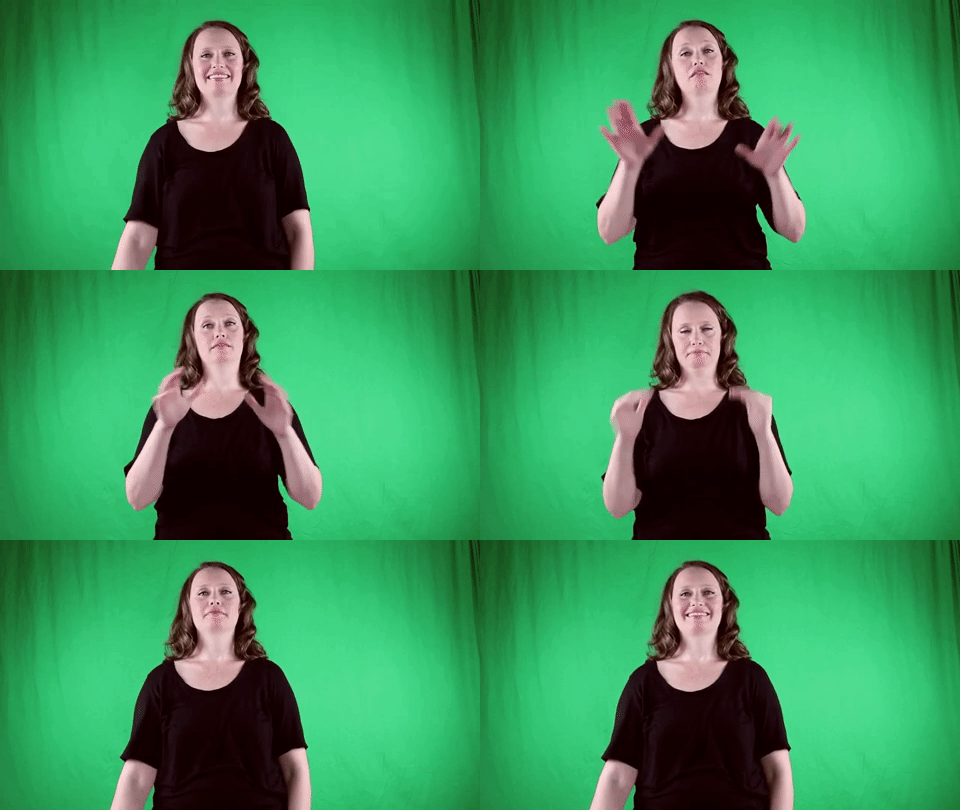
Definition: The level of engagement in activities.
Sign for ACTIVITY LEVEL in ASL

Practice Activities:
To practice the sign for activity level in ASL, start by signing it repeatedly in front of a mirror. Focus on proper handshape, movement, and facial expressions to ensure clarity. Try signing it slowly at first, then gradually increase your speed while maintaining accuracy.
Use the sign for activity level in ASL in different sentences to reinforce understanding. For example, describe your own daily routine and vary the intensity: “My activity level is high in the morning but low at night.” Try asking yourself or a partner, “What is your activity level after work?” This will help develop fluency in conversation.
Practice storytelling by creating a short narrative using the sign for activity level in ASL. Describe a hectic day versus a calm one and use the sign to emphasize changes. For instance, explain how your activity level rises when exercising but drops while watching TV. This will allow you to practice contextual usage naturally.
Engage in a role-playing activity where one person describes their energy levels throughout the day while the other reacts. Ask each other follow-up questions like, “When is your highest activity level?” or “What affects your activity level?” This exercise will strengthen receptive and expressive skills.
Pair up with a partner and sign a mini-dialogue using the sign for activity level in ASL. One person can describe their ideal weekend while incorporating the sign, and the other can respond with theirs. This interactive practice will enhance understanding and confidence in signing.
Lastly, watch ASL videos where signers discuss energy levels or daily routines. Observe how the sign for activity level in ASL is used naturally in conversation, and try mimicking their signs. This exposure to real-life usage will help build fluidity and comprehension.
Cultural Context:
Understanding the sign for activity level in ASL is essential for clear communication, especially in discussions about health, fitness, and daily routines. ASL provides a visual way to express concepts like high energy, moderate exertion, or low activity. This sign is frequently used in conversations about lifestyle choices, physical ability, and medical assessments.
When discussing physical activity, the sign for activity level in ASL helps clarify the intensity of movement or exercise. Whether describing someone’s workout habits, mobility, or daily exertion, this sign provides an efficient, visual way to communicate. It is particularly useful in fitness training, physical therapy, and healthcare settings.
Deaf culture values clear and expressive communication, making the sign for activity level in ASL an important tool for describing one’s physical engagement. The Deaf community often emphasizes visual and spatial awareness, which enhances the expression of movement-related concepts. This sign allows individuals to specify if they have an active or sedentary lifestyle.
Parents and educators also use the sign for activity level in ASL when discussing children’s energy levels and engagement. Whether in classrooms or at home, this sign helps caregivers describe if a child is highly energetic or requires more movement. It plays a key role in behavioral observations and structured activities.
Medical professionals rely on the sign for activity level in ASL when assessing patients’ physical capabilities or rehabilitation progress. Whether a patient is recovering from an injury or managing a chronic condition, this sign helps describe their movement and exertion levels. It ensures clear communication between patients and healthcare providers.
In workplace settings, the sign for activity level in ASL is useful when discussing job tasks that require various physical demands. Employees and employers can use this sign to describe how much physical effort a task involves. It helps ensure workplace accommodations and proper task assignments for Deaf and hard-of-hearing individuals.
The sign for activity level in ASL is also prevalent in discussions about sports and recreation. Athletes, coaches, and trainers use it to describe game intensity, training sessions, and player endurance. This sign facilitates communication in team sports and personal fitness coaching.
Social interactions often involve describing someone’s energy or participation in activities. Using the sign for activity level in ASL allows Deaf and hard-of-hearing individuals to express their engagement in hobbies, events, or social gatherings. It helps convey enthusiasm or the need for rest in an accessible way.
When planning activities, knowing the sign for activity level in ASL helps ensure inclusivity. It enables effective communication when organizing
Extended Definition:
The sign for activity level in ASL is used to describe the amount of physical or mental energy involved in a task or situation. This can refer to a person’s energy, movement, or engagement in different activities. Understanding how to express this concept accurately in ASL helps improve clarity in conversations.
When signing activity level in ASL, the movement, facial expressions, and context play a crucial role. The sign may vary based on whether you’re describing a high-energy event, moderate exertion, or a low-activity state. Portraying the correct level of movement ensures your message is easily understood.
Different situations require different ways to express activity level in ASL. For example, if describing an intense workout, your movements may be larger and more expressive. If talking about a relaxed setting, the sign may be smaller and performed at a slower pace.
Non-manual markers such as facial expressions can further clarify activity level in ASL. Raised eyebrows or an open mouth can suggest high activity, while a relaxed or neutral face can indicate a lower level. Combining these elements makes signed communication richer and more effective.
The concept of activity level in ASL can be applied to people, animals, or even machines. For instance, when talking about a child’s energy levels, the sign might emphasize how active or calm they are. Similarly, discussing a machine’s function might require signs showing whether it is operating at full speed or barely working.
Teachers, fitness trainers, and healthcare workers often use the sign for activity level in ASL to discuss physical or cognitive engagement. Adjusting the sign to match the appropriate intensity ensures clear communication in professional and everyday settings. This helps Deaf and Hard of Hearing individuals describe activities more precisely.
In social conversations, knowing how to sign activity level in ASL can help describe events and situations accurately. Whether explaining the excitement of a party or the tranquility of a meditation session, proper sign usage enhances storytelling. This makes interactions more engaging and meaningful.
Learning the sign for activity level in ASL can also improve descriptions of emotions and energy in conversations. For example, when expressing feelings of exhaustion or enthusiasm, adjusting the movement and intensity can provide more context. This helps ensure that conversations are clear and expressive.
For those new to ASL, practicing activity level in ASL with different situations can build fluency and confidence. Watching videos, working with an instructor, or engaging in real-life conversations can refine your understanding. The more you practice, the
Synonyms: energy level, engagement rate, intensity level, participation degree, exertion level
Educational resources: Find related learning materials in our course bank!
Want more? Check out some of our popular learning activities on the homepage!
Need to look up a sign? Use our highly rated dictionary: https://aslinteractive.com/best-asl-dictionary/
Follow us on tiktok: https://www.tiktok.com/@aslinteractive. More social media links at the bottom of this page!
Long-tail Keywords: what is the sign for activity level in ASL, how do you sign activity level in ASL, activity level in American Sign Language
Categories:
tags: Activities, Language Learning, Verbs, Everyday activities, Sports
Parameters
*Handshape*:
The sign for ACTIVITY LEVEL in ASL uses open “5” handshapes with palms facing downward. Both hands move in alternating circular motions, as if illustrating ongoing movement or engagement. This motion reflects the concept of activity and fluctuation in intensity. The fluid movement of the hands emphasizes the dynamic nature of the sign for ACTIVITY LEVEL in ASL, effectively capturing changes in energy or participation levels.
*Palm Orientation*:
The palm orientation for the sign for ACTIVITY LEVEL in ASL varies slightly depending on regional differences and signer preference. Generally, both hands are open with fingers slightly curved, palms facing downward or slightly inward. Throughout the motion, the palms maintain this downward or inward-facing posture while the hands move in small circular motions. This movement visually represents fluctuations in intensity, reinforcing the meaning of the sign for ACTIVITY LEVEL in ASL.
*Location*:
The sign for ACTIVITY LEVEL in ASL is produced in the neutral space in front of the torso. Both hands move in an alternating motion to convey movement and engagement. The hands typically remain around chest level, allowing for clear visibility and fluid execution. The sign stays within a comfortable signing space, ensuring that each movement is natural and expressive, effectively representing the concept of ACTIVITY LEVEL in ASL.
*Movement*:
To sign for activity level in ASL, both hands use open “5” handshapes with palms facing downward. The hands alternate moving in small, circular motions parallel to the ground, as if indicating ongoing movement or engagement. This motion represents activity or continuous action. For level, use flat “B” hands, palms facing downward, and move them horizontally apart to emphasize an even or balanced state. Together, these signs convey the meaning of activity level in ASL effectively.
*Non-Manual Signals*:
Facial expression plays a crucial role when using the sign for ACTIVITY LEVEL in ASL, as it conveys intensity and emphasis. Raised eyebrows can indicate curiosity or a question about someone’s activity level, while a neutral face suggests a general statement. If expressing high activity, widened eyes and a slightly open mouth help show enthusiasm. Conversely, a lower activity level can be accompanied by a relaxed expression with slightly pressed lips.
*Prosody, Dominant/Non-Dominant Hand*:
The sign for ACTIVITY LEVEL in ASL uses both hands in a dynamic motion. The dominant and non-dominant hands form open-5 handshapes, with palms facing downward. They move in small alternating circular motions, representing movement and engagement. The motion varies slightly depending on context, with larger or faster movements indicating higher activity levels. Facial expressions can modify the sign for emphasis, reflecting intensity or energy associated with the concept.
Tips for Beginners:
When learning the sign for ACTIVITY LEVEL in ASL, focus on maintaining smooth and controlled hand movements. The motion should be fluid rather than choppy, as abrupt changes can alter the meaning or make the sign harder to understand. Keeping your hands at a consistent height will also help ensure clarity.
One of the common mistakes beginners make with the sign for ACTIVITY LEVEL in ASL is exaggerating the movement too much. While expressive signing is important, over-exaggeration can create an unnatural look and may cause confusion. Aim for a comfortable and intentional motion that matches the natural flow of ASL.
Pay attention to handshape and placement when practicing the sign for ACTIVITY LEVEL in ASL. If your fingers are too rigid or your hands are positioned too far apart, it can make the sign look awkward or unclear. Relax your hands while maintaining enough structure to form the correct sign.
Facial expressions can also enhance the meaning of the sign for ACTIVITY LEVEL in ASL. If you’re expressing a high activity level, you might raise your eyebrows and show excitement. For a lower activity level, a more neutral or relaxed expression can help communicate the intended concept.
Practicing in front of a mirror will help ensure accuracy in signing ACTIVITY LEVEL in ASL. This allows you to check your hand placement, ensure symmetry, and watch for any tension that might interfere with smooth signing. Recording yourself can also be beneficial for tracking progress over time.
When practicing the sign for ACTIVITY LEVEL in ASL, try incorporating it into real-life conversations. Using the sign in meaningful contexts will strengthen muscle memory and improve retention. Pairing it with related signs can also help reinforce your understanding and usage naturally.
Connections to Other topics:
The sign for ACTIVITY LEVEL in ASL is closely related to other signs that describe movement, energy, and intensity. It often connects to the signs for ACTIVE, ENERGY, and EXERCISE, as they all express varying degrees of physical or mental engagement. These concepts are frequently used in conversations about fitness, work habits, and daily routines, making the sign for ACTIVITY LEVEL in ASL a useful descriptor in everyday discussions.
This sign also links to discussions about health, performance, and productivity. In medical contexts, describing a person’s ACTIVITY LEVEL can indicate mobility, stamina, or recovery progress. Similarly, in workplace or academic settings, it helps describe effectiveness and engagement, aligning with signs like FOCUS, EFFORT, and PARTICIPATION.
Compound signs or descriptive phrases can incorporate this sign for more specific meanings, such as combining it with HIGH or LOW to clarify varying ACTIVITY LEVELS. Additionally, it pairs well with signs like INTENSITY or RATE to express a change in effort or movement over time. This makes it particularly useful in fields like sports, therapy, and education, where monitoring performance is essential.
The sign for ACTIVITY LEVEL in ASL is also valuable when discussing emotional or behavioral tendencies. Parents, teachers, and therapists often use it to describe how engaged or restless a child may be, which ties into signs like CALM, HYPER, or ATTENTION. It allows for precise communication about how much energy a person is displaying and whether adjustments might be needed for balance.
Overall, this sign functions as a linguistic bridge between physical motion and the intensity of effort, making it vital in many areas of conversation. By pairing it with other descriptive signs, users can communicate nuanced information about speed, endurance, and engagement. This enhances discussions about work habits, physical fitness, and overall well-being.
Summary:
The sign for ACTIVITY LEVEL in ASL combines concepts of movement and intensity. To express “activity,” the hands typically move in a rhythmic manner, showing energy or engagement. “Level” is signed to indicate degree or measurement, often using a flat hand motion to represent different heights or amounts.
The dominant and non-dominant hands generally mirror each other when signing “activity.” They may move in an alternating or circular motion to express continuous engagement. This conveys the sense of movement being ongoing or fluctuating.
To show “level” in the sign for ACTIVITY LEVEL in ASL, the hands may be placed at different heights. A single shift in positioning can indicate a comparison between low and high levels of activity. Holding the hand flat and horizontal reinforces the idea of measuring a state or intensity.
Facial expressions are important when signing the sign for ACTIVITY LEVEL in ASL. A neutral expression may indicate a moderate level, while raised eyebrows and an excited demeanor can show a high level of activity. Conversely, a slower movement with a relaxed face may suggest a lower level.
The context of the conversation affects how the sign for ACTIVITY LEVEL in ASL is understood. If discussing physical fitness, fast movements might suggest intense workouts. When talking about productivity, steady, deliberate movements can signify consistent effort.
In discussions about health, the sign for ACTIVITY LEVEL in ASL can be crucial for conveying energy levels. A nurse or doctor may ask about someone’s activity level when assessing mobility or fatigue. The concept also applies to children’s energy levels, helping parents and caregivers describe behavior.
The sign for ACTIVITY LEVEL in ASL shares similarities with signs for “energy” and “motion.” This makes it easy to transition between related concepts like “hyperactivity” or “low energy.” The ability to modify the sign’s movement allows for nuanced descriptions.
Culturally, the sign for ACTIVITY LEVEL in ASL is useful in deaf education. Teachers use it to talk about participation, engagement, and energy in the classroom. It helps students recognize different levels of involvement in both academic and social settings.
The sign for ACTIVITY LEVEL in ASL can be adapted for different contexts based on need. Workplace discussions may use it to describe efficiency and output. Leisure conversations can use it to compare how lively or relaxed a situation is.
Grammar plays an essential role in how the sign for ACTIVITY LEVEL in ASL is used. If asking a question, eyebrows are raised and the sign may be held in a questioning manner. If making a statement, the movement remains fluid and at a normal pace.
In storytelling, the sign for ACTIVITY LEVEL in ASL can help explain dynamic scenes. A character’s action may be displayed by adjusting the speed and intensity of the signing. Slow, deliberate signing might indicate calm situations, whereas rapid signing increases tension.
The sign for ACTIVITY LEVEL in ASL overlaps with linguistic concepts of classifiers. Since “activity” involves movements, classifiers can be embedded to show different types of motion. For example, legs moving quickly versus arms waving can change the meaning slightly.
Science and fitness discussions rely on the sign for ACTIVITY LEVEL in ASL to explain exercise regimes. Personal trainers or physical therapists may sign it to indicate how much effort a person is using. It is also relevant in biology when discussing metabolic rates or heart rates.
Children learning ASL may use the sign for ACTIVITY LEVEL in ASL to explain how much energy they have. They can describe whether they feel excited, sluggish, or anything in between. Parents also use the sign to monitor their child’s moods and energy fluctuations.
Weather discussions sometimes incorporate the sign for ACTIVITY LEVEL in ASL to describe storm intensity. A hurricane with high wind speeds may be represented by bigger, faster movements. A calm day with little wind may be shown with small, slow motions.
The sign for ACTIVITY LEVEL in ASL is important when comparing different states of action. It can be used to describe a city versus a rural area, based on how busy each place is. The same concept applies to indicating seasonal differences in activity.
Sports conversations often require the sign for ACTIVITY LEVEL in ASL to distinguish playing intensity. A player who is highly active may be shown using exaggerated or forceful movements. Someone who is barely participating may be represented with more minimal motions.
In social interactions, the sign for ACTIVITY LEVEL in ASL helps set expectations. A lively party may have big, repeated signs to show excitement. A quiet gathering may have more subdued, slower repetitions to indicate a calm environment.
The sign for ACTIVITY LEVEL in ASL can be modified by speed and repetition to show fluctuation. If a person’s energy changes throughout the day, the sign can be done at different speeds. A steady rhythm represents consistency, while varied speed shows ups and downs.
When used in medical contexts, the sign for ACTIVITY LEVEL in ASL
Want more? Check out some of our popular learning activities!
ASL Interactive Resources
ASLInteractive YouTube Channel
Follow us on tiktok: @aslinteractive.com
Follow us on Instagram: aslinteractive
Facebook page: aslinteractive
Facebook group: aslinteractive
LInkedIn: ASL Interactive LLC
Twitter: @ASL_interactive
*Some information on this page is AI-generated. AI can make mistakes. Please check the information.


Responses