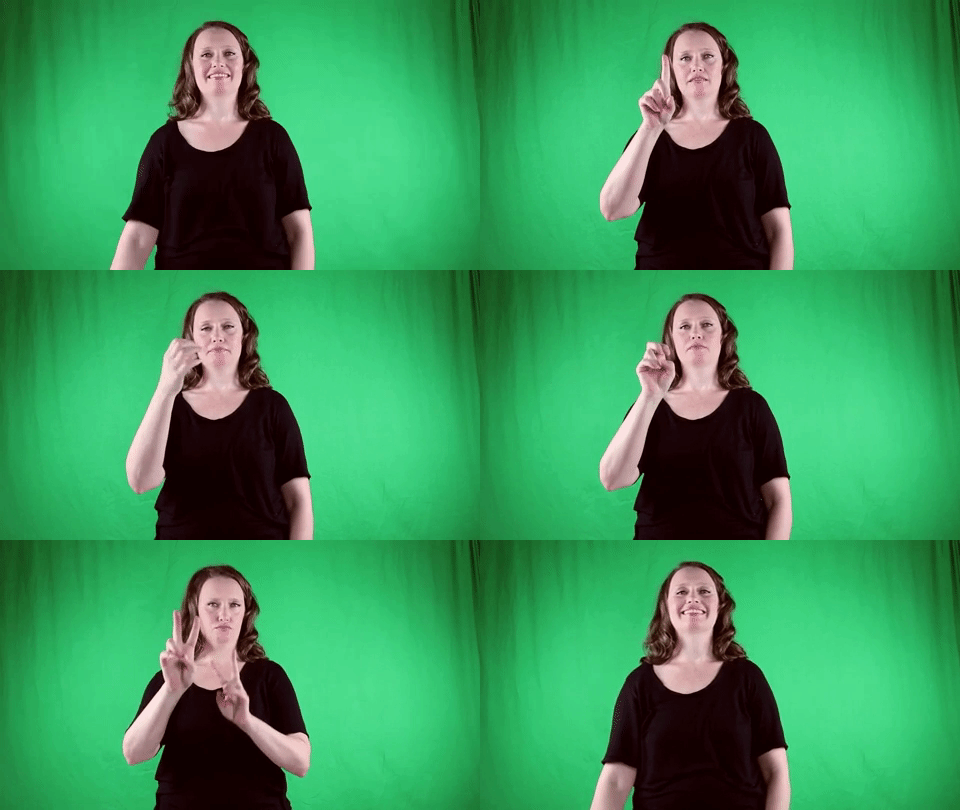
Definition: A funeral service for someone named Adams.
Sign for ADAMS FUNERAL in ASL

Practice Activities:
To practice the sign for ADAMS FUNERAL in ASL, start by signing each word separately before combining them smoothly. Focus on maintaining correct handshape, movement, and facial expression to ensure clear communication. Try signing ADAMS using fingerspelling at a steady pace, then practice FUNERAL, ensuring fluid motion as you depict a funeral procession.
Use a mirror or record yourself signing to observe accuracy and consistency. Repeat the sign for ADAMS FUNERAL in ASL multiple times, gradually increasing speed while maintaining clarity. Practice transitioning smoothly between ADAMS and FUNERAL to improve fluency.
Create sentences using the sign naturally in conversations. For example, sign “Yesterday, I attended ADAMS FUNERAL” or “ADAMS FUNERAL will be next week.” Focus on appropriate facial expressions to convey the emotions associated with a funeral.
Engage in partner activities by practicing conversations where one person asks about a funeral service and the other responds using the sign for ADAMS FUNERAL in ASL. Role-play scenarios such as planning or attending a funeral to reinforce context and usage.
For storytelling, describe an experience of attending a funeral, incorporating details about who was there, emotions, and how people supported each other. Use facial expressions and body language to enhance meaning. This helps reinforce fluency and natural communication.
Challenge yourself to fingerspell ADAMS fluently, ensuring each letter is clear and distinct. Try a speed drill by signing it faster while maintaining accuracy. Then, practice signing the entire phrase smoothly and naturally.
Watch videos of native ASL users signing about funeral services to observe natural pacing and flow. Mimic their expressions and movements to improve your signing skills. Practicing in real-life conversations or through recorded signing enhances learning and retention.
Cultural Context:
The sign for ADAMS FUNERAL in ASL is essential for funeral planning and discussions related to memorial services. Using ASL ensures that Deaf individuals can fully participate in conversations about arrangements, locations, and services. Signing properly allows for clear and respectful communication during sensitive moments.
Funerals hold deep cultural and emotional significance in both Deaf and hearing communities. The sign for ADAMS FUNERAL in ASL helps Deaf individuals express sympathy, share condolences, and navigate discussions about funeral services. Signing effectively ensures accessibility and inclusion in mourning rituals.
Many funeral homes prioritize accessibility, ensuring that Deaf individuals have interpreters or ASL-fluent staff. The sign for ADAMS FUNERAL in ASL is useful when arranging services, asking about accommodations, or confirming details. Learning this sign allows Deaf and hard-of-hearing individuals to participate fully in ceremonies.
Deaf culture emphasizes visual communication, making ASL crucial in times of grief. The sign for ADAMS FUNERAL in ASL enables seamless communication between Deaf family members, friends, and funeral service providers. Using ASL during such moments fosters understanding and emotional support.
Attending a funeral as a Deaf individual can present communication challenges without proper resources. Knowing the sign for ADAMS FUNERAL in ASL can help with understanding service details, coordinating logistics, and expressing condolences. Creating inclusive spaces allows everyone to mourn and support each other effectively.
Deaf-friendly funeral services often include interpreters, captioned videos, and ASL support. The sign for ADAMS FUNERAL in ASL ensures that Deaf attendees understand the proceedings and participate in discussions. Equal access to information brings comfort during difficult times.
The importance of using ASL in funeral settings cannot be overstated. The sign for ADAMS FUNERAL in ASL assists in honoring loved ones while promoting accessible communication. Familiarity with this sign fosters inclusivity within the Deaf community during moments of remembrance.
Extended Definition:
The sign for adams funeral in ASL is a meaningful representation of a funeral service associated with the name Adams. In American Sign Language, people often use signs to refer to specific places, businesses, or institutions. If you need to express the idea of Adams Funeral in ASL, you might fingerspell “Adams” followed by the standard sign for “funeral.”
Funeral services are an important event for honoring loved ones who have passed away. The funeral sign in ASL typically involves two upright “V” handshapes moving forward, symbolizing a funeral procession. For a specific funeral home like Adams Funeral, you may need to clarify with fingerspelling or additional context.
When signing the name of a specific funeral home, it’s common to use location-based context or explanations. If Adams Funeral is a well-known establishment in your area, fluent ASL users may already have an established sign for it. Otherwise, fingerspelling remains the most accurate way to convey the name.
In conversations involving funeral arrangements, grief, or memorial services, understanding the sign for adams funeral in ASL can be essential. Sign language allows for clear, expressive communication during emotional situations. Whether discussing funeral services or making plans, knowing the correct signs helps ensure clarity and respect.
ASL incorporates meaningful gestures that reflect culture and tradition. The sign for adams funeral in ASL, like other funeral-related signs, respects the solemnity of the occasion. Being familiar with signs related to funerals can help bridge communication gaps for the Deaf community when discussing important events.
Learning how to sign different funeral-related terms enhances accessibility for Deaf individuals who rely on ASL to communicate. Knowing the sign for adams funeral in ASL allows for smoother interactions when discussing memorial services, funeral ceremonies, or arrangements. Accurate signing fosters inclusivity and understanding in all conversations.
Synonyms: Sorry, I need more clarification. “Adams Funeral” doesn’t seem clear as a term or phrase to generate synonyms for. Please provide more context or specify a different term.
Educational resources: Find related learning materials in our course bank!
Want more? Check out some of our popular learning activities on the homepage!
Need to look up a sign? Use our highly rated dictionary: https://aslinteractive.com/best-asl-dictionary/
Follow us on tiktok: https://www.tiktok.com/@aslinteractive. More social media links at the bottom of this page!
Long-tail Keywords: what is the sign for Adams Funeral in ASL, how do you sign Adams Funeral in ASL, Adams Funeral sign language translation
Categories:
tags: Funeral, Occasions, Events, Family, Relationships
Parameters
*Handshape*:
The sign for ADAMS FUNERAL in ASL is fingerspelled, using a series of distinct handshapes to represent each letter in “ADAMS” followed by the sign for “FUNERAL.” To spell “ADAMS,” the signer forms the handshapes for A, D, A, M, and S in smooth succession. The sign for “FUNERAL” is created by forming the “V” handshape with both hands and moving them in an upright procession-like motion.
This combination ensures clarity when conveying the sign for ADAMS FUNERAL in ASL. Maintaining steady hand positioning and movement helps make the fingerspelled portion legible. When transitioning to the funeral sign, the hands should remain at a consistent height to preserve the visual flow of the motion.
*Palm Orientation*:
For the sign for ADAMS FUNERAL in ASL, the palm orientation varies depending on the components of the sign. When fingerspelling “ADAMS,” the palm faces outward, ensuring clear letter formation. For “FUNERAL,” both hands are in a “V” shape with palms facing forward as they move in an upward motion. The movement mimics a procession, symbolizing the meaning behind the sign for ADAMS FUNERAL in ASL.
*Location*:
The sign for ADAMS FUNERAL in ASL is a combination of fingerspelling and a common funeral-related sign. The name “Adams” is fingerspelled using the manual alphabet, starting with “A” and continuing through each letter. For “funeral,” both hands, in a “V” handshape, move forward in a solemn walking motion. This sign generally appears in front of the body, around chest level, to mimic a procession.
*Movement*:
The sign for ADAMS FUNERAL in ASL begins by fingerspelling “ADAMS” using the dominant hand in a fluid motion. After spelling “ADAMS,” transition smoothly to the sign for “FUNERAL.” Both hands, forming the “V” handshape, move forward in a slow, solemn walking motion to represent a funeral procession. Keep the movement steady and respectful. Facial expressions should match the solemnity of the occasion when signing the phrase.
*Non-Manual Signals*:
Facial expressions play a crucial role in conveying emotional context when using the sign for ADAMS FUNERAL in ASL. A solemn or serious expression is typically used to reflect the somber nature of the event. Eyebrows may be slightly furrowed, and the mouth may be set in a neutral or downturned position.
Eye contact may be steady but not overly intense, maintaining a respectful demeanor. Head movements should remain controlled, avoiding excessive nodding or tilting. A slow and deliberate motion enhances the overall tone of the sign for ADAMS FUNERAL in ASL, ensuring that the intended meaning is conveyed respectfully.
*Prosody, Dominant/Non-Dominant Hand*:
The sign for ADAMS FUNERAL in ASL is a combination of fingerspelling and a commonly recognized funeral sign. For “ADAMS,” use your dominant hand to fingerspell each letter: “A-D-A-M-S,” maintaining steady hand movement with clear letter transitions. For “FUNERAL,” both hands form “V” handshapes (✌️), held upright and moving forward in a slow, solemn motion, mimicking a funeral procession. Maintain a respectful facial expression to match the meaning.
Tips for Beginners:
When learning the sign for ADAMS FUNERAL in ASL, start by ensuring clear and precise finger movements. Since this name includes “Adams,” you will need to fingerspell it first, so practice smooth transitions between letters. When fingerspelling, keep your hand steady and at chest level for clear visibility, avoiding unnecessary bouncing between letters.
For “funeral,” practice moving both hands in a controlled, steady motion to depict the gesture accurately. This sign involves “V” handshapes moving forward, mimicking the procession of a funeral. Keep your fingers firmly extended to maintain proper clarity, and be mindful of the speed—too fast may make the sign unclear, while too slow may look unnatural.
A common mistake beginners make when signing ADAMS FUNERAL in ASL is rushing through the fingerspelling portion. Take your time to accurately form each letter in “Adams” before transitioning into “funeral.” If you’re unsure about fingerspelling speed, practice with a mirror or record yourself to check for consistency.
Hand placement is crucial in signing ADAMS FUNERAL in ASL. Keep your hands within your signing space—too high or too low can make the sign less readable. Also, maintain relaxed fingers without curling them inward, especially when forming the “V” handshape in “funeral.” This helps others distinguish your sign clearly.
To improve fluency, practice with native signers or use online signing platforms for feedback. Repetition is key, so practice fingerspelling “Adams” multiple times until you feel confident before adding “funeral.” Watching ASL videos or attending Deaf community events can provide great exposure to how experienced signers use this sign in real conversations.
Connections to Other topics:
The sign for ADAMS FUNERAL in ASL is thematically linked to the broader category of funeral and mourning signs. In ASL, signs related to death, mourning, and memorials often carry cultural significance and specific gestures that convey emotion and tradition. Some signs related to this topic include FUNERAL, BURY, GRAVE, and REMEMBER, all of which can be used in conversations about loss or memorial services. Connecting these signs helps build fluency when discussing topics of grief and remembrance.
Funeral signs in ASL often incorporate movement and spatial placement to indicate the direction or context of the event. The sign for FUNERAL typically shows a somber procession, which can be modified to reference specific funeral customs. When signing the sign for ADAMS FUNERAL in ASL, incorporating other relevant signs like SERVICE, RESPECT, or FAMILY can provide additional context. Additionally, signs such as PRAY, FLOWERS, and SUPPORT can help describe the emotional and communal aspects of funerals.
Proper names, like ADAMS, are typically fingerspelled unless a well-known sign exists for a particular place or entity. Fingerspelling allows for flexible communication, especially when referring to specific funeral homes, cemeteries, or memorial services. Since the sign for ADAMS FUNERAL in ASL involves a proper name, it may be beneficial to practice fingerspelling smoothness, clarity, and pacing. This reinforces a key ASL skill when mentioning businesses or formal names.
Understanding funeral-related signs allows for conversations about cultural traditions and personal experiences with loss. These signs can be integrated into discussions about grief counseling, religious services, or historical events like memorial dedications. By mastering the sign for ADAMS FUNERAL in ASL along with related concepts, signers can engage in meaningful discussions about remembrance and honoring loved ones.
Summary:
The sign for ADAMS FUNERAL in ASL is a proper noun representation, often requiring fingerspelling for accuracy. Proper names, like “Adams,” are typically represented by spelling out each letter using the dominant hand in the ASL fingerspelling alphabet. This approach ensures precise communication, especially when discussing names that are not commonly recognized by a single established sign.
For “Adams,” the signer forms each letter—A-D-A-M-S—while keeping a steady hand position near shoulder level. The movement should be fluid yet deliberate, ensuring clarity, as fingerspelling can be misread if rushed. Some names, depending on the context, may develop initialized name signs, but unless a widely accepted sign exists, fingerspelling remains the default method.
The second part of the phrase, “Funeral,” has an established ASL sign that utilizes both hands. The dominant and non-dominant hands form upright “V” handshapes, resembling legs walking forward. Typically, these “V” handshapes move slightly forward in a slow, deliberate motion, mimicking the solemn processional movement of a funeral march.
This sign visually represents pallbearers walking in a procession, making it highly iconic and easy to understand. The movement is smooth and coordinated, reflecting the serious and somber nature of a funeral ceremony. While some regional variations exist, this is the most widely accepted sign for “funeral” in ASL.
When signing the phrase in full, the signer spells out “Adams” first, then smoothly transitions into the sign for “funeral.” This ensures clarity and maintains proper ASL grammar. Just as spoken language maintains a natural flow, transitioning smoothly from one sign to another improves comprehension.
Proper nouns in ASL, especially less common ones, are almost always fingerspelled unless a widely known sign has been established. Some cities, schools, and organizations have name signs, but last names typically remain fingerspelled. This practice allows for flexibility and avoids confusion between similar-sounding or similarly spelled names.
Funeral ceremonies hold cultural significance across communities, and ASL captures this gravity in its signed representation. The sign for “funeral” encapsulates not only the physical movement of a procession but also the emotional weight of the event. Non-manual markers, such as a solemn facial expression, further emphasize the serious tone of the concept.
Incorporating facial expressions while signing “funeral” is crucial in conveying the appropriate emotions. A neutral or slightly sorrowful expression aligns with the cultural expectations of discussing such an event. ASL relies heavily on non-manual markers to add emotional depth and meaning beyond hand movements.
When fingerspelling “Adams,” speed and clarity matter significantly. Each letter should be formed distinctly with no excessive bouncing, which could cause misunderstanding. Holding a steady rhythm while fingerspelling ensures smooth readability for the recipient.
Regarding ASL grammar, name signs must align with Deaf cultural norms. If “Adams” were to develop into a name sign, it would need to be approved or adopted within the Deaf community based on known characteristics of the individual. However, full fingerspelling remains the standard unless otherwise established.
The sign for ADAMS FUNERAL in ASL follows a logical progression that reflects natural language structure. While spoken English relies on word order, ASL incorporates spatial and visual elements to provide context. This means that a conversation surrounding “Adams’ funeral” might include additional contextual signs before or after the main phrase to clarify meaning.
Funeral customs vary across cultures, and ASL reflects this diversity through the richness of its vocabulary and expressions. Some individuals may describe different aspects of a funeral, such as gathering, mourning, or burial, using other signs in conjunction with “funeral.” This flexible approach aligns with ASL’s visual-spatial nature.
Signed communication about sensitive topics, such as funerals, often incorporates respectful pacing and intentional pauses. These slight pauses between signs help mirror the natural emotional weight of such discussions. They ensure the topic is approached with appropriate gravitas and respect.
In larger ASL conversations about funerals, classifiers might also be used to provide more information about the setting. A signer could use classifier handshapes to represent a coffin, a group of mourners, or a procession moving through a space. This visual storytelling aspect enhances the richness of ASL expression.
For those new to ASL, mastering the sign for “funeral” can help with discussions involving serious or formal topics. Practicing smooth transitions between fingerspelling and conceptually accurate signs is essential for fluency. Understanding how to adjust facial expressions appropriately adds further depth to communication.
When fingerspelling last names like “Adams,” dominant-hand positioning plays a significant role in ensuring visibility. The hand should remain comfortably in the signing space, not too low or too high. Keeping fingerspelling steady and positioned correctly improves legibility for those
Want more? Check out some of our popular learning activities!
ASL Interactive Resources
ASLInteractive YouTube Channel
Follow us on tiktok: @aslinteractive.com
Follow us on Instagram: aslinteractive
Facebook page: aslinteractive
Facebook group: aslinteractive
LInkedIn: ASL Interactive LLC
Twitter: @ASL_interactive
*Some information on this page is AI-generated. AI can make mistakes. Please check the information.


Responses