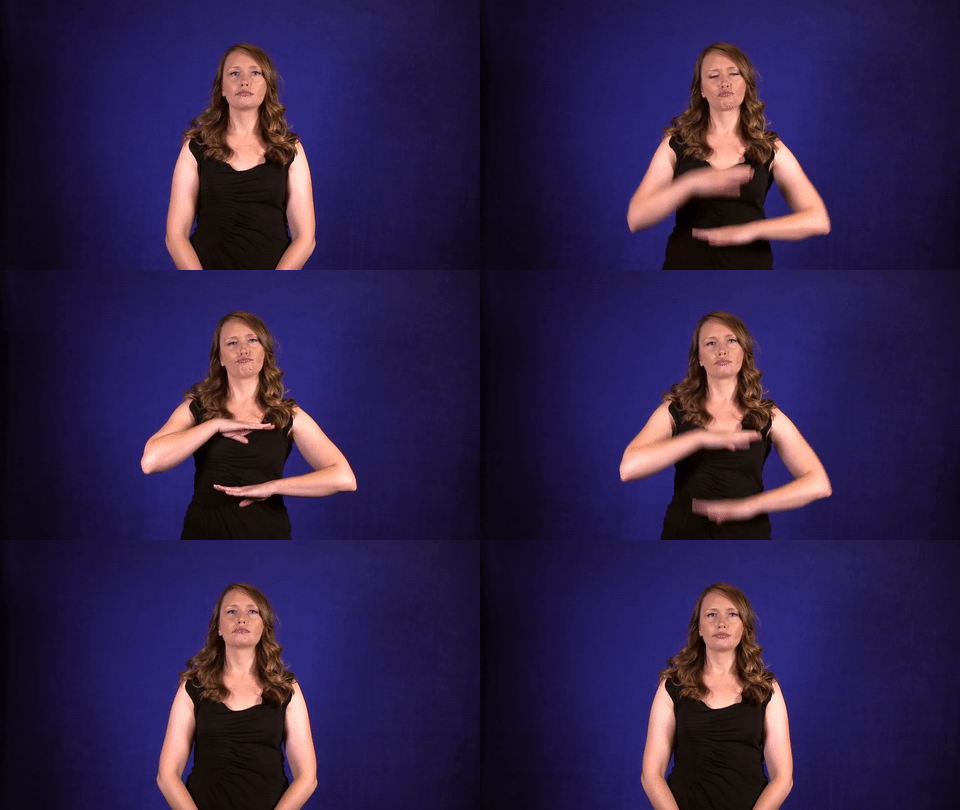
Sign for ADEQUATE in ASL | 🍵 ASL Dictionary

Definition: Sufficient or acceptable.

Sign for ADEQUATE in ASL 

YouTube player

Practice Activities:

Practicing the sign for adequate in ASL begins with repetition. Stand in front of a mirror and sign adequate multiple times while focusing on hand positioning and movement. Pay close attention to maintaining fluid motion and proper facial expression to reinforce meaning.

Use the sign for adequate in ASL with various sentences. Try signing “The food is adequate,” “His effort was adequate,” or “Your work is adequate for now.” Experiment with different facial expressions to show variations in tone and intent.

Partner up with a friend and engage in question-and-answer practice. One person can ask, “Was the hotel comfortable?” and the other can sign “It was adequate.” This practice helps reinforce conversational use and improves response time.

Create a short story incorporating the sign for adequate in ASL. For instance, narrate a day at a restaurant where the service or food was just acceptable. Emphasize signing adequate to describe different aspects of the experience.

Incorporate the sign for adequate in ASL into roleplaying activities. Pretend to be a customer giving feedback on a product, a teacher evaluating a student, or an employer assessing an interview. These scenarios help embed the sign into meaningful interactions.

Play a game where you have to rank things from poor to excellent using signs. Include adequate as one of the middle levels and compare it to signs such as good, bad, and excellent. This reinforces the meaning of adequate in a clear, visual way.

Watch videos of native ASL users signing stories and sentences using adequate. Try to mimic their style, speed, and fluency. Repetition and real-world usage are key to mastering the sign for adequate in ASL.

Cultural Context:

The sign for adequate in ASL is commonly used in conversations to express something that meets a certain standard or is just enough for a particular situation. In American Sign Language, understanding the cultural context of words like adequate helps ensure clear and effective communication within the Deaf community. This sign conveys the idea of sufficiency without implying excess or lack.

In Deaf culture, communication is highly visual, and using the correct sign for adequate in ASL ensures clarity in discussions about expectations, needs, and requirements. This sign often comes up in conversations about work performance, school grades, or even everyday tasks. ASL users rely on facial expressions and body language to add nuance to the meaning of adequate.

When discussing topics like accessibility or services for the Deaf community, the sign for adequate in ASL may be used to express whether something meets the necessary minimum standard. For example, a Deaf student might sign adequate when describing school accommodations that are acceptable but not exceptional. This illustrates how the word conveys a neutral stance rather than strong approval or dissatisfaction.

Parents, teachers, and employers interacting with Deaf individuals may find it useful to recognize when someone uses the sign for adequate in ASL. Understanding this sign can provide insight into how a Deaf person views the quality or sufficiency of a particular service, resource, or situation. In professional or academic settings, expressing adequacy lets others understand that a task or requirement has been met without exceeding expectations.

Another cultural consideration with the sign for adequate in ASL is how it may be modified with facial expressions and intensity. A slight head nod or neutral face can indicate basic sufficiency, while an uncertain expression may suggest doubt about whether something is truly adequate. ASL often combines signs with other non-manual markers to refine meaning and avoid misunderstandings.

The Deaf community values access and inclusion, so discussions about whether something is adequate can be crucial in advocacy and accessibility efforts. For example, if captioning on a video is unreliable, a Deaf person might use the sign for adequate in ASL with a negative expression to indicate it is not acceptable. This highlights the importance of understanding the multiple layers of meaning within ASL conversations.

Whether in social, educational, or work environments, knowing the sign for adequate in ASL allows for more meaningful exchanges. It helps ensure smooth communication about standards and expectations, making it an important sign for both Deaf and hearing individuals to understand. Learning this sign is especially valuable for interpreters, educators, and allies who want to engage effectively with

Extended Definition:

The sign for adequate in ASL conveys the meaning of something being sufficient or acceptable. This word is often used to describe something that meets a certain standard but may not exceed expectations. In American Sign Language, this concept is expressed through a specific hand movement that is easy to learn and understand.

To sign adequate in ASL, place one flat hand on top of the other in a horizontal position. Move the top hand slightly forward in a small, controlled motion. This movement visually represents the idea of meeting a standard or being good enough.

Understanding the sign for adequate in ASL helps improve communication for those discussing competence, sufficiency, or acceptable levels of quality. When learning new signs, visualizing their meaning can help with retention and proper usage. Practicing this sign regularly will help ensure fluency and natural expression.

In everyday conversations, the sign for adequate in ASL can be useful in various contexts. It can describe work performance, food portions, or even someone’s ability to complete a task. Knowing how to use this sign correctly allows for clear and effective communication.

The concept of adequacy is important in both personal and professional discussions. Being able to sign adequate in ASL ensures that individuals can convey when something is acceptable or meets expectations without needing further explanation. This is particularly beneficial in workplace settings where clarity is essential.

ASL learners often find that context influences how adequate is signed in different situations. Facial expressions and body language can emphasize whether something is barely sufficient or more than acceptable. Combining these elements enhances the overall message and makes communication more meaningful.

Teaching the sign for adequate in ASL to beginners can be beneficial for building a strong foundation in sign language. Pairing it with related concepts like sufficient, enough, or acceptable allows learners to understand it in different contexts. Using the sign in conversations helps reinforce its meaning and promotes better signing skills.

The simplicity of this ASL sign makes it one of the easier terms to remember. Because the movement mimics a subtle pushing forward, it visually represents something just reaching the required level. This connection between the motion and its meaning makes it more intuitive for learners.

Like other ASL signs, the sign for adequate in ASL may have slight variations depending on regional differences. However, the general movement remains the same across most signing communities. Learning multiple versions of a sign can enhance overall comprehension and adaptability in conversations.

Mastering the sign for adequate in ASL can contribute to more natural and fluent interactions. Whether discussing

Synonyms: sufficient, enough, satisfactory, acceptable, ample

Educational resources: Find related learning materials in our course bank!

Want more? Check out some of our popular learning activities on the homepage!

Need to look up a sign? Use our highly rated dictionary: https://aslinteractive.com/best-asl-dictionary/

Follow us on tiktok: https://www.tiktok.com/@aslinteractive. More social media links at the bottom of this page!

Long-tail Keywords: what is the sign for adequate in ASL, how do you sign adequate in ASL, adequate in ASL language

Categories:

tags: Language Learning, Describing, Verbs, Basic Grammar, Everyday Activities

Parameters

*Handshape*:

The sign for ADEQUATE in ASL uses a flat dominant hand with fingers together, positioned palm down, resting on the back of the non-dominant hand, which is also flat with fingers together. The dominant hand moves forward slightly in a brushing motion over the non-dominant hand. This movement symbolizes the concept of sufficient or enough. The sign for ADEQUATE in ASL is a visual representation of meeting a necessary standard or level.

*Palm Orientation*:

The sign for ADEQUATE in ASL uses a flat dominant hand with the palm facing downward, resting on top of the non-dominant hand, which is also flat with the palm facing upward. Both hands remain steady as the dominant hand slides slightly forward over the non-dominant hand. The palm orientation helps convey the concept of sufficient or satisfactory completion, ensuring clarity in meaning.

*Location*:

The sign for ADEQUATE in ASL is located in the neutral space in front of the torso. The dominant hand, shaped like a flat B-hand, moves over the top of the non-dominant hand, which is also in a flat B-hand shape. The movement is smooth and conveys the meaning of sufficiency or being enough. The hands stay close to the midline of the body, maintaining a natural and relaxed posture.

*Movement*:

To produce the sign for adequate in ASL, place your dominant hand, shaped flat with the palm facing downward, gently above your non-dominant hand, which is also flat with the palm facing sideways. Move the dominant hand forward in a slight arc, brushing it over the top of the non-dominant hand. This movement mimics the idea of something being sufficient or meeting a necessary level. Ensure smooth and controlled motion for clarity.

*Non-Manual Signals*:

When using the sign for ADEQUATE in ASL, maintain a neutral facial expression or a slight nod to indicate sufficiency. If emphasizing that something is barely adequate, you might raise your eyebrows or tilt your head slightly forward . To show that something is more than adequate, a confident nod or slight smile can reinforce the meaning. Non-manual signals help provide context and clarify the appropriate level of adequacy.

*Prosody, Dominant/Non-Dominant Hand*:

The sign for ADEQUATE in ASL uses a dominant hand shaped as a flat B-hand ✋, placed on top of the non-dominant flat B-hand ✋. The dominant hand moves forward slightly in a small, controlled motion, indicating sufficiency or adequacy. Both hands remain parallel, reinforcing the concept of enough or sufficient.

Facial expressions play a significant role in modifying the meaning of the sign for ADEQUATE in ASL. A neutral expression conveys adequacy, while a slight nod can emphasize certainty. The movement should be smooth and deliberate, ensuring clarity in communication.

Tips for Beginners:

When learning the sign for ADEQUATE in ASL, focus on maintaining smooth hand movements and proper hand shape. This sign involves one hand moving over the other to indicate a level of sufficiency. Keeping a consistent, fluid motion ensures that the sign is understood clearly.

One common mistake is using too much tension in the hands or moving too quickly, which can make the sign look abrupt or unclear. Practice keeping your movements steady and natural to maintain legibility. Watching native ASL signers can help improve your flow and accuracy.

Hand positioning is crucial for signing ADEQUATE correctly. If your hands are too far apart or not aligned properly, the meaning may be unclear. Double-check that your hands are positioned in the right orientation against each other for the most accurate representation of the sign.

Facial expressions play a key role in supporting the sign for ADEQUATE in ASL. A neutral or slightly approving facial expression complements the meaning and enhances clarity. Avoid exaggerated expressions that could alter the intended message.

When practicing, work in front of a mirror to observe your hand motion and placement. Signing in front of others and getting feedback is also useful. Signing in context rather than in isolation helps reinforce retention.

Remember that consistency is more important than speed. Signing too quickly before mastering the proper movement can lead to unclear or inaccurate signing. Take your time to develop muscle memory and confidence.

Watching multiple examples of the sign in use across different conversations can expose you to natural variations. Observe how fluent signers incorporate ADEQUATE into conversations to understand how it transitions smoothly between other signs. Practice regularly to build confidence and fluency.

Connections to Other topics:

The sign for adequate in ASL shares similarities with signs related to sufficiency, capability, and satisfaction. This connection helps learners understand related concepts like “enough,” which has a very similar movement pattern. Other comparable signs include “sufficient” and “acceptable,” which emphasize varying degrees of adequacy in different contexts.

Because the sign for adequate in ASL conveys a sense of meeting a standard or minimum requirement, it is often used in discussions about quality, tasks, and personal abilities. It connects with signs like “good enough” or “barely sufficient,” which modify adequacy depending on facial expressions. This flexibility allows for nuanced communication, such as indicating whether something is just acceptable or barely meeting expectations.

In a compound or conceptual way, the sign for adequate in ASL can be integrated into phrases discussing work performance, expenses, or resources. It appears in conversations about whether something is sufficient to complete a task, such as “adequate funds” or “adequate time.” These applications show how the sign is useful in both everyday life and professional settings.

Facial expressions enhance the meaning of the sign for adequate in ASL, adding shades of doubt or assurance. A neutral face can communicate a simple acknowledgment of adequacy, while a skeptical or reluctant facial expression can imply that something may not truly be enough. This makes it a versatile sign that adapts to different conversational needs.

Understanding the connections between the sign for adequate in ASL and related signs helps develop a deeper grasp of comparative concepts like necessity and excess. Learning how to modify and combine the sign with others improves fluency and allows for more natural dialogue. These connections make it easier for ASL learners to describe conditions with precision and subtlety.

Summary:

The sign for ADEQUATE in ASL conveys the idea of something being sufficient, enough, or meeting a necessary standard. This concept is often used when expressing that something is neither excessive nor lacking but falls within an acceptable range. The sign captures this nuance by utilizing the handshape and movement to articulate the idea of meeting expectations without going beyond necessity.

To sign ADEQUATE in ASL, the dominant hand is placed on top of the non-dominant hand, both in a “flat” or “B” handshape. The dominant hand moves forward slightly over the non-dominant hand, creating a small motion that emphasizes sufficiency. This movement visually mimics the idea of something being just enough, rather than excessive or insufficient.

The placement of the hands is significant in capturing the balance inherent in the meaning of ADEQUATE. The top hand gently hovering or moving forward slightly signals that the subject meets the required conditions without exceeding them. It is a neutral sign that can convey adequacy in a positive or neutral tone but may lean toward a negative connotation in some contexts.

In conversation, the sign for ADEQUATE in ASL can be modified with facial expressions to emphasize a speaker’s attitude. If a signer furrows their brow or accompanies the sign with a slight head shake, they may indicate that something is barely acceptable. A neutral facial expression, however, would imply that something is simply meeting the necessary standard.

The sign for ADEQUATE can be used in various settings, from casual conversations to professional discussions. A teacher might use the sign to describe a student’s work as meeting minimum requirements but not excelling. In a workplace context, a manager might sign this word to indicate that an employee’s performance is satisfactory but has room for improvement.

ASL is a highly expressive language, and the sign for ADEQUATE in ASL can work alongside other signs to clarify meaning. If a signer wants to express that something is barely adequate, they might pair it with the sign for “just,” emphasizing the closeness to a lower threshold. Conversely, it can be combined with “acceptable” to indicate approval without enthusiasm.

The concept behind ADEQUATE is deeply tied to evaluation and assessment, making it useful in discussions about quality and performance. In educational or professional evaluations, the sign can indicate that something meets the standard while also implying potential limitations. Individuals often use this sign to communicate expectations, quality control, or even slight dissatisfaction in a non-confrontational way.

Linguistically, ADEQUATE belongs to a group of signs that describe levels of sufficiency, such as “enough,” “sufficient,” and “acceptable.” The movement of the dominant hand over the non-dominant hand provides a spatial representation of one thing satisfactorily meeting another. This spatial articulation captures the balance inherent in the meaning of the word and reinforces the idea visually.

The cultural significance of ADEQUATE in ASL extends into how Deaf communities express expectations and evaluations. Since ASL is a visual language that relies on nuance and expression, signs like ADEQUATE often gain meaning from their context and accompanying facial expressions. This reinforces the importance of non-manual markers, such as eyebrow position and head movements, in conveying precise intent.

In broader discourse, the sign for ADEQUATE in ASL reflects a pragmatic approach to communication. Many discussions require a way to indicate that something is functional but not exemplary. This ability to express adequacy without embellishment allows for clarity in assessment without unnecessary elaboration.

Understanding the sign for ADEQUATE in ASL also helps learners differentiate it from related concepts like “good” or “excellent.” Unlike those signs, ADEQUATE carries a sense of limitation, reminding the viewer that something is not necessarily outstanding but still functions as required. Mastering this distinction in ASL helps signers communicate more precise evaluations.

Applied linguistics offers insights into how signs like ADEQUATE function in ASL discourse. Since the sign represents a comparative measure, it fits into broader discussions about descriptive gradation. Language users must naturally infer from context whether the sign suggests mere sufficiency or an understated criticism.

ASL learners often struggle with subtle differences in meaning between similar signs. The sign for ADEQUATE in ASL provides an opportunity to practice conveying levels of sufficiency without relying on spoken modifiers. Small variations in movement, placement, and non-manual markers create distinct interpretations, making it an important sign for intermediate and advanced signers.

In ASL storytelling or narratives, the sign for ADEQUATE can contribute to character descriptions and plot development. A storyteller may use the sign to describe a meal, an accomplishment, or even a relationship that meets expectations but lacks enthusiasm. Nuances like this allow a rich storytelling tradition within the Deaf community to express a wide range of experiences.

When teaching ASL, instructors emphasize the importance of context and facial expressions when using evaluative signs like ADEQUATE. Beginning

Want more? Check out some of our popular learning activities!

ASL Interactive Resources

ASLInteractive YouTube Channel

Follow us on tiktok: @aslinteractive.com

Follow us on Instagram: aslinteractive

Facebook page: aslinteractive

Facebook group: aslinteractive

LInkedIn: ASL Interactive LLC

Twitter: @ASL_interactive

*Some information on this page is AI-generated. AI can make mistakes. Please check the information.

Sign for ADEQUATE in ASL 

Responses