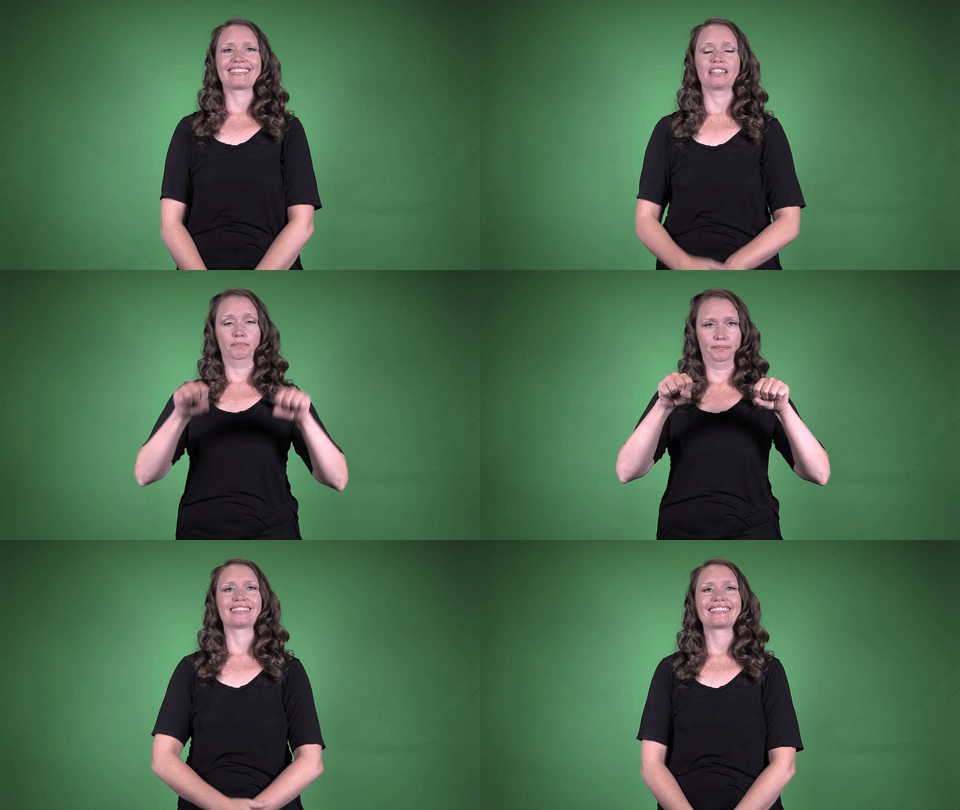
Definition: To legally take another’s child and bring it up as one’s own.
Sign for ADOPT in ASL

Practice Activities:
Practicing the sign for adopt in ASL can be done through a combination of repetition, real-life application, and interactive activities. Start by signing adopt repeatedly in front of a mirror to ensure correct handshape and motion. Try switching hands to build fluency and muscle memory. Use slow-motion signing to focus on accuracy before speeding up to a normal pace.
Use the sign in short phrases such as “They adopt a cat” or “I want to adopt a puppy.” Incorporate fingerspelling by saying, “My family will adopt” and then spell the word FAMILY. For a challenge, try signing full sentences like “Some people adopt children from other countries” or “My friend wants to adopt a dog.”
Practice with a storytelling prompt such as narrating an adoption journey. For example, tell the story of a family adopting a pet and use the sign for adopt in ASL multiple times. You can also describe a process where someone decides to adopt and explain why. If possible, record yourself signing and watch for clarity in movements.
Engage in a conversation by role-playing scenarios with a partner. One person can ask, “Did you adopt your dog?” while the other responds using the sign for adopt in ASL in their response. Take turns asking and answering different questions using the sign in context.
Try an ASL charades game where players act out different adoption scenarios. One player can sign “adopt a pet,” while the other guesses the phrase. Another activity is to watch ASL videos about adoption and try to identify when the word adopt appears. The more you incorporate the sign into meaningful use, the more naturally it will become part of your ASL vocabulary.
Cultural Context:
The sign for adopt in ASL is a meaningful representation of gaining a new family member. Adoption is an important concept in the Deaf community, just as it is in any culture. The sign reflects the idea of being taken in or claimed as part of a family.
In ASL, many signs are visually descriptive, and the sign for adopt mirrors the idea of bringing something close. This sign is commonly used in conversations about family, legal guardianship, and even adopting pets. It expresses the welcoming and inclusive nature of adoption.
Family and relationships are central to ASL and Deaf culture. The sign for adopt helps communicate the emotional significance of adoption. Whether discussing personal experiences or legal processes, this sign is essential for conveying the concept clearly.
ASL reflects cultural values, including the idea of belonging and acceptance. The sign for adopt carries both a literal and symbolic meaning. It emphasizes the importance of inclusion, whether within families or the Deaf community itself.
Deaf parents may adopt deaf or hearing children, and hearing parents may adopt deaf children. Understanding the sign for adopt in ASL allows for clear communication in these family dynamics. It is especially valuable for creating connections in diverse family structures.
In conversations, this sign may be used to talk about adopting traditions, ideas, or even signs into daily communication. ASL is a dynamic language that evolves to reflect new concepts. The sign for adopt extends beyond legal adoption to describe other forms of welcoming or claiming something.
Learning the sign for adopt in ASL benefits those working with children, social services, or adoption agencies. It ensures accessibility and inclusivity for both deaf and hearing individuals in adoption discussions. Knowing this sign fosters a deeper understanding of ASL and Deaf culture.
Extended Definition:
The sign for adopt in ASL is a common verb used to describe the process of legally taking in a child or assuming responsibility for someone or something. It can also be used metaphorically to mean accepting an idea, practice, or custom as your own. This sign is frequently used in conversations about family, legal guardianship, and personal choices.
To sign adopt in ASL, the movement typically involves grasping with an open hand and then bringing it up to a closed hand, as if symbolizing picking up or claiming something. This movement represents the concept of taking in or choosing to bring something into one’s care. Hand shape and movement may vary slightly among signers, but the general motion is widely understood within the Deaf community.
Adoption can refer to more than just bringing a child into a family. The sign for adopt in ASL can also apply to adopting a pet, new habits, traditions, or viewpoints. In different contexts, the meaning shifts, but the core idea remains the same—embracing something new as one’s own.
Within Deaf culture, the discussion of adoption often extends to the adoption of ASL itself by new learners. Non-native signers may adopt ASL as their primary means of communication, and this concept can be expressed using the same sign. Whether discussing language, ideas, or family, the sign effectively conveys the act of taking in something new.
The sign for adopt in ASL is useful in many real-life situations, especially for parents, social workers, and educators. When talking about adopting a child, pet, or practice, this sign helps convey the action clearly. Because ASL is a visual language, the movement of the sign reinforces the meaning, making communication more effective.
When signing adopt in ASL, facial expressions and context help clarify its meaning. If discussing adoption in a legal sense, a serious or formal facial expression may be used. For more casual uses, like adopting a hobby, expressions may be more relaxed or enthusiastic.
Signs related to adopt in ASL may include signs for family, legal, guardian, and acceptance. Depending on the conversation, these additional signs may help provide more context or specify the type of adoption being discussed. Understanding related vocabulary enhances communication and ensures clarity.
Because ASL is a dynamic, evolving language, regional variations of the sign for adopt in ASL may exist. Some signers may use slightly different handshapes or movements based on personal or community preferences. Exposure to various signing styles
Synonyms: embrace, take on, accept, assume, approve
Educational resources: Find related learning materials in our course bank!
Want more? Check out some of our popular learning activities on the homepage!
Need to look up a sign? Use our highly rated dictionary: https://aslinteractive.com/best-asl-dictionary/
Follow us on tiktok: https://www.tiktok.com/@aslinteractive. More social media links at the bottom of this page!
Long-tail Keywords: what is the sign for adopt in ASL, how do you sign adopt in ASL, ASL sign for adopt
Categories:
tags: Adoption, Relationships, Family, Life Milestones, Verbs
Parameters
*Handshape*:
the sign for adopt in ASL starts with both hands open, with relaxed fingers spread slightly apart, palms facing down. As the motion progresses, the hands close into “S” handshapes while moving upward, symbolizing the act of picking something up or taking possession. This movement effectively represents the concept of adoption or taking in. The sign for adopt in ASL visually communicates the idea of bringing something or someone into one’s care.
*Palm Orientation*:
The sign for ADOPT in ASL begins with both hands open, palms facing downward. As the movement progresses, the hands close into fists while lifting upward, shifting the palm orientation to face inward toward the body. This transition from open to closed hands symbolizes the concept of taking in or acquiring. The palm orientation remains neutral as the hands complete the upward motion, visually reinforcing the meaning of adoption.
*Location*:
The sign for ADOPT in ASL is produced in a neutral space near the torso. Both hands start open with relaxed fingers, palms facing downward. As the movement progresses, the hands close into fists while lifting slightly upward, symbolizing the concept of taking or adopting. This motion typically stays centered in front of the body for clarity. The sign for ADOPT in ASL is visually clear and intuitive, representing a grasping and taking motion.
*Movement*:
To sign for adopt in ASL, start with both hands open and relaxed in front of you, palms facing down. Then bring your hands upward while closing them into fists, as if you are lifting something and taking it in. The movement should be smooth, and the transition from open hands to closed fists should happen naturally. This sign for adopt in ASL symbolizes the concept of taking something and making it your own.
*Non-Manual Signals*:
Facial expressions play a crucial role when using the sign for ADOPT in ASL, often reflecting emotions associated with the concept. A neutral or slightly serious expression is common, but a warm expression can convey a positive connotation. Raised eyebrows may indicate a question about adoption, while a small head nod can reinforce affirmation. If the context is emotional, soft eyes and a gentle smile can help enhance the meaning of the sign.
*Prosody, Dominant/Non-Dominant Hand*:
The sign for ADOPT in ASL uses both hands. Begin with open relaxed hands ( ️) facing upward, palms up. Then, move both hands upward while bringing the fingers together into an “S” shape ( ), as if grasping and lifting something. The dominant hand and non-dominant hand perform this movement simultaneously. This sign visually represents the idea of picking up or taking in, which aligns with the meaning of adoption.
Tips for Beginners:
When learning the sign for ADOPT in ASL, focus on hand movement and clarity. The sign starts with both hands open and relaxed, fingers spread slightly, then one hand closes into an “S” shape as you bring it upward. This motion represents grasping or taking something in, which ties into the meaning of adoption. Keep your movement fluid to ensure the sign is executed smoothly.
A common mistake beginners make is not fully closing the hand at the end of the sign. If your fingers remain spread apart or don’t close completely, it may look like a different sign. Practice closing your dominant hand into a firm “S” shape with confidence. Additionally, make sure to use only one hand for the movement after the initial two-hand position, as using both can change the sign’s meaning.
Facial expressions are important when signing ADOPT. Depending on context, adoption can be an emotional or positive experience, so adjust your expression accordingly. In conversational signing, this can add depth to your communication. If discussing a joyful adoption, a slight smile can enhance clarity, while a neutral expression works for general discussions.
When signing in real-life situations, ensure your movements are crisp but natural. Over-exaggerating the motion can make the sign look unnatural, while signing too quickly may cause confusion. Keep a steady pace and practice in front of a mirror or with a partner to refine your accuracy.
The sign for ADOPT in ASL is useful in many contexts, whether discussing adoption of children, pets, or even ideas. Exposure to native signers and immersion will help reinforce the correct form. If unsure, watching videos or asking fluent ASL users for feedback is a great way to improve.
Connections to Other topics:
The sign for ADOPT in ASL connects closely to concepts of family and belonging. It is often used in discussions about family structures, legal processes, and life changes. This sign can also be conceptually linked to signs like FAMILY, TAKE, and ACCEPT, as all convey ideas of gathering or claiming something as one’s own.
This sign is also related to foster care and guardianship. While foster care may have different signs or phrases to clarify temporary versus permanent care, the sign for ADOPT in ASL helps distinguish formal, legal relationships from other forms of caregiving. It is frequently used in storytelling and discussions about identity, emphasizing the integration of individuals into new familial networks.
There are compound or derived signs that incorporate similar movements or concepts. For example, signs like TAKE-UP or CHOOSE share similarities with ADOPT because they also involve a grasping or selecting motion. In conversations, signers might pair the sign for ADOPT in ASL with CHILDREN or BABY to specify an adoption process, reinforcing the meaning with contextual signs.
Social and emotional contexts enhance the use of this sign. Discussions about cultural identity, heritage, and belonging often incorporate ADOPT when explaining how people embrace new traditions or personal histories. The adoption process is also a significant theme in legal and medical interpreting, where precise signs clarify official proceedings.
Media, literature, and community discussions frequently bring up adoption-related topics, making this sign essential for various ASL conversations. Performance storytelling in Deaf culture may use the sign in narratives about personal journeys, reinforcing the concept of finding a place within a chosen or assigned family. Understanding the sign for ADOPT in ASL helps in discussing broader life transitions and commitments within the Deaf community.
Summary:
The sign for ADOPT in ASL uses a movement that conveys the idea of taking in or bringing something into one’s care. The sign is performed by using both open hands facing downward with slightly curved fingers, resembling loose claws. The movement then involves pulling the hands upward while closing them into fists, symbolizing the action of taking hold and making something one’s own.
This sign visually represents the concept of adopting something by grasping and taking it in. The motion is symbolic of bringing something or someone into a new family or situation. The transition from open hands to closed fists reinforces the idea of securing or claiming responsibility for something.
There are variations of the sign for ADOPT in ASL depending on context and regional use. Some signers may use a one-handed version, particularly if signing quickly in a conversational setting. However, the two-handed version is the most common and widely understood in the deaf community.
This sign aligns with the broader ASL principle of using physical representations to express abstract concepts. The grasping movement metaphorically demonstrates the action of claiming, taking in, or assuming responsibility for another person or thing. This visual element makes the concept clear even to those unfamiliar with ASL.
ASL signs often reflect deep cultural values, and the sign for ADOPT in ASL is no different. Adoption as a concept is significant in many cultures, including the deaf community, where families may adopt deaf children or hearing parents may adopt sign language into their household. This sign can be used both in legal and personal contexts when discussing family structures.
Linguistically, ASL is a space-based language that conveys meaning through movement, palm orientation, and facial expressions. The sign for ADOPT in ASL follows this principle by using upward motion to show acquiring or bringing in, strengthening its meaning through physical representation. The facial expression accompanying this sign can add nuance, indicating whether adoption is literal or metaphorical.
Family signs in ASL often involve gestures that convey relationships, and ADOPT fits into this category. Similar signs like TAKE or GET use related motion, demonstrating how ASL builds meaning through movement patterns. By seeing the connection between these signs, signers can deepen their understanding of ASL’s conceptual framework.
Adoption is a concept that extends beyond legal guardianship and familial ties. It can refer to adopting ideas, habits, or practices, and the sign for ADOPT in ASL can be used metaphorically in this way. For example, signers may use this sign when talking about adopting a new approach at work or adopting a healthier lifestyle.
When using the sign for ADOPT in ASL, the context will often clarify its precise meaning. If discussing legal adoption, additional signs such as FAMILY, PARENT, or CHILD can provide necessary details. In contrast, if speaking of adopting customs or beliefs, signs related to that topic can supplement the meaning.
Many ASL signs have logical and intuitive roots, and the sign for ADOPT in ASL is an excellent example of this. The motion naturally mimics the physical act of taking something in, making it accessible to new learners and understandable even without spoken explanation. This illustrates ASL’s rich use of meaningful gestures that align with human intuition.
The deaf community values clear and expressive communication, and this sign efficiently conveys the concept without excess movement. Because ASL thrives on economy of motion, this sign effectively communicates adoption in one fluid action without requiring additional clarification.
Expanding on its usage, the sign for ADOPT in ASL can also be modified to fit different contexts. A slower or more deliberate motion can convey solemnity when discussing legal adoption, while a quicker, casual motion might be used when discussing adopting ideas or habits in everyday conversations.
Adoption is a sensitive and meaningful topic, and ASL reflects this in its communication. When discussing family or personal history, signers may pair this sign with expressions of care or emotion to fully convey the significance of the topic. This assists in adding depth to communication and ensures that the conversation is clear and emotionally appropriate.
The formation of the sign for ADOPT in ASL follows ASL’s linguistic principles, where motions are assigned layers of meaning. The upward pull signifies bringing in, while the closing hands indicate securing or holding onto that which is adopted. This reflects ASL’s use of physical space to reinforce meaning.
Additionally, the sign for ADOPT in ASL can be adapted by role-shifting, a common ASL technique where a signer visually switches between perspectives. This is useful when explaining adoption processes, showing how one party takes in another, or narrating events with clarity.
Because ASL is a visual language, the smooth transition from open to closed hands in this sign strengthens comprehension. The motion is iconic, directly representing the action involved in adoption, making it an effective and memorable sign for learners.
Comparing similar signs in ASL, such as TAKE or ACCEPT, highlights the nuances of the sign
Want more? Check out some of our popular learning activities!
ASL Interactive Resources
ASLInteractive YouTube Channel
Follow us on tiktok: @aslinteractive.com
Follow us on Instagram: aslinteractive
Facebook page: aslinteractive
Facebook group: aslinteractive
LInkedIn: ASL Interactive LLC
Twitter: @ASL_interactive
*Some information on this page is AI-generated. AI can make mistakes. Please check the information.


Responses