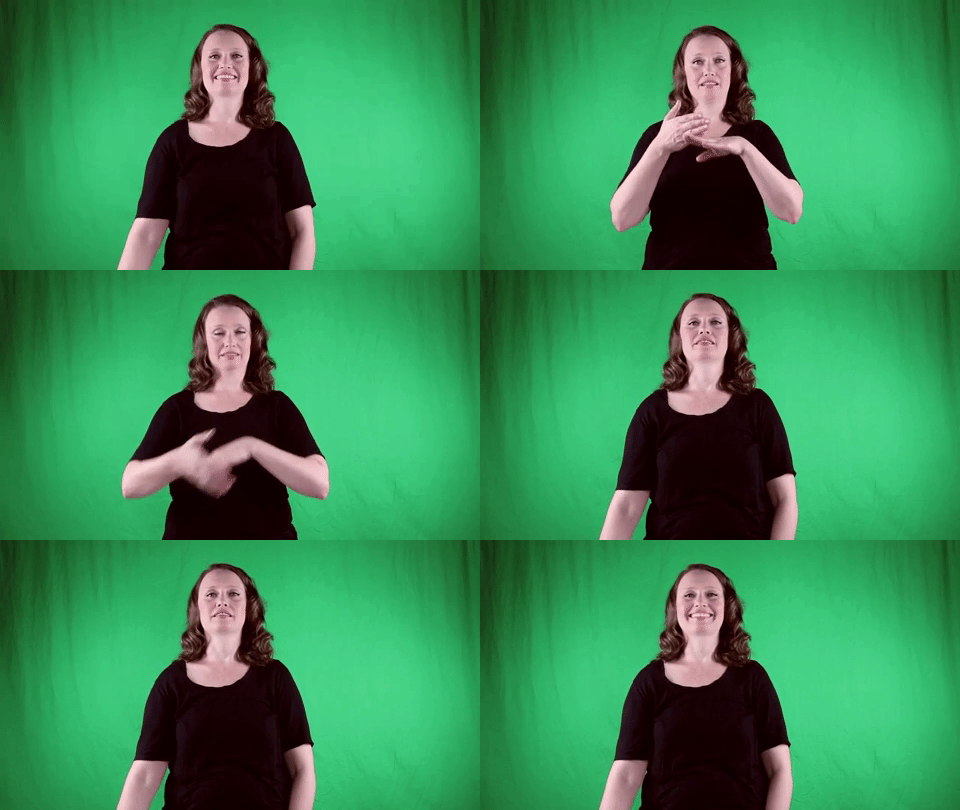
Definition: Subsequent to a time or event.
Sign for AFTER in ASL

Practice Activities:
Start by practicing the sign for after in ASL in isolation. Repeat the motion multiple times, focusing on fluidity and hand positioning. Use a mirror or record yourself to ensure accuracy.
Once comfortable with the movement, use the sign for after in ASL in simple phrases. Try signing “after lunch,” “after school,” or “after work.” Pair each phrase with a visual cue, such as a drawing or picture, to reinforce meaning.
Practice using the sign in full sentences. Sign statements like “I will go home after school” or “We will eat after the meeting.” Work on maintaining a natural rhythm and clarity while signing.
Engage in a storytelling activity that requires sequencing. Describe a daily routine, signing actions and emphasizing what happens after each step. For example, sign “I wake up, after that, I brush my teeth.”
Pair up with a partner and play a sequencing game. One person signs a short event, and the other adds what happens after. For example, one partner signs “I finished my homework,” and the other responds “after that, I played outside.”
Use real-life practice by incorporating the sign into daily interactions. When explaining schedules or events, make a conscious effort to include the sign naturally. Doing this helps reinforce memorization and fluency.
For an advanced challenge, create a short ASL dialogue where after is frequently used. Act out the conversation with a friend or record yourself signing different scenarios where one event follows another.
To build recognition skills, watch ASL videos or stories where sequencing words like before and after appear. Identify how native signers use the motion in conversation and try to replicate their fluency.
Cultural Context:
In American Sign Language, the sign for after in ASL is commonly used in everyday conversations. It helps express sequences, future events, and the passage of time. Understanding how to sign after in ASL correctly is important for clear communication.
The sign for after in ASL reflects the concept of one event following another. This aligns with ASL’s visual and spatial nature, where the hands represent different points in time. When signing after in ASL, the movement of one hand moving past the other shows an event happening later.
In Deaf culture, time-related signs like after in ASL are essential for discussing schedules, plans, and storytelling. ASL users rely on visual storytelling to express detailed sequences of events. Mastering the sign for after in ASL helps make conversations more fluid and natural.
When learning ASL, recognizing how native signers use after in ASL in context is valuable. In signed conversations, facial expressions and body language often emphasize timing. Using the sign for after in ASL with proper expressions ensures clarity in meaning.
ASL depends on conceptual accuracy rather than direct word-for-word translations. This means the sign for after in ASL might vary slightly depending on the context. Understanding when and how to modify this sign improves fluency in ASL.
In daily interactions, after in ASL is commonly used when discussing plans and directions. Whether scheduling a meeting or giving step-by-step instructions, signing after in ASL helps structure conversations logically. The ability to use time-related signs ensures smooth communication.
When signing after in ASL, awareness of signing space and movement is important. Proper hand positioning and directionality ensure the sign is correctly understood. Practicing the sign for after in ASL with fluent signers can improve signing accuracy.
ASL learners benefit from watching native signers use after in ASL naturally in conversation. Studying signed stories, vlogs, and ASL classes can help reinforce the correct use of this sign. Repetition and real-world practice lead to more confident signing skills in ASL.
Since ASL is a visual language, each sign conveys meaning through movement and space. The sign for after in ASL visually represents one event coming after another in a clear, intuitive way. This makes it easier to grasp sequencing concepts in ASL compared to spoken languages.
Deaf and hard-of-hearing communities rely on signs like after in ASL to convey time-related information efficiently. Using ASL correctly strengthens connections within
Extended Definition:
The sign for after in ASL is a useful term when talking about events happening later in time. It helps describe sequences, scheduling, and actions that take place following another event. Understanding this sign will improve communication in conversations about past and future activities.
When signing after in ASL, the motion typically involves one hand moving past the other to indicate something occurring later. This visual representation makes it easy to understand the concept of progression. Fluent signers often use this sign naturally in discussions about time and order.
The sign for after in ASL can be used in daily conversations when discussing plans, routines, or instructions. For example, you might sign “we will eat after the meeting” to clarify the order of events. It is a practical sign that enhances clarity in storytelling and scheduling.
ASL grammar does not always follow English sentence structure, so this sign is often combined with other gestures and facial expressions. Context plays an important role in making sure the meaning is clear. A signer might emphasize the movement or use additional signs to specify time frames.
This sign is helpful for both beginners and advanced signers when structuring sentences about the future or past. Practicing the motion and incorporating it into conversations helps reinforce its meaning. The more it is used, the more naturally it becomes part of fluent signing.
Using the sign for after in ASL correctly can prevent confusion when giving instructions or making plans. It allows for seamless conversations without needing lengthy explanations. In ASL, clear and concise signs improve communication and understanding.
People often pair this sign with expressions like before, later, or next to specify exact timing. This makes it easier to create complex sentences about schedules and activities. Knowing these related signs can make dialogues feel more natural and precise.
In everyday conversations, this sign is commonly used in discussions about meals, work, events, or travel plans. Native signers and ASL learners alike benefit from mastering this essential time-related sign. It is a key component of storytelling and everyday scheduling.
The sign for after in ASL demonstrates the visual nature of the language and how concepts of time are expressed through movement. Watching native signers use this sign in context can help learners use it correctly. Observing ASL conversations is a great way to see how this sign fits naturally into discussions.
Practicing this sign with a partner or using it in sentences will help reinforce its meaning. The more it is used in real-life situations, the easier it becomes to recall and
Synonyms: following, subsequent, later, next, ensuing
Educational resources: Find related learning materials in our course bank!
Want more? Check out some of our popular learning activities on the homepage!
Need to look up a sign? Use our highly rated dictionary: https://aslinteractive.com/best-asl-dictionary/
Follow us on tiktok: https://www.tiktok.com/@aslinteractive. More social media links at the bottom of this page!
Long-tail Keywords: what is the sign for after in ASL, how do you sign after in ASL, ASL sign for after
Categories:
tags: Actions, Sequence, Language Learning, Verbs, Everyday Activities
Parameters
*Handshape*:
The sign for after in ASL uses a dominant flat hand ( ️) moving past the stationary non-dominant flat hand. The fingertips of the dominant hand brush over the edge of the non-dominant hand as it moves forward. This movement symbolizes progression or something occurring later in time. The motion should be smooth and fluid to convey the concept clearly. Using facial expressions can help add emphasis when signing the sign for after in ASL.
*Palm Orientation*:
The sign for after in ASL uses both hands. The non-dominant hand is held in a vertical position with the palm facing to the side. The dominant hand has the palm also facing to the side and moves forward over the back of the non-dominant hand. The movement creates a visual representation of something happening after another event. The palm orientation remains consistent throughout the sign for after in ASL, ensuring clarity in communication.
*Location*:
The sign for AFTER in ASL is produced in front of the body in neutral space. The dominant hand starts behind the non-dominant hand and moves forward in a smooth, arcing motion. Both hands are typically in a flat “B” handshape, with palms facing the side. The motion represents something progressing or happening later, reinforcing the meaning of the sign for AFTER in ASL.
*Movement*:
To produce the sign for after in ASL, hold your non-dominant hand steady in a vertical “B” handshape, palm facing to the side. Take your dominant hand in a matching “B” handshape and place it behind the non-dominant hand. Move the dominant hand forward in a smooth motion, passing over the edge of the non-dominant hand. This movement represents the concept of one event occurring after another in sequence.
*Non-Manual Signals*:
When using the sign for AFTER in ASL, non-manual signals play an essential role in conveying precise meaning. Slight forward head movement and raised eyebrows may indicate a yes/no question, while a neutral or slightly furrowed brow can clarify a declarative statement. Mouth movements such as “after” or “then” may reinforce the concept. A slight shift in body posture can provide emphasis, ensuring the sign for AFTER in ASL is clear in context.
*Prosody, Dominant/Non-Dominant Hand*:
The sign for AFTER in ASL uses both hands. The non-dominant hand is held flat and stationary in front of the body, palm facing the side. The dominant hand is also flat and placed behind the non-dominant hand, then moves forward over the top in a smooth motion. This movement represents the concept of moving beyond a point in time. The sign for AFTER in ASL visually conveys the idea of something occurring later.
Tips for Beginners:
The sign for AFTER in ASL relies on clear hand positioning and movement. Make sure your dominant hand gently glides forward over the back of your non-dominant hand. This movement represents the concept of something following another event. Keep the motion smooth and fluid, avoiding any jerky or overly exaggerated gestures.
One of the biggest challenges for beginners is maintaining correct hand orientation. Your non-dominant hand should remain steady, palm facing to the side, while your dominant hand moves past it. If your hands are too far apart or the movement is inconsistent, the sign may be misunderstood. Practicing in front of a mirror can help perfect alignment and ensure correct execution.
Another common mistake is moving the dominant hand too far forward or too quickly. The sign for AFTER in ASL should have controlled, deliberate movement. Rushing the motion can make it look like a different sign, leading to confusion. Focus on precision by keeping your hands properly positioned and moving smoothly.
Pay attention to facial expressions, as they can change the meaning of the sign. A neutral expression typically works best, but raising your eyebrows can indicate a question. If you’re signing “after” in the context of a sequence, adjusting your facial expression can add emphasis.
Practice using the sign for AFTER in ASL within sentences to build fluency. Try combining it with other time-related signs, such as BEFORE or LATER, to reinforce understanding. Watching native signers and participating in conversations will help you grasp the natural flow of ASL. Consistent practice will lead to confidence and accuracy in your signing.
Connections to Other topics:
The sign for AFTER in ASL is closely connected to the concepts of time, sequence, and progression. It is often used when discussing schedules, narrating past events, or making plans. Since ASL relies on visual representation, the movement of this sign naturally conveys the idea of one event following another. This sign appears in many contexts where order or transition is important, such as storytelling or giving directions.
In ASL, many temporal concepts share similarities with the sign for AFTER in ASL. Signs like BEFORE, NEXT, and LATER are related since they also indicate the passage of time. These signs complement each other when explaining sequences or events within a timeline. ASL’s tendency to place events spatially in front or behind the signer reinforces these connections. This spatial organization helps express time visually, making it easier to compare different temporal ideas.
Compound signs and phrases often incorporate the sign for AFTER in ASL. For example, signing AFTERNOON combines AFTER and NOON, following ASL’s efficient structure. Additionally, it appears in phrases like AFTER-WORK or AFTER-SCHOOL, where it is paired with other signs to indicate specific post-event activities. This approach allows ASL users to form more complex ideas while still maintaining clarity and brevity.
Because ASL is a time-oriented language, the use of AFTER in ASL can influence sentence structure. While English relies heavily on specific words like “then” or “later,” ASL often uses body orientation and directional movement to express a similar idea. Fluent signers might shift their body slightly to indicate the passage of time between events. This visual representation of sequences makes ASL uniquely expressive and efficient for discussing past and future actions.
Summary:
The sign for after in ASL is a dynamic and context-dependent gesture that conveys the concept of something occurring later in time. This sign often involves one hand moving past the other in a forward motion, symbolizing progression. The movement visually represents the way events unfold sequentially, reinforcing the temporal meaning behind the word.
In ASL, spatial representation is key to understanding meanings. The sign for after in ASL uses movement to metaphorically show something happening later in a sequence. This spatial organization allows signers to create a clear mental timeline in conversation.
The dominant hand typically moves over the non-dominant hand, indicating that one event follows another. This motion resembles pages turning forward or a step taken past a reference point. The visual metaphor provides a natural way for ASL users to conceptualize time.
Because ASL is a visual language, it relies heavily on movement patterns to establish tense. The sign for after in ASL fits within this framework by physically demonstrating the concept of later. This aligns with ASL’s reliance on visual and spatial cues rather than verb conjugations.
Context shapes how signers use this word in ASL. Additional signs, facial expressions, or body positioning can alter the meaning to express distinctions such as “right after” or “long after.” This flexibility allows signers to provide precise details without extra words.
In everyday conversation, the sign for after in ASL is frequently paired with time-related signs such as before, later, or next. These combinations allow for comprehensive descriptions of events and their sequence. The order of signs is crucial to conveying accurate timelines.
ASL grammar does not follow English word order, so the placement of after in a sentence depends on emphasis. Sometimes, signers place it early in the sentence to set up a sequence, while other times, it appears in the middle or end. This fluid structure highlights ASL’s flexibility.
Cultural influences impact how ASL users depict time. The sign for after in ASL aligns with the general forward motion used to signify the future. Past events are often signed with a backward movement, reinforcing the future-facing conventions of ASL.
When narrating a story or describing a process, signers frequently use the sign for after in ASL to transition between stages. This helps maintain clarity and logical flow. It also ensures that the sequence is visually reinforced for the viewer.
The conversational tone when using this sign varies based on context. In casual conversation, the movement may be quick and relaxed. In formal or instructional settings, signers may use a more deliberate and expansive motion to clarify the sequence.
Facial expressions and body language are essential when signing after in ASL. A raised eyebrow or a slight pause before the sign can convey emphasis. These nuances help differentiate urgency, expectation, or mere chronological order.
In storytelling, after often appears alongside role-shifting, where signers take on different characters. This allows for a fluid narrative where events unfold naturally. The sign for after in ASL visually reinforces the passage of time within these performances.
It is important to recognize that ASL is not simply a signed version of English. The use of the sign for after in ASL follows unique grammar rules tailored to a visual medium. This makes direct translation between English and ASL problematic without considering syntax and structure.
Deaf culture values clarity and directness in communication. When using the sign for after in ASL, signers aim to be concise and visually explicit. Ambiguity is generally avoided by providing clear references to events and times.
This sign also plays a crucial role in conveying cause-and-effect relationships. When discussing logical sequences, such as instructions or problem-solving, the sign for after in ASL helps break down the steps. This supports effective communication in academic and workplace settings.
In ASL linguistics, time concepts rely largely on spatialization. The sign for after in ASL fits within ASL’s larger system of time representation, which includes established spatial distinctions for past, present, and future. This makes temporal concepts more intuitive for signers.
Children learning ASL quickly acquire time-related words, as they provide essential structure to communication. The sign for after in ASL helps young signers grasp cause and effect, order of events, and storytelling techniques. Mastering this sign supports overall language development.
Bilingual ASL/English signers may switch between structures depending on the language they are using. The placement of after in English follows spoken language grammar, whereas in ASL, other factors like emphasis dictate sign order. Fluency in both requires understanding these differences.
Regional variations may exist in how this sign is used or slight modifications in movement. Some areas may incorporate different timing or positioning. However, the general conceptual framework remains the same across ASL dialects.
Technology has influenced how people learn signs, including the sign for after in ASL. Online ASL dictionaries and video tutorials provide visual learners
Want more? Check out some of our popular learning activities!
ASL Interactive Resources
ASLInteractive YouTube Channel
Follow us on tiktok: @aslinteractive.com
Follow us on Instagram: aslinteractive
Facebook page: aslinteractive
Facebook group: aslinteractive
LInkedIn: ASL Interactive LLC
Twitter: @ASL_interactive
*Some information on this page is AI-generated. AI can make mistakes. Please check the information.


Responses