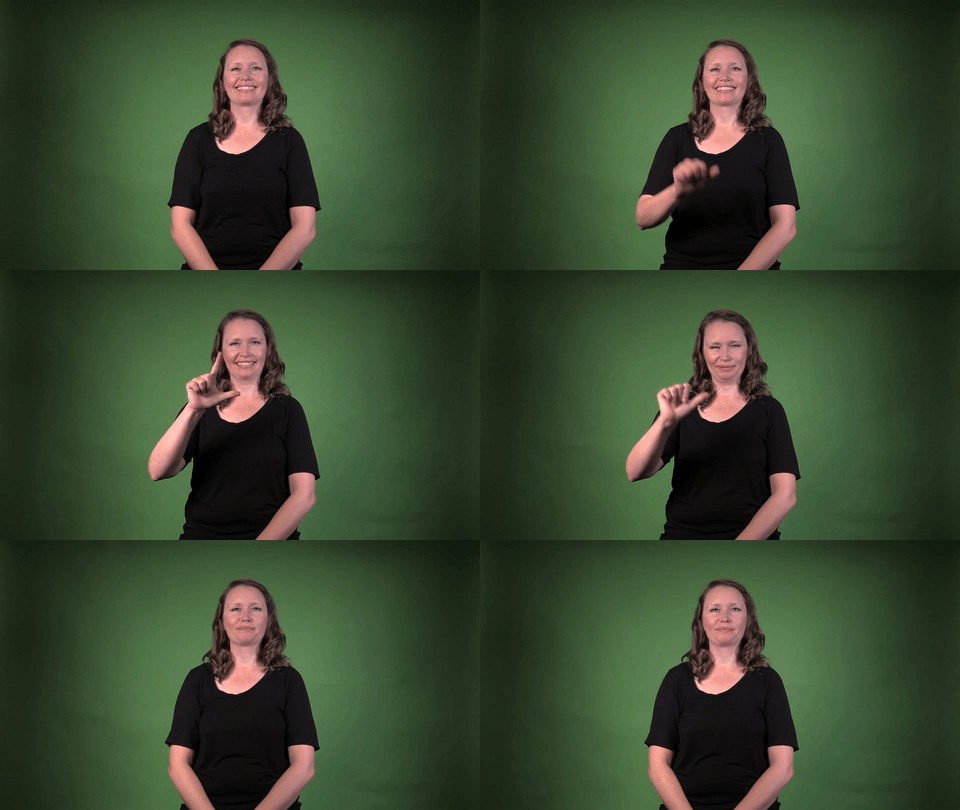
Sign for ALABAMA in ASL | 🌇 ASL Dictionary

Definition: Abbreviation for the US state Alabama

Sign for ALABAMA in ASL

YouTube player

Practice Activities:

Practice the sign for ALABAMA in ASL by signing it repeatedly in front of a mirror. Focus on the movement and handshape to ensure accuracy. Try varying your speed to build fluency while keeping the sign clear and precise.

Use the sign for ALABAMA in ASL in sentences to reinforce its meaning. For example, practice signing “I was born in ALABAMA” or “Have you visited ALABAMA before?” Say the sentence aloud as you sign to strengthen the connection between the sign and its meaning.

Create a mini-story that includes the sign for ALABAMA in ASL. You could describe a road trip through the southern United States, mentioning ALABAMA as one of your stops. Try incorporating details like cities or landmarks to make your story more engaging.

Find a practice partner and ask each other questions that require using the sign for ALABAMA in ASL. One person can ask, “Where do you want to travel?” while the other answers, “I want to go to ALABAMA.” This helps with conversational practice and improves confidence in signing.

Watch videos of native ASL signers using the sign for ALABAMA in ASL in context. Pay attention to how smoothly they incorporate it into conversations. Try mimicking their signing speed and fluidity to match natural signing styles.

Challenge yourself to spell ALABAMA letter by letter and then transition smoothly to signing it correctly. This helps reinforce spelling skills while also improving the recall of the sign itself. Try timing yourself to increase speed and accuracy over multiple attempts.

Write a short paragraph about an imaginary trip to ALABAMA. Then, sign it in ASL using the correct sign for ALABAMA. This exercise will help with storytelling skills and using the sign naturally within a narrative.

Cultural Context:

The sign for Alabama in ASL is an important part of American Sign Language, especially when discussing U.S. states, geography, and cultural identity. Many deaf and hard-of-hearing individuals use ASL to communicate about locations, including states like Alabama. Knowing the correct sign for Alabama in ASL helps enhance conversations and ensures clear communication.

Alabama has a deep history connected to the civil rights movement and southern traditions. Signing Alabama in ASL allows people to discuss historical events, landmarks, and cultural aspects of the state. Whether talking about Montgomery, Birmingham, or the University of Alabama, using the correct sign makes conversations smoother.

The sign for Alabama in ASL may vary slightly among different signers, but generally, it follows a recognizable pattern. ASL is a living language, influenced by regional variations and cultural influences. Learning the most accepted sign for Alabama in ASL helps avoid misunderstandings and strengthens communication.

For deaf travelers and residents of Alabama, knowing how to sign the state name is essential. ASL users often discuss travel plans, locations, and historical sites, making it useful to know the regional signs. Whether talking about Alabama’s rich history, football culture, or famous landmarks, using the correct ASL sign adds clarity to discussions.

Alabama is famous for its southern hospitality, music, and food traditions. The ability to sign Alabama in ASL helps people engage in conversations about its unique culture and heritage. From discussions about local cuisine like barbecue and fried green tomatoes to civil rights history, ASL ensures accessibility for all.

Sports play a major role in Alabama’s identity, with college football being a major part of the culture. Whether cheering for the University of Alabama Crimson Tide or Auburn Tigers, using ASL to talk about the state is common. Signing Alabama in ASL allows deaf sports fans to fully participate in conversations and celebrate their teams.

The state’s historical significance in the civil rights movement makes Alabama an important topic in ASL discussions. Landmark events in Montgomery, Selma, and Birmingham are frequently referenced, making it valuable to know how to sign Alabama in ASL. Conversations about these historical moments become more meaningful when everyone can communicate clearly.

ASL is an expressive language that bridges communication gaps for deaf and hard-of-hearing individuals. Learning how to sign Alabama in ASL expands vocabulary and improves fluency. Whether in educational settings, travel discussions, or historical conversations, knowing the correct ASL sign ensures effective communication.

Children learning ASL

Extended Definition:

The sign for Alabama in ASL is a simple and effective way to represent the state in American Sign Language. It typically involves fingerspelling “A-L-A-B-A-M-A” in a smooth, fluid motion. This method ensures that the name is clearly understood by those who are familiar with ASL.

Since Alabama is a proper noun, fingerspelling is the primary way to sign it in ASL. Many state names are signed using abbreviations or initials, but Alabama does not have a unique ASL sign. Instead, spelling out the full name helps maintain clarity in conversations.

When fingerspelling, it’s important to keep a steady rhythm and avoid unnecessary pauses between letters. The sign for Alabama in ASL should be performed at a comfortable speed for the signer and the viewer. Fluency in fingerspelling improves with practice, making the hand movements appear natural and effortless.

In casual or fast-paced conversations, some signers may abbreviate Alabama to “A-L-A” for convenience. However, this shortened form is not widely accepted in formal settings. To ensure clear communication, it’s best to fingerspell the full state name whenever possible.

Regional variations may exist, as ASL can have different signing styles among communities. While the standard method is to fully fingerspell Alabama, some local groups may adopt slight modifications. It’s always helpful to observe and adapt to the signing preferences of the people you are communicating with.

Learning the sign for Alabama in ASL is useful for travelers, educators, and anyone interacting with the Deaf community. Knowing how to fingerspell state names can enhance communication in discussions about locations and geography. It also allows for smoother conversations when talking about travel plans or news related to Alabama.

When fingerspelling Alabama, maintain eye contact with your conversation partner. This ensures they can clearly see the movement of your hands and understand the spelling. Good fingerspelling technique includes a relaxed hand position and avoiding excessive bouncing between letters.

For beginners, practicing fingerspelling Alabama regularly can help build confidence in using ASL. Repeating the motion several times will improve speed and accuracy. Using a mirror or recording yourself can also help identify areas for improvement in hand positioning and movement.

The sign for Alabama in ASL is just one example of how ASL represents proper nouns. Other state names may have specific signs, abbreviations, or require full fingerspelling. Understanding these variations makes communication smoother and more effective in ASL conversations.

Synonyms: Alabama, The Yellowhammer State, Heart of Dixie, The Cotton State, The Camellia State

Educational resources: Find related learning materials in our course bank!

Want more? Check out some of our popular learning activities on the homepage!

Need to look up a sign? Use our highly rated dictionary: https://aslinteractive.com/best-asl-dictionary/

Follow us on tiktok: https://www.tiktok.com/@aslinteractive. More social media links at the bottom of this page!

Long-tail Keywords: what is the sign for Alabama in ASL, how do you sign Alabama in ASL, Alabama sign language translation

Categories:

tags: language learning, geography, fingerspelling, letters A-Z, States

Parameters

*Handshape*:

The sign for ALABAMA in ASL typically involves fingerspelling. Start with the dominant hand forming the “A” handshape, followed by “L,” then “A,” “B,” “A,” and finally “M” and “A.” Each letter should be fluidly transitioned to represent the state’s name clearly.

When signing, keep your hand at chest level and make smooth transitions between letters. The sign for ALABAMA in ASL should be performed at a natural pace, ensuring clarity while maintaining the correct handshapes for each letter.

*Palm Orientation*:

The palm orientation for the sign for ALABAMA in ASL depends on the variation used. One common way is fingerspelling “A-L-A-B-A-M-A,” where each letter maintains a natural fingerspelling orientation, with the palm facing slightly forward or outward. Some variations may drop the final “A” or modify movement slightly, but the general orientation remains consistent with standard fingerspelling conventions. When signing smoothly, ensure each letter transitions fluidly while keeping the hand steady.

*Location*:

The sign for ALABAMA in ASL is produced in the neutral signing space in front of the body. The dominant hand fingerspells “A-L-A-B-A-M-A” using clear and fluid movements. Make sure to maintain a steady rhythm while fingerspelling to ensure clarity. The hand remains at chest level, slightly in front of the torso, with a natural posture.

*Movement*:

To make the sign for ALABAMA in ASL, form an open “A” handshape with your dominant hand. Start at the side of your chest and smoothly spell out “A-L-A-B-A-M-A” using clear, controlled fingerspelling. Make sure each letter transitions fluidly to the next while keeping your hand steady in the signing space. The movement should be natural and slightly arced forward. Maintain a relaxed posture and clear hand positioning for readability.

*Non-Manual Signals*:

When producing the sign for ALABAMA in ASL, maintain a neutral or slightly content facial expression unless the context indicates a different emotion. Eye contact should be natural, showing engagement with the conversation. If fingerspelling the state’s name, keep your mouth relaxed, slightly mouthing “Alabama” without exaggeration. Head positioning remains steady, with slight forward movement if emphasizing the location. Natural blinking and relaxed shoulders convey confidence in the sign for ALABAMA in ASL.

*Prosody, Dominant/Non-Dominant Hand*:

The sign for ALABAMA in ASL uses the dominant hand to fingerspell the state’s name. Start with an “A” handshape, followed by “L,” “A,” “B,” “A,” “M,” and “A,” moving smoothly from one letter to the next. Keep the hand at chest level, maintaining a steady rhythm. Ensure each letter is clearly formed to enhance readability. If signing at a faster pace, be mindful of clarity so the sign remains recognizable.

Tips for Beginners:

The sign for ALABAMA in ASL involves fingerspelling “A-L-A-B-A-M-A.” Because this is a longer state name, maintaining a steady rhythm while spelling is key. Pay close attention to hand positioning and letter transitions to ensure clarity and readability. It’s helpful to practice with a mirror or record yourself to catch any missteps in execution.

One common challenge when signing ALABAMA is keeping the letters fluid without rushing. Be mindful not to drop letters, especially the second “A,” which can easily get lost if you’re moving too quickly. Keep your hand steady and slightly in front of your shoulder level while fingerspelling. This ensures that your signing stays clear and visible to your audience.

Another important factor is handshape consistency. The “A” hand should be closed with the thumb resting on the side, not extended outward. The “L” should form a clear 90-degree angle with the index finger pointing up and the thumb extended. Practicing each letter separately before signing the full word can help build muscle memory and confidence.

If you’re fingerspelling for someone unfamiliar with ASL, slightly slowing down your pace can make it easier to understand. However, avoid exaggerating movements, as that can make the sign look unnatural. Smooth, controlled movements with slight pauses between letters will make the sign for ALABAMA in ASL more effective.

Finally, fingerspelling fluency takes time. Practicing commonly used words such as states and cities will improve your overall ASL skills. Watching native signers fingerspell ALABAMA in ASL can provide insight into natural pacing and hand movements. Over time, muscle memory will help make spelling the state’s name feel effortless and more natural in conversation.

Connections to Other topics:

The sign for ALABAMA in ASL connects to other U.S. state name signs, many of which use abbreviations, fingerspelling, or unique gestures. Some states, like TEXAS and CALIFORNIA, have their own distinct signs, while others, such as ALABAMA, rely on fingerspelling. This demonstrates a broader pattern in ASL where proper nouns, especially names of places, may be fully spelled out or abbreviated based on common linguistic shortcuts within the Deaf community.

The sign for ALABAMA in ASL also fits into the category of geographical name signs, making it useful for discussions about maps, locations, and travel. When discussing how to get from ALABAMA to another state, one might include directional verbs to show movement, such as FLY-TO or DRIVE-TO. These forms help incorporate space and directionality in ASL storytelling, making geography more visually engaging for signers.

Because ALABAMA is fully fingerspelled, it connects to fingerspelling fluency and clarity in ASL learning. Longer state names challenge signers to practice smooth transitions between letters, reinforcing fingerspelling as a critical skill. The need for fluidity when fingerspelling ALABAMA relates to other situations where full words must be signed for clarity, such as spelling out uncommon names or unfamiliar terms.

The culture of ALABAMA, including history and regional identity, may also influence how the sign for ALABAMA in ASL is used in conversations. Signers might incorporate the state name in discussions about civil rights history, Southern culture, or famous events. This further ties to the ability of ASL to visually convey not just place names but also deeper contextual meanings.

Summary:

The sign for ALABAMA in ASL is typically fingerspelled using the manual alphabet. The most common version involves spelling out “A-L-A-B-A-M-A” with a slight fluid motion. Some signers may abbreviate the state name by fingerspelling only “A-L-A,” depending on context and familiarity.

Fingerspelling state names is common in ASL, especially when there is no widely accepted lexicalized sign. The sign for ALABAMA in ASL adheres to this tradition, emphasizing clarity and ease of recognition. Due to the length of the word, fingerspelling it smoothly requires practice and strong control of hand transitions.

More experienced signers develop a natural rhythm when signing ALABAMA in ASL, making it appear seamless. Each letter should be articulated clearly, but the transition between letters should not be stiff. The sign moves slightly from left to right (for right-handed signers) as the fingerspelling progresses.

Lexicalized fingerspelling sometimes occurs with state names, but ALABAMA in ASL does not have a common lexicalized form. This means that while some fingerspelled words take on their own unique handshapes, ALABAMA remains a fully fingerspelled name. Context might determine if fingerspelling is done at a slower or faster pace.

Regional variations can affect how signers manage longer state names like ALABAMA in ASL. Some Deaf communities might use an abbreviation, such as just fingerspelling “ALA,” while others insist on spelling out the full name each time. This variability reflects the organic nature of ASL as a living language.

Because the state’s name is relatively long, it can be more challenging for new signers to spell it smoothly. The repetition of the letter “A” can make hand positioning feel awkward without practice. Consistent use can help a signer become more confident in fingerspelling ALABAMA in ASL with natural flow.

The importance of accuracy in fingerspelling is crucial, as minor changes in hand positioning could lead to misinterpretation. For example, if fingerspelling ALABAMA in ASL is rushed or unclear, a viewer might mistake it for a different state name. This demonstrates how crucial precision is in ASL communication, even with commonly fingerspelled words.

Cultural context plays a significant role in ASL, especially with place names like ALABAMA. Some states or cities develop unique signs based on historical or cultural references. However, ALABAMA in ASL remains primarily fingerspelled, preserving the original spelling format.

ASL grammar does not require fingerspelled words to follow English sentence structure strictly. When incorporating ALABAMA in ASL into a sentence, non-manual signals such as head tilts, facial expressions, and body movement help provide meaning. Placement in signing space can also indicate whether the signer is discussing ALABAMA in past, present, or future contexts.

Since ALABAMA is commonly fingerspelled, it requires knowledge of ASL fingerspelling conventions. This includes knowing how to form each letter correctly, maintaining spatial clarity, and avoiding excessive bouncing. While some bouncing may be natural due to the alternating letters, excessive movement can make it harder to read.

In linguistic terms, fingerspelling ALABAMA in ASL highlights the interface between ASL and English. Fingerspelling serves as a bridge between the two languages, allowing ASL signers to represent English words without direct translation. This method preserves the integrity of ASL while accommodating proper nouns like ALABAMA.

The broader theme of fingerspelling state names shows how ASL adapts to the need for identity markers while remaining efficient. Some states, like TEXAS or CALIFORNIA, have unique signs, while others, like ALABAMA, rely on fingerspelling. This distinction reflects how frequently a location is referenced within the Deaf community.

Individuals learning to spell ALABAMA in ASL should practice the sequence multiple times in a row. This technique helps with muscle memory, ensuring that a signer can transition between letters smoothly. Training in fingerspelling fluency is useful for communicating names, brands, and other words without direct ASL equivalents.

The historical connection of ALABAMA to the broader United States plays into how it is signed. States with significant Deaf history or Deaf institutions have often developed unique signs instead of fingerspelling. However, ALABAMA does not have a widely known lexicalized variation, making fingerspelling the primary form.

When conversing about ALABAMA in ASL, classifiers may follow the fingerspelled sign to provide additional context. For example, after spelling ALABAMA, a signer might use a classifier to indicate a city, landmark, or movement across the state. This strategy helps integrate fingerspelling naturally into ASL discourse.

Signers often wonder why some states get unique signs while others

Want more? Check out some of our popular learning activities!

ASL Interactive Resources

ASLInteractive YouTube Channel

Follow us on tiktok: @aslinteractive.com

Follow us on Instagram: aslinteractive

Facebook page: aslinteractive

Facebook group: aslinteractive

LInkedIn: ASL Interactive LLC

Twitter: @ASL_interactive

*Some information on this page is AI-generated. AI can make mistakes. Please check the information.

Sign for ALABAMA in ASL

Responses