Sign for ALL-INCLUSIVE in ASL | ☑ ASL Dictionary

Definition: Including everything.

Sign for ALL-INCLUSIVE in ASL 

YouTube player

Practice Activities:

Practicing the sign for all-inclusive in ASL starts with mastering the movement and handshape. First, practice the sign in isolation by signing it repeatedly while watching yourself in a mirror. Try moving your dominant hand in a circular motion around your non-dominant hand, ensuring a smooth and complete motion each time.

Once comfortable with the motion, use the sign for all-inclusive in ASL within simple sentences. Examples include “The resort is all-inclusive” or “The price is all-inclusive.” Sign slowly at first, then increase speed while maintaining accuracy. To reinforce learning, fingerspell the phrase, then immediately sign it to create a stronger connection between the concept and movement.

For storytelling practice, create a short narrative where everything is included in a package deal. For example, imagine planning a vacation where the hotel, food, and entertainment are all inclusive. Include additional ASL signs like hotel, food, drinks, and tickets to build fluency. Try telling this story to a partner and have them ask questions using ASL to make it interactive.

Engage in a partner activity where one person describes a scenario, and the other confirms if it is all-inclusive. For instance, one partner signs “The cruise has food, drinks, and shows included” while the other responds using the sign for all-inclusive in ASL. Switch roles to practice both expressive and receptive skills.

For a real-world challenge, find online ads or brochures for all-inclusive services and sign them to yourself. This will help bridge the gap between written language and ASL comprehension. Keep practicing in different contexts to reinforce understanding and improve fluidity in signing.

Cultural Context:

The sign for all-inclusive in ASL represents the concept of inclusivity, completeness, and encompassing everything. In Deaf culture, being all-inclusive means ensuring that everyone, regardless of background, has access to communication, resources, and participation. This aligns with the Deaf community’s values of equal access and full involvement in all aspects of life.

Using the sign for all-inclusive in ASL can be important in discussions about accessibility and diversity. It conveys the idea of welcoming all individuals, regardless of communication ability or background. This sign is often used in contexts where inclusivity is essential, such as education, workplaces, and social gatherings.

In Deaf culture, the concept of being all-inclusive extends to ASL accessibility in various environments. Providing interpreters, captions, and other accommodations ensures that Deaf individuals can participate fully. This aligns with the broader principle of equality and inclusion within the community.

When signing all-inclusive in ASL, the movement of the sign visually represents the idea of encompassing everything. The sign demonstrates a circular motion, symbolizing completeness and unity. This visual aspect of ASL enhances the meaning, reinforcing the importance of inclusion.

The Deaf community advocates for all-inclusive spaces in schools, workplaces, and public settings. Using ASL and providing equal access ensures that no one is left out due to communication barriers. The sign for all-inclusive in ASL highlights the ongoing efforts for accessibility and equality.

Businesses and organizations that embrace an all-inclusive approach benefit from a more diverse and engaged audience. Ensuring ASL access in customer service, events, and media strengthens connections with the Deaf community. The use of the sign for all-inclusive in ASL reinforces the message of welcoming all individuals.

Educational institutions that support all-inclusive environments incorporate ASL and Deaf awareness into their programs. Creating inclusive learning spaces allows Deaf students to thrive. The representation of the sign for all-inclusive in ASL in these spaces promotes openness and equality.

Social equality is a core principle behind the use of the sign for all-inclusive in ASL. Deaf individuals advocate for an accessible world where communication is not a barrier. Using this sign emphasizes the importance of removing obstacles that prevent full participation.

The meaning behind the sign for all-inclusive in ASL goes beyond just a gesture, reflecting a deeper commitment to accessibility. Deaf culture values inclusivity as a fundamental right, not just an option. This sign serves as a reminder of the ongoing pursuit of equal opportunities for all.

Extended Definition:

The sign for all-inclusive in ASL effectively conveys the concept of something encompassing everything within a particular scope. This sign is commonly used in conversations about services, packages, or ideas that include all aspects without exclusion. It is a useful term in both everyday and professional settings.

To sign all-inclusive in ASL, one hand forms a circular motion around the other as if symbolizing the inclusion of all elements. This movement visually represents the idea of completeness and totality. The exact execution of the sign may vary slightly depending on regional dialects or signing speed.

The concept behind the sign for all-inclusive in ASL is particularly relevant in areas like business, education, and travel. Hotels, resorts, and vacation packages often advertise all-inclusive deals, meaning food, activities, and accommodations are covered. In education, this term can describe inclusive learning environments where all students have access to the same opportunities.

People use the all-inclusive sign to discuss fairness, accessibility, and opportunities that are open to everyone. It can describe pricing structures that do not require additional payments or contexts where all people are welcome regardless of background. The sign emphasizes that nothing is left out or separately charged.

Understanding the sign for all-inclusive in ASL is valuable when engaging in discussions about equality and full access. This sign helps ensure clarity when explaining comprehensive offerings, policies, or benefits. Including this sign in one’s ASL vocabulary makes communication about broad or total coverage more precise.

When using the all-inclusive sign in ASL, facial expressions can add context. A positive expression might indicate excitement over an excellent deal, while a neutral face keeps the focus on factual information. Facial expressions work together with the hand movement to clarify meaning.

Learning the sign for all-inclusive in ASL is beneficial for those in customer service, event planning, or hospitality industries. Employees in these sectors frequently discuss packages, services, and offers that cover everything in one price. Mastering this sign can improve communication with Deaf customers by ensuring clear explanations.

In ASL conversations, the all-inclusive sign can be combined with other relevant signs. For example, pairing it with signs for vacation or membership helps specify the discussion. This flexibility allows for more detailed and efficient communication in everyday interactions.

Exposure to different signing styles helps reinforce the proper way to use the all-inclusive sign in ASL. Watching fluent signers, taking ASL classes, or engaging in Deaf community events can improve signing accuracy. Like all ASL vocabulary, practice is essential to

Synonyms: comprehensive, all-encompassing, exhaustive, complete, inclusive

Educational resources: Find related learning materials in our course bank!

Want more? Check out some of our popular learning activities on the homepage!

Need to look up a sign? Use our highly rated dictionary: https://aslinteractive.com/best-asl-dictionary/

Follow us on tiktok: https://www.tiktok.com/@aslinteractive. More social media links at the bottom of this page!

Long-tail Keywords: what is the sign for all-inclusive in ASL, how do you sign all-inclusive in ASL, learn the ASL sign for all-inclusive

Categories:

tags: Universal, Inclusive, Diversity, Language Learning, People

Parameters

*Handshape*:

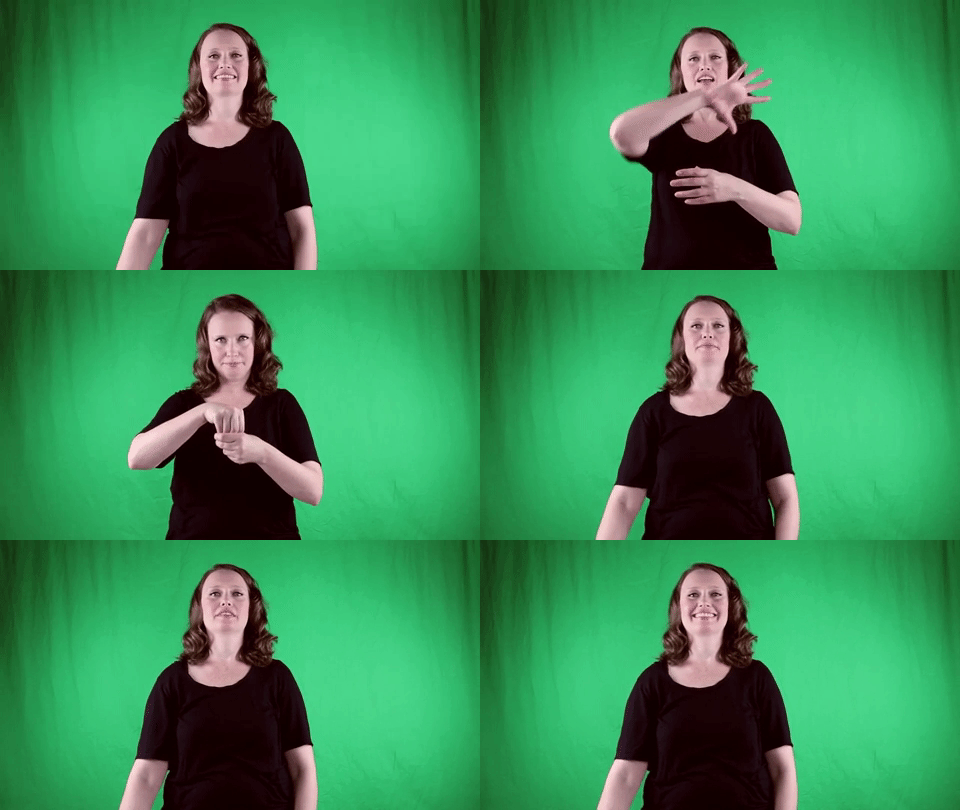
The sign for all-inclusive in ASL uses a dominant hand in a flat “O” shape, while the non-dominant hand remains open with the palm facing upward. The dominant hand circles around and closes inside the non-dominant hand, symbolizing the idea of encompassing everything. This movement represents inclusivity and the concept of bringing all elements together in the sign for all-inclusive in ASL. Proper placement and smooth execution help clarify the meaning.

*Palm Orientation*:

The sign for ALL-INCLUSIVE in ASL has the dominant hand open with the palm facing sideways before moving in a circular motion. As it moves, the fingers of the dominant hand close around the non-dominant hand, which remains stationary with the palm facing inward. The motion suggests the idea of encompassing everything. This expressive sign clearly conveys the meaning of all-encompassing or inclusive ideas.

*Location*:

The sign for all-inclusive in ASL is produced in the neutral space in front of the body. The dominant hand moves in a circular motion around the non-dominant hand, which remains stationary. This location allows for clear visibility and ensures the movement is easily distinguishable. Signing in this space keeps the gesture fluid and visually effective, emphasizing the concept of including everything within the motion.

*Movement*:

The sign for all-inclusive in ASL begins with the dominant hand in a flat “O” shape while the non-dominant hand remains open with the palm facing up. The dominant hand moves in a circular motion above the non-dominant hand, as if gathering all elements into one space. The movement concludes by bringing the dominant hand to rest on the palm of the non-dominant hand, symbolizing the idea of everything being included.

*Non-Manual Signals*:

When using the sign for all-inclusive in ASL, widen your eyes slightly to emphasize inclusivity . A small head nod or gentle forward tilt reinforces the concept of encompassing everything. Maintain a neutral or slightly positive facial expression to convey completeness without exaggeration. If stressing the idea of total inclusion, a slight eyebrow raise can add emphasis. Keep your mouth relaxed to avoid conflicting signals.

*Prosody, Dominant/Non-Dominant Hand*:

The sign for ALL-INCLUSIVE in ASL uses both hands to illustrate the idea of encompassing everything. The non-dominant hand forms a stationary, open “C” shape, representing a container or encompassing space. The dominant hand starts as an open “5” shape, moves in a circular motion around the non-dominant hand, and then closes into the “C” shape inside it. This motion symbolizes the idea of bringing all elements together comprehensively.

Tips for Beginners:

When learning the sign for ALL-INCLUSIVE in ASL, focus on fluidity and precision. This sign involves a circular motion, so maintaining a smooth and continuous movement is essential. Avoid choppy or rigid hand movements, as these can make your sign look unclear or awkward. Practice in front of a mirror to ensure your dominant hand fully encircles your non-dominant hand in a controlled yet natural manner.

Hand positioning is crucial when signing the sign for ALL-INCLUSIVE in ASL. Make sure your dominant hand’s motion fully includes the non-dominant hand, as missing this key element could alter the meaning. It’s also important to maintain proper handshape throughout the motion. Keep your fingers relaxed but controlled, and make sure your gesture remains clear from start to finish.

A common mistake beginners make when signing the sign for ALL-INCLUSIVE in ASL is rushing the motion. While the movement should be fluid, going too fast can make the sign difficult to recognize. Aim for a steady, deliberate pace that allows the sign to be easily understood. Additionally, ensure your palm orientation is correct so the movement appears intentional and natural.

Facial expressions and body language enhance clarity when using the sign for ALL-INCLUSIVE in ASL. Since this sign conveys the idea of inclusivity, consider using a confident and neutral facial expression. If the context requires emphasis, you can slightly raise your eyebrows or nod to reinforce the meaning. Consistent practice with expressive signing can help improve fluency over time.

To build confidence with the sign for ALL-INCLUSIVE in ASL, incorporate it into daily practice sessions. Repetition will help develop muscle memory, making the movement smoother and more intuitive. Practicing with a language partner or instructor can also provide valuable feedback that ensures accuracy and clarity in real-life conversations.

Connections to Other topics:

The sign for ALL-INCLUSIVE in ASL connects to concepts of totality, inclusion, and completeness. It is linked to other signs like “ALL,” “EVERYTHING,” and “WHOLE,” which also convey the idea of encompassing all elements. These signs are often used interchangeably or in combination to emphasize the idea of inclusion or entirety in different contexts.

Many ASL signs related to classification and groupings share similarities with the sign for ALL-INCLUSIVE in ASL. It can be connected to signs like “GROUP,” “CATEGORY,” or “CIRCLE,” which visually represent collective or comprehensive ideas. These connections help in discussions about diversity, accessibility, and the inclusion of all people or items within a particular set.

When discussing accessibility and equity, the sign for ALL-INCLUSIVE in ASL can be used in sentences about universal participation. In educational settings, this sign is helpful when referring to inclusive classrooms that accommodate all students. Similarly, in business or social settings, it can describe policies that ensure equal opportunities for everyone.

The motion of the sign for ALL-INCLUSIVE in ASL is similar to other signs that show movement around a central point, such as “INCLUDE” and “INVOLVE.” These connections reinforce the concept of gathering multiple elements into one unified whole. The visual representation in ASL often mimics how inclusion and comprehensiveness appear in everyday life.

The sign for ALL-INCLUSIVE in ASL also relates to signs used in pricing or tourism, such as “PACKAGE” or “COVER ALL.” Travel agencies frequently use this sign to express “all-inclusive” vacation packages where all costs are covered. This connection makes the sign highly relevant in marketing, budgeting, and event planning where the idea of “everything included” is essential.

Summary:

The sign for all-inclusive in ASL conveys the idea of inclusivity, comprehensiveness, and bringing everything together into one. This concept is central to many discussions involving accessibility, diversity, and representation, making it an important term in various conversations. The sign demonstrates the action of gathering all elements into a whole, reinforcing its meaning visually.

To form the sign for all-inclusive in ASL, one hand remains stationary while the other moves in a circular motion, symbolizing things being grouped together. Typically, the dominant hand starts from an outward position and moves inward to enclose everything within a space. This gives the visual impression of everything being gathered into unity.

The motion in the sign for all-inclusive in ASL mirrors the gesture of collecting objects or ideas and bringing them into a complete set. The circular motion symbolizes comprehensive inclusion, emphasizing that nothing is left out. This visually striking movement makes it easy to understand even for non-signers who observe the action.

In ASL, many abstract concepts are represented through iconic gestures that directly reflect their meanings, and this is true for the sign for all-inclusive in ASL. The use of a sweeping motion suggests completeness, much like how people might physically gather things together with their hands. This reinforces the symbolic nature of the sign.

The sign for all-inclusive in ASL often appears in discussions about policies or approaches that seek to include everyone. It can be used in conversations about accessibility in education, workplaces, and events. This sign is especially useful for advocating equity and fairness.

Culturally, the concept of being all-inclusive is fundamental to the Deaf community, emphasizing the importance of ensuring participation for all. The Deaf community values environments where accessibility and consideration for diverse communication needs are prioritized. The sign for all-inclusive in ASL effectively represents such ideals.

Grammatically, the sign for all-inclusive in ASL may be accompanied by facial expressions and contextual signs to provide further meaning. For example, if someone is discussing an event that includes all people, emphasizing the sign with an affirming head nod can strengthen the meaning. Non-manual markers help modify the intensity or certainty of the sign’s application.

Related signs such as everything, whole, or include may sometimes be used interchangeably depending on context. However, the sign for all-inclusive in ASL distinctly captures the concept of complete inclusion rather than a general collection. This distinction in meaning makes it particularly relevant for discussions about comprehensive policies or approaches.

Linguistically, ASL utilizes spatial representation to express abstract concepts, and the sign for all-inclusive in ASL exemplifies this. The movement within the sign visually encapsulates the merging of all elements into one entity. This demonstrates how ASL blends form with meaning in visually intuitive ways.

Applied linguistics explores how ASL signs function in real-world applications, and the sign for all-inclusive in ASL has strong implications in inclusive language practices. It serves as a visual representation of embracing diversity, making it a powerful tool in advocacy settings. This sign supports broader efforts in ensuring accessibility for all communities.

The concept embedded in the sign for all-inclusive in ASL can also be applied to inclusion in media, education, and workplace accessibility. As more organizations focus on diversity and inclusivity, understanding how to express these ideas in ASL becomes essential. The sign helps reinforce the concept of complete acceptance and accommodation.

Broader social themes surrounding inclusion highlight the significance of expressing all-inclusive principles in ASL. The sign promotes understanding and solidarity with communities advocating for fair and equal treatment. The power of ASL as a visual language makes such expressions more direct and impactful.

Historically, Deaf individuals have faced barriers to inclusion, making the need for signs like all-inclusive even more critical. The ability to convey inclusion through a clear visual sign fosters better communication about accessibility issues. It enables discussions on rights and equal opportunities within all sectors of society.

The sign for all-inclusive in ASL plays an important role in activism and advocacy work. Advocates use this sign to support policies that include people of all backgrounds, particularly within disability rights movements. Its use reinforces efforts in breaking systemic barriers that exclude marginalized groups.

ASL is a dynamic language that adapts to evolving discussions in society, including those centered on equity and inclusion. The sign for all-inclusive in ASL reflects how language evolves to meet the needs of changing cultural dialogues. This adaptability ensures that ASL remains a relevant tool for meaningful discourse.

The concept of being all-inclusive extends beyond language and into daily interactions within the Deaf and hearing communities. It influences how people consider diverse perspectives and accessibility efforts in different spaces. The sign for all-inclusive in ASL acts as a bridge in discussions about universal accessibility.

Learning the sign for all-inclusive in ASL helps individuals engage more fully in conversations about social justice, diversity, and inclusion. Knowing this sign empowers people to communicate inclusivity in various settings, from classrooms to workplaces. Using this sign effectively reinforces commitments

Want more? Check out some of our popular learning activities!

ASL Interactive Resources

ASLInteractive YouTube Channel

Follow us on tiktok: @aslinteractive.com

Follow us on Instagram: aslinteractive

Facebook page: aslinteractive

Facebook group: aslinteractive

LInkedIn: ASL Interactive LLC

Twitter: @ASL_interactive

*Some information on this page is AI-generated. AI can make mistakes. Please check the information.

Sign for ALL-INCLUSIVE in ASL 

Responses