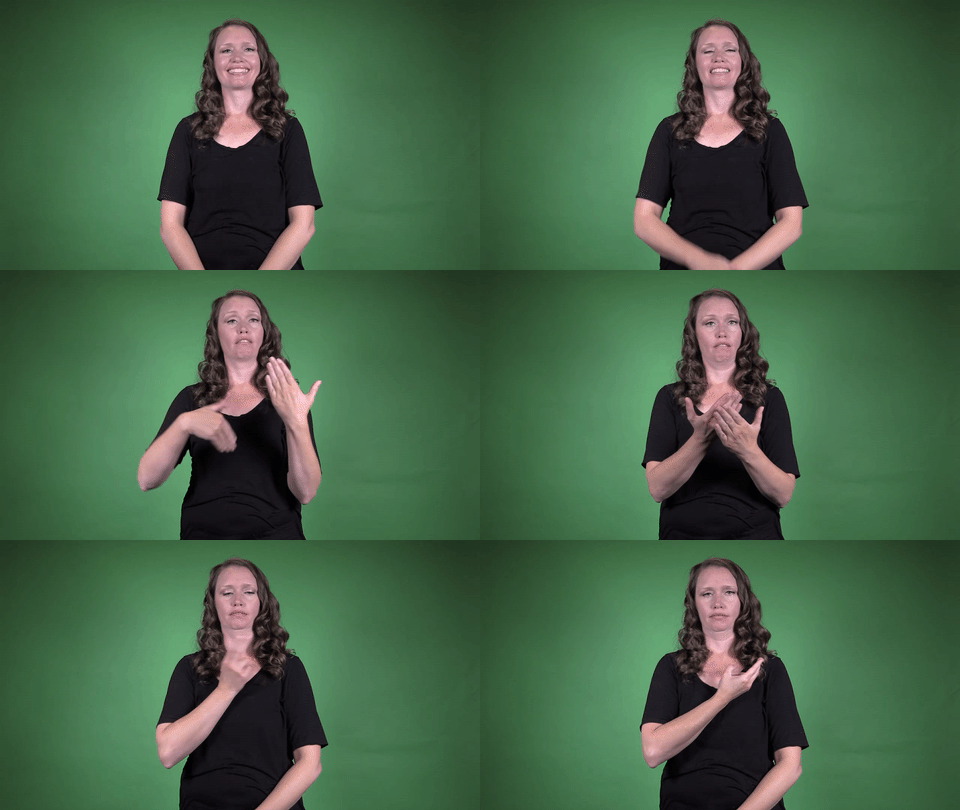
Sign for ALL OF US in ASL | 🧑‍🧑‍🧒‍🧒 ASL Dictionary

Definition: Including every person.

Sign for ALL OF US in ASL 

YouTube player

Practice Activities:

To practice the sign for all of us in ASL, start by signing it slowly in front of a mirror. Watch the movement of your dominant hand as it moves in an arc to indicate inclusivity. Repeat this movement multiple times while saying the English phrase aloud in your head.

Try using the sign for all of us in ASL in different contexts. For example, say, “This gift is for all of us,” or “All of us are going to the park.” Use ASL syntax by placing the sign correctly within the sentence. Record yourself signing these phrases and compare them to videos of fluent signers.

Engage in partner activities by asking a practice buddy, “Who is invited?” and responding with the sign for all of us in ASL. Switch roles and practice different sentences, incorporating signs for various people like friends, family, or classmates. Encourage smooth, natural movements while avoiding hesitation.

For a storytelling challenge, create a short story about a community event. Describe a picnic, a party, or a volunteer activity where all of us participated. Incorporating facial expressions and other relevant signs will strengthen visual storytelling skills.

Watch ASL videos or attend a Deaf community event to observe how native signers use the sign for all of us in ASL naturally. Pay attention to how it appears in conversations and responses. Afterward, practice using it in different settings to reinforce your learning.

Use flashcards with various group-related themes, such as “We all went to the game” or “All of us helped clean up.” Sign each sentence correctly and time yourself to improve fluency. Consistently practicing the sign in meaningful situations will build confidence and accuracy in everyday ASL communication.

Cultural Context:

The sign for all of us in ASL represents inclusivity and unity within the Deaf community. This sign visually sweeps to indicate that “all” people within a particular group are included. It’s commonly used in conversations to emphasize shared experiences or collective action.

In Deaf culture, the sign for all of us in ASL reinforces the idea of community and support. The Deaf community values togetherness, and this sign is often seen in discussions about advocacy, events, or shared goals. Signing this phrase helps express a sense of belonging.

When signing all of us in ASL, facial expressions play a crucial role in conveying the intended meaning. A warm smile can emphasize camaraderie, while a serious expression can indicate unity in facing challenges. Non-manual signals help add depth to the message.

The sign for all of us in ASL is widely used in group discussions, storytelling, and public speaking. It allows signers to include everyone in a conversation without needing to list individuals. ASL is rich in spatial referencing, making this sign practical and efficient.

Communities using ASL often emphasize collective identity. The sign for all of us in ASL strengthens that value, allowing people to talk about shared traditions, struggles, and victories. Its use can be seen in Deaf organizations, classrooms, and social gatherings.

Learning the sign for all of us in ASL helps foster deeper connections with Deaf individuals and ASL users. By using it correctly, signers show cultural awareness and respect for ASL grammar. Understanding this sign enhances both comprehension and engagement in ASL conversations.

When discussing accessibility, rights, or community efforts, the sign for all of us in ASL becomes especially powerful. It helps to unify ideas and include everyone in important discussions. Whether in casual or formal settings, this sign plays an important role in communication.

In educational environments, teachers and students use the sign for all of us in ASL to refer to the entire class. This inclusive language supports collaboration and teamwork. It helps build a sense of community within ASL learning spaces.

The sign for all of us in ASL is an essential part of everyday interactions in Deaf culture. It highlights the importance of unity and shared experiences. Learning and using this sign correctly shows appreciation for the richness of ASL.

Extended Definition:

The sign for all of us in ASL is a natural and expressive way to include everyone in a group. This sign visually represents a collective idea, making it an important phrase for communication in American Sign Language. It emphasizes inclusivity, ensuring that no one is left out of the conversation.

To sign all of us in ASL, the dominant hand typically moves in a circular motion, showing that the group includes the signer. This movement differentiates it from similar signs like “all of you,” which focuses on others rather than the signer. Facial expressions can add further meaning, emphasizing unity and community.

Context plays a crucial role when using the sign for all of us in ASL. It can be used to talk about family, friends, classmates, or any group that involves the signer. Depending on the conversation, it may be followed by additional signs that clarify the group being referenced.

This sign is commonly used in both casual and formal settings. In casual settings, it helps express group relationships, such as, “All of us are going to the movie.” In formal situations, it can be used in speeches, presentations, and storytelling to indicate collective experiences.

Learning the sign for all of us in ASL benefits both Deaf and hearing individuals. It fosters deeper connections and ensures effective communication in group discussions. Understanding and using this sign properly enhances fluency and clarity in ASL conversations.

Some variations of this sign exist depending on regional differences or signer’s preferences. While the circular motion is widely accepted, some signers may incorporate slight changes based on their community. Exposure to different signers helps develop a more comprehensive understanding of ASL usage.

Using the sign for all of us in ASL can strengthen social bonds and create a more inclusive environment. It ensures that everyone in the group feels seen and included during conversations. Practicing this sign regularly improves confidence and fluency in American Sign Language.

For beginners, practicing in front of a mirror or with a partner can help build muscle memory. Watching native ASL signers demonstrate the sign for all of us in ASL can also improve accuracy. Consistent practice is key to mastering this essential ASL phrase.

Synonyms: all of us, everyone, everybody, all together, the whole group

Educational resources: Find related learning materials in our course bank!

Want more? Check out some of our popular learning activities on the homepage!

Need to look up a sign? Use our highly rated dictionary: https://aslinteractive.com/best-asl-dictionary/

Follow us on tiktok: https://www.tiktok.com/@aslinteractive. More social media links at the bottom of this page!

Long-tail Keywords: what is the sign for all of us in ASL, how do you sign all of us in ASL, ASL sign for all of us

Categories:

tags: Pronouns, People, Relationships, Family, Plural pronoun

Parameters

*Handshape*:

The sign for ALL OF US in ASL uses the index finger of the dominant hand. The index finger moves in a circular motion in front of the body, starting from one side and curving around to the other. This motion visually represents the concept of inclusion. The non-dominant hand typically remains at rest. The sign for ALL OF US in ASL helps convey the idea of a collective group, encompassing everyone present.

*Palm Orientation*:

The palm orientation for the sign for ALL OF US in ASL typically faces inward toward the body. The dominant hand moves in a circular motion, with the palm remaining mostly upright or slightly tilted. As the hand circles, the fingers may curve slightly, maintaining a relaxed shape. This motion visually represents the idea of inclusiveness, indicating that everyone present is involved. When signing the sign for ALL OF US in ASL, consistency in palm orientation helps maintain clarity and fluidity.

*Location*:

The sign for all of us in ASL is made in the neutral space in front of the body. The dominant hand forms the number 1 handshape and moves in a small circular motion from one side of the body to the other. This motion visually represents including everyone present. The location remains in front of the chest, ensuring clarity and visibility for the entire movement. Adjust hand position slightly based on the signer’s comfort and audience perspective.

*Movement*:

Start with the dominant hand in the 1-handshape (index finger extended, other fingers curled in) and point towards yourself. Move your hand in a circular motion, palm facing outward, as you arc around in front of your body. Finish by pointing back to yourself. This motion visually represents a group that includes the signer. The sign for all of us in ASL follows a smooth, fluid movement to indicate inclusivity of everyone in the conversation.

*Non-Manual Signals*:

When using the sign for all of us in ASL, maintain a natural and relaxed facial expression unless emphasizing inclusiveness or warmth, where a slight smile can be appropriate . If emphasizing a group’s importance, raised eyebrows or a slight head tilt can help convey engagement. A fluid, circular motion with the dominant hand should be accompanied by eye contact with the group to visually reinforce inclusiveness.

*Prosody, Dominant/Non-Dominant Hand*:

The sign for ALL OF US in ASL uses the dominant hand in an open-handed circular motion. Start with the dominant index finger extended, palm facing inward, and move in a clockwise arc, pointing to different locations as if indicating a group. The movement should be fluid and include a full semi-circle to visually encompass an inclusive space. The non-dominant hand usually remains relaxed or at your side, as the dominant hand conveys the meaning clearly.

Tips for Beginners:

When learning the sign for ALL OF US in ASL, focus on maintaining a fluid and natural circular motion. The dominant hand, using either an index or full-hand gesture, moves in a smooth arc to indicate the collective group. Keep your hand relaxed to ensure the movement is graceful rather than stiff.

A common beginner mistake is making the motion too sharp or too fast. The sign for ALL OF US in ASL should feel continuous and connected, as if drawing an invisible circle around the group. If the movement is jerky, it may look like a different sign or throw off the clarity of communication.

Hand placement is crucial. If the motion is too small, it may seem unclear, while an overly exaggerated movement could appear unnatural. Aim for a moderate size that clearly conveys inclusion without unnecessary embellishment. Practicing in front of a mirror can help fine-tune this balance.

Facial expressions and body language add meaning and emphasis. A warm, inclusive facial expression can reinforce the concept of community, while a neutral face may make the sign feel less engaging. ASL relies not only on hand movements but also on the communicative power of facial expressions.

Be mindful to keep your hand at an appropriate height. Signing too low may be harder to see, while signing too high can seem awkward. The optimal position is around chest level for easy visibility.

If signing in a conversational setting, adapt the size of the movement depending on the group size. For a small group, a tighter circle might be appropriate, while for a larger group, a broader motion is clearer. Watching skilled signers can help reinforce the right fluidity and pacing.

Connections to Other topics:

The sign for ALL OF US in ASL is closely tied to the concepts of inclusion and collective reference. It shares similarities with other signs that indicate groups, such as WE and ALL, both of which emphasize involvement of multiple people. The motion of the sign visually reinforces the idea that everyone present is included, making it useful in various social and conversational contexts.

This sign is frequently combined with other signs to clarify group dynamics. For example, signing ALL OF US followed by FRIENDS can specify that an entire friend group is included. Similarly, ALL OF US paired with KNOW can indicate that everyone in the group has knowledge of a particular topic. These combinations help convey more nuanced messages about who is involved in a situation.

Conceptually, ALL OF US in ASL relates to broader discussions of community and collectivity. It connects with signs such as TOGETHER and GROUP, which emphasize unity. In storytelling or presentations, this sign helps reinforce inclusive ideas by making it visually clear who is being referenced. It is also useful in educational settings to describe shared actions, like ALL OF US LEARN or ALL OF US UNDERSTAND.

The use of a circular motion in the sign for ALL OF US aligns with other inclusive signs that visually indicate coverage of a space. This is similar to the sign for WORLD, which also moves in a circular motion to represent global inclusion. Understanding these motion patterns can help learners recognize how ASL visually represents collective ideas. Learning this sign also prepares users to describe gatherings, teamwork, and shared experiences effectively in ASL communication.

Summary:

The sign for ALL OF US in ASL is a dynamic and visually expressive movement that captures the idea of inclusivity. The signer uses a dominant hand in a pointing shape and moves it in an arc to indicate a collective group. This motion reinforces the meaning that the person is referring to everyone involved in a conversation or situation.

ASL is a spatial language, and the movement used in the sign for ALL OF US in ASL reflects this. Instead of a static gesture, the hand travels in a semi-circle, visually encompassing everyone in the group. The direction of motion can be adjusted based on the arrangement of people in real space.

The sign for ALL OF US in ASL is similar to the sign for WE but covers a broader area. This distinction helps determine whether a general group is included or just a smaller, speaker-related subset. The sign can be modified slightly in placement and movement depending on context.

Some signers emphasize inclusion by using different hand shapes for this sign. While the pointing-hand shape is common, an open-hand shape may also be used for a broader, sweeping motion. These variations exist because ASL, like all languages, evolves naturally through use.

The cultural significance of the sign for ALL OF US in ASL is tied to its collectivist nature. Many Deaf communities value group inclusion and shared experiences, which aligns with the visual nature of the sign. The movement reinforcing an encompassing group mirrors the way Deaf individuals often navigate social interactions.

Grammatically, the sign for ALL OF US in ASL usually follows ASL word order, which can differ from English. It is often placed at the beginning or end of a sentence for emphasis. The flexibility of ASL syntax allows for meaning to be expressed without direct English translations.

Linguistically, this sign takes advantage of ASL’s spatial features. Moving the hand in a semi-circle utilizes the three-dimensional space available in sign language. This highlights one of the defining traits of signed languages that spoken languages do not share.

The sign for ALL OF US in ASL connects to other inclusive signs such as EVERYONE or TOGETHER. These concepts are often physically broad in ASL, using open, sweeping gestures. This reinforces the importance of community and interconnectedness.

In applied linguistics, ASL learners often struggle with the distinction between WE, ALL OF US, and YOU-ALL. Mastering these differences requires an understanding of movement, placement, and directional context. Teaching these concepts effectively involves exposure to natural ASL conversations.

Broader themes tied to the sign for ALL OF US in ASL include inclusivity and community. Deaf culture heavily values shared spaces and group identity, elements that naturally emerge in language use. This sign embodies those ideas in a succinct, visually powerful way.

English speakers might expect words like “we” or “us” to work the same way in ASL, but the spatial and movement aspects of ASL add depth. The sign for ALL OF US in ASL explicitly marks who is included, leaving less ambiguity than its English counterparts. Clear visual distinctions help avoid confusion in conversation.

Signed and spoken languages develop structures that fit their particular modality. ASL relies on movement and space, while spoken languages use intonation and word choice. The sign for ALL OF US in ASL is a strong example of how ASL conveys meaning in ways distinct from spoken English.

Interpreters must be precise when conveying group inclusivity in ASL. Because the sign for ALL OF US in ASL visually encapsulates a wider group, it may not always align perfectly with its English translation. Skilled interpreters consider context to ensure accuracy.

This sign also reinforces the importance of facial expressions in ASL communication. A signer may emphasize the inclusivity of the group by using a facial expression that implies warmth, excitement, or clarity. Expression often fine-tunes meaning beyond the hand movement itself.

Variation exists across different ASL users, with some choosing slightly more exaggerated movements for emphasis. In formal, deliberate signing, the arc might be wider, while in casual conversations, a smaller motion may suffice. Understanding these nuances comes with fluency.

The sign for ALL OF US in ASL is also useful in educational settings, where teachers sign to groups of students. It reinforces the idea of participation and belonging, which is essential in the Deaf community. Classroom contexts often highlight this type of inclusivity.

Social gatherings and Deaf events frequently incorporate this sign. Many public Deaf spaces emphasize group discussion and interaction, making this a common and useful sign. The repetition of such group-centered signs helps foster a shared sense of identity.

Media representation of ASL sometimes alters signs for simplicity or clarity on screen. The sign for ALL OF US in ASL, however, is relatively straightforward and typically remains authentic in various contexts. Its widespread use makes it recognizable even to those with limited ASL knowledge.

The sign for ALL OF US in ASL fits

Want more? Check out some of our popular learning activities!

ASL Interactive Resources

ASLInteractive YouTube Channel

Follow us on tiktok: @aslinteractive.com

Follow us on Instagram: aslinteractive

Facebook page: aslinteractive

Facebook group: aslinteractive

LInkedIn: ASL Interactive LLC

Twitter: @ASL_interactive

*Some information on this page is AI-generated. AI can make mistakes. Please check the information.

Sign for ALL OF US in ASL 

Responses