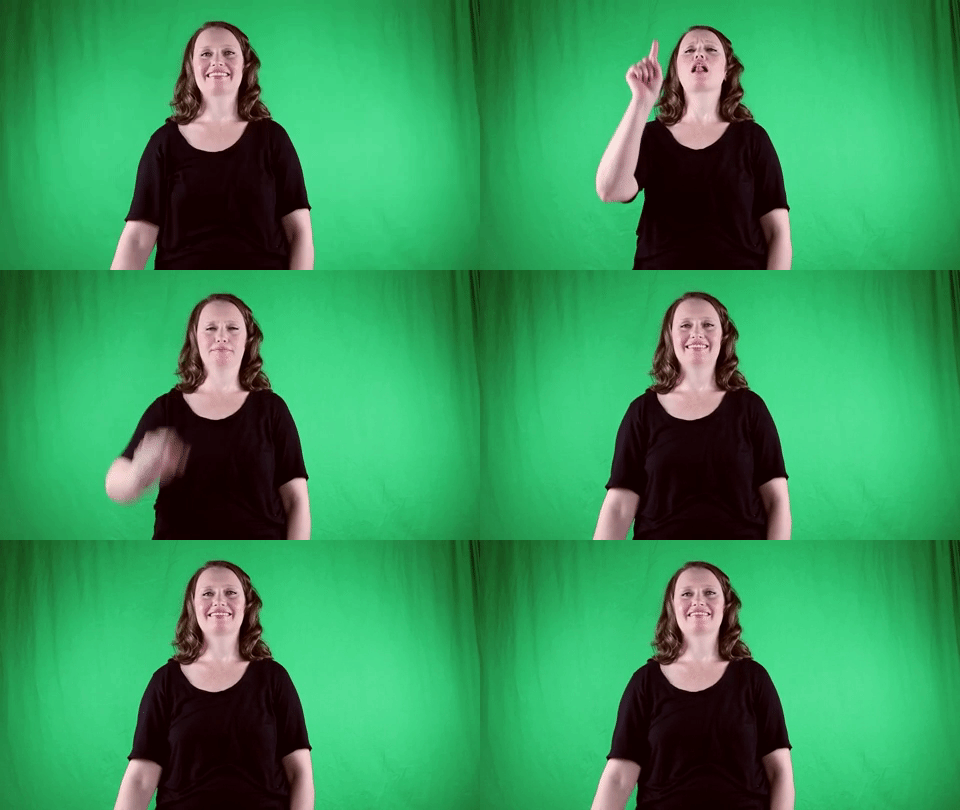
Definition: Completely to the bottom.
Sign for ALL-WAY-DOWN in ASL

Practice Activities:
To practice the sign for all-way-down in ASL, start by signing it in isolation multiple times while watching yourself in a mirror. Pay attention to handshape, movement, and facial expressions. Repetition will help solidify muscle memory and improve fluency.
Try incorporating the sign into simple sentences to reinforce meaning. For example, sign “The elevator goes all-way-down” or “The ball rolled all-way-down the hill.” Practice these sentences at a slow pace, then gradually increase speed as you become more comfortable.
Create a short story using the sign for all-way-down in ASL. For instance, describe a scenario where someone drops an item and watches it slide to the bottom. Act out the motion with your expressions and body movements to enhance clarity. Perform the story for a partner or record yourself for review.
Engage in a partner activity where one person describes a process using directional signs while the other interprets the meaning. One prompt could be: “Describe a leaf falling from the highest tree branch all-way-down to the ground.” This promotes interactive learning and improves comprehension.
Visualize real-life situations where you would use the sign for all-way-down in ASL. Imagine guiding someone onto an escalator and explaining that it will carry them all the way down. By linking the sign to everyday experiences, you strengthen recall and practical application.
Play a game where you give directions using directional signs, including all-way-down, to guide a partner through an obstacle course or imaginary setting. This encourages thinking of spatial relationships and reinforces accurate sign production.
Keep a journal where you write down new phrases and situations where you used the sign for all-way-down in ASL. Reviewing your progress helps identify areas for improvement and reinforces learning over time.
Cultural Context:
The sign for all-way-down in ASL is commonly used to show something moving downward completely. This phrase can describe anything that descends fully, whether it’s an elevator, prices dropping, or emotions sinking. In ASL, the sign for all-way-down visually represents this complete downward motion.
Deaf culture values clear and expressive communication, making directional signs like the sign for all-way-down essential. Signing this phrase correctly ensures the message is precise, preventing any misunderstandings. Since ASL is a visual language, the sign for all-way-down must be performed with the appropriate facial expressions and movement.
Context influences how the sign for all-way-down in ASL is used. It can describe physical movement, such as a person going downstairs, or metaphorical concepts, like the economy declining. Understanding the sign for all-way-down helps make conversations in ASL more fluid and natural.
In storytelling, the sign for all-way-down can add dramatic effect when describing characters falling or an object dropping completely. ASL storytelling relies heavily on visual imagery, so using directional signs like the sign for all-way-down enhances the narrative. Deaf performers use this sign to create a vivid representation of events unfolding.
The frequency of using the sign for all-way-down in ASL depends on everyday conversations and specific topics. Discussions about geography, travel, or financial decline might feature this sign often. Mastering the sign for all-way-down is useful for fluency in ASL.
Learning ASL requires understanding how signs work together to form clear communication. The sign for all-way-down connects with other directional signs to describe movement in space. By practicing the sign for all-way-down, signers can better convey precise messages in conversations.
Extended Definition:
The sign for all-way-down in ASL is used to indicate something that descends completely, whether physically, metaphorically, or in a directional sense. This sign conveys the idea of something moving downward in various ways, covering all possible paths or angles. It can be applied to objects, concepts, or even personal experiences.
When using the sign for all-way-down in ASL, the movement of the hands often follows a thorough downward motion. The hands may sweep downward in a controlled or exaggerated manner, depending on the context. Facial expressions can further clarify whether the descent is gradual, sudden, or extreme.
This sign can be used in different contexts, such as describing a road that slopes in multiple directions before reaching the lowest point. It can also describe emotions, such as feeling completely drained or defeated. Additionally, it may apply to economic or performance-based situations, like a stock price dropping significantly.
In storytelling, the sign for all-way-down in ASL adds visual depth to descriptions of falling objects, sinking ships, or descending action sequences. It helps to create a more immersive experience by illustrating motion in a dynamic way. This makes it valuable for ASL literature and expressive signing.
Understanding how to use this sign effectively depends on context, hand shape, and movement. Small changes in palm orientation or speed can alter the meaning slightly. Using appropriate facial expressions can strengthen the sign’s impact and ensure the message is clear.
Another important aspect of this sign is its ability to show direction and completeness. Unlike a simple “down” movement, the sign for all-way-down in ASL emphasizes thoroughness. This means that whatever is being described has gone fully downward without stopping halfway.
This sign is useful in everyday conversation and professional settings where detailed descriptions of movement or decline are necessary. ASL users rely on it to explain concepts like heavy rainfall, business downturns, or even emotional states. It serves a functional and expressive role in communication.
By mastering the sign for all-way-down in ASL, signers can enhance their fluency and storytelling abilities. It allows for clear, descriptive communication in a wide variety of situations. Using this sign correctly helps maintain the richness and precision of ASL.
Synonyms: completely, entirely, fully, down to the bottom, to the very end
Educational resources: Find related learning materials in our course bank!
Want more? Check out some of our popular learning activities on the homepage!
Need to look up a sign? Use our highly rated dictionary: https://aslinteractive.com/best-asl-dictionary/
Follow us on tiktok: https://www.tiktok.com/@aslinteractive. More social media links at the bottom of this page!
Long-tail Keywords: what is the sign for all-way-down in ASL, how do you sign all-way-down in ASL, ASL sign for all-way-down
Categories:
tags: Directions, commands, verbs, everyday activities, actions
Parameters
*Handshape*:
The sign for ALL-WAY-DOWN in ASL uses an open handshape, usually with the dominant hand forming a flat palm facing downward. The movement follows a directional path, smoothly transitioning from a higher position to a lower one, emphasizing the concept of gradual descent. This sign visually represents something moving all the way down, often with an extended motion to show the full range. Depending on the context, facial expressions can enhance meaning.
*Palm Orientation*:
The palm orientation for the sign for ALL-WAY-DOWN in ASL starts with the dominant hand facing upward or slightly forward. As the hand moves downward in a controlled manner, the palm may slowly shift to face more downward, depending on the emphasis or specific variation. This movement visually represents the concept of descending completely. The non-dominant hand may serve as a reference point, remaining steady while the dominant hand moves.
*Location*:
The sign for ALL-WAY-DOWN in ASL is typically produced in the neutral space in front of the signer’s torso. The dominant hand moves from an elevated position down toward a lower location, often near the waist or hip area. Depending on context, the movement may be smooth or more deliberate to emphasize complete descent. The handshape and motion help visually depict the idea of something moving entirely downward.
*Movement*:
To sign for all-way-down in ASL, begin with your dominant hand in a flattened “B” handshape, palm facing downward. Move the hand in a steady downward motion while your non-dominant hand, also in a flat “B” handshape, remains stationary to indicate a reference point. The movement should be smooth and continuous, emphasizing a descent from a higher position to a lower one. Facial expressions help convey the extent or intensity of the action.
*Non-Manual Signals*:
When expressing the sign for ALL-WAY-DOWN in ASL, the eyebrows are typically slightly furrowed to emphasize directionality or intensity. The head may tilt downward slightly to reinforce the descending motion. Mouth movements can include a slight “mm” or “oo” shape to show the extent of movement. If emphasizing a gradual descent, the signer may use a slower motion with a concentrated expression. A more abrupt movement may be paired with widened eyes or a sudden head movement.
*Prosody, Dominant/Non-Dominant Hand*:
The sign for ALL-WAY-DOWN in ASL uses the dominant hand in an open palm or slightly bent “B” handshape, starting from a higher position and moving downward in an arcing motion. The non-dominant hand can remain stationary to provide a reference point or stay neutral. This movement visually represents the concept of something gradually going down completely. Facial expressions may emphasize the degree or speed of descent for added meaning.
Tips for Beginners:
When learning the sign for ALL-WAY-DOWN in ASL, focus on maintaining smooth movement from start to finish. This sign typically involves a dominant hand that moves downward in a controlled yet fluid manner, ensuring clarity. Keep your handshape consistent throughout the motion to avoid adding extra movements that might confuse the meaning.
A common mistake beginners make when signing ALL-WAY-DOWN in ASL is making the movement too choppy or fast. The sign should clearly show a transition from a higher position to a lower one, so rushing can make it hard to understand. Practicing in front of a mirror can help ensure the movement remains accurate and easy to recognize.
Hand orientation is crucial when performing the sign for ALL-WAY-DOWN in ASL. Ensure that your palm faces the correct direction while moving downward to maintain the sign’s accuracy. If your palm is positioned incorrectly, the sign might be misinterpreted, so be mindful of where your fingers and hand are pointing.
For clear communication, always incorporate facial expressions that match the meaning of the sign for ALL-WAY-DOWN in ASL. If emphasizing a significant or dramatic drop, a corresponding facial expression can enhance the sign’s impact. Facial expressions help convey intent and intensity, making your signing more natural.
If you’re struggling with the sign for ALL-WAY-DOWN in ASL, try breaking it into smaller movements. Practicing each part separately and then stringing them together will help with muscle memory. Watching videos of fluent signers and mimicking their motion can also improve accuracy.
Consistency and repetition are key when mastering the sign for ALL-WAY-DOWN in ASL. Practice regularly, be mindful of hand positioning, and seek feedback from experienced signers. Over time, the motion will feel more natural, and you’ll be able to sign it confidently in conversations.
Connections to Other topics:
The sign for ALL-WAY-DOWN in ASL connects with directional and spatial concepts widely used in signing. It shares similarities with directional verbs, where movement indicates both location and destination. This sign is particularly useful in descriptions of movement, pathways, or when explaining changes from a higher position to a lower one, such as an elevator descending or an object slowly sinking.
This concept also relates to signs for falling, decreasing, or sinking, as they all depict movement in a downward direction. Some signs, like DECREASE or DECLINE, may use similar motion patterns but with modifications to indicate gradual reduction or a figurative loss. In contrast, the sign for ALL-WAY-DOWN in ASL emphasizes complete downward movement, making it particularly relevant in contexts like explaining water drainage, going down a hill, or objects falling to the ground entirely.
Many compound signs incorporate directional movement to describe various actions. A phrase like WALK-ALL-WAY-DOWN can combine directional movement with locomotion, giving a clear visual representation of continuous movement downward. Similarly, FALL-ALL-WAY-DOWN can indicate a fall that extends to the lowest point, making it distinct from a brief or interrupted fall. These uses showcase how movement and space interact in ASL to convey precise meanings.
This sign also connects to discussions about classifiers in ASL, particularly CL:V (used for legs or a person falling) or CL:B (used for a flat object moving downward). Classifiers allow signers to illustrate movement patterns in more depth, helping describe how something or someone moves all the way down. Learning the sign for ALL-WAY-DOWN in ASL builds stronger spatial awareness and enhances the ability to describe movement in a visually rich way.
Summary:
The sign for ALL-WAY-DOWN in ASL is used to describe something moving downward completely or to its lowest possible point. It can refer to a physical descent, such as an elevator going from the highest floor to the basement, or a metaphorical decline, like a stock market crash. The motion of the sign typically emphasizes a full and complete lowering, reinforcing the idea of total descent.
In ASL, concepts dealing with direction and movement often rely on clear spatial representation. The sign for ALL-WAY-DOWN in ASL captures not just the motion downward but also the extent to which something is being lowered. This helps express the full range of movement efficiently without needing additional clarification.
Hand placement and movement are essential in making the sign for ALL-WAY-DOWN in ASL clear. A dominant hand usually moves in a steady motion, guiding the viewer’s perspective from a higher point to a lower point. This movement is essential for proper interpretation, ensuring that the meaning of complete descent is conveyed accurately.
Facial expressions play an important role in reinforcing the meaning of the sign for ALL-WAY-DOWN in ASL. A neutral face might indicate something mundane, like an object dropping, while a more exaggerated expression could suggest a drastic or unexpected drop. Contextual details help refine the meaning, so ASL users often rely on complementary nonmanual markers.
The sign’s grammatical usage can vary depending on whether the movement is literal or figurative. If someone signs ALL-WAY-DOWN in the context of a person’s mood, it might suggest deep sadness or depression. If used in mechanical contexts, it could refer to gears or levers dropping to a lower position.
Cultural significance plays a role in how the sign for ALL-WAY-DOWN in ASL is understood. In some Deaf communities, directional signs like this one are tied to shared visual-spatial ways of thinking. This means signers naturally adjust their use of space to match real-world topography and concepts.
Related ASL signs include DOWN, FALL, DROP, and REDUCE. These signs share a similar downward motion but lack the emphasis on complete descent that distinguishes the sign for ALL-WAY-DOWN in ASL. By modifying these related signs with movement and direction, signers can create nuanced meanings.
One linguistic insight is that directional verbs in ASL often involve intentional spatial structuring. The sign for ALL-WAY-DOWN in ASL makes use of its downward motion to depict movement realistically, aligning ASL more closely with visual representation than spoken languages. This highlights the language’s capacity for naturalistic expression.
Applied linguistics supports the idea that spatial awareness is crucial for effective communication in ASL. The sign for ALL-WAY-DOWN in ASL is an excellent example of how motion provides meaning. Teaching ASL learners to emphasize directional movement enhances their fluency and ability to describe changes in position effectively.
For interpreters, accurately representing the sign for ALL-WAY-DOWN in ASL requires appropriate pacing and nonmanual markers. If something is falling slowly, the motion of the sign should reflect that. If the descent is sudden, a sharp movement is needed to capture the immediacy of the action.
Storytelling in ASL frequently relies on dynamic movement to relay detailed narratives. The sign for ALL-WAY-DOWN in ASL is useful in storytelling when describing dramatic drops, like a character plummeting off a cliff or an intense emotional downturn. The exaggerated motion can heighten the storytelling effect.
The broader theme of downward movement in ASL connects to a range of concepts, from literal changes in position to abstract concepts like financial losses or emotional struggles. The sign for ALL-WAY-DOWN in ASL allows for nuanced descriptions of various declines, expanding ASL’s expressive depth.
Technology and engineering discussions sometimes use the sign for ALL-WAY-DOWN in ASL to describe mechanical lowering or system shutdowns. A bridge that lowers, a computer that completely powers off, or a machine that stops all operations are examples where the sign fits well. The visual-spatial nature of ASL makes it effective for technical explanations.
Everyday conversations utilize the sign for ALL-WAY-DOWN in ASL when describing experiences like a staircase leading to a basement or an escalator reaching the ground floor. It is also essential in sports terminology, such as a player being thrown completely down during a game. The sign’s flexibility makes it widely applicable.
Directional repetition can change the meaning of the sign, allowing variations in emphasis. A single, firm movement expresses a decisive downward action, while repeated, slower movements can indicate a gradual descent. These modifications ensure precision in communication, enhancing ASL’s structural efficiency.
Nonmanual elements such as raised eyebrows or an open mouth often enhance the message conveyed with the sign for ALL-WAY-DOWN in ASL. A quick head tilt can signal urgency, while a calm expression may suggest a slow descent
Want more? Check out some of our popular learning activities!
ASL Interactive Resources
ASLInteractive YouTube Channel
Follow us on tiktok: @aslinteractive.com
Follow us on Instagram: aslinteractive
Facebook page: aslinteractive
Facebook group: aslinteractive
LInkedIn: ASL Interactive LLC
Twitter: @ASL_interactive
*Some information on this page is AI-generated. AI can make mistakes. Please check the information.


Responses