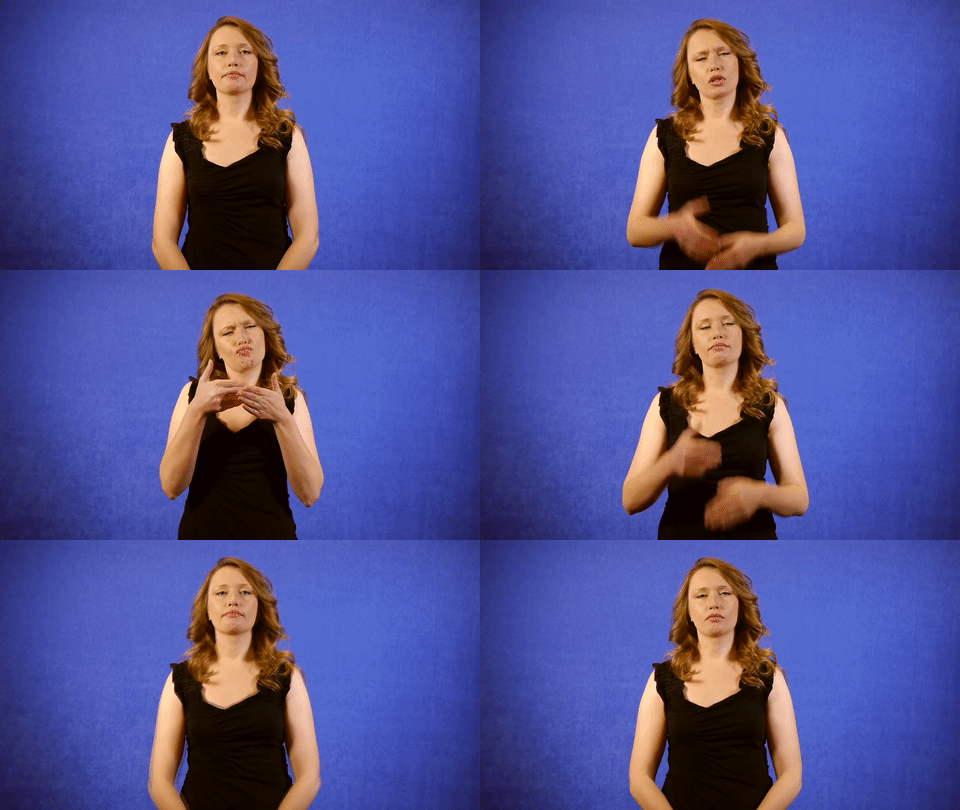
Sign for ALMOST in ASL | o ASL Dictionary

Definition: Not quite; very nearly.

Sign for ALMOST in ASL 

YouTube player

Practice Activities:

To practice the sign for almost in ASL, start by signing it in isolation. Hold your dominant hand in a bent shape and brush it up slightly on the fingertips of your non-dominant hand. Repeat this movement multiple times while looking in a mirror to ensure accuracy. Say the English word in your mind as you sign to reinforce the connection.

Try using the sign for almost in ASL within simple sentences. For example, sign “I almost forgot” or “She is almost late.” Practice signing these sentences slowly at first, then increase speed while maintaining clarity. Use facial expressions to emphasize the meaning, showing relief if you just avoided forgetting something or concern if someone is close to being late.

Engage in a storytelling activity that includes the sign for almost in ASL. Create a short story where something is close to happening but doesn’t quite occur. For example, tell a story about a person almost catching a bus, almost winning a race, or almost dropping their phone. Use exaggerated facial expressions and body language to add emphasis.

Pair up with a partner for a conversational exercise. One partner signs the beginning of a scenario, such as “I was running to class…” and the other finishes with something that almost happened, like “I almost tripped.” Take turns coming up with different scenarios, making sure to sign smoothly.

For a fun practice challenge, watch ASL storytelling videos or real-life conversations to spot when the sign for almost in ASL is used. Try signing along with the videos to improve speed and fluency. You can also play a charades-style game where one person signs a phrase using almost, and others guess what they are describing.

Cultural Context:

The sign for almost in ASL is an important expression in everyday conversations. It helps convey the idea of something being close to happening but not quite there. This sign is useful in both casual and formal settings.

In Deaf culture, clear and precise communication is essential. The sign for almost in ASL allows signers to express near misses, close calls, or upcoming events. It is commonly used to describe situations where something was just about to happen.

Facial expressions play a big role when using the sign for almost in ASL. Slight changes in expression can indicate whether something was frustrating, exciting, or disappointing. Deaf signers rely on these non-manual signals to express emotions and add depth to their signs.

This sign is often used in storytelling, especially to build suspense. When narrating events, signers might use the sign for almost in ASL to show that something was on the verge of occurring. This enhances the visual imagery that ASL is known for.

In academic and professional settings, this sign is useful for discussing progress. It helps explain when a project is nearly finished or when a goal is close to being achieved. Using the sign for almost in ASL ensures clarity in workplace and classroom discussions.

Learning the sign for almost in ASL is beneficial for both Deaf and hearing signers. It allows for smoother interactions in social and professional environments. Knowing how to express “almost” accurately strengthens ASL communication skills.

Many ASL learners find this sign helpful when describing personal experiences. Conversations often include moments where something was just about to happen but didn’t. The sign for almost in ASL makes it easy to share these relatable moments.

Understanding cultural aspects of ASL, including the use of non-manual markers, enhances signing accuracy. A simple sign like this can have different meanings based on facial expressions. Mastering the sign for almost in ASL improves overall communication within the Deaf community.

Teachers often introduce this sign early in ASL lessons. It helps students form more detailed sentences and express timing more effectively. The sign for almost in ASL is considered a fundamental part of fluent communication.

Many ASL dictionaries and online resources include video demonstrations of this sign. Watching how fluent signers use the sign for almost in ASL helps learners perfect their technique. Repeating and practicing the sign regularly increases confidence in signing.

In everyday life, this sign is practical in many situations, from talking about upcoming events to discussing near successes. The

Extended Definition:

The sign for almost in ASL is a useful word to describe something that is close to happening but doesn’t quite occur. It conveys the idea of being near completion or just short of a goal. This sign is commonly used in everyday conversations.

To sign for almost in ASL, place one hand flat with the palm facing upward. The other hand moves toward the fingers of the stationary hand, stopping just before touching. This movement represents something coming close but not fully reaching its destination.

This sign can describe various situations, such as almost finishing a project, almost winning a game, or almost arriving at a destination. It helps express near-success or near-completion without actually achieving the final result. Understanding the sign for almost in ASL improves fluency and communication.

When using this sign, facial expressions play an important role in emphasizing how close something is to happening. A slight raise of the eyebrows or a look of disappointment can enhance the meaning. ASL relies on more than just hand movements; facial expressions and body language add depth to communication.

The sign for almost in ASL is different from words like “barely” or “just missed.” While these words may seem similar, they have different meanings and are signed differently. Learning the correct distinctions ensures accurate communication in ASL conversations.

In real-life situations, the sign for almost in ASL can be helpful in storytelling, daily interactions, and even jokes. For example, someone might use this sign when talking about nearly catching the bus or almost dropping a coffee cup. The versatility of this sign makes it a valuable part of ASL vocabulary.

Many signs in ASL visually represent their meanings, and the sign for almost in ASL is a good example. The movement of one hand stopping just short of the other hand creates a visual clue that makes it easy to remember. This logical structure helps ASL learners recall signs more efficiently.

Learning the correct way to sign for almost in ASL is important for both beginners and advanced signers. Practicing the motion and incorporating appropriate facial expressions enhances clarity. Watching native signers and practicing in real conversations can improve fluency.

ASL is a rich language with its own grammar and structure, and the sign for almost in ASL is just one of many descriptive signs. Expanding vocabulary with precise signs helps individuals express thoughts more clearly. Continuing to learn more ASL signs strengthens communication skills and fosters connections within the Deaf community.

Synonyms: nearly, about, close to, roughly, just about

Educational resources: Find related learning materials in our course bank!

Want more? Check out some of our popular learning activities on the homepage!

Need to look up a sign? Use our highly rated dictionary: https://aslinteractive.com/best-asl-dictionary/

Follow us on tiktok: https://www.tiktok.com/@aslinteractive. More social media links at the bottom of this page!

Long-tail Keywords: what is the sign for almost in ASL, how do you sign almost in American Sign Language, ASL sign for almost explained

Categories:

tags: actions, language learning, almost, verbs, everyday activities

Parameters

*Handshape*:

The sign for ALMOST in ASL uses a dominant hand in a bent “B” handshape with the fingers slightly curved. The dominant hand moves upward in a quick flicking motion as it brushes the palm of the non-dominant hand, which remains steady in a flat position. This movement visually emphasizes closeness or near completion. The sign for ALMOST in ASL effectively conveys the meaning of something being very close to happening but not quite there yet. ✋

*Palm Orientation*:

The palm orientation for the sign for ALMOST in ASL is typically open with the dominant hand’s palm facing upward or slightly tilted. The fingers are relaxed and slightly curved. The dominant hand moves in a quick, upward brushing motion against the upward-facing palm of the non-dominant hand. The non-dominant hand remains stationary in a relaxed position. This movement conveys the concept of something being close to happening but not quite.

*Location*:

The sign for ALMOST in ASL is located in the neutral signing space in front of the body, slightly below chest level. The dominant hand is open with the palm facing up, and the fingertips of the dominant hand brush up against the upward-facing palm of the non-dominant hand. The movement is subtle but conveys the concept of nearly reaching a point. This sign is positioned centrally for clear visibility.

*Movement*:

To sign for almost in ASL, place your dominant hand flat with the palm facing up. Position it near the fingertips of your non-dominant hand, which is also flat and facing up. Quickly brush your dominant hand’s fingertips against the palm or fingers of your non-dominant hand in an upward and forward motion. This movement suggests something being just out of reach or nearly happening. Keep your facial expression neutral or slightly expectant to match the meaning.

*Non-Manual Signals*:

When using the sign for ALMOST in ASL, the eyebrows are typically neutral or slightly raised, depending on the context. A slight head tilt forward can emphasize the meaning, especially in conversational signing. Mouth movements such as “almost” or a slight pursing of the lips can add clarity. If emphasizing frustration or disappointment, a small sigh or tightening of the lips may accompany the sign for ALMOST in ASL.

*Prosody, Dominant/Non-Dominant Hand*:

The sign for ALMOST in ASL uses both hands. The non-dominant hand is flat, palm facing down in a relaxed position. The dominant hand is also flat with fingers together, positioned below or slightly behind the non-dominant hand. The dominant hand moves upward and forward, sliding against the bottom of the non-dominant hand with a quick, brushing motion. This movement conveys the idea of something being close but not quite achieved.

Tips for Beginners:

When learning the sign for ALMOST in ASL, start by making sure your dominant hand is in a flat, open shape with your fingers together. Your non-dominant hand will also be flat and slightly angled. The motion involves a quick upward swipe with your dominant hand gently brushing against the fingertips of your non-dominant hand.

Focus on using a light, controlled motion rather than a forceful one. A common mistake beginners make is pressing too hard or rushing the movement. Keep your gestures smooth and fluid to ensure clarity. Practice in front of a mirror to check that you’re maintaining proper hand positioning.

Facial expressions can help convey meaning when you sign for ALMOST in ASL. Slightly raising your eyebrows or pursing your lips can emphasize that something was close but didn’t quite happen. Watch fluent signers or video examples to see how expressions naturally accompany the sign.

Avoid turning your hands or moving them too much to the side. Keeping your hands in the correct orientation ensures that the sign is easily recognizable. Small adjustments in hand angle or motion can make a big difference in clarity.

If you’re struggling with accuracy, slow the movement down and gradually increase your speed as you build confidence. Regular practice will help reinforce correct muscle memory. Signing in front of a fluent signer or getting feedback from an instructor can also be helpful.

In everyday conversations, the sign for ALMOST in ASL is often used with other signs to describe events or actions that nearly happened. Pay attention to context so you can use it naturally. Watching ASL conversations or signing practice sentences will strengthen your understanding. Keep practicing, and don’t be afraid to refine your technique as you go!

Connections to Other topics:

The sign for ALMOST in ASL connects to various related concepts expressing proximity, near completion, or close approximation. This sign shares a conceptual link with signs like CLOSE, NEAR, and APPROACH, all of which describe distances or degrees of completion. Additionally, it pairs well with time-related signs like FINISH or SOON, helping to convey that something is nearly done but not quite complete.

In conversational ASL, the sign for ALMOST in ASL can be used with modulations in facial expressions to indicate how close something was to happening. For instance, pairing it with WIN can emphasize that someone nearly won a game, with disappointment or relief depending on the context. This adaptability in expression is crucial for conveying tone and emphasis in ASL storytelling and everyday communication.

This sign also integrates smoothly into compound phrases like ALMOST FORGET, reinforcing concepts of forgetfulness and near-misses. Similarly, ALMOST FALL can express a close call with balance, useful in narrative descriptions. These combinations illustrate how ASL efficiently combines basic signs to express more complex meanings without needing additional words.

Understanding the sign for ALMOST in ASL also supports comprehension of related adverbial expressions like BARELY or HARDLY, which modify actions by indicating degrees of occurrence. These concepts are useful for describing experiences where something was just short of happening, making them valuable for nuanced conversations. Mastering these distinctions improves clarity and expressive depth in ASL communication.

Summary:

The sign for ALMOST in ASL is an important sign used to convey the idea of something being very close to happening but not quite completed. It captures the nuance of near completion or an event that was narrowly missed. The movement and handshape used in this sign reflect the concept of proximity and anticipation.

To produce the sign for ALMOST in ASL, use an open dominant hand with the fingers slightly curved. Place the dominant hand near the palm of the non-dominant hand without making contact. Then, swiftly move the dominant hand forward in an upward, curved motion, brushing just above the fingers of the non-dominant hand.

This movement expresses the idea of being extremely close to finishing something, but not quite achieving it. The upward flick mimics the concept of reaching but missing, which visually embodies the meaning of “almost.” The non-dominant hand remains stable, reinforcing the spatial relationship necessary for the full meaning of the sign to be clear.

In ASL, movement and spatial relationships are crucial for conveying nuances. The sign for ALMOST in ASL relies on the subtle interplay between hand motion and positioning. A slight variation in movement speed and hand proximity can change the meaning, emphasizing just how close or far something was from completion.

This sign is commonly used in everyday conversations to express things like “I almost finished my work” or “I was almost late.” It is a useful descriptor in storytelling, especially when relaying events that were on the verge of happening but did not. The visual component of ASL makes this an effective way to capture near misses or partial completions.

The sign for ALMOST in ASL can also convey emotional undertones depending on the signer’s facial expressions. If the signer shows frustration or disappointment, it indicates a missed opportunity. If the expression is neutral or positive, it can signal progress toward a goal that is not yet reached.

This expressive nature of ASL signs highlights how non-manual markers such as facial expressions and head movements influence interpretation. Since ALMOST often conveys a point of contrast—meaning something was expected but didn’t fully happen—emphasis on facial grammar is key. Raised eyebrows can signal uncertainty, while a head shake might add emphasis to the idea that completion did not occur.

Some signs closely related to ALMOST are CLOSE, NEAR, and NOT-YET. CLOSE and NEAR share similar spatial concepts, whereas NOT-YET implies something is still pending. These related signs provide subtle distinctions that allow for precise communication in ASL.

In linguistic terms, ALMOST functions as an adverb in English, and its ASL equivalent similarly modifies the surrounding signs. It often precedes or follows a verb sign, depending on sentence structure. Understanding its role in ASL grammar helps learners use it fluently in various contexts.

Because ASL is a spatial language, slight modifications to a sign can dramatically shift meaning. By adjusting the speed or position of the sign for ALMOST in ASL, a signer can indicate greater urgency or near certainty of an incomplete action. This adaptability is a core feature of ASL’s expressiveness.

The concept of ALMOST is significant in many cultures, highlighting moments of anticipation, failure, or progress. In Deaf culture, storytelling plays a vital role, and signs like ALMOST enhance narratives by creating visual suspense. It allows deaf and hard-of-hearing individuals to vividly describe moments of near success or emotional tension.

The sign for ALMOST in ASL aligns with broader linguistic theories about gesture and meaning representation. Gestural languages create iconic representations of abstract concepts, making comprehension intuitive. The brush-like motion in ALMOST visually parallels the notion of something barely missing a threshold.

Applying ASL signs like ALMOST effectively in conversation requires an understanding of pacing and emphasis. Quick, sharp movements might indicate urgency, while slower, drawn-out gestures can suggest hesitation. The fluid nature of ASL allows for natural variation based on conversational needs.

In storytelling, ALMOST can foreshadow future events or shift a narrative’s trajectory. A signer may pause slightly after signing ALMOST to create suspense before revealing whether the action was later completed. This pacing technique mirrors storytelling methods in spoken languages.

The sign for ALMOST in ASL also reflects the broader cognitive principle of near-miss experiences. Human perception emphasizes differences between completed and near-completed actions, affecting attention and memory. ASL’s visual nature enhances the retention of nuanced experiences like ALMOST scenarios.

ASL learners often struggle with concepts like ALMOST because it uses indirect movement rather than direct depiction. Unlike object-based signs, ALMOST relies on relative hand positioning. Developing fluency requires an understanding of how spatial movement in ASL represents abstract ideas.

Teachers and interpreters emphasize ALMOST because it helps bridge beginner and advanced ASL comprehension. Mastering it allows signers to describe probabilities, unfinished tasks, and expectations. It also builds a foundation for learning more complex ASL

Want more? Check out some of our popular learning activities!

ASL Interactive Resources

ASLInteractive YouTube Channel

Follow us on tiktok: @aslinteractive.com

Follow us on Instagram: aslinteractive

Facebook page: aslinteractive

Facebook group: aslinteractive

LInkedIn: ASL Interactive LLC

Twitter: @ASL_interactive

*Some information on this page is AI-generated. AI can make mistakes. Please check the information.

Sign for ALMOST in ASL 

Responses