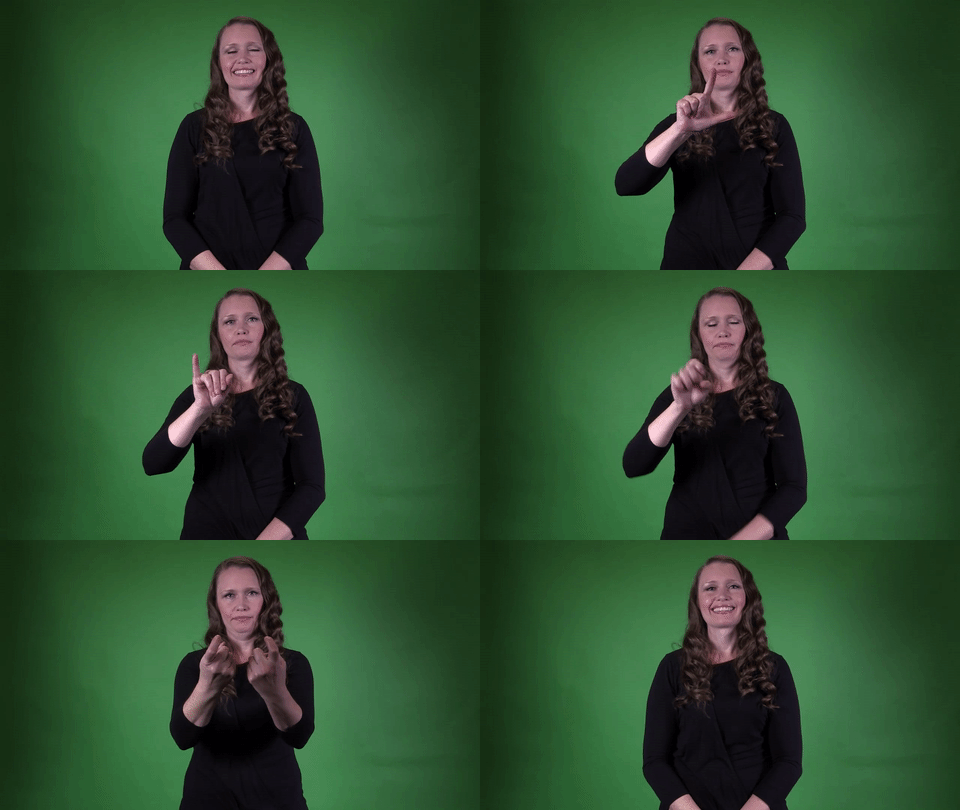
Sign for ALPINE SKIING in ASL | ⛷️ ASL Dictionary

Definition: A sport involving skiing down hills covered in snow.

Sign for ALPINE SKIING in ASL 

YouTube player

Practice Activities:

To practice the sign for alpine skiing in ASL, start by signing it in isolation multiple times while watching yourself in a mirror. Focus on handshape, movement, and facial expression to ensure accuracy. Then, try signing it at different speeds to improve fluidity.

Use the sign for alpine skiing in ASL within simple sentences like “I love alpine skiing” or “Alpine skiing is fast and fun.” Sign these sentences slowly at first, then increase speed as you get more comfortable. Record yourself signing and compare it to a native ASL user for self-correction.

Engage in a storytelling activity where you describe a day on the slopes using the sign for alpine skiing in ASL. Include details about the weather, the mountain, and the experience of skiing downhill. Practice this several times, refining your use of classifiers and facial expressions.

Work with a partner to create a short skit about planning a ski trip. One person can ask, “Do you want to go alpine skiing this weekend?” and the other can respond, “Yes, I love alpine skiing!” Include signs for snow, mountains, and other skiing-related terms to enrich your conversation.

Play a category game where you list various winter sports and sign each one. When you sign the sign for alpine skiing in ASL, exaggerate the movement slightly to mimic the downhill motion. This will help reinforce the concept while making practice fun.

Try fingerspelling “ski resort” and then sign alpine skiing right after to create a fluid phrase. Doing this will improve transitions between fingerspelling and signing. Repeat this process with other related terms like “mountains” or “snow.”

Finally, participate in a group challenge where each person shares one fact about alpine skiing using ASL. This activity will help you integrate the sign naturally into conversation while also learning more about the sport.

Cultural Context:

Alpine skiing in ASL is an essential sign for anyone passionate about winter sports. Whether you’re a skiing enthusiast, an instructor, or just enjoy watching the Winter Olympics, knowing the sign for alpine skiing in ASL connects you with the Deaf and Hard-of-Hearing community. This sign allows for clear communication about one of the most exciting downhill sports. ⛷️

Alpine skiing is a popular winter activity enjoyed by millions worldwide. From the snowy mountains of Colorado to the Swiss Alps, this thrilling sport combines speed, skill, and technique. Learning the sign for alpine skiing in ASL makes it easier to discuss ski trips, lessons, and competitions with Deaf friends and athletes.

This high-speed winter sport involves skiing down steep slopes, navigating turns, and mastering control on packed snow. The sign for alpine skiing in ASL helps convey not just the action of skiing but also the excitement and challenge it brings. Whether you’re talking about ski resorts, gear, or techniques, this ASL sign is a valuable addition to your vocabulary.

The Deaf community actively participates in and enjoys alpine skiing. Many ski resorts offer adaptive programs, including ASL interpretation for skiing lessons. Knowing the sign for alpine skiing in ASL ensures smooth communication on the slopes and in ski lodges.

From competitive skiing events to recreational fun, alpine skiing is a significant part of winter culture. Whether discussing famous skiers, sharing personal experiences, or planning ski vacations, the sign for alpine skiing in ASL makes conversations more inclusive. By learning this sign, you can better connect with Deaf ski lovers and winter sports enthusiasts.

If you’re gearing up for a ski trip, learning the sign for alpine skiing in ASL can enhance your experience. It’s useful for discussing ski conditions, resort amenities, and safety guidelines. Understanding this ASL sign allows you to share your passion for alpine skiing with a broader audience. ❄️

Sports signs in ASL help bridge communication gaps in the athletic community. The sign for alpine skiing in ASL is particularly important for ski instructors working with Deaf students. It creates an inclusive learning environment and ensures that every skier gets the support they need to develop their skills.

Alpine skiing is featured in the Winter Olympics and the Paralympic Games. Many Deaf athletes and fans closely follow these competitions. Knowing the sign for alpine skiing in ASL can help you engage in conversations about races, athletes, and medal standings with the Deaf sports community.

Winter sports bring people

Extended Definition:

The sign for alpine skiing in ASL represents the action and stance of a skier racing down a mountain. This sign typically involves both hands in a gripping position, mimicking ski poles, while the body leans slightly forward to suggest movement downhill. The motion helps capture the essence of speed and control associated with this winter sport.

Alpine skiing is a popular competitive and recreational activity that involves skiing down snow-covered slopes with fixed-heel bindings. It differs from other forms of skiing, such as cross-country or freestyle, because of its emphasis on speed, precision, and technique. The sign for alpine skiing in ASL reflects these elements by incorporating body positioning that resembles the stance of a skier navigating the slopes.

Deaf and hard-of-hearing skiers use ASL to communicate with instructors, teammates, and fellow athletes while on the slopes. In ski resorts that offer adaptive sports programs, knowing the sign for alpine skiing in ASL can enhance accessibility and inclusion for sign language users. This makes learning specific ASL signs for skiing-related terms beneficial in both casual and professional ski settings.

Alpine skiing requires specialized equipment, such as skis, poles, boots, and goggles. Each of these pieces of gear plays a crucial role in ensuring control and safety on the slopes. The sign for alpine skiing in ASL focuses on the skier’s stance and movement rather than individual pieces of equipment, keeping it simple and recognizable.

This winter sport is featured in international competitions, including the Winter Olympics and Paralympics. Deaf athletes also participate in alpine skiing events at the Deaflympics, showcasing remarkable skill and endurance. Understanding how to use the sign for alpine skiing in ASL fosters better communication between athletes, coaches, and fans within the Deaf community.

Learning ASL signs for different sports-related terms allows for a richer vocabulary and greater accessibility in social and athletic settings. When discussing skiing in ASL, using accurate signs helps convey specific meaning and prevents confusion. Mastering the sign for alpine skiing in ASL can be especially useful when giving directions, discussing techniques, or describing experiences on the slopes.

Many ski resorts and training programs offer adaptive instruction that includes ASL interpretation or Deaf-friendly teaching methods. Whether a beginner or an advanced skier, knowing the correct ASL sign for alpine skiing can facilitate learning and engagement within the Deaf community. This fosters a more inclusive environment in the world of skiing and winter sports.

By incorporating ASL into ski culture, athletes and enthusiasts can bridge communication gaps

Synonyms: downhill skiing, alpine racing, mountain skiing, slope skiing, competitive skiing

Educational resources: Find related learning materials in our course bank!

Want more? Check out some of our popular learning activities on the homepage!

Need to look up a sign? Use our highly rated dictionary: https://aslinteractive.com/best-asl-dictionary/

Follow us on tiktok: https://www.tiktok.com/@aslinteractive. More social media links at the bottom of this page!

Long-tail Keywords: what is the sign for Alpine skiing in ASL, how do you sign Alpine skiing in American Sign Language, ASL sign for Alpine skiing

Categories:

tags: Alpine skiing, sports, winter activities, Olympics, movement

Parameters

*Handshape*:

The sign for alpine skiing in ASL uses both hands in a modified “X” handshape , resembling ski poles. The hands are positioned in front of the body, slightly bent at the elbows, with the fingers pointing downward. A small bouncing motion mimics the movement of a skier navigating slopes. This movement effectively conveys the dynamic action of the sport. The sign for alpine skiing in ASL visually captures the essentials of downhill skiing with ease.

*Palm Orientation*:

The palm orientation for the sign for alpine skiing in ASL typically has both hands in an “X” handshape, positioned in front of the body. The palms face downward or slightly outward as they mimic the motion of skiing downhill. This movement represents the controlled descent associated with alpine skiing, reinforcing the meaning visually. In some variations, the palm orientation may shift slightly depending on regional or stylistic differences in signing.

*Location*:

The sign for alpine skiing in ASL is produced in front of the body at chest level. Both hands are in the “X” handshape, positioned slightly apart with palms facing downward. The hands move forward in a small, downward motion, mimicking the action of skiing downhill. This sign captures the essence of skiing on steep slopes, closely resembling the motion of skis gliding over snow.

*Movement*:

To sign for alpine skiing in ASL, position both hands in an “X” shape, as if gripping ski poles. Move them alternately forward in a slight downward motion, mimicking the motion of skiing downhill. Maintain a rhythmic, controlled movement to emphasize the smooth, gliding action of alpine skiing. The facial expression can include slight excitement or determination to reflect the energy of the sport. This sign effectively captures the dynamic movement involved in skiing down steep slopes.

*Non-Manual Signals*:

Eyebrows may be slightly raised to indicate focus or engagement while performing the sign for alpine skiing in ASL . Head movement can mimic the sensation of skiing downhill, subtly tilting forward to enhance the visual representation. Facial expression may include a slight squint or determined look, reflecting the intensity and concentration involved in alpine skiing.

Lip movements may accompany the sign for alpine skiing in ASL to emphasize the motion, such as a small “whoosh” sound with the mouth to depict speed. Shoulders may be slightly hunched to reinforce the forward-leaning posture of a skier. Depending on context, excitement or exhilaration might be portrayed through a slight smile or wide eyes.

*Prosody, Dominant/Non-Dominant Hand*:

The sign for alpine skiing in ASL uses both hands to mimic the motion of skiing downhill. The dominant and non-dominant hands are in fists, positioned slightly forward as if gripping ski poles. The hands move in a subtle bouncing motion, representing the movement of a skier navigating slopes. Facial expressions can enhance meaning, such as a slight head tilt or focused gaze to indicate control while skiing. This sign captures the essence of skiing at high speeds on mountainous terrain.

Tips for Beginners:

When learning the sign for ALPINE SKIING in ASL, focus on maintaining a confident and clear motion. This helps convey the action of skiing down a mountain effectively. Keep your hands in the proper shape and position to ensure accuracy.

A common mistake beginners make when signing ALPINE SKIING in ASL is rushing the movement. Slow down and focus on executing the correct motion to improve clarity. It’s important to practice in front of a mirror or with a fluent signer to fine-tune your technique.

Handshape is a key factor in making the sign for ALPINE SKIING in ASL look natural. Keep your fingers relaxed but controlled. If your fingers are too stiff, the sign can look unnatural, while overly loose fingers can change the intended meaning.

Pay attention to facial expressions when signing ALPINE SKIING in ASL. A slight forward-leaning posture can enhance the meaning, mimicking the real movement of skiing downhill. Adding appropriate facial expressions will make your communication more vivid.

If you find the sign for ALPINE SKIING in ASL challenging at first, try breaking it down into smaller parts. Practicing each motion separately will help you build confidence. Over time, you’ll develop muscle memory, making the movement smoother and more natural.

Watching fluent signers perform the sign for ALPINE SKIING in ASL can also help reinforce accuracy. Try watching videos or attending ASL events to see real-time usage. Mimicking experienced signers can give you a better feel for the flow of the sign.

Consistency is key when mastering ALPINE SKIING in ASL. Repetition and practice allow signs to become second nature. The more you use the sign in conversation, the more comfortable you’ll be in everyday signing situations.

Connections to Other topics:

The sign for alpine skiing in ASL connects closely to the general sign for skiing, which depicts the motion of a skier moving down a slope. This sign can also relate to other winter sports, such as snowboarding, where the handshape adjusts slightly to indicate a snowboarder’s stance. Understanding the movement and context of winter-related signs can help differentiate skiing from similar activities like cross-country skiing, which has distinct hand motions to represent a different technique.

The sign for alpine skiing in ASL is also connected to locations known for the sport, such as mountains and ski resorts. The sign for mountain, which often appears in discussions about skiing, involves a gesture resembling rocky peaks. Similarly, the sign for snow is relevant since alpine skiing takes place on snowy slopes, and combining these signs can help construct descriptions like “skiing in the mountains” or “ski resort.”

In an athletic context, signs related to sports and competition often appear alongside the sign for alpine skiing in ASL. Signs such as race, fast, and challenge can be used to describe competitive downhill skiing. Additionally, directional signs can be helpful when explaining concepts like turning, slowing down, or stopping while skiing, reinforcing the importance of movement-based descriptions in ASL.

People discussing winter activities in ASL frequently use related signs like cold, winter, and fun, making conversations about skiing more expressive. Descriptive classifiers can also be applied to illustrate the shape of a ski slope or the motion of a skier coming downhill. These connections make the sign for alpine skiing in ASL a versatile addition to conversations about outdoor activities and winter sports.

Summary:

The sign for alpine skiing in ASL captures the essence of the sport with movement and hand positioning. It typically involves mimicking the action of skiing downhill using both hands in a bent “V” shape. The fingers point downward to represent skis as they move forward in a slight bouncing motion, indicating dynamic motion down a slope.

Alpine skiing is a well-known winter sport associated with snow-covered mountains, making context an important factor when signing. If discussing competitive skiing, the sign may be supplemented with additional context to differentiate from general skiing. The sign conveys not just movement but also the sense of speed and controlled descent.

The structure of the sign for alpine skiing in ASL reflects real-world experience. The bent “V” handshape closely resembles the stance of a skier’s legs while descending a mountain. The bouncing movement adds realism, mimicking how skiers navigate changes in terrain and adjust their stance for balance.

When using the sign conversationally, placement and facial expressions enhance meaning. Raised eyebrows may indicate a question about skiing, while an intense expression might show an exciting or extreme skiing experience. ASL frequently incorporates facial grammar to add nuance, ensuring clarity in communication.

Linguistically, the sign for alpine skiing in ASL follows a pattern seen in many sports-related signs. It employs iconicity, as the sign’s form visually represents the real-world action. This makes it easy to recognize for those familiar with the sport, demonstrating how ASL utilizes clear visual principles.

Alpine skiing has strong cultural associations, especially in countries known for winter sports. In ASL, adding classifiers or body shifting can help communicate different aspects of skiing, such as turning, stopping, or jumping. The sign for alpine skiing in ASL can also be modified to describe skill level by adjusting speed or intensity of movement.

Differentiating between skiing types can be important in ASL discussions. While the sign for skiing in general is widely recognized, the term alpine skiing specifically refers to downhill skiing. If needed, fingerspelling “ALPINE” before the general skiing sign can specify the type explicitly.

Skiing terminology in ASL often expands with classifiers, which allow for detailed depictions of a skier’s path or environment. For example, incorporating directional movement and handshapes can illustrate winding routes, steep slopes, or even obstacles. This ability makes ASL highly expressive when communicating about sports.

The history of alpine skiing influences its representation in ASL. As an internationally popular sport, alpine skiing has featured in events such as the Winter Olympics, increasing exposure within the Deaf community. ASL users involved in winter sports often create more specialized signs to adapt to evolving terminology.

Learning signs like the sign for alpine skiing in ASL benefits communication in outdoor and recreational settings. Whether discussing skiing trips, competitions, or sharing personal experiences, accurate depiction of ski-related actions ensures effective dialogue. These signs bridge gaps between those who love winter sports and the Deaf community.

ASL’s visual-gestural nature allows signs to convey physical experience organically. The sign for alpine skiing in ASL effectively represents the activity by drawing upon natural movements. Instead of static forms, dynamic elements help depict fast-paced and changing action, making the sign more meaningful.

For those unfamiliar with ASL, learning sports-related signs can increase accessibility and engagement in recreational activities. Alpine skiing involves specific gear, terrain, and techniques, all of which may be communicated visually using sign language. This further highlights ASL’s adaptability to various aspects of life.

In structured ASL discourse, classifiers often expand on signed concepts. For example, a “B” handshape may indicate a ski slope, and index fingers can show the skier’s movement. Such expansions help build a deeper understanding of skiing experiences within the language.

The broader application of the sign for alpine skiing in ASL extends to related discussions on winter safety. Signing about skiing conditions, proper gear, or potential hazards becomes smoother when using well-established signs. These discussions are valuable for ensuring safety while participating in the sport.

Regional variations may slightly alter how skiing signs are executed. While the primary movement generally remains the same, some ASL users may adjust positioning or incorporate additional clarifying gestures. This reflects ASL’s natural variation based on community usage.

The sign for alpine skiing in ASL can also be playful and exaggerated to show excitement or extreme experiences. A skier flipping hands outward quickly may represent someone losing balance, while a controlled, steady movement can indicate expert skill. ASL users take advantage of expressive range when signing about sports.

Sign language interpreters play a key role in making alpine skiing events more accessible. When interpreting sports commentary, they may integrate classifiers and body shifting to represent skiing movements. This enhances comprehension and maintains engagement for Deaf audiences during live events.

The connection between space and movement in ASL makes sports signs particularly engaging. The sign for alpine skiing in ASL incorporates directional motion to show downhill movement, reinforcing

Want more? Check out some of our popular learning activities!

ASL Interactive Resources

ASLInteractive YouTube Channel

Follow us on tiktok: @aslinteractive.com

Follow us on Instagram: aslinteractive

Facebook page: aslinteractive

Facebook group: aslinteractive

LInkedIn: ASL Interactive LLC

Twitter: @ASL_interactive

*Some information on this page is AI-generated. AI can make mistakes. Please check the information.

Sign for ALPINE SKIING in ASL 

Responses