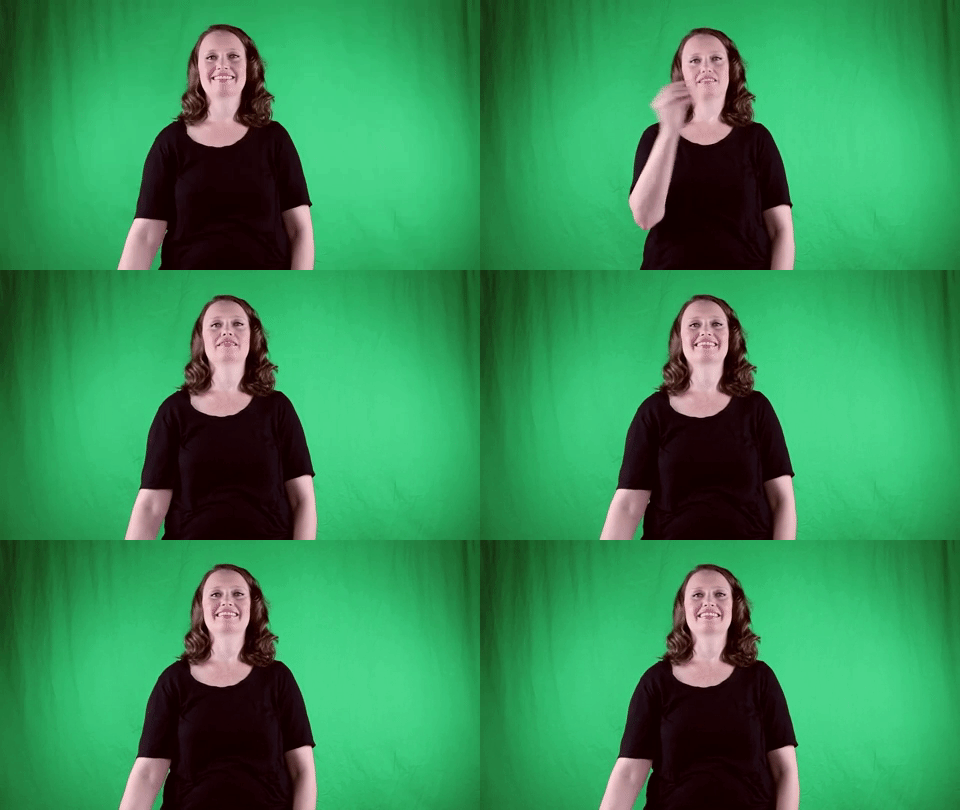
Sign for AND in ASL | & ASL Dictionary

Definition: Used to connect words or phrases.

Sign for AND in ASL 

YouTube player

Practice Activities:

To practice the sign for and in ASL, start by signing it repeatedly in front of a mirror. Make sure your dominant hand moves in a smooth motion from one side to the other, as if pulling a string. Pay close attention to the shape and movement of your fingers to ensure clarity.

Try incorporating the sign into simple phrases like “you and me” or “mom and dad.” Use flashcards with words like “apple” and “banana” to sign a full phrase, practicing fluidity. Recording yourself signing these phrases can help you refine accuracy.

Use the sign for and in ASL while describing familiar routines. For example, sign “I wake up and eat breakfast” or “I go to school and study.” Challenge yourself to increase the complexity by adding more details.

Practice storytelling by creating a short story that uses the sign multiple times. A prompt might be: “Describe a weekend where you had fun with family and friends.” Try to sign fluently, focusing on transitions between concepts.

Pair up with a signing partner and take turns making sentences that contain the sign for and in ASL. One partner signs, while the other watches and repeats. Offering feedback on each other’s hand placement and movement will reinforce proper technique.

Watch ASL videos or engage in signed conversations where the sign naturally occurs. Try to identify how fluidly native signers incorporate and. Mimic their speed and style to improve your signing fluency.

For an advanced challenge, describe a series of events using multiple instances of the sign. An example could be your daily routine: “I wake up and brush my teeth, then I eat and go to work.” This will help in mastering smooth transitions.

Cultural Context:

The sign for and in ASL is an essential component of conversations in American Sign Language. It connects thoughts, ideas, and lists, making communication smooth and natural. Understanding how to use the sign for and in ASL helps signers create clear and fluent sentences.

In Deaf culture, ASL is more than just a way to communicate—it represents identity and community. The sign for and in ASL plays a key role in storytelling, discussions, and everyday interactions. It helps convey relationships between concepts in a visually expressive way.

Facial expressions and body language are crucial when using the sign for and in ASL. ASL relies on non-manual markers to add meaning, clarify intent, and show emphasis. Combining the sign for and in ASL with appropriate expressions enhances understanding.

Word order and syntax in ASL differ from English, influencing how the sign for and in ASL is used. Instead of relying on spoken conjunctions, ASL often incorporates pauses and slight shifts in body position. Still, the sign for and in ASL provides an explicit way to link ideas when necessary.

ASL is a visual-spatial language, meaning that the structure and flow rely on space and movement. While the sign for and in ASL can be used in some contexts, skilled signers often omit it when the meaning is already clear. This efficiency makes ASL a dynamic and expressive language.

Deaf and hard-of-hearing individuals use ASL daily for personal and professional communication. The sign for and in ASL helps construct sentences fluidly in conversations, storytelling, and formal settings. Learning this sign improves fluency and deepens understanding of ASL grammar.

The use of the sign for and in ASL can vary slightly depending on regional dialects and individual signing styles. Just as spoken languages have accents, ASL has variations based on location and community preferences. Exposure to different signing environments helps learners recognize these differences.

Practicing the sign for and in ASL in real conversations strengthens signing skills. Watching Deaf signers in conversations, videos, and live interactions provides valuable insight into natural ASL usage. Repetition and immersion make it easier to understand when to use the sign for and in ASL.

ASL is a living language that continues to evolve over time, and language changes can affect how frequently certain signs are used. The sign for and in ASL remains a fundamental part of the language, helping to connect words and ideas seamlessly. Being aware of

Extended Definition:

The sign for and in ASL is a useful tool for connecting words and phrases in conversation. It helps convey relationships between ideas in a smooth and natural way. This sign is commonly used in daily communication among Deaf and hard-of-hearing individuals.

To produce the sign for and in ASL, start with your dominant hand in an open position. Move it in a slight arc, closing your fingers together as you move from one side to the other. This motion represents the idea of linking two concepts together.

Different contexts may influence how the sign for and in ASL is used. In casual conversation, signers often rely on body language, pauses, or listing to indicate the same meaning. However, the sign is still useful when clarity is needed.

Facial expressions and signing pace can add more meaning when using the sign for and in ASL. Subtle changes in movement or expression can emphasize connection, contrast, or grouping. ASL relies on visual and spatial elements to enhance communication.

In ASL grammar, the sign for and in ASL is not always necessary. Many sentences use listing or shifts in signing space to link ideas instead. English sentence structures do not always translate directly into ASL.

Learning the sign for and in ASL can improve fluency in conversations. Knowing when to use it and when to rely on other ASL grammatical structures is important. Watching fluent signers can help build an understanding of natural usage.

This sign is especially helpful when listing items. Moving the hand slightly in signing space can help distinguish between each listed item. This technique helps maintain clarity in signing.

There are regional and stylistic variations in the sign for and in ASL. Some signers may prefer to use alternative methods depending on context and familiarity. Exposure to different signing styles will expand understanding.

Practicing the sign for and in ASL will help build signing confidence. Pairing it with other ASL grammar techniques enhances communication skills. Combining proper hand movements with facial expressions makes signing more effective.

Adding transitions like the sign for and in ASL creates smoother conversations. It helps structure thoughts clearly while engaging in sign language discussions. Mastering this sign enhances overall ASL proficiency.

Synonyms: plus, also, in addition, as well as, furthermore

Educational resources: Find related learning materials in our course bank!

Want more? Check out some of our popular learning activities on the homepage!

Need to look up a sign? Use our highly rated dictionary: https://aslinteractive.com/best-asl-dictionary/

Follow us on tiktok: https://www.tiktok.com/@aslinteractive. More social media links at the bottom of this page!

Long-tail Keywords: what is the sign for and in ASL, how do you sign and in American Sign Language, ASL sign for and

Categories:

tags: Classroom Picture, Language Learning, Everyday Activities, People, Vocabulary Words

Parameters

*Handshape*:

The sign for AND in ASL uses a dominant hand in an open “5” handshape. The hand starts to the side with fingers spread and moves toward the center while closing into a flat “O” handshape. This motion represents the idea of inclusion or grouping in ASL. The non-dominant hand remains inactive. The sign for AND in ASL is fluid, and the fingers should come together smoothly without hesitation.

*Palm Orientation*:

The palm orientation for the sign for AND in ASL starts with the dominant hand open and palm facing the side. As the hand moves from left to right across the body, the fingers come together, forming a flattened “O” shape. The palm remains sideways throughout the movement, ensuring clarity in the motion. When signing AND in ASL, maintaining a consistent palm orientation is essential for accurate communication.

*Location*:

The sign for and in ASL is formed in the neutral space in front of the body, slightly to the side of the dominant hand. The movement flows from one side to the other in a smooth motion. The hand starts in an open position and moves to a closed position as it transitions, symbolizing inclusion or connection. It is typically performed at chest height for easy visibility.

*Movement*:

To produce the sign for and in ASL, start with your dominant hand open, fingers extended and spread apart. Place your hand to the side of your dominant shoulder, then move it horizontally across your body while bringing your fingers together to form a flattened “O” shape. The motion is smooth and fluid, as if gathering or bringing items together. This gesture visually represents the concept of connection or inclusion.

*Non-Manual Signals*:

When using the sign for and in ASL, the facial expression remains neutral or slightly engaged, depending on the context. If emphasizing inclusion, the eyebrows may raise slightly to indicate distinction between listed items. When expressing contrast or adding emphasis, slight head movement or a subtle pause can clarify meaning. The mouth may remain relaxed, but slight pursing of the lips can indicate grouping or separating ideas visually.

*Prosody, Dominant/Non-Dominant Hand*:

The sign for AND in ASL uses the dominant hand. Form a flat hand with fingers extended and together. Position the hand to the side of your body, palm facing in. Move it horizontally while bringing the fingers together into a flattened “O” shape. The non-dominant hand remains idle. The motion is smooth and fluid, showing a clear transition from one item to another in a list.

Tips for Beginners:

The sign for AND in ASL is simple but requires precise hand movement to be clear. Make sure your dominant hand starts in an open position and smoothly closes slightly while moving from one side to the other. Keep the motion fluid and avoid jerky movements to ensure clarity.

Beginners often make the mistake of making the movement too large or too stiff. The sign for AND in ASL should be small and compact, roughly the width of your face. Exaggerating the motion can make it unclear or resemble other signs.

Hand placement is key to making the sign recognizable. Keep your dominant hand in a relaxed but firm position, and don’t rush the movement. If the hand closes too quickly or hesitates, it may be misread as another sign.

Another common mistake is angling the hand too much. The palm should face slightly inward rather than turning completely to the side. Over-rotating the hand can make the sign confusing in fast communication.

Practicing in front of a mirror can help ensure the motion is smooth and controlled. Watching videos of native signers can also improve accuracy. If possible, sign with others who use ASL regularly to reinforce proper technique.

The sign for AND in ASL is frequently used in everyday conversation, so mastering it will improve fluency. Try incorporating it naturally when listing items or connecting thoughts. The more you use it, the more natural it will feel.

Facial expressions aren’t as important for this sign, but maintaining a neutral or slight transition expression can improve overall clarity. Avoid unnecessary movements or distracting gestures, as they may take away from the simplicity of the sign.

With consistent practice, this sign will become second nature. Keep movements controlled, smooth, and clear to ensure effective communication.

Connections to Other topics:

The sign for AND in ASL plays an essential role in forming compound sentences, grouping ideas, and connecting thoughts. It often appears in conversational signing to link multiple concepts smoothly. Instead of using the sign repetitively, signers may opt for listing strategies or rephrasing sentences for clarity.

The sign for AND in ASL is closely related to conjunctions like OR, BUT, and ALSO, which help structure signed sentences effectively. While English heavily relies on spoken conjunctions, ASL often incorporates pauses, shifts in signing space, and facial expressions to indicate similar connections. Understanding these differences enhances fluency and naturalness in ASL communication.

In some contexts, the sign for AND in ASL can be replaced with shifts in sign placement or eye gaze to indicate contrast or addition. This is particularly useful in storytelling when describing multiple events or characteristics. For example, instead of signing AND repeatedly, a signer might list two objects in separate locations in their signing space to show they are distinct yet connected.

The concept of conjunctions in ASL extends beyond simple direct translations from English. Some related compounds include phrases like BLACK-AND-WHITE or GIVE-AND-TAKE, where ASL expresses the relationship between ideas more dynamically. In such cases, the sign for AND in ASL may be omitted entirely in favor of a more fluid transition.

Understanding the sign for AND in ASL also helps with interpreting classifiers and role shifting. Signers frequently connect subjects and actions without explicitly signing AND by using fluid transitions and spatial referencing. This approach makes conversations more engaging and visually clear, demonstrating how ASL operates as a three-dimensional language.

Summary:

The sign for AND in ASL is a fundamental part of everyday communication in American Sign Language. It connects concepts, ideas, and phrases fluidly, serving a similar grammatical function to its English counterpart. Instead of relying on spoken conjunctions, ASL uses distinct movements to indicate coordination between concepts.

To form the sign for AND in ASL, start with your dominant hand open and palm facing toward the side. Slightly spread your fingers apart, then move your hand from one side to the other while bringing your fingers together. This closing motion resembles grasping an idea and pulling it along, linking one concept to another.

Facial expressions and context play a powerful role when using the sign for AND in ASL. By adjusting non-manual markers such as eyebrow movement or mouth shape, the signer can indicate emphasis or differentiate between clauses. This flexibility allows ASL users to enhance meaning without additional signs.

In casual ASL conversations, the sign for AND in ASL is often omitted. By pausing slightly between two signs or shifting hand position, signers naturally establish a connection without explicitly signing AND. This omission mirrors how spoken English often replaces “and” with pauses or tonal shifts.

Despite its common omission in everyday signing, the sign for AND in ASL still holds importance in formal and structured discourse. In academic, legal, or instructional settings, explicitly signing AND can help clarify longer lists or more complex relationships between ideas. This ensures that the message remains precise and unambiguous.

ASL linguists categorize the sign for AND in ASL as a coordinating conjunction. It joins two or more elements without altering their individual meanings. Coordinating conjunctions are crucial in ASL syntax, influencing how sentences flow and how ideas are perceived.

The concept of conjunctions in ASL extends beyond the sign for AND in ASL. Other coordinating signs such as OR, BUT, and BECAUSE serve similar functions, establishing relationships between ideas. The selection of the appropriate conjunction depends on the context and intent of the message.

Because ASL is a visual language, the sign for AND in ASL functions differently than in spoken English. Instead of being a filler word, the sign is employed only when necessary. This aligns with ASL’s efficiency as a language, emphasizing clarity while minimizing redundancy.

Children learning ASL often incorporate the sign for AND in ASL explicitly as they develop language skills. Over time, through immersion and practice, they recognize when the sign is needed and when a simple shift in body orientation suffices. This mirrors how English-speaking children learn to use conjunctions appropriately in conversation.

When interpreting from English to ASL, sign language interpreters must decide when to include or omit the sign for AND in ASL. The decision depends on factors such as the speaker’s emphasis, the flow of the conversation, and audience comprehension. Skilled interpreters use natural ASL structures rather than a word-for-word translation.

Many Deaf individuals prioritize visual clarity over explicit conjunctions like the sign for AND in ASL. The natural rhythm of ASL allows for meaning to be conveyed through movement, facial expressions, and body shifts. This makes ASL a dynamic and expressive language that efficiently relays information.

Some ASL dialects include variations in the execution of the sign for AND in ASL. Regional signing communities may modify movement, hand positioning, or even omit the sign entirely. These variations reveal the diversity within ASL and highlight how language evolves based on usage and cultural context.

In some cases, fingerspelling “A-N-D” may be used instead of signing AND, especially in academic or legal settings. Fingerspelling ensures precision when translating formal texts or names that require strict adherence to written conventions. However, in everyday conversations, this approach is rarely employed.

The sign for AND in ASL is particularly useful in structured environments like classrooms, business meetings, and presentations. In these settings, clarification and structured communication are essential, making explicit conjunctions valuable tools in maintaining understanding.

The omission of the sign for AND in ASL demonstrates ASL’s linguistic flexibility. Instead of relying on fixed words, ASL users shape their sentences based on visual cues and spatial positioning. This adaptability reflects ASL’s role as a fully developed language distinct from English.

ASL poetry and storytelling often use the sign for AND in ASL to enhance rhythm and pacing. Storytellers may incorporate intentional pauses, emphasize movements, or use repetition to create a compelling visual experience. By manipulating linguistic structures, they craft narratives that captivate their audience.

Technology is influencing the frequency and manner in which the sign for AND in ASL is used. With the rise of video communication and ASL-based artificial intelligence, variations in signing styles are being documented more frequently. These technological influences contribute to the evolution of ASL as a living language.

When teaching ASL to non-signers, instructors often emphasize the sign for AND in ASL to help students

Want more? Check out some of our popular learning activities!

ASL Interactive Resources

ASLInteractive YouTube Channel

Follow us on tiktok: @aslinteractive.com

Follow us on Instagram: aslinteractive

Facebook page: aslinteractive

Facebook group: aslinteractive

LInkedIn: ASL Interactive LLC

Twitter: @ASL_interactive

*Some information on this page is AI-generated. AI can make mistakes. Please check the information.

Sign for AND in ASL 
Sign for AND in ASL 

Responses