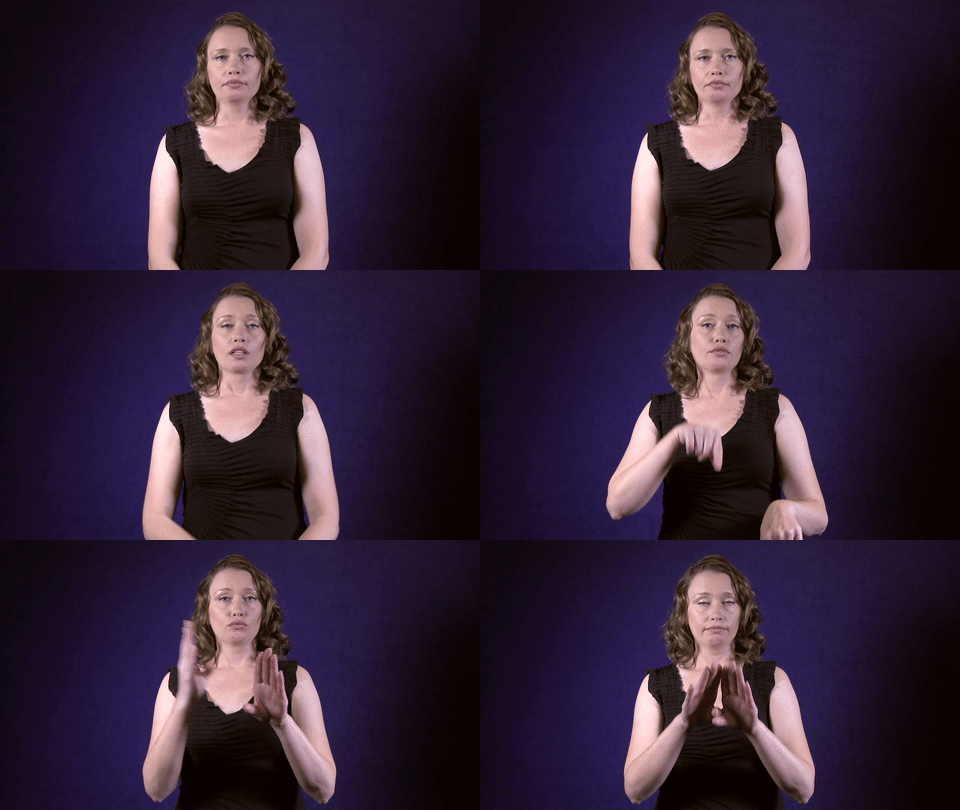
Definition: To respond to a doorbell or knock.
Sign for ANSWER DOOR in ASL

Practice Activities:
Practicing the sign for answer door in ASL can be both interactive and fun. Start by signing it in isolation, making sure your handshape and movement are accurate. Repeat the sign multiple times while looking in a mirror or recording yourself to check consistency. Try signing it at different speeds to develop fluency and confidence.
Use the sign for answer door in ASL in realistic scenarios to reinforce learning. Imagine you hear a knock on your door and sign that you need to respond. Practice signing phrases like “I will answer the door” or “Can you answer the door?” This will help connect the sign to practical daily use.
Partner activities are a great way to improve signing skills. One person can pretend to knock on a door while the other signs indicating they will answer it. Switch roles to ensure both participants get practice using the sign for answer door in ASL in different contexts. Adding role-play scenarios helps build real-world signing abilities.
Storytelling provides another great way to practice. Create a short narrative where you describe hearing someone at the door and responding. For example, “I was watching TV when I heard knocking, so I got up to answer the door.” This helps you use the sign naturally within longer sentences.
Incorporate the sign into daily activities. Each time you actually go to open a door, make an effort to sign it first. This builds strong muscle memory and reinforces recall. Setting reminders to practice signing throughout the day can also be helpful.
Engaging in interactive ASL games can enhance learning. Play a guessing game where one person acts out different household tasks and the other identifies them using signs. When someone pretends to hear a knock, use the sign for answer door in ASL to respond correctly.
Cultural Context:
In Deaf culture, when someone comes to visit, the way to answer the door in ASL is influenced by visual communication and shared norms. Instead of relying on a doorbell, Deaf individuals may use flashing lights or vibration alerts to signal someone is at the door. These adaptations ensure accessibility and maintain effective communication in a visual environment.
When learning the sign for answer door in ASL, it’s important to consider the natural flow of movement. The sign typically incorporates gestures that indicate responding to a knock or an alert. This action reflects everyday interactions in the Deaf community, where nonverbal cues play a crucial role in communication.
Technology has helped make it easier to answer the door in ASL. Many Deaf households use video doorbells or smart home systems that provide visual notifications. These advancements allow Deaf and hard-of-hearing individuals to see who is at their door before answering, enhancing both convenience and safety.
Social interactions also influence how people answer the door in ASL. Within the Deaf community, it is common to announce oneself visually rather than knocking softly. Visitors may wave at a window or use text messages to let the person inside know they have arrived.
The sign for answer door in ASL is not just about opening a door; it carries cultural significance. It reflects how Deaf individuals adapt their environment to fit their needs, ensuring clear communication in all aspects of daily life. Understanding these cultural aspects helps signers interact more naturally and respectfully in Deaf spaces.
Extended Definition:
The sign for answer door in ASL is a combination of signs that conveys the action of responding to a knock or doorbell. This phrase is commonly used to indicate that someone should physically open the door after hearing someone outside. It is a practical and frequently used sign in everyday conversations.
To sign answer door in ASL, you typically start with the sign for “answer,” which involves extending both index fingers and moving one forward from the other in a directional motion. Then, the sign for “door” is made by positioning both hands in front of you with palms facing outward and moving one hand slightly open like a door swinging. Together, these movements create a clear visual representation of the action.
This sign is useful in everyday interactions when directing someone to open the door. For example, if a family member hears a knock, another person might sign answer door in ASL to prompt them to respond. It can also be used in formal settings like workplaces, schools, or even when talking about answering the door in storytelling.
Context plays an important role in how this sign is used. In some cases, facial expressions or additional signs like “please” or “now” might be added to specify urgency. The placement and movement of the sign can also clarify whether the person signing is giving a command or merely making a statement.
In Deaf culture, signing answer door in ASL is a natural way to communicate this action without needing to rely on sound. It allows for smooth communication in homes, offices, and social gatherings. Deaf and hard-of-hearing individuals use this sign to ensure seamless interaction when someone is at the door.
This phrase is particularly valuable for parents, teachers, and caregivers who use ASL to communicate instructions. Teaching children how to sign answer door in ASL helps them understand and follow daily routines. It also empowers them to engage in household responsibilities.
For those learning sign language, practicing this phrase can enhance their ability to describe real-world actions. Signing answer door in ASL is a great way to build fluency with directional verbs and spatial awareness. The sign can also be paired with other signs to create more detailed sentences.
Learning this phrase can help non-ASL users communicate better with the Deaf community. Whether in customer service, at home, or in casual encounters, knowing how to sign answer door in ASL can foster inclusivity. It is an easy yet essential phrase to remember.
With regular use, this sign becomes a natural part of AS
Synonyms: respond to door, open the door, answer knock, attend the door, greet at door
Educational resources: Find related learning materials in our course bank!
Want more? Check out some of our popular learning activities on the homepage!
Need to look up a sign? Use our highly rated dictionary: https://aslinteractive.com/best-asl-dictionary/
Follow us on tiktok: https://www.tiktok.com/@aslinteractive. More social media links at the bottom of this page!
Long-tail Keywords: What is the ASL sign for answer door, How do I sign answer door in American Sign Language, Show me how to sign answer door in ASL
Categories:
tags: Commands, Actions, Housing, Verbs, Everyday activities
Parameters
*Handshape*:
The sign for ANSWER DOOR in ASL uses an index finger handshape. Both hands are in the “1” handshape, with the dominant hand positioned near the mouth and the non-dominant hand slightly in front. The dominant hand moves outward, resembling the action of responding, while the non-dominant hand remains steady. This sign combines the concept of answering with the motion of a door opening, visually representing its meaning.
*Palm Orientation*:
In the sign for ANSWER DOOR in ASL, the dominant hand typically starts in an upright position with the palm facing outward. As the motion progresses, the hand moves forward slightly, maintaining an open-palm orientation. The nondominant hand may act as a stationary reference, simulating a door. This handshape and movement suggest the action of opening a door in response to someone knocking, reinforcing the sign’s meaning.
*Location*:
The sign for ANSWER DOOR in ASL is produced near the torso and face. The dominant hand starts near the chin, resembling the sign for ANSWER, then moves outward as if responding. For DOOR, both hands are positioned in front of the body with palms facing forward, representing a doorway. The dominant hand moves slightly outward, mimicking the motion of opening a door. The sign takes place in the neutral space directly in front of the body.
*Movement*:
To sign for answer door in ASL, start with your dominant hand in the “1” handshape near your chin. Move it forward in a straight motion, resembling giving an answer. Then, transition both hands into “B” handshapes, held vertically in front of you like a door. One hand represents the stationary doorframe while the other swings open slightly to mimic opening a door. This sign visually represents responding to someone at the door.
*Non-Manual Signals*:
When using the sign for ANSWER DOOR in ASL, your facial expression should match the context. If you are casually responding to a knock, maintain a neutral or slightly interested expression. If the knock is unexpected, raise your eyebrows slightly to show curiosity or surprise.
Head movement plays a role—slightly tilting your head toward the imagined door helps establish the spatial reference. Eye gaze should shift toward where the door would be, reinforcing engagement. A slight forward body motion can emphasize the action of answering.
*Prosody, Dominant/Non-Dominant Hand*:
The sign for ANSWER DOOR in ASL combines two movements. For ANSWER, the dominant hand forms an index finger pointing outward from the chin, moving forward in a straight line. The DOOR sign uses both hands in a “B” handshape, with palms facing outward, mimicking the motion of a door opening. The hands pivot as if opening a door slightly. These signs together represent answering a door when someone knocks or rings.
Tips for Beginners:
When learning the sign for ANSWER DOOR in ASL, focus on fluid motion and confident gestures. This phrase combines signs to indicate responding to a door knock, usually by opening the door. Make sure each part of the sign is clear and well-paced to avoid confusion in everyday conversations.
Hand positioning is especially important when signing ANSWER DOOR in ASL. The sign for ANSWER involves a movement that extends forward from the mouth, symbolizing a response. The sign for DOOR usually mimics the action of opening a door with both hands. Keep the movements distinct but connected to convey meaning naturally.
Practice answering an imaginary door to reinforce muscle memory. Stand in front of a mirror or record yourself to ensure that the hand movements flow together smoothly. Since this is an action-based phrase, exaggerate the movement slightly for clarity, particularly when communicating with newer signers.
One common mistake when signing ANSWER DOOR in ASL is moving too hastily, making the signs look unclear. Focus on keeping your handshapes precise—especially when forming the “open door” motion. If you rush, it might look like an entirely different sign or confuse the person watching.
Context can alter the way this phrase is signed. If someone is knocking on your door, you may combine this phrase with a head tilt or raised eyebrows to signal a question. If you’re describing answering the door in the past, you may adjust your body positioning slightly to reflect storytelling conventions in ASL.
Since this phrase involves movement, practice its components in real-life situations. Next time someone knocks on a door, visualize and sign it as practice. Engaging with these real-world experiences will help the transition from memorization to natural conversation in ASL.
Connections to Other topics:
The sign for ANSWER DOOR in ASL is closely related to the concept of answering or responding in different contexts. The sign ANSWER itself is commonly used in discussions about communication, responsibility, and interaction. It also connects with signs like OPEN-DOOR and KNOCK to show actions related to entering or greeting people. Since opening the door often implies acknowledging someone’s presence, this sign naturally ties into social interactions and hospitality.
This phrase in ASL demonstrates how compound signs work in expressing everyday activities. Combining ANSWER and DOOR creates a meaning specifically about the action of responding to someone at the entrance. Other similar compound signs in ASL include ANSWER-PHONE and OPEN-WINDOW, which also describe interactions with objects rather than abstract responses. Understanding these combinations helps learners see how individual signs merge for clarity and efficiency in ASL.
The sign for ANSWER DOOR in ASL is also connected to discussions about household actions and common routines. It integrates well into topics around welcoming visitors, security, or expected guests. Related signs like VISITOR, INVITE, and GREET often appear in similar conversations. This highlights the practicality of ASL in describing motion-based or sequential actions in one fluid phrase.
Non-manual markers (NMMs) play a role when signing ANSWER DOOR, as the facial expressions can indicate different emotions. Signing it with an inquisitive or cautious expression may show uncertainty about who is at the door, while a neutral expression may indicate a routine action. Combining this sign with LOOK-THROUGH-WINDOW or CHECK can add more depth, showing decision-making before opening the door.
Summary:
The sign for ANSWER DOOR in ASL combines elements that represent both the concept of responding and the action of engaging with a door. To effectively convey this meaning, the sign typically follows a structure where ANSWER is signed first, followed by a representation of the door opening. This structure maintains ASL’s grammatical nature, ensuring that the meaning is clear and fluid. Understanding the connection between the two ideas—answering and a door—can be crucial in mastering the sign.
ANSWER in ASL is signed by extending both index fingers, placing one near the mouth as if originating from a response, then moving forward together as if directing an answer outward. This sign visually represents the idea of words or responses flowing from the signer. The motion often indicates a directed response, reinforcing the notion that an answer is given to someone or something. The spatial direction of the movement can also adjust depending on the referent within the signing space.
DOOR in ASL is typically signed by placing both hands in a vertical position, palms facing outward, resembling a door. The dominant hand then moves slightly away from the non-dominant hand as if showing a door opening. This movement mimics the real-world action of opening a door, making it an iconic or visually representative sign. The movement may vary depending on whether the signer wishes to show the door being opened partially or fully.
When combining these two signs to form the sign for ANSWER DOOR in ASL, the sequence is important. Signers typically first produce ANSWER, signifying their response to a knock or call, followed immediately by the motion of opening a door. This sequence logically follows the idea of hearing or perceiving someone at the door and then physically opening it. The combination of the two separate motions ensures the meaning is clearly interpreted by viewers.
ASL is a visual language that relies on conceptual accuracy, so the sign for ANSWER DOOR in ASL is structured to mirror real-life actions. If responding to a knock, the sign may be modified with facial expressions that indicate awareness or curiosity. If answering a door in an excited or urgent manner, the speed and force of the signing can be adjusted accordingly. Non-manual markers such as raised eyebrows or widened eyes can complement the sign, adding clarity.
The cultural significance of the sign for ANSWER DOOR in ASL is tied closely to everyday interactions. Deaf individuals rely heavily on visual cues, so door-answering often involves technology such as video doorbells or flashing light systems. Signing ANSWER DOOR acknowledges this cultural context in a visually appropriate manner. Additionally, body positioning while signing can subtly indicate whether one is aware of someone at the door or surprised.
ASL grammar does not simply mimic English; rather, it structures concepts in a way that visually conveys real-world events. In the sign for ANSWER DOOR in ASL, the sequence is key—first acknowledging a response, then performing an action. If one wanted to sign “someone is answering the door,” the movement might be directionally adjusted to indicate the external subject. The language’s flexibility allows for variations in meaning without additional spoken words.
Linguistically, ASL classifiers can be incorporated into signing ANSWER DOOR to enhance meaning. A classifier handshape representing a door can be used to further clarify how the door is being answered. If fingerspelling DOOR is necessary in formal or educational settings, the fingerspelled version can replace the standard sign. Classifiers and spatial organization bring additional grammatical depth to ASL language use.
In storytelling, the sign for ANSWER DOOR in ASL might be expanded with context. If relaying an event about someone knocking unexpectedly, a knock gesture might be included before ANSWER. If describing someone cautiously peeking through a door, the handshape and motion for DOOR may include a slow and hesitant opening. These variations demonstrate ASL’s capacity for nuanced storytelling.
The sign for ANSWER DOOR in ASL is frequently used in everyday life, from casual home interactions to formal workplace settings. Deaf individuals and sign language learners alike benefit from understanding this concept clearly for smooth communication. Whether discussing household routines, work etiquette, or emergency responses, the sign remains relevant. Practicing the sign with real-world scenarios ensures fluency and comprehension.
A related sign concept involves KNOCK, which can be signed with an extended knuckle tapping slightly on the non-dominant palm or an imaginary surface. If including a knocking action before signing ANSWER DOOR, the message becomes even clearer. Facial expressions paired with knocking can alter the meaning, such as showing impatience or politeness. The flexibility of signs allows for multiple interpretations within the same concept.
For applied linguistics, studying the sign for ANSWER DOOR in ASL showcases how language mirrors actions in real life. Unlike written or spoken languages, ASL conveys direct experiences using spatial and kinetic elements. This highlights the iconic nature of the language
Want more? Check out some of our popular learning activities!
ASL Interactive Resources
ASLInteractive YouTube Channel
Follow us on tiktok: @aslinteractive.com
Follow us on Instagram: aslinteractive
Facebook page: aslinteractive
Facebook group: aslinteractive
LInkedIn: ASL Interactive LLC
Twitter: @ASL_interactive
*Some information on this page is AI-generated. AI can make mistakes. Please check the information.


Responses