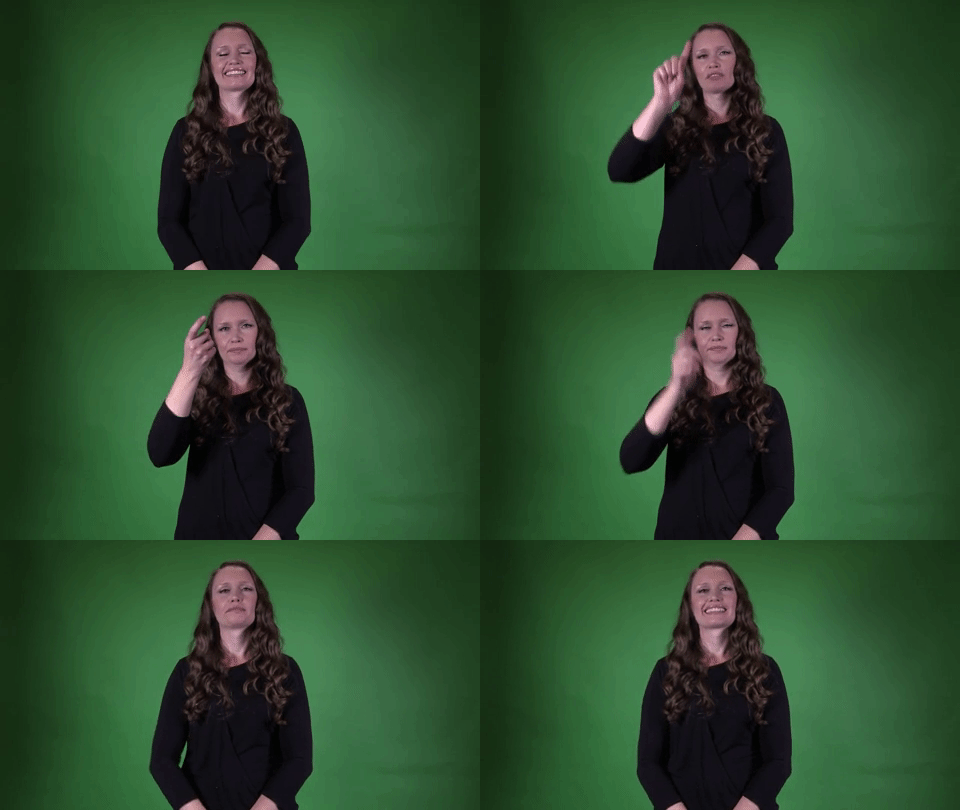
Definition: A punctuation mark used to indicate possession or omission of letters.
Sign for APOSTROPHE in ASL

Practice Activities:
Practicing the sign for apostrophe in ASL can help improve both fingerspelling accuracy and fluency when incorporating contractions and possessives into signing. Start by fingerspelling a series of words that require apostrophes, such as “can’t,” “won’t,” and “it’s.” Focus on smooth transitions between letters while maintaining proper handshape and movement. Try fingerspelling slowly at first, then gradually increase your speed while maintaining clarity.
Use the sign for apostrophe in ASL in sentences to practice incorporating it naturally into signed communication. For example, fingerspell phrases like “John’s book” or “Sarah’s dog” and practice mouth movements to match spoken English. Partner with a friend and take turns fingerspelling contractions while the other person writes them down. This helps reinforce the correct placement of the apostrophe in written form while improving receptive finger-spelling skills.
Try storytelling exercises that incorporate words needing an apostrophe. Create a short story or dialogue about a family or group of friends, using possessives and contractions like “Dad’s car” or “we’ll go later.” Sign the story fluently while ensuring the apostrophe is represented clearly in each word. Ask a partner or mentor to watch and provide feedback on clarity and accuracy.
For a fun challenge, set a timer for one minute and see how many words using an apostrophe you can fingerspell correctly. You can also write out daily conversations and highlight where an apostrophe would be used, then practice signing them. The more frequently you use the sign for apostrophe in ASL, the more natural it will become in everyday conversations. Keep practicing with real-life examples to make signing contractions and possessives second nature.
Cultural Context:
The sign for apostrophe in ASL is not commonly used in everyday conversation because ASL does not rely on punctuation the same way written English does. Instead of using an apostrophe, ASL expresses possession or contractions through structure, context, and facial expressions. However, learners and interpreters may need to recognize the sign for apostrophe in ASL for educational or professional settings.
When fingerspelling words that include an apostrophe in ASL, signers often pause slightly or shift their hand position to indicate missing letters. For example, instead of signing “can’t” with an apostrophe, ASL typically signs “cannot” as a complete word. This approach keeps ASL grammar fluid and natural without relying on English punctuation rules.
In teaching environments, the sign for apostrophe in ASL may be introduced to help students understand written English. When discussing contractions like “it’s” or possessives like “John’s book,” educators may use a slight movement or a dropped hand position to represent the missing letters. However, native ASL signers prefer to restructure sentences to avoid the need for an apostrophe in ASL.
ASL grammar does not require punctuation marks because meaning is conveyed through facial expressions, hand movements, and sentence structure. Instead of the sign for apostrophe in ASL, signers use possessive markers like “his,” “hers,” or “theirs” to clarify ownership. For contractions, ASL signers often spell out both words in full or rely on conceptually accurate signs.
When working with English text, interpreters sometimes incorporate the sign for apostrophe in ASL to clarify meaning for students learning written language. In settings like classrooms or ASL-English translation work, this helps bridge the gap between ASL and English grammar. Still, the apostrophe in ASL remains an exception rather than a commonly used feature.
Using the sign for apostrophe in ASL can be helpful when discussing formal text, such as reading aloud from books or teaching grammar. Some ASL instructors use a small flicking motion or a brief pause in fingerspelling to represent an apostrophe. However, ASL remains a visual language that prioritizes clarity over strict adherence to English punctuation.
Understanding how the apostrophe in ASL is used can help learners navigate both languages more effectively. While ASL does not typically use the sign for apostrophe in daily conversations, recognizing how it appears in fingerspelling or educational contexts can improve bilingual communication. A strong
Extended Definition:
The sign for apostrophe in ASL is an essential part of conveying written language elements in American Sign Language. While apostrophes are commonly used in English for contractions, possessives, and omissions of letters, their representation in ASL depends on context. Instead of a direct handshape, signers often indicate an apostrophe by fingerspelling or adjusting their signing style.
When fingerspelling a word that contains an apostrophe, most ASL users omit the actual punctuation and rely on context to clarify meaning. For example, when signing “don’t,” the signer would spell out D-O-N-T without explicitly indicating an apostrophe. This approach allows for a natural flow in communication while staying consistent with ASL grammar.
Possessives in English typically use an apostrophe followed by an “s,” but in ASL, possessive pronouns or specific phrasing replace the need for the apostrophe. Instead of signing “John’s book,” a signer would use JOHN BOOK HIS to reflect possession. This structure effectively conveys meaning without relying on an exact sign for apostrophe in ASL.
When apostrophes indicate omitted letters in contractions, fingerspelling or a modified sign is used. Words like “can’t,” “it’s,” and “he’ll” are either spelled out or signed with contractions specific to ASL. Because ASL has its own syntax and grammar, direct translations of every apostrophe usage are unnecessary.
Some ASL users may incorporate a brief finger movement or a small pause where an apostrophe would appear in written English. However, this is not a standardized method and isn’t commonly taught in formal ASL instruction. Understanding when to modify fingerspelling or sentence structure is key to representing apostrophes in ASL effectively.
Since ASL is a visual language with its own rules, the need for a sign for apostrophe in ASL is minimal. Context, sentence structure, and facial expressions help clarify meaning without requiring a specific gesture for an apostrophe. By focusing on these language features, ASL maintains clarity while adapting English punctuation into its expressive form.
Synonyms: punctuation mark, possessive marker, contraction marker, single quote, closing quote
Educational resources: Find related learning materials in our course bank!
Want more? Check out some of our popular learning activities on the homepage!
Need to look up a sign? Use our highly rated dictionary: https://aslinteractive.com/best-asl-dictionary/
Follow us on tiktok: https://www.tiktok.com/@aslinteractive. More social media links at the bottom of this page!
Long-tail Keywords: what is the sign for apostrophe in ASL, how do you sign apostrophe in ASL, ASL sign for apostrophe
Categories:
tags: Language Learning, Basic Grammar, Punctuation, Classroom Picture, Education
Parameters
*Handshape*:
The sign for apostrophe in ASL typically involves a dominant hand forming an index finger handshape, resembling a small mark in the air. The motion mimics writing an apostrophe, often placed in the proper context within fingerspelled words. Since apostrophes are not commonly used in ASL structure, this motion helps visually indicate possession or contractions when necessary. The sign for apostrophe in ASL may vary among signers, with some preferring to fingerspell the associated word instead.
*Palm Orientation*:
The sign for apostrophe in ASL is typically fingerspelled, as there is no dedicated ASL sign for this punctuation mark. When fingerspelling, the dominant hand forms each letter of “APOSTROPHE” in sequence, with the palm facing forward or slightly to the side. The hand remains steady, and the fingers maintain a clear, firm shape to ensure legibility.
When indicating an apostrophe in ASL within a word, such as a contraction or possessive form, the dominant hand may form an “X” handshape and make a small flicking motion. The palm is generally oriented outward or slightly downward. This movement helps to visually represent the role of an apostrophe in written English.
*Location*:
The sign for apostrophe in ASL is typically represented by fingerspelling the word “APOSTROPHE.” Since this is a less common sign, ASL users often rely on context or manually spell it out using the ASL alphabet. The dominant hand forms each letter in a smooth and clear motion near the neutral signing space. If needed, some signers may use a small, quick flick motion to visually indicate an apostrophe within a word.
*Movement*:
The sign for apostrophe in ASL is typically fingerspelled as A-P-O-S-T-R-O-P-H-E. When needed, a small, quick movement of the dominant index finger may be used to indicate the placement of an apostrophe in written words. This motion is usually made in the air near where the imaginary text would be. Some ASL users prefer contextual clarification instead of signing an apostrophe explicitly.
*Non-Manual Signals*:
Facial expression remains neutral when demonstrating the sign for apostrophe in ASL, as it represents a punctuation mark rather than an emotion-driven concept. The eyebrows are generally relaxed, and the mouth remains in a natural resting position. If emphasizing the apostrophe’s grammatical role, a slight head tilt or raised eyebrow may be used for clarification. Eye gaze remains focused on the signing space, ensuring clear visual communication of the sign for apostrophe in ASL.
*Prosody, Dominant/Non-Dominant Hand*:
The sign for APOSTROPHE in ASL is typically represented by fingerspelling the symbol itself or using a small, quick movement to indicate its presence. The dominant hand, usually in a bent index or modified X handshape, moves slightly downward in an arc, mimicking the shape of an apostrophe. If fingerspelled, the dominant hand forms the letter “S” followed by a slight flick to represent the punctuation.
Tips for Beginners:
The sign for APOSTROPHE in ASL is often fingerspelled, so it is essential to practice smooth and clear letter transitions. Since apostrophe is a longer word, it helps to maintain steady hand positioning and avoid excessive movement. Keeping your fingers slightly relaxed and ensuring that each letter is distinct will improve clarity.
One common pitfall when fingerspelling the sign for APOSTROPHE in ASL is rushing through the letters, which can make it difficult for others to understand. Instead, maintain a consistent speed and focus on forming each letter accurately. If you’re still building confidence in fingerspelling, break the word down into smaller sections to improve fluency.
Hand orientation and placement play a crucial role in making the sign for APOSTROPHE in ASL readable. Keep your dominant hand steady in front of your shoulder, ensuring it remains within your visual signing space. Avoid twisting or flipping your hand awkwardly, as this can make letters harder to decode.
Finger dexterity is a key factor in efficient fingerspelling, so regular practice will help improve your muscle memory. Try spelling common words daily, incorporating the sign for APOSTROPHE in ASL during practice sessions. Using a mirror or recording yourself can help identify areas where adjustments are needed to maintain legibility.
When signing in real-world conversations, contextual clues can assist if someone struggles to recognize the fingerspelled word. If needed, you can supplement with facial expressions or use a brief pause before restarting the word. Developing patience while fingerspelling allows for smoother exchanges and better comprehension from your signing partners.
Lastly, practicing with another ASL user or participating in signing groups can refine your ability to fingerspell naturally. Exposure to receptive signing environments will significantly strengthen your ability to use the sign for APOSTROPHE in ASL effectively.
Connections to Other topics:
The sign for apostrophe in ASL connects to punctuation and written language concepts. Since ASL is a visual-spatial language, it does not have a direct equivalent for punctuation marks; instead, facial expressions, pauses, and shifts in movement convey meaning. However, when fingerspelling words that typically include an apostrophe, such as “can’t” or “it’s,” ASL users often omit the apostrophe and rely on the sign’s meaning within context.
Apostrophes are commonly used in contractions, which ties the sign for apostrophe in ASL to signs that represent shortened words. Many contractions like “you’re” or “I’ll” do not require a separate sign; instead, the full phrase is signed, making the apostrophe unnecessary. However, in glossing ASL sentences, an apostrophe is sometimes used in written form to indicate possessive nouns, though ASL instead uses possessive handshapes or context to show possession.
The fingerspelled representation of the apostrophe is also relevant in academic or formal settings. ASL students or interpreters may see apostrophes in transliterations of English or when quoting written materials. In educational environments, clear fingerspelling and an understanding of how ASL conveys possessive and contracted meanings without an apostrophe help bridge the gap between signed and written English.
The concept of the apostrophe also relates to abbreviations and initials, which are often fingerspelled in ASL. Some possessive abbreviations, such as “CEO’s decision,” are understood through context rather than through the visual representation of the apostrophe itself. This emphasizes the importance of context and grammar structures in ASL rather than relying on punctuation marks from English.
Summary:
The sign for apostrophe in ASL is not widely standardized, as written punctuation marks are primarily a feature of English and other written languages rather than signed languages. Because ASL is a visual-spatial language, it does not rely on punctuation in the same way that written English or other written languages do. Instead, ASL conveys meaning through facial expressions, pauses, and specific grammatical structures that indicate phrase separation, possession, and contractions.
One common approach to representing the apostrophe in ASL is through fingerspelling, particularly when referring to the punctuation mark itself in an educational or instructional context. When fingerspelling apostrophe, signers may spell out the word “A-P-O-S-T-R-O-P-H-E” letter by letter. It is crucial to maintain proper fingerspelling fluency, ensuring that each letter is clearly formed and transitions smoothly to the next.
Another approach involves using non-manual markers to indicate the grammatical functions that apostrophes serve in English. For example, when expressing possession, ASL often uses a possessive pronoun such as “MY,” “HIS,” “THEIR,” or a possessive handshape rather than an apostrophe plus “s” as in English. This structural difference highlights how ASL is an independent language with its own grammatical rules rather than a mere representation of English.
In contractions, where English may use an apostrophe to combine words like “can’t” from “cannot,” ASL employs a more direct method of signing the negated or contracted concept. Instead of signing “CAN” and then adding an apostrophe “T,” ASL usually signs “CANNOT” as a single unit using a specific movement. This difference shows how ASL uses visually inherent structures rather than punctuation-based symbols.
Sometimes, when explaining English grammar in an academic or instructional setting, an ASL signer may indicate the presence of an apostrophe by momentarily showing an “X” handshape near the location of a word. However, this is not commonly used in everyday ASL discourse. It serves primarily as an adaptation for English language instruction within the ASL framework.
The sign for apostrophe in ASL is mostly relevant in written language discussions rather than in conversational or narrative contexts. Because ASL relies heavily on visual-spatial structures rather than symbolic punctuation, apostrophes do not serve the same role they do in English. Instead, alternative grammatical features such as role shifting, classifiers, and facial expressions ensure clarity in communication.
When discussing possessive nouns, English uses an apostrophe plus an “s” at the end of a noun, like “Sarah’s book.” In ASL, this structure can be conveyed by signing “SARAH” followed by the possessive modifier “HER” before “BOOK.” The concept is clearly communicated without the need for an apostrophe symbol.
In contractions, English words like “it’s,” meaning “it is,” use an apostrophe for omission. ASL does not represent this the same way but instead may use a single sign for “IT IS” or rely on context and facial expressions to streamline meaning. Since ASL does not use apostrophes, contractions are more conceptual rather than reliant on written symbols.
For plural possessives like “the teachers’ lounge,” where the apostrophe appears after the final “s,” ASL uses different ordering to show plurality and possession. Usually, the phrase would be structured as “TEACHER MANY’S LOUNGE” or simply “TEACHER LOUNGE,” with the plurality inferred from context. The need for a specific sign for apostrophe in ASL is minimal due to these linguistic differences.
Applied linguistics highlights that ASL users structure their sentences spatially, unlike the linear format of English writing. This means the apostrophe functions English speakers rely on do not naturally fit into ASL’s grammar. Instead, ASL’s structure prioritizes meaning through emphasis and placement.
From a broader linguistic perspective, apostrophes are generally a feature of written alphabets rather than signed languages. The lack of a universal sign for apostrophe in ASL demonstrates how signed languages evolve based on communication needs rather than written rules. This concept further reinforces that ASL is not a visual representation of English but a fully developed language with unique syntactic structures.
Culturally, the teaching of the apostrophe in ASL contexts typically occurs in academic settings when discussing English literacy. Deaf and Hard of Hearing students learning English as a second language may receive instruction on punctuation through fingerspelling or adapted signs. These strategies help bridge the gap between written and signed communication without altering ASL grammar itself.
Educators working with Deaf students often use visual tools to teach the use of apostrophes in English. They may point to locations in written text, use fingerspelling, or provide alternative explanations through ASL structure. These adaptations ensure concepts of possession and contractions are understood across both languages.
When translating
Want more? Check out some of our popular learning activities!
ASL Interactive Resources
ASLInteractive YouTube Channel
Follow us on tiktok: @aslinteractive.com
Follow us on Instagram: aslinteractive
Facebook page: aslinteractive
Facebook group: aslinteractive
LInkedIn: ASL Interactive LLC
Twitter: @ASL_interactive
*Some information on this page is AI-generated. AI can make mistakes. Please check the information.


Responses