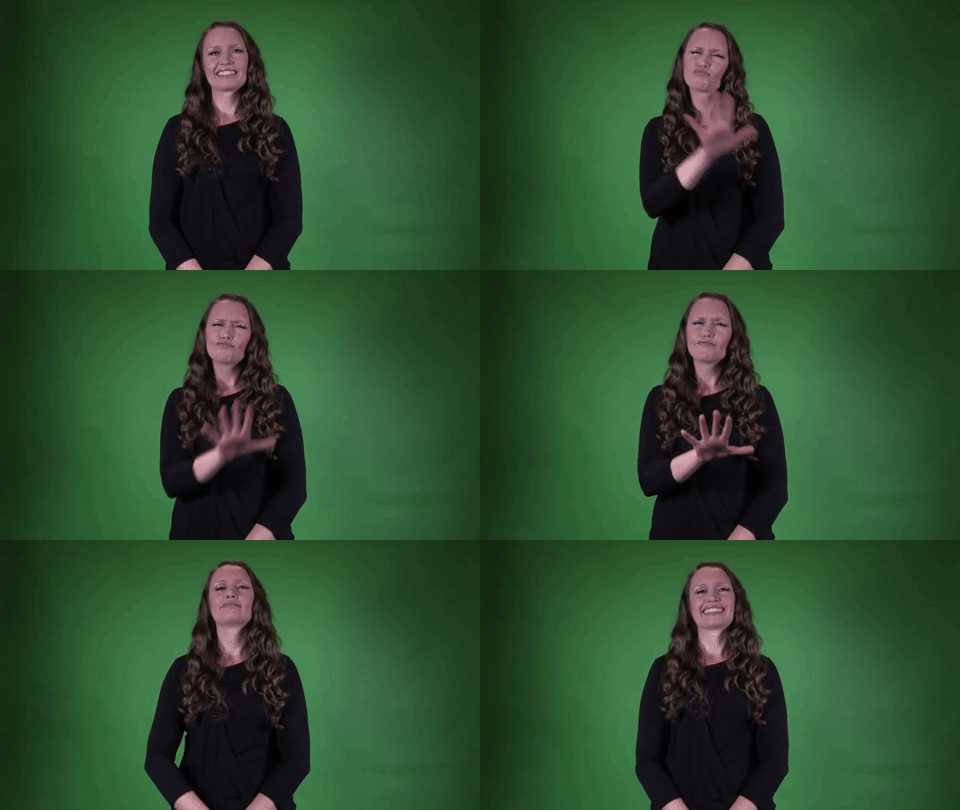
Definition: Almost, but not exactly.
Sign for APPROXIMATELY in ASL

Practice Activities:
Practicing the sign for approximately in ASL begins with repetition. Stand in front of a mirror and sign it multiple times, ensuring smooth, rounded movement. Pay attention to hand placement and motion consistency to make sure you’re maintaining the proper execution.
After mastering the movement, incorporate the sign for approximately in ASL into basic sentences. Practice saying things like, “The meeting starts approximately at 3 PM,” or “I have approximately ten dollars.” Try signing these phrases at different speeds to build fluency and confidence.
Another way to reinforce the sign for approximately in ASL is through estimation games. Look around your environment and estimate quantities, distances, or time. For example, point to a stack of books and sign, “That is approximately five books.” This helps connect the sign to real-life contexts.
For partner practice, engage in a guessing game. One person describes a situation using estimation while the other guesses the details. You can sign, “It takes approximately ten minutes to walk to the store,” and have your partner check for understanding. This encourages conversational flow and context-based practice.
Storytelling is a useful way to expand your comfort with the sign for approximately in ASL. Create a short narrative where estimation plays a role, such as planning a trip or preparing a meal. “We need approximately three cups of flour for this recipe,” or “We arrived at the park approximately at noon.” Telling a story naturally incorporates the sign in a meaningful way.
Finally, challenge yourself to sign without speaking. Watch ASL videos or participate in silent practice where the only communication is through signs. This solidifies understanding and ensures that you can use approximately in ASL smoothly in a variety of situations.
Cultural Context:
The sign for approximately in ASL is commonly used in conversations where exact numbers or estimates are uncertain. In ASL, approximation often conveys flexibility, rounding, or estimation in quantities, times, and measurements. This sign helps maintain natural flow in discussions without needing precise figures.
The sign for approximately in ASL reflects the visual and conceptual nature of the language. Instead of relying on spoken qualifiers like “about” or “around,” ASL uses a specific movement to indicate approximation. This allows signers to express estimates quickly and efficiently.
Cultural context plays an essential role when using the sign for approximately in ASL. Deaf and hard-of-hearing individuals often emphasize clarity and precision in communication, so this sign helps ensure mutual understanding. Using it correctly can prevent misunderstandings, especially in negotiations, storytelling, or planning.
In ASL conversations, the sign for approximately in ASL is often accompanied by facial expressions. Non-manual markers, such as slightly raised eyebrows or a slight tilt of the head, can enhance the meaning. These additional visual cues provide context, helping clarify whether a number or idea is an estimate.
Knowing when to use the sign for approximately in ASL can be crucial in various settings. In casual conversations, it allows for flexibility when discussing general timeframes or guesses. In professional or academic contexts, it may provide a way to present figures without committing to absolute precision.
ASL is a dynamic visual language that relies on context, body language, and hand movements. The sign for approximately in ASL is just one of many examples of how meaning is conveyed efficiently. Mastering it helps improve communication flow while maintaining linguistic accuracy.
This sign is frequently used when discussing dates, measurements, or amounts without needing exact figures. If someone is unsure about a specific number, they can use the sign for approximately in ASL to convey a close estimate. This is especially useful in everyday conversations where exact numbers may not be necessary.
In the Deaf community, visual cues make communication more effective. The sign for approximately in ASL fits naturally into the language’s structure, ensuring estimates are clearly understood. It helps bridge gaps in communication, making interactions smoother and more natural.
Using the sign for approximately in ASL correctly shows respect for the language and culture. ASL is not just about hand movements; it incorporates facial expressions and body language to create a complete message. Learning proper usage enhances fluency and improves overall communication skills.
Whether discussing time, quantity, or
Extended Definition:
The sign for approximately in ASL is a useful concept for conveying an estimated amount or value. It is often used when giving rough numbers, describing general timeframes, or indicating something that is not exact. This sign helps maintain clarity in communication while allowing for flexibility in understanding.
To sign approximately in ASL, make a circular motion with your dominant hand, palm facing down. The movement is small and fluid, representing an estimate or an inexact number. Context plays an important role in understanding how this sign is used in different conversations.
The sign for approximately in ASL is often seen in discussions about time, money, measurements, and numerical estimates. For example, when talking about a meeting time, you might sign “approximately 3 o’clock” to indicate flexibility. It can also be used for distances, population counts, or general descriptions of amounts.
This sign is commonly used in everyday conversations as well as in more formal settings. Interpreters and ASL users frequently use it in business, medical, and academic contexts to avoid giving precise but potentially incorrect information. Using this sign appropriately helps maintain accuracy while allowing for some level of uncertainty.
When learning the sign for approximately in ASL, it is important to observe fluent signers and practice the movement naturally. The meaning can sometimes change slightly depending on facial expressions, so paying attention to non-manual markers is essential. Watching videos of native signers can be a great way to reinforce proper use.
Knowing how to sign approximately in ASL is valuable for both beginners and advanced signers. It enhances conversational skills and allows for more natural communication when discussing estimates. Learning this sign can help you feel more confident when communicating in ASL.
Overall, the sign for approximately in ASL is a practical and widely used concept for expressing uncertainty in numbers, time, and measurements. It is a simple yet effective way to convey estimations without needing an exact number. By mastering this sign, ASL users can communicate more fluidly and accurately in a variety of situations.
Synonyms: about, roughly, nearly, around, close to
Educational resources: Find related learning materials in our course bank!
Want more? Check out some of our popular learning activities on the homepage!
Need to look up a sign? Use our highly rated dictionary: https://aslinteractive.com/best-asl-dictionary/
Follow us on tiktok: https://www.tiktok.com/@aslinteractive. More social media links at the bottom of this page!
Long-tail Keywords: what is the sign for approximately in asl, how do you sign approximately in asl, what does approximately mean in asl
Categories:
tags: approximately, numbers, math, measuring, language learning
Parameters
*Handshape*:
The sign for APPROXIMATELY in ASL uses a loose, open-5 handshape with the fingers slightly spread apart. The dominant hand moves in a small circular motion in front of the torso, palm facing downward. This gesture visually conveys the idea of “about” or “roughly.” When using the sign for APPROXIMATELY in ASL, the movement should be smooth and continuous, reinforcing the meaning of an estimated or general amount.
*Palm Orientation*:
The palm orientation for the sign for APPROXIMATELY in ASL is generally facing downward or slightly tilted forward. The dominant hand moves in a small circular motion as if indicating an estimate or an uncertain amount. This sign visually conveys the concept of an approximation, reinforcing the meaning through movement and orientation. When using the sign for APPROXIMATELY in ASL, ensure the palm stays mostly open and relaxed, emphasizing the fluid nature of an estimate.
*Location*:
The sign for approximately in ASL is produced in the neutral space in front of the body, typically at chest level. This location allows for clear visibility and fluid motion. Since the dominant hand moves in a small circular motion to convey the meaning, maintaining it at this comfortable height ensures the sign is easily seen and understood. Keeping the sign within this signing space makes it natural and clear for the viewer.
*Movement*:
To produce the sign for approximately in ASL, form an open dominant hand with fingers slightly curved. Position the palm facing downward at chest level. Move the hand in a small, circular motion, maintaining a steady pace. The movement should be relaxed and continuous, as if making a swirling motion in the air. This circular motion conveys the idea of an estimation or rough measure, which aligns with the meaning of the sign for approximately in ASL.
*Non-Manual Signals*:
When using the sign for approximately in ASL, the facial expression is neutral or slightly tilted eyebrows to indicate estimation. A slight pursing of the lips or a small “mm” mouth shape often accompanies the motion. The head may tilt slightly while the dominant hand moves in a small circular motion, reinforcing the idea of an approximate value.
Depending on the context, a mild squint or slight shoulder raise can signal uncertainty. If emphasis is needed, the signer may slightly exaggerate the circling motion while maintaining the same non-manual markers. The sign for approximately in ASL often conveys a general sense of estimation rather than a precise number.
*Prosody, Dominant/Non-Dominant Hand*:
The sign for APPROXIMATELY in ASL uses the dominant hand. Form a loose, open “5” handshape with the palm facing outward. Move the hand in a small, circular motion in front of the body, typically at chest level. The motion should be smooth and relaxed, conveying an estimated or near value. Facial expressions can add emphasis, such as slightly raised eyebrows, to indicate approximation. Non-dominant hand is not used.
Tips for Beginners:
When learning the sign for APPROXIMATELY in ASL, focus on maintaining a natural and relaxed hand movement. The sign involves a circular motion with the dominant hand, palm facing outward, hovering slightly in front of the body. Keep the motion smooth and fluid rather than stiff or robotic to ensure clarity and ease of recognition.
Beginners often make the mistake of moving the hand too quickly or too large, which can make the sign look overly exaggerated. A gentle, small circular motion is best, as large motions may appear unnatural or unclear. Be mindful of your facial expressions, as a slight tilting of the head or a neutral expression can help convey the meaning effectively.
One of the challenges with the sign for APPROXIMATELY in ASL is maintaining consistency in movement without making it look like a different sign. Avoid jerky or uneven motions that may confuse the meaning. Practicing in front of a mirror or recording yourself signing can help you identify any inconsistencies and refine the movement.
Hand positioning is also key to making the sign clear. Keep your palm facing outward in a comfortable, slightly forward position, rather than too close to your body. This keeps your signing space open and easy to see, making it more readable to others. Pay attention to the natural rhythm of the motion—too slow may seem hesitant, while too fast may cause confusion.
A useful practice tip is to observe native ASL signers using the sign for APPROXIMATELY in ASL in real-life conversation or videos. This will give you insight into the natural flow and movement, helping you develop a more authentic looking sign. With regular practice and mindful movement, your signing will become more fluid and confident.
Connections to Other topics:
The sign for approximately in ASL is connected to concepts such as estimation, rough calculations, and uncertainty. This sign is frequently used in conversations that involve vague or non-exact quantities, such as discussing time, measurements, or population estimates. It shares similarities with signs that describe ranges or undefined amounts, such as “about” or “around,” which also convey a lack of precision.
In discussions involving time, the sign for approximately in ASL is useful when describing durations, schedules, or deadlines that may not be exact. For example, when discussing meeting times, a signer might combine this sign with time signs like “hour” or “minute” to indicate an approximate duration. This flexibility helps in situations where precise numbers are unnecessary, allowing for smoother communication about general timeframes.
Mathematical and numerical concepts often make use of the sign for approximately in ASL, particularly in educational and scientific discussions. When discussing estimates, probabilities, or averages, this sign can be valuable in clarifying that a number is not exact but rather an approximation. It can also appear alongside signs for percentages, fractions, and statistical terms to further emphasize uncertainty or generalization in mathematical contexts.
In everyday interactions, this sign is useful in casual descriptions where precision is not crucial. Someone might use it when describing the distance between two locations, the number of people in a group, or even when estimating how much something weighs. It is particularly beneficial in storytelling, where providing approximate details can help set the scene without focusing on exact numbers.
The sign for approximately in ASL also relates to concepts like estimation and guessing, which are important in both daily conversations and academic settings. These ideas appear in various contexts, including business discussions, scientific data analysis, and personal planning. By understanding how this sign connects to broader concepts, signers can use it effectively to convey vague or estimated information in different situations.
Summary:
The sign for approximately in ASL conveys the meaning of “about” or “around” when referring to an estimate or rough number. To produce this sign, the dominant hand is held in a loose five-handshape, palm facing down, and moved in small circular motions. This motion indicates an imprecise or estimated amount, aligning with the everyday use of “approximately” in English.
Facial expressions play an essential role in signing approximately in ASL. A slight brow raise or neutral expression can make it clear that the number or concept being discussed is not exact. If extra emphasis is needed, adjusting the size or speed of the circular motion can help. A wider motion may imply greater uncertainty, while a smaller motion suggests a closer approximation.
Linguistically, the sign for approximately in ASL functions as a modifier in a sentence. In English, “approximately” precedes a number or estimate, and in ASL, it follows a similar placement, often appearing before or around numerical signs. The sign is frequently used when discussing dates, times, distances, and quantities where an exact number is unavailable or unnecessary.
Understanding the nuances of the sign for approximately in ASL is important for clear communication. For example, when discussing an event occurring “at approximately 3 PM,” the sign will precede or accompany the sign for 3 o’clock. The same applies to discussions about measurements, where the sign clarifies that the given value is not precise.
ASL uses this sign in place of verbal hedging, allowing signers to provide estimates while maintaining accuracy within a conversation. This is especially useful in casual and formal communication settings. Signers often rely on this to ensure they are not unintentionally misleading when precise numbers are either unknown or unnecessary.
Culturally, precision may be less relevant in certain conversational contexts, making the sign for approximately in ASL a practical tool for everyday communication. This helps prevent unnecessary specificity, which might slow down natural interaction. The use of approximation aligns with the way people speak naturally in both spoken and signed languages.
There is also a connection between this sign and concepts such as “almost” or “nearly.” Although related, those signs convey slightly different meanings, emphasizing closeness to a final outcome rather than a general estimation. Recognizing these distinctions helps avoid miscommunication in ASL.
Applied linguistics demonstrates how estimation is conveyed differently across languages, with ASL using both manual and non-manual markers. Where English relies on words like “around” and “about,” ASL condenses the concept into one efficient sign. This showcases the economy of motion and clarity that ASL maintains.
ASL linguistics recognizes that numerical approximation plays a role in pragmatics. The sign for approximately in ASL serves a similar function to “roughly” in English, ensuring that quantitative information is properly contextualized. This avoids misinterpretation while maintaining conversational efficiency.
Signers use approximately when discussing guesses, assumptions, or flexible timeframes. For example, when planning to meet someone, a signer might use this sign before or after a time reference to indicate flexibility. This helps set expectations without requiring absolute adherence to a specific schedule.
Learning the appropriate use of approximately in ASL helps build fluency and improves comprehension. Signers must practice integrating the sign naturally into sentences where ambiguity is expected. This enhances conversational flow and demonstrates eloquence in ASL.
The sign for approximately in ASL also complements other signs related to estimation and generalization. It often appears with signs for “guess,” “estimate,” or “about” to reinforce meanings. These signs together aid in expressing levels of certainty when discussing figures or timeframes.
In discussions involving money, sales, or statistical data, the sign for approximately in ASL is particularly useful. It helps communicate business estimates where a precise value is either unavailable or unnecessary. This helps keep financial discussions more adaptable and practical.
The sign can also serve as a linguistic bridge when translating between English and ASL. Since some languages rely more heavily on explicit qualifiers, learning how ASL naturally expresses approximation improves bilingual communication. Understanding this difference allows for smoother interpretations between the two languages.
The concept of approximation is crucial when conveying historical information, estimates in scientific discussions, and probabilities in statistical contexts. The sign for approximately in ASL allows for clear yet flexible communication in academic and research settings. This is particularly useful when presenting research findings or projected figures.
A broader cultural theme surrounding approximation is the acknowledgment of uncertainty. Signers frequently use non-verbal cues in addition to the sign itself, such as tilting the head or appearing thoughtful. This reinforces that the information is not exact, matching how spoken language users hedge statements.
For beginners, mastering this sign is relatively simple, making it a great addition to an ASL vocabulary. Since it is often used in daily conversation, learning the sign early aids in developing practical sign language skills. Its versatility ensures that it will frequently
Want more? Check out some of our popular learning activities!
ASL Interactive Resources
ASLInteractive YouTube Channel
Follow us on tiktok: @aslinteractive.com
Follow us on Instagram: aslinteractive
Facebook page: aslinteractive
Facebook group: aslinteractive
LInkedIn: ASL Interactive LLC
Twitter: @ASL_interactive
*Some information on this page is AI-generated. AI can make mistakes. Please check the information.


Responses