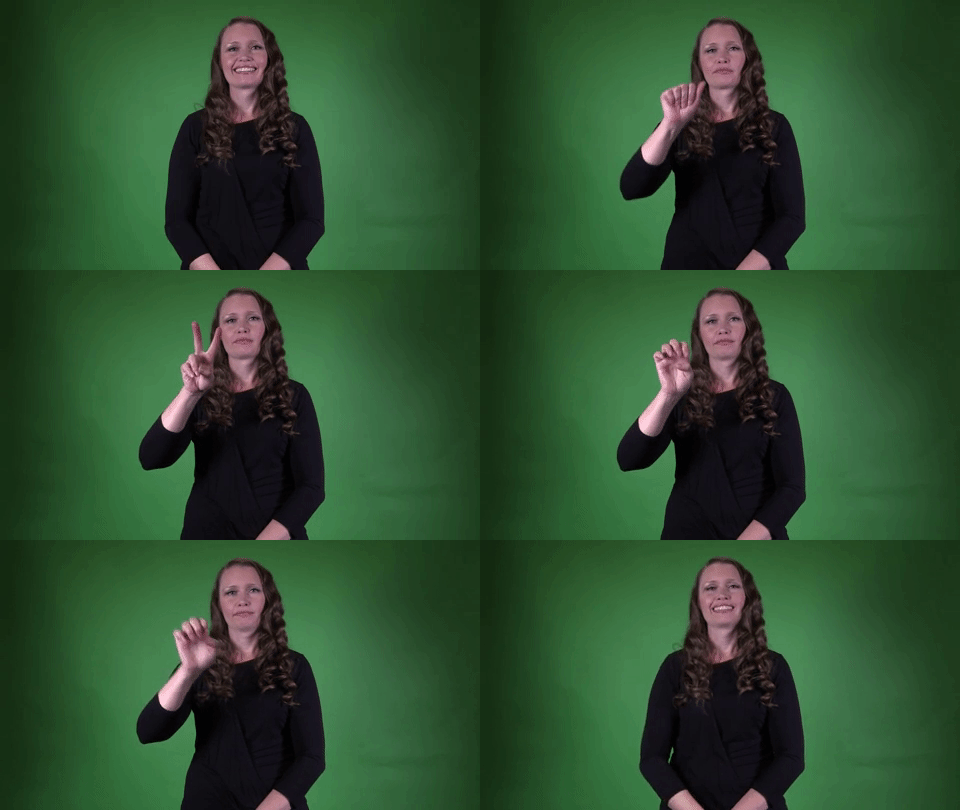
Definition: A broad road in a town or city.
Sign for AVENUE in ASL

Practice Activities:
To begin practicing the sign for AVENUE in ASL, try isolated repetition in front of a mirror. Focus on clarity, handshape accuracy, and consistent movement. Practice the sign five to ten times in a row, pausing in between to self-correct and assess fluency.
Create a list of street names that include the word avenue, such as Fifth Avenue, Park Avenue, or Sunset Avenue. Use the sign for AVENUE in ASL while fingerspelling the street name before it, combining the proper noun with the directional concept smoothly. This builds muscle memory and helps you incorporate the sign naturally into contextual phrases.
Work with a partner to role-play giving and receiving directions. One person can ask for directions to a specific location, and the other can respond by including street names with the sign for AVENUE in ASL. Practice varying the sign’s placement within a sentence to keep it fluid in use.
Write a short story or visual description that takes place in a city or town and includes references to multiple avenues. Then sign your story, emphasizing the correct use of the sign for AVENUE in ASL each time it appears. Use your phone or a camera to record and review your signing to note areas for improvement.
As a fun vocabulary mix, create flashcards with street suffixes like street, boulevard, avenue, and lane. Randomly draw a card and sign the suffix for practice. Reinforce the visual and directional nature of each term.
Join an online signing group or community and practice asking others about locations they’ve visited that include avenues. This adds a real-world conversational element that encourages spontaneous use of the sign for AVENUE in ASL while building your confidence in social settings.
Cultural Context:
In American Sign Language, understanding how to sign locations and street types like the sign for avenue in ASL is an important part of everyday communication. Signs for places, directions, or street names often have cultural context, especially in urban environments where navigation is key.
The sign for avenue in ASL reflects the importance of spatial awareness in Deaf culture. ASL often uses classifiers and visual referencing to convey the layout of streets and buildings. When expressing the concept of an avenue, signers may use directional cues or simulate the parallel nature of streets, helping to indicate the long, wide street typical of an avenue.
Learning the sign for avenue in ASL helps Deaf individuals and ASL users navigate their surroundings more effectively. It’s frequently used in conversations about locations, directions, or when explaining how to get somewhere. Whether giving directions or describing an address, the ability to correctly use the sign for avenue in ASL can add clarity and precision.
In ASL, direction and orientation matter greatly. The sign for avenue in ASL may involve movement that mimics the structure of streets running parallel. This adds a layer of cultural richness, showing how ASL integrates visual-spatial elements to communicate meaning beyond just words.
This sign is also part of broader sign language conversations about city life. Whether talking about a street corner, a well-known avenue, or finding a new location, using the correct street-type adds detail to the exchange. That’s why learning terms like the sign for avenue in ASL is as important as learning specific place names.
In many communities, avenue might be part of a common location name, like Park Avenue or Michigan Avenue. Being able to express that with the appropriate sign for avenue in ASL helps Deaf individuals participate more fully in social and professional conversations. It also supports independence in navigating urban environments.
The sign for avenue in ASL may slightly vary depending on the context or regional dialect. Some communities might add finger spelling to include specific street names while still using classifiers to emphasize spatial relationships. This flexibility is a hallmark of ASL and highlights its adaptability across cultural settings.
Teaching this sign is crucial not just for vocabulary expansion but for understanding how the Deaf community engages with the world. The sign for avenue in ASL supports communication around travel, real estate, daily errands, and social meetings. It fits into a larger system of signs for places that enrich communication for both Deaf and hearing ASL users.
Social cues, facial expressions, and hand shapes all come into play when signing terms related to places
Extended Definition:
The sign for avenue in ASL is typically represented by two parallel hands moving forward in unison, symbolizing a street or roadway. This sign visually mimics the structure of a wide road, often used for transportation and lined with buildings or trees. It conveys the concept of an avenue as a type of street, often in cities or towns, where the layout is linear and spacious.
When expressing the sign for avenue in ASL, it’s important to maintain proper handshape and movement. Both hands use a flat handshape, palms facing each other with a bit of distance between them, then move straight ahead. This movement helps distinguish the meaning from related signs like street or road, making communication clear and accurate.
The sign for avenue in ASL is commonly combined with directional or location signs for more specific meaning. For instance, signing the name of a specific avenue such as “Park Avenue” would begin with fingerspelling the name and then adding the sign for avenue. This combination helps provide context in both conversations and storytelling.
In educational settings, learning the sign for avenue in ASL is part of basic vocabulary related to geography, navigation, and urban settings. Students practice the sign along with similar terms like road, boulevard, and street to build functional language for daily use. Understanding the differences in signs helps learners better describe their surroundings or follow directions.
When used in conversation, the sign for avenue in ASL allows for clearer references to addresses or giving directions in an urban environment. Knowing how to sign street names and types like avenue makes it easier to communicate where someone is going or where an event will take place. It’s a practical sign that is often used alongside numbers and building-related vocabulary.
For those learning American Sign Language, mastering the sign for avenue along with other common location words builds confidence and fluency. It supports everyday interactions, whether asking for directions or talking about a place someone lives or visits. Accuracy in signing contributes to mutual understanding and effective communication.
Cultural context also plays a role in how the sign for avenue in ASL is used. For example, specific cities may have popular avenues that are signed frequently or with local variations in expression. Understanding the general sign along with regional influence helps deepen knowledge of the language and the Deaf community.
Using the sign for avenue in ASL can also appear in stories, poems, and visual narratives within the Deaf culture. It allows for expressiveness and accurate setting descriptions, adding depth to communication beyond simple vocabulary. The sign’s visual nature helps convey
Synonyms: route, path, street, boulevard, road
Educational resources: Find related learning materials in our course bank!
Want more? Check out some of our popular learning activities on the homepage!
Need to look up a sign? Use our highly rated dictionary: https://aslinteractive.com/best-asl-dictionary/
Follow us on tiktok: https://www.tiktok.com/@aslinteractive. More social media links at the bottom of this page!
Long-tail Keywords: what is the sign for Avenue in ASL, how do you sign Avenue in ASL, ASL sign for Avenue
Categories:
tags: Facilities and other locations/needs, Cities, Transportation, Directions, Street vocabulary
Parameters
*Handshape*:
The handshape for the sign for AVENUE in ASL uses the A handshape on both hands. Both hands form the letter A, with thumbs extended alongside the fists.
This fingerspelled sign relies on clear, controlled movement of each hand to spell A-V-E-N-U-E. Since the sign for AVENUE in ASL is fingerspelled, maintaining steady and precise A handshapes is essential for accurate recognition.
*Palm Orientation*:
The palm orientation for the sign for AVENUE in ASL typically involves both hands held upright, with palms facing each other as if outlining parallel lines or a pathway. The hands move forward together, maintaining the same distance apart to suggest the concept of a road or avenue.
When fingerspelling the word in the sign for AVENUE in ASL, each handshape remains in neutral orientation with the palm facing slightly outward. This is common in fingerspelled signs to maintain clarity of each letter.
*Location*:
The sign for AVENUE in ASL is generally fingerspelled, so the location centers around neutral space, usually in front of the upper chest or torso area. This placement allows clear visibility of each letter as it is signed from the dominant hand.
When using the sign for AVENUE in ASL during a sentence, the signer typically maintains the hand in this central location to ensure clarity and fluid motion. Repeating the sign in a consistent space helps with legibility, especially in longer place names.
*Movement*:
The sign for AVENUE in ASL is typically fingerspelled, which involves spelling out the letters A-V-E-N-U-E using the manual alphabet. Each handshape transitions smoothly to the next, keeping the movement steady and clear for readability. ✋
When using the sign for AVENUE in ASL, keep your dominant hand in front of your chest, palm facing outward, with controlled wrist and finger movement. Maintain eye contact and a consistent pace to ensure the sign is understood accurately.
*Non-Manual Signals*:
When using the sign for AVENUE in ASL, maintain a neutral or slightly inquisitive facial expression, especially if clarifying or naming a location. Eyebrows may be slightly raised if it’s part of a question or description of an address.
The sign for AVENUE in ASL is typically fingerspelled, so your mouth should remain relaxed or slightly mouthed to match the letter formation. Keep eye contact with your conversation partner and nod slightly at the end for confirmation ️.
*Prosody, Dominant/Non-Dominant Hand*:
The sign for AVENUE in ASL is typically fingerspelled, meaning each letter of the word A-V-E-N-U-E is signed individually with the dominant hand. The non-dominant hand remains still or relaxed at your side during the process.
Since the sign for AVENUE in ASL uses fingerspelling, proper handshape for each letter is essential. Maintain a steady pace and clear hand positioning to ensure legibility when signing in conversations. ️
Tips for Beginners:
When learning the sign for AVENUE in ASL, remember this word is usually fingerspelled. This means you’ll need to be confident and fluid with each letter of A-V-E-N-U-E. Take your time practicing the ASL alphabet so your fingerspelling is clear, consistent, and easy to read from different angles. Repetition helps build that natural rhythm and spacing between letters.
One common beginner mistake when signing the sign for AVENUE in ASL is rushing through the fingerspelling too quickly. While speed can come with time, clarity should be your first priority . Make sure you form each letter correctly and pause slightly after spelling the entire word so the viewer knows the sign is complete. This brief pause can really help your communication feel smoother and more confident.
Fingerspaced words like AVENUE are often used for place names, addresses, or formal documentation. That’s why recognizing context is important. If you’re discussing streets, intersections, or giving directions, the sign for AVENUE in ASL may come up frequently. Watch native signers online or in your community to understand how and when they fingerspell location-based terms to fit different conversational settings ️.
It’s also helpful to practice fingerspelling AVENUE in front of a mirror or record yourself, checking each letter formation. This builds visual feedback into your practice. Ask a friend or teacher to give you spontaneous location names to fingerspell so you can build speed and accuracy under real-world pressure. Since fingerspelling is visual and spatial, keeping your hand steady and at chest height will improve viewer comprehension.
By taking time to internalize the sign for AVENUE in ASL through focused practice, you’ll be able to use it naturally in everyday situations. Stay patient, and don’t forget to use resources like ASL dictionaries or video demos to keep improving .
sign for AVENUE in ASL, avenue asl sign, fingerspelling AVENUE in ASL, how to sign avenue in asl, ASL word for avenue
Connections to Other topics:
The sign for AVENUE in ASL is closely related to other directional and location-based vocabulary, such as STREET, ROAD, and BOULEVARD. These signs often use similar handshapes and spatial orientation to depict parallel lanes or pathways, making it easier for learners to see patterns in the language. Understanding the distinctions between them helps in giving clearer directions or describing urban landscapes more accurately.
In compound signs, the sign for AVENUE in ASL may be combined with fingerspelled letters or initialized signs when used with named streets like “Main Avenue” or “5th Avenue.” These combinations allow users to specify a particular location while maintaining the correct grammatical structure of ASL. For instance, one might sign AVENUE following the spelled-out street name for complete clarity.
The concept also connects well to classifiers, especially CL:3 (vehicle classifiers) and CL:1 (people or linear path). These classifiers are often used after signing something like STREET or AVENUE to describe cars driving along or people walking down the lane. Incorporating classifiers adds rich visual context and enhances storytelling or giving directions.
In discussions about neighborhoods or cities within ASL, using the sign for AVENUE in ASL supports conversations about infrastructure, housing, and transportation. It helps frame a mental map for the signer and viewer, allowing for more visually precise communication. This is particularly useful in narratives or when describing movement through space in ASL.
The sign also connects with temporal and event-based expressions, like parades or festivals that occur on avenues. One might reference an annual event taking place along a specific avenue, which would require the use of descriptive and spatial language. In this way, the word AVENUE becomes a cornerstone for building more complex visual scenes in ASL.
Summary:
The sign for AVENUE in ASL often relies on conceptual understanding rather than a strict one-to-one translation. In many contexts, the sign is connected with signs like STREET or ROAD, using two parallel, flat-hand shapes that mimic road surfaces. This sign is directional, typically moving forward from the signer’s body, suggesting linearity or thoroughfare.
Another rendition of the sign includes fingerspelling A-V-E to preserve specificity, like when referring to an actual named avenue such as “Park Avenue.” In Deaf culture, clarity and precision are highly valued, especially for place names. So, fingerspelling AVENUE remains common in urban conversations.
The choice between fingerspelling and using a conceptual sign depends on the context. In casual conversations, signers may default to the STREET sign, adding context through signs for BUILDING, CITY, or NAME. But in formal, navigational, or professional settings, spelling out AVENUE ensures the audience understands the exact location discussed.
The sign for AVENUE in ASL shares the same structure as ROAD and STREET, with two B-hands or palm-flat hands moving forward in parallel. This conceptual strategy demonstrates how ASL expresses abstract or concrete places in space through classifier-like hand shapes. These space-oriented signs pair well with directional body shifts that indicate geographic orientation.
ASL uses space metaphorically and visually. So when using the sign for AVENUE in ASL, the signer often establishes a location in signing space, positioning the “avenue” in relation to other features like intersections, buildings, or landmarks. This shows ASL’s deep spatial grammar which mimics real-world positioning for clarity.
When conveying navigation or describing locations, the sign for AVENUE in ASL can be accompanied by directional verbs like GO, TURN, and PASS. These grammatical combinations allow ASL users to guide others through a visual map. This makes the sign highly functional in storytelling and offering directions.
In urban geography discussions, ASL allows for nuanced commentary. If an avenue is narrower, bigger, or more touristic, signers may describe these features visually, adding signs like WIDE or LINE-UP. Using the sign for AVENUE in ASL becomes part of schematic, rich descriptions within Deaf discourse.
Notably, the AVENUE sign joins a family of urban landscape signs in ASL, including STREET, ROAD, FREEWAY, and LANE. These terms occupy a semantic field that frequently overlaps. Each sign depends on visual metaphors that reflect real-world road structures—existing within a classifier spectrum.
From a linguistic perspective, the use of two parallel handshapes in AVENUE piggybacks off ASL’s classifier system. This showcases how ASL leans on iconicity. The literal visual resemblance between hand configuration and city streets is a prime example of ASL’s spatial and visual nature.
Moreover, when talking about addresses, many Deaf signers fingerspell elements like AVENUE, especially when they appear in forms, school names, or work details. The architecture of fingerspelling often acts as a borrowing mechanism from English. In these instances, the sign for AVENUE in ASL embodies bilingual interplay.
Deaf children learning about community and safety often are introduced to the sign for AVENUE in ASL in the context of roles—like recognizing the difference between avenues and streets. Educators use visual aids and maps to reinforce the sign with real-world references. This connects physical navigation with linguistic classification.
The concept of AVENUE also fits into discussions of urban identity. For instance, famous avenues like Fifth Avenue are cultural icons. Teaching the fingerspelled version of AVENUE helps learners preserve this cultural prestige during translation into ASL.
The sign for AVENUE in ASL emphasizes the language’s reliance on spatial reasoning. Its format reflects the language’s deep affinity for visual geometry. These non-manual markers may include eyebrow movements or head tilts to indicate reference points.
Furthermore, ASL’s grammar allows for the sign to be embedded seamlessly into classifiers that describe vehicles or movement down avenues. For instance, a signer could use a CL:3 handshape moving between the two hands representing an avenue to depict a car driving. These visual strategies animate the signing space.
In conversations about real estate, architecture, or urban planning within the Deaf community, the sign for AVENUE in ASL becomes even more salient. It serves as a node in geographic descriptions. Paired ephemerally with CITY signs, it helps map the visual ecosystem of a place.
Storytelling in ASL often includes details of environment. The sign for AVENUE in ASL is effective in setting scenes—whether for dramatic vignettes or everyday accounts. Signers will often widen or narrow their parallel hand movement to match the perceived character of the avenue they’re referencing.
Technological tools like virtual maps and GPS systems have also started incorporating ASL equivalents of road signs, often relying on simplified gestures for quick reference
Want more? Check out some of our popular learning activities!
ASL Interactive Resources
ASLInteractive YouTube Channel
Follow us on tiktok: @aslinteractive.com
Follow us on Instagram: aslinteractive
Facebook page: aslinteractive
Facebook group: aslinteractive
LInkedIn: ASL Interactive LLC
Twitter: @ASL_interactive
*Some information on this page is AI-generated. AI can make mistakes. Please check the information.


Responses