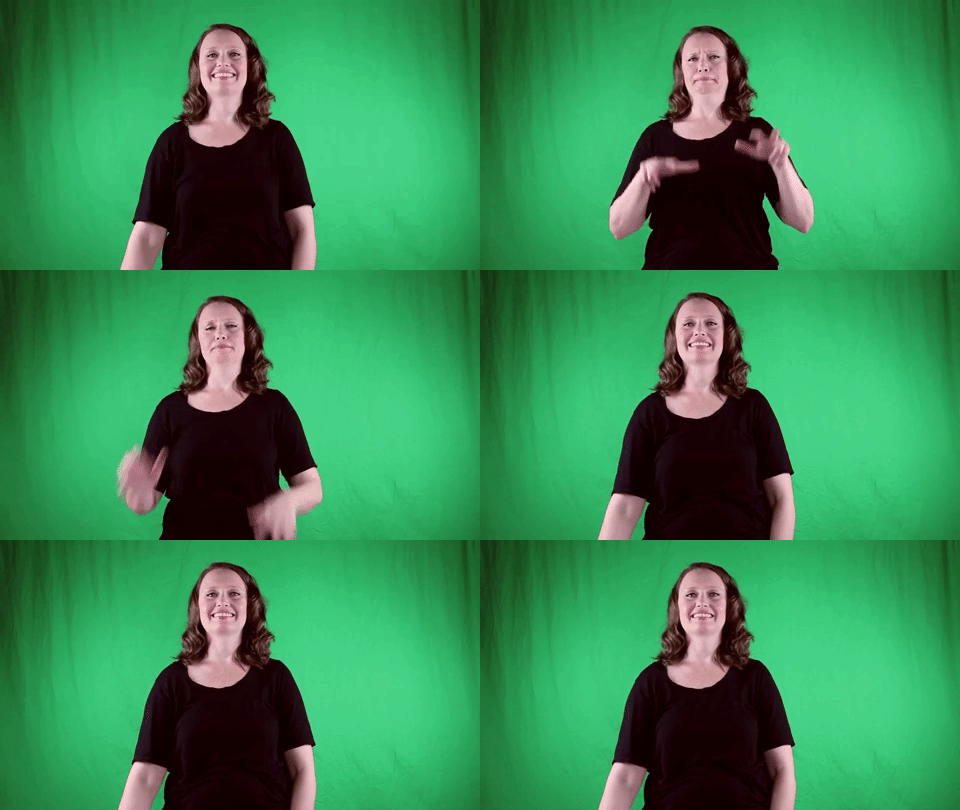
Definition: Causing discomfort or embarrassment.
Sign for AWKWARD in ASL

Practice Activities:
To practice the sign for AWKWARD in ASL, begin by isolating the handshape and movement. Use both hands in a “3” handshape, palms facing down. Alternate an up-and-down rocking motion, simulating a person walking awkwardly. Practice this in front of a mirror and focus on the rhythm and facial expression—include a wince or grimace to convey the uncomfortable feeling.
Now try using the sign in short phrases. For example: FEEL AWKWARD ME or PARTY AWKWARD WHY?. Use these phrases in repetition to build fluency. Record yourself and watch the video to evaluate your facial expressions and transitions between signs.
Create short mini-dialogues using the sign. One partner might say: YESTERDAY DATE ME AWKWARD. The other can respond: REALLY? HAPPEN WHAT?. This allows both signers to explore different settings where the sign for AWKWARD in ASL can be used naturally and conversationally.
Add storytelling to boost contextual skills. Describe an uncomfortable or embarrassing moment, such as arriving to class late or tripping in public. Incorporate the sign wherever it feels appropriate. This helps reinforce the emotional quality of AWKWARD in a realistic scenario.
Use roleplay games with a partner. Take turns acting out awkward social situations like meeting someone and forgetting their name or mixing up two friends. Pause and sign when you feel awkward. Repeating the sign during different emotions and contexts strengthens your expressive range.
Wrap up each session by listing five times you felt awkward this week. Use the sign each time and try to explain the situation in ASL. This makes the sign for AWKWARD in ASL part of your personal vocabulary, helping you connect the meaning with real-life application.
Cultural Context:
In American Sign Language, the sign for awkward in ASL carries more than just a simple translation. It reveals cultural nuances around communication, social interaction, and humor. The way the Deaf community expresses awkwardness can differ slightly from how hearing people interpret socially uncomfortable situations.
When using the sign for awkward in ASL, it’s important to consider the context. Deaf culture often values directness and clarity. Social discomfort is not always hidden or downplayed—it’s typically acknowledged more openly with facial expressions and body language that match the meaning of the sign.
Facial expressions play a huge role in how the sign for awkward in ASL is delivered. A raised eyebrow, a smirk, or a confused look often complements the sign to show the level or type of awkwardness. This is especially important since ASL relies heavily on non-manual markers to convey full meaning.
In the Deaf community, using the sign for awkward in ASL can also have a playful or humorous tone. It can be a way to bond with others or point out a funny misstep. This shows how ASL doesn’t just communicate facts but expresses shared social experiences through signs.
Awkward moments can arise in cross-cultural interactions or during conversations with new signers. In those instances, the sign for awkward in ASL becomes a useful tool not just for communication but also for breaking the ice. It signals to others that something is off, but it also lets the conversation continue in a lighthearted way.
Culturally, there’s value in naming social discomfort in a way that’s both honest and constructive. By using the sign for awkward in ASL, a signer can call attention to a moment without judgment. It’s a form of social awareness that often leads to deeper engagement rather than avoidance.
The use of space and timing in the sign for awkward in ASL is another reflection of cultural values. The rhythm and body movement are not just linguistic elements—they help convey emotional nuance. This aligns with a communication style that prioritizes expressive, full-body language.
Children in the Deaf community learn early on how to use the sign for awkward in ASL in social learning environments. Whether it be during peer interactions, classroom discussions, or family gatherings, knowing how to describe an awkward moment helps children become socially fluent in ASL.
Explaining awkwardness visually can sometimes be more effective than trying to navigate it with spoken language. This makes the sign for awkward in ASL especially powerful. It allows signers to acknowledge social missteps quickly and move on
Extended Definition:
The sign for awkward in ASL captures the uncomfortable or uneasy feeling people often experience in social situations. It typically involves both hands flat, palms facing downward, moving in alternating up-and-down motions to mimic a wobbly balance. This movement helps portray the shaky, uneasy vibe that people associate with the word awkward.
When teaching or learning the sign for awkward in ASL, it’s important to focus on the hand movement and facial expression. ASL relies heavily on facial cues, and the appropriate awkward facial expression will help convey the correct tone. Slightly raised eyebrows and a confused or embarrassed look can enhance the overall message.
There can be variations in how people sign awkward, depending on regional differences or personal styles. Some Deaf signers might combine the awkward movement with other signs or gestures to convey more nuance. This variation is common in ASL and reflects the language’s natural flexibility and richness.
Understanding the sign for awkward in ASL can be useful in everyday conversations. Whether you’re talking about an uncomfortable silence or a socially uneasy moment, this sign helps express those feelings clearly. It’s commonly used in casual interactions, storytelling, and even humor.
For beginners learning ASL, practicing the awkward sign can also be a fun way to get used to symmetrical hand movements. This particular sign requires coordination between both hands and emphasizes spatial awareness. It serves as a great exercise in refining motor skills while learning expressive vocabulary.
The sign for awkward in ASL is also a great example of how signs are often visually representative of the concept they’re communicating. The wobbling hand motion clearly illustrates a feeling of imbalance or discomfort. This visual connection makes the sign easier to remember and more effective when used in conversation.
In some contexts, the sign for awkward in ASL might carry more emotional weight. For instance, it could express social anxiety, discomfort during public speaking, or misunderstandings among friends. Paired with expressive body language and face gestures, it gives the signer the power to express these subtle feelings clearly.
The beauty of ASL lies in how each sign tells a story, and the awkward sign is no exception. It combines hand movement, facial expression, and context to convey more than just a word—it’s a full emotional experience. ASL learners benefit greatly by immersing themselves in signs like this that have layered meaning.
When interpreting or translating the sign for awkward in ASL to English, it’s crucial to consider the entire context. Just signing awkward isn’t enough without the full background of the conversation, tone, and physical expression
Synonyms: clumsy, uncomfortable, embarrassing, ungainly, inept
Educational resources: Find related learning materials in our course bank!
Want more? Check out some of our popular learning activities on the homepage!
Need to look up a sign? Use our highly rated dictionary: https://aslinteractive.com/best-asl-dictionary/
Follow us on tiktok: https://www.tiktok.com/@aslinteractive. More social media links at the bottom of this page!
Long-tail Keywords: what is the sign for awkward in ASL, how do you sign awkward in ASL, ASL sign for awkward
Categories:
tags: Emotions, Negation, Language Learning, Describing Feelings, Reactions
Parameters
*Handshape*:
The sign for AWKWARD in ASL uses the “3” handshape on both hands. Each hand has the thumb, index finger, and middle finger extended, while the ring and pinky fingers are tucked into the palm.
To perform the sign for AWKWARD in ASL, both “3” handshapes are held in front of you with palms facing down. The hands alternate moving up and down slightly in an unbalanced, offbeat motion to convey discomfort or a socially uneasy situation.
*Palm Orientation*:
The palm orientation for the sign for AWKWARD in ASL involves both hands held in the air, each palm facing down toward the floor. The hands typically form “5” handshapes with fingers spread, maintaining a flat palm throughout the motion.
During the motion, the hands move up and down alternately, as if teetering on a seesaw . This back-and-forth movement, combined with the downward-facing palms, conveys the unbalanced or uneasy feeling suggested by the sign for AWKWARD in ASL.
*Location*:
The sign for AWKWARD in ASL takes place in the neutral space in front of the torso, approximately at waist to chest level. Both hands are extended in a five-handshape and move alternately up and down, like a seesaw motion, approximately 8 to 12 inches apart.
This sign is made in open space and does not contact the body, allowing full visibility. The sign for AWKWARD in ASL often includes a facial expression that matches the feeling of discomfort or unease, helping convey the full meaning.
*Movement*:
The sign for awkward in ASL involves both hands held in the “3” handshape, palms facing down. The hands move in a see-saw motion, alternating up and down slightly as if mimicking an uneven or uncomfortable balance.
This movement reflects the unsteady or unsure feeling commonly associated with the meaning of awkwardness. The sign for awkward in ASL is often exaggerated based on the intensity of the situation being described.
*Non-Manual Signals*:
The non-manual signals for the sign for awkward in ASL commonly include a tense or uncomfortable facial expression. Eyebrows may be slightly furrowed, and the mouth can show hesitation or unease, such as a tight-lipped grimace or a crooked smirk.
Body posture may also play a role, with slight shoulder hunching or a subtle head tilt helping to convey the awkward situation. These elements help reinforce the emotional tone of the sign for awkward in ASL .
*Prosody, Dominant/Non-Dominant Hand*:
The sign for AWKWARD in ASL uses both hands in an alternating movement. Both hands are in the “3” handshape, palms facing downward, and hover slightly above waist level. The dominant and non-dominant hands move up and down in an uncoordinated, see-saw motion, mimicking an off-balance or uncomfortable feeling.
Facial expressions are an important part of the sign for AWKWARD in ASL. A squinted or uncomfortable look enhances the meaning. Use slightly exaggerated or uneven motion for the hands to emphasize the awkwardness of a situation.
Tips for Beginners:
When learning the sign for AWKWARD in ASL, it’s important to pay close attention to the handshape and movement. This sign uses the “3” handshape on both hands, palms facing down, with fingertips pointed slightly forward. The hands alternate moving up and down, as if bobbing unevenly, mimicking a clumsy or off-balance motion which perfectly matches the feeling of awkwardness.
To avoid common mistakes, be careful not to move the hands too quickly or too stiffly. Awkwardness is often represented with an uneven or exaggerated bounce to reflect the uncomfortable vibe, so keep the movement smooth but distinct. Exaggerating the motion slightly can actually improve clarity, especially for novice signers.
Practice in front of a mirror to make sure both your handshape and rhythm are accurate. When you first start learning the sign for AWKWARD in ASL, it’s easy to mirror your dominant hand incorrectly or let one hand lead rather than alternate evenly. Keeping both hands in sync with the alternate motion is key to mastering this sign.
Facial expression also plays a critical role. Pair the sign with a facial expression that shows discomfort or embarrassment. This non-manual signal helps convey the full meaning and sets ASL apart as a three-dimensional language.
Engage in real-world application by watching videos or conversations that include the sign for AWKWARD in ASL. Observing fluent signers in natural contexts allows you to grasp the subtleties of timing and expression better than memorizing alone.
Finally, don’t rush the learning process. Repeat the motion slowly at first, then increase speed only when your muscle memory improves. With consistent practice and attention to detail, you’ll express awkward moments clearly and confidently in ASL.
Connections to Other topics:
The sign for AWKWARD in ASL connects closely with the concept of social discomfort or imbalance, and this is conveyed visually through the use of both hands mimicking a seesawing motion. This balance-focused motion shares traits with signs like CLUMSY and WEIRD, which also depict emotional or situational unease. ASL often uses spatial referencing and palm orientation to reflect states of being or social interaction, and the sign for AWKWARD visually reinforces that metaphor.
This sign can compound with expressions or body language to deepen its meaning. For instance, raising eyebrows or tilting the head while using the sign can convey different types of awkwardness—such as confusion in an unfamiliar situation, or discomfort in a social setting. Learners can also combine the sign with signs like MEET, PARTY, or DATE to describe specific awkward scenarios like an awkward date or awkward conversation at a social gathering.
Additionally, the sign for AWKWARD shares visual and conceptual similarities to the sign for STRANGE, especially when used in contexts involving unfamiliar social dynamics. These subtle differences in facial expression or movement speed can determine whether the signer is indicating awkwardness due to clumsiness, tension, or confusion. This reinforces the importance of non-manual markers in ASL.
In storytelling contexts, the sign for AWKWARD in ASL becomes a useful tool for building narrative rhythm. It helps create emotional emphasis or convey the mood during staged miscommunications or humorous skits. This versatility makes it a valuable sign for ASL performers and interpreters.
Understanding the sign for AWKWARD in ASL also helps learners navigate more complex social descriptions, such as signs for EMBARRASSED, NERVOUS, or UNCOMFORTABLE. By exploring how these signs relate, users expand their expressive tools and grow more confident in discussing subtle emotional nuances in ASL .
Summary:
The sign for AWKWARD in ASL is both visually descriptive and expressive of social discomfort. It captures the unsteady, offbeat nature of awkward situations through its gestural mechanics. The sign actively demonstrates imbalance, mirroring how awkward moments can feel emotionally or socially unstable.
To produce the sign for AWKWARD in ASL, both hands are extended forward in the “5” handshape, palms facing downward. Then the hands alternate moving up and down slightly in a kind of seesawing motion. This mimics an uneven, back-and-forth pattern, almost revealing how people might shift uncomfortably in an awkward setting.
Facial expressions play a key role in conveying the intent and emotional tone of the sign. When using the sign for AWKWARD in ASL, brows are often furrowed or a tight-lipped smirk may appear, enhancing the feeling of discomfort or tension. Non-manual markers are critical here — the facial expression can drastically alter the tone from light social awkwardness to a more painful or cringeworthy level.
The sign is highly contextual. It can describe awkward feelings in personal situations, suggest someone is socially clumsy, or reflect tension in broader cultural settings. In native ASL discourse, the sign shifts depending on how lighthearted or serious the user wants to be.
The sign for AWKWARD in ASL is considered informal but still very natural in casual conversations. It’s not commonly used in formal or academic ASL contexts unless being cited or mentioned directly in relevant dialogs. That said, it is well understood and widely recognized across diverse signing communities.
Some signers employ the variation that uses the bent “V” handshapes bouncing in the air, especially younger signers or those influenced by digital ASL media on platforms like TikTok. This variation adds a playful visual metaphor and gains more traction in expressive storytelling or jest.
Grammatically, the sign for AWKWARD in ASL often behaves like an adjective, modifying nouns such as moments, people, or situations. However, it can also appear in predicate positions, following subject signs for describing emotional or social states. It leans on classifiers and established syntactic frames to build clarity.
In ASL narratives, awkwardness can be constructed spatially through role shifts and body orientation. For example, a signer may sign two sides to a conversation and end with the AWKWARD sign to punctuate a social misstep. This layered narrative use shows how the sign functions beyond a label — as an interpretive tool.
There’s a related sign meaning UNCOMFORTABLE, which shares overlapping facial expressions and sometimes precedes or follows the sign for AWKWARD in ASL. The two signs may appear together in sequences that build emotion or describe nuanced social experiences. Pairing them further enhances expressive accuracy.
Linguistically, the sign is iconic because it represents its concept through visual metaphor. The bouncing hands appear offbeat, synchronizing with the perception of behavioral instability. Yet it is arbitrary in its exact execution across regions, revealing a descriptive yet variable nature in ASL’s lexicon.
The morphology of the sign includes movement and non-manual markers, and it lacks directionality, making it a stative adjectival verb. It does not show subject-object agreement, but its functional morphology adapts in dialogue. Morphologically, it’s simple, yet pragmatically flexible.
Phonetically, the configuration of the “5” handshape is open and neutral, allowing quick transition to and from other signs. The rhythmic alternation of movement gives it a speechlike cadence, mirroring spoken language’s intonation when expressing hesitation or tension.
From a sociolinguistic view, the sign for AWKWARD in ASL is more commonly used among younger generations or in digital spaces where direct descriptions of emotion are encouraged. It evolves with cultural trends, gaining new forms as expressive needs grow, particularly in narratives detailing social fumbles.
Culturally, awkwardness is a shared human experience and Deaf culture uses specific visual tools to capture it vividly. The use of the sign for AWKWARD in ASL allows users to express moments that might feel clumsy, strange, or cringeworthy, thus valuing emotional transparency in communication.
Humor plays a role in how this sign is used. Awkward moments are often shared in stories as comic relief, especially during group conversations or performances. These uses of the sign show how ASL embraces vulnerability through storytelling.
In Deaf theater or ASL vlogging, signers often build up to the sign for AWKWARD in ASL through pacing, body shifts, and exaggerated narrative beats. It becomes the emotional climax or twist, enhancing audience engagement. The sign becomes a punchline or narrative cue.
Analyzing the sign through applied linguistics shows how gestures are mapped onto psychological experiences. The kinetic structure of AWKWARD mirrors instability, suggesting a metaphorical linking of physical imbalance with social unease. This mapping supports theories of embodied language.
When
Want more? Check out some of our popular learning activities!
ASL Interactive Resources
ASLInteractive YouTube Channel
Follow us on tiktok: @aslinteractive.com
Follow us on Instagram: aslinteractive
Facebook page: aslinteractive
Facebook group: aslinteractive
LInkedIn: ASL Interactive LLC
Twitter: @ASL_interactive
*Some information on this page is AI-generated. AI can make mistakes. Please check the information.


Responses