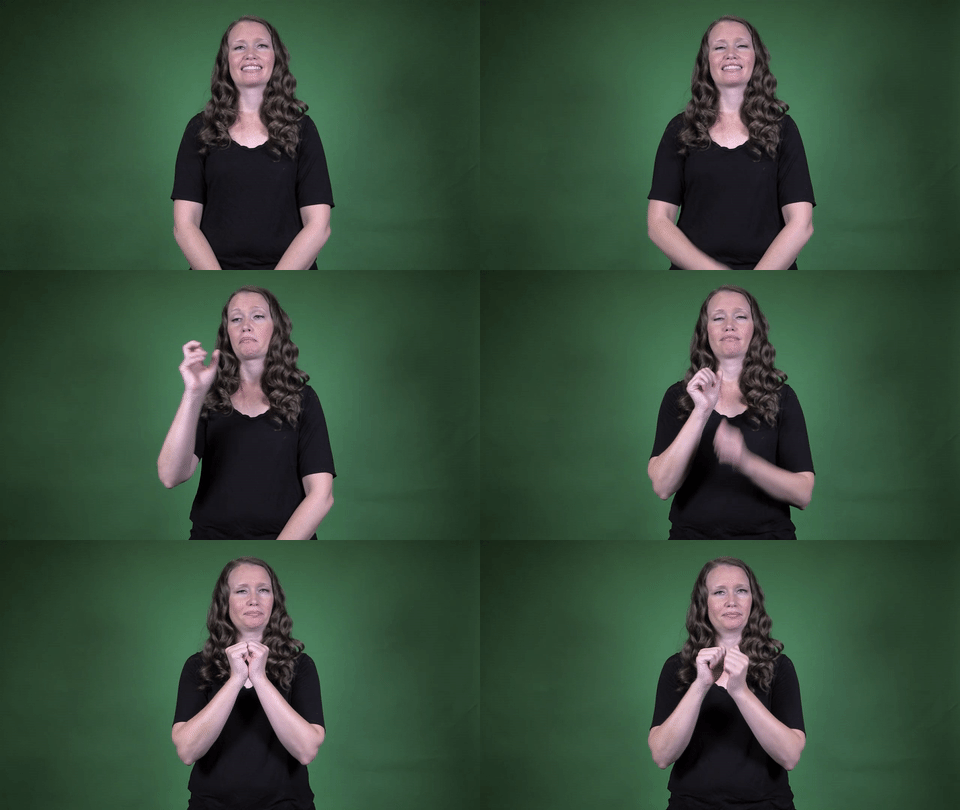
Definition: To be reunited.
Sign for BACK TOGETHER in ASL

Practice Activities:
To begin practicing the sign for back together in ASL, start by signing it in isolation in front of a mirror. Focus on handshape, movement, and facial expression. Repeating it slowly and then increasing speed can help with fluidity and muscle memory.
Next, try using the sign for back together in ASL with short phrases. Examples include “They are back together” or “Friends back together again.” Say the sentence aloud while signing to build a strong connection between English and ASL structure. Repeating these daily can boost confidence.
Storytelling is a fun and immersive way to use the sign in context. Create a short story about two people who were separated but eventually reunited. Use the sign for back together in ASL at the emotional turning point to reinforce its use and meaning. You can also record yourself signing the story to review later.
For interactive practice, use role-play with a partner. One person tells a short anecdote about characters rekindling a friendship or relationship. The other partner responds using the sign appropriately. This activity encourages conversational use and can identify areas that need improvement.
Another useful exercise involves watching short video clips that show reunions, like scenes from movies or TV shows. After viewing, describe the event in ASL, making sure to include the sign for back together. This simulates real-life applications and helps with narrative flow.
Incorporate flashcards showing the English phrase and prompt yourself to sign back together quickly and accurately. You can mix this into broader vocabulary review sessions. These drills build speed and reinforce recall.
Finally, write out potential scenarios in English where people come back together, then translate those into ASL. This helps bridge translation skills and deepen understanding of the sign’s emotional and social nuance.
Cultural Context:
In American Sign Language (ASL), the sign for back together carries emotional depth and cultural significance. This phrase is often used to express reunion, reconciliation, or the reuniting of people who were previously separated, either emotionally or physically. Within the Deaf community, the sign for back together in ASL can be a powerful way to communicate restored relationships or coming back to familiar connections.
The sign for back together in ASL reflects more than just literal proximity. It often conveys shared experiences, renewed bonds, or healed connections after time apart. Whether reuniting with friends, family, or loved ones, this sign communicates warmth, belonging, and emotional reconnection.
In the context of Deaf culture, community and shared identity are central themes. The sign for back together in ASL resonates deeply in social gatherings or after life changes such as moving, returning from school, or even after a disagreement. The act of signing this phrase visualizes the emotional relief and joy of being reunited.
You may see the sign used in social settings like Deaf events, family reunions, and when people return from long trips or disrupted communication. The sign for back together in ASL can be made with a gesture that emphasizes joining or connecting once again, emphasizing unity. This expression is rich in cultural context when used among Deaf friends or close-knit networks who place strong value on connection.
In daily ASL conversations, it’s common to use this sign when describing storylines, personal experiences, or relationship updates. For example, sharing that two people are back together can instantly convey a narrative of reconciliation or progress without long explanation. The sign for back together in ASL gives visual and natural fluency to these types of stories.
ASL is a visual language, and every gesture involves both meaning and emotion. The sign for back together in ASL is an excellent example of how ASL portrays feelings through movement and facial expressions. The concept of coming together again is visually reinforced in a way that spoken language may not capture as intuitively.
In Deaf culture, emotional expressions are highly visible parts of communication. Signing back together in ASL often goes along with smiling, expressive eyebrows, or a warm body movement, enhancing the sign’s meaning. This combination enriches the message and creates shared understanding without relying on spoken cues.
As relationships change and grow, having a way to express returning to each other becomes meaningful. The sign for back together in ASL offers a way to mark those emotional milestones clearly and with intention. It holds particular
Extended Definition:
The sign for back together in ASL conveys the idea of two people or things coming back into a union or reunited after being apart. This sign is commonly used when talking about rekindled relationships, reuniting with family members or friends, or even getting back in touch after a long time. It is a concept often associated with reconciliation, healing, or second chances.
In American Sign Language, signs are not just hand movements but also facial expressions and body language. The sign for back together in ASL typically involves movement that shows separation followed by reconnection, clearly illustrating the meaning of coming back as one. Signers may incorporate non-manual signals like raised eyebrows or a slight head nod to emphasize the emotional aspect of reconnection.
This sign can be used in casual situations or more serious conversations depending on the context. For instance, you might use the sign when telling someone that two friends are back together after an argument. Or, you might use it in a romantic context to say a couple has reconciled and is in a relationship again.
Sometimes the sign for back together in ASL can vary slightly depending on regional dialect or the age of the signer. As with many ASL signs, context plays a critical role in interpreting meaning. It’s always helpful to watch ASL videos or interact with native signers to fully understand how to use this sign appropriately and naturally.
When expressing this concept, it’s useful to sign both the idea of separation and then union, making the message visually clear. This type of visual storytelling is one of the powerful aspects of using ASL. The sign for back together in ASL gives the viewer a sense of action, showing how two entities move from distance to unity.
In relationships, this sign is often used with positive facial expressions to suggest a joyful reunion. In contrast, if the reunion is uncertain or comes with mixed emotions, the signer might change facial expressions to convey emotional complexity. These visual nuances are part of what makes ASL so expressive and effective.
Because American Sign Language is not a word-for-word translation of English, understanding the phrase in visual terms is important. The sign for back together in ASL doesn’t have an exact English equivalent—it embodies a feeling or a situation, not just a word. That’s why video demonstrations can be especially helpful when learning this sign.
People learning ASL often find that signs like this allow for more connection and depth in conversations. It allows you to talk about life events in more meaningful ways. Whether it’s
Synonyms: reunited, reconciled, rejoined, reconnected, restored
Educational resources: Find related learning materials in our course bank!
Want more? Check out some of our popular learning activities on the homepage!
Need to look up a sign? Use our highly rated dictionary: https://aslinteractive.com/best-asl-dictionary/
Follow us on tiktok: https://www.tiktok.com/@aslinteractive. More social media links at the bottom of this page!
Long-tail Keywords: what is the sign for back together in ASL, how do you sign back together in ASL, ASL sign for back together
Categories:
tags: Back To School: Education, School Supplies, Classroom Activities, School Year, Learning Experience
Parameters
*Handshape*:
The handshape used in the sign for BACK TOGETHER in ASL begins with both hands in a flat “O” shape, where the fingertips touch the thumbs, forming a circular handshape. This configuration helps represent the concept of joining or reuniting.
To convey the sign for BACK TOGETHER in ASL, the hands move toward each other, touching at the fingertips while maintaining the “O” shapes. This motion emphasizes the action of returning or reuniting, aligning with the meaning of the phrase.
*Palm Orientation*:
For the sign for BACK TOGETHER in ASL, the palm orientation generally starts with both palms facing toward the body. As the hands move toward each other to touch at the knuckles, the palms may shift slightly inward, still generally facing oneself. This mirrors the concept of individuals coming back into proximity or unity. The palm positioning plays a key role in conveying the full meaning of the sign for BACK TOGETHER in ASL .
*Location*:
The sign for BACK TOGETHER in ASL is typically produced in the neutral space just in front of the chest. Both hands start in an open position and then move toward each other to form interlocked or clasped shapes. This location allows for clear visibility and emphasizes the idea of reconnection or reunion.
In the sign for BACK TOGETHER in ASL, the emphasis is on coordinated hand movement in the central signing space. The area just in front of the torso provides a balanced location for symmetrical handshapes to meet and link, symbolizing coming back into unity.
*Movement*:
Start with both index fingers extended and pointing forward, palms facing each other, held a few inches apart in front of your chest. Move the hands toward each other in a smooth, inward arc so that the tips of the index fingers meet, symbolizing a coming together.
This movement in the sign for back together in ASL emphasizes reconnection or reunion. The curved path of the fingers visually expresses the idea of returning to unity or a previous relationship.
*Non-Manual Signals*:
The sign for BACK TOGETHER in ASL often includes a warm, relieved non-manual signal. Eyebrows are typically raised slightly, with a soft smile to show positive emotion or reconciliation.
Head may lean forward a bit or nod subtly, signaling mutual connection or reunion. Using the appropriate expression reinforces the intent behind the sign for BACK TOGETHER in ASL , especially in emotional or social contexts.
*Prosody, Dominant/Non-Dominant Hand*:
The sign for BACK TOGETHER in ASL uses both hands. The dominant and non-dominant hands begin as flat hands facing each other a short distance apart. They move inward and clasp into interlocking fingers, symbolizing reunion or reconnection .
This sign emphasizes mutual connection using both hands equally. The prosody shows a smooth, firm motion that reflects unity, which is key for conveying the meaning behind the sign for BACK TOGETHER in ASL.
Tips for Beginners:
When learning the sign for BACK TOGETHER in ASL, it’s important to understand the context behind the phrase. This sign typically conveys the idea of people reuniting or being in a relationship again. It’s often a conceptual sign rather than a literal one, so focusing on facial expressions and body language is essential for delivering clear meaning.
To practice the sign for BACK TOGETHER in ASL effectively, start by reviewing related signs like “reconnect,” “again,” and “relationship.” These may be involved in how BACK TOGETHER is expressed depending on the context. Since there may not be a single designated sign, skilled signers use a combination of signs and expressions to convey this concept. Being mindful of the emotional nuance helps reinforce your message.
One helpful tip is to practice combining signs smoothly. For example, use the sign for “break up” followed by “together again” or “same two connect again.” Make sure movements are clear and defined, using appropriate directional cues to show two individuals coming back into contact. Keep your signs close to the body and within your signing space to maintain clarity.
A common mistake beginners make with the sign for BACK TOGETHER in ASL is relying too much on English word order. Instead, focus on ASL grammar by signing the concept using visual storytelling. For instance, use non-manual markers like raised eyebrows to indicate something has changed or returned to a previous state.
Don’t forget to use facial expressions to show emotion—joy, surprise, relief—all can enhance the message you’re delivering. Record yourself signing to spot inconsistencies and improve fluency. Watching native signers and mimicking their use of space and emotion will also deepen your understanding.
Remember that in the Deaf community, signing naturally and expressively matters more than literal translation. Immerse yourself in ASL and keep practicing the sign for BACK TOGETHER in ASL to build confidence and accuracy.
Connections to Other topics:
The sign for BACK TOGETHER in ASL connects naturally to the broader concept of reunification, making it useful in social and relational contexts. This sign often draws from conceptual combinations of “return” and “together,” both of which have roots in foundational ASL vocabulary. These root signs help learners understand how ASL expresses abstract and emotional ideas physically, using movement and handshape.
The sign for BACK TOGETHER in ASL also aligns with other signs that involve emotional reconnection, such as “reunite,” “reconnect,” and “reconcile.” These concepts may vary slightly in presentation depending on context, but they share the theme of restoring a previous connection. It is useful for learners to study these related signs together to build a more nuanced vocabulary in conversations about relationships or returning to a previous state.
ASL often relies on spatial referencing and shared use of classifiers to show relationships among people or things. In the case of the sign for BACK TOGETHER in ASL, directional movement may mimic two entities coming back to a central point. This blend of classifiers and motion conveys both the physical and emotional aspects of being back with someone.
This sign also links to time-based vocabulary like “again,” “return,” and “past.” These concepts are often needed when discussing events like reunions, returning home, or restoring a partnership. Contextually, learners may see this sign in discussions about family gatherings, romantic relationships, or even teammates coming back after a break.
Understanding the sign for BACK TOGETHER in ASL also helps reinforce the importance of non-manual markers in conveying emotional context. Facial expression adds depth to the sign, showing whether the reunion is joyful, awkward, or bittersweet. Through these connections, learners can more effectively communicate nuanced emotional experiences in ASL.
Summary:
The sign for BACK TOGETHER in ASL combines both literal and abstract meanings. In everyday use, it often signifies the idea of people reuniting after being apart, whether in friendship, family, or romance.
To produce the sign for BACK TOGETHER in ASL, the hands usually begin in a separated open form and then move toward each other, closing into interlocked or clasped positions. This motion emphasizes the idea of convergence or reunion, reinforcing both emotional and physical coming together.
Context determines how the sign is shaped and expressed. When referring to romantic relationships, facial expressions that convey warmth or hesitation can deeply influence the delivered meaning.
Culturally, the sign for BACK TOGETHER in ASL is rich with emotional nuance. It can signify forgiveness, reconciliation, or the overcoming of past grievances, and signals emotional growth within the Deaf community or interpersonal relationships.
In a Deaf-centric discourse, getting back together may be associated with values of loyalty, community-building, and emotional restoration. Community members may use this sign in storytelling about childhood friends reconnecting or people reconciled after conflict.
ASL often places verbs toward the end of a sentence. So when signing phrases focused on reunion, such as “we’re back together,” the sign for BACK TOGETHER in ASL helps close narrative arcs or emotional loops.
The visual-spatial nature of sign language allows users to map out the backstory leading to the reunion. The gesture of coming together visually complements the deeper emotional context embedded in ASL conversations.
In storytelling, narratives may include separation and eventual reunion. The sign for BACK TOGETHER in ASL functions as a powerful concluding symbol in such stories.
In a linguistic sense, this sign tends to function as a verb phrase, capturing dynamic action rather than static description. Its function depends heavily on movement and spatial orientation.
This movement is generally symmetrical and deliberate. Both hands share the motion equally, enforcing the idea of equality and mutual effort in coming back together.
An interesting linguistic element of ASL is that many compound signs indicate more than one concept or timeframe. The sign for BACK TOGETHER in ASL might incorporate directional cues that reference prior separation.
Directional signs in ASL vary the path and position to shift meaning. Signing BACK TOGETHER while referencing a previous time or place can squarely locate the event in the past.
Non-manual signals such as facial expressions or head nods are essential. A slight head tilt with raised eyebrows may suggest curiosity or cautious optimism, modifying the emotional shade of the sign.
In applied linguistics, educators often teach the sign for BACK TOGETHER in ASL in situations involving relationships, group dynamics, or narrative expression. It forms part of the broader vocabulary related to temporal and emotional change.
Reunion-themed signs often carry idiomatic or metaphorical weight. Back together can mean emotional restoration or a literal rejoining of people or objects—making it multi-functional.
In romantic contexts, the sign can signal a recommitment. For example, signing BACK TOGETHER after issues in a relationship shows personal development and vulnerability—core values within many cultural narratives.
ASL’s grammar and pragmatics allow for flexibility in this concept. Returning to a team or cause might use the same sign, supported by additional clarifying signs or role shifts for precision.
Community-wise, the sign may symbolize broader reconnection—such as one’s return to the Deaf community after years of absence, educational expansion, or personal transformation.
Using classifiers to describe events that led to separation and eventual reunion often occurs in storytelling. These classifiers help signers elaborate the emotional pathways that culminate in being back together.
Some signers employ body shift visualization when showing past separation and current connection. In these cases, the sign for BACK TOGETHER in ASL acts as the narrative pivot.
In poetic ASL or visual storytelling, repetition of hand contact and separation can enhance emotional resonance. This visual motif of separation-reunion supports the emotional theme of reconciliation or growth.
The concept also applies to objects or abstract projects coming back together. For example, rejoining a collaborative endeavor or fixing something broken could benefit from this sign.
The rhythm and pacing of the sign can change meaning too. A slow, deliberate motion may imply hesitance or emotional weight, whereas a quick, assertive gesture might suggest excitement or confidence.
Related signs include RECONNECT, UNITE, and TOGETHER. Each of these is similar in motion but nuanced in reason and context.
There is also potential overlap with signs for MAKE UP or APOLOGIZE, especially in romantic or interpersonal frames. These signs often appear in sequences with BACK TOGETHER to show intention and process.
Fingerspelling is rarely used for this concept unless emphasizing an unconventional or technical context, such as brand names or proper nouns related to a reunion.
Video-based teaching resources often demonstrate contextual usage. Observing these scenarios helps users understand appropriate body language and facial expressions when using the sign.
The sign’s spatial element can be
Want more? Check out some of our popular learning activities!
ASL Interactive Resources
ASLInteractive YouTube Channel
Follow us on tiktok: @aslinteractive.com
Follow us on Instagram: aslinteractive
Facebook page: aslinteractive
Facebook group: aslinteractive
LInkedIn: ASL Interactive LLC
Twitter: @ASL_interactive
*Some information on this page is AI-generated. AI can make mistakes. Please check the information.


Responses