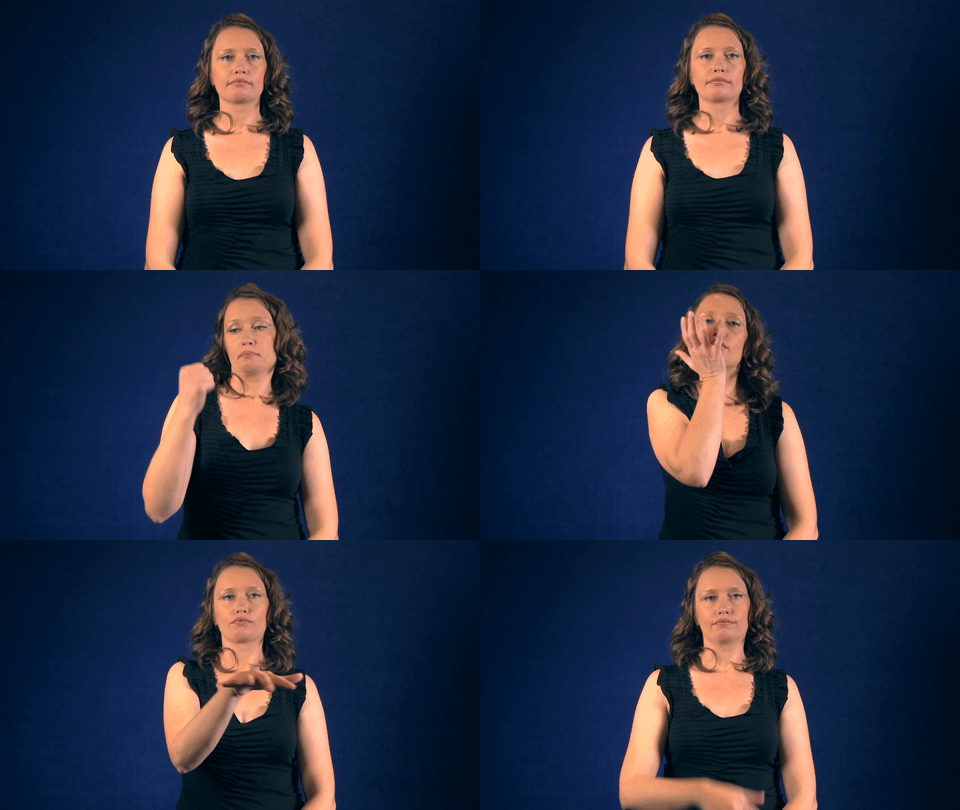
Definition: An area behind a house.
Sign for BACKYARD in ASL

Practice Activities:
Start by practicing the sign for BACKYARD in ASL in isolation. Stand in front of a mirror and repeat the sign slowly to check handshape, movement, and placement. Focus on the directionality of the sign and consider how it differs from the sign for YARD or BACK.
Once you’re comfortable signing it alone, incorporate the sign for BACKYARD in ASL into simple sentences. Sign phrases like “I play in the backyard,” “My dog runs in the backyard,” or “We eat lunch in the backyard.” This helps reinforce fluency and prepares you for conversational use.
Use flashcards or images to stimulate responses. Look at a picture of a house and describe where things are, using the sign for BACKYARD in ASL when appropriate. Try writing five sentences in English and then sign them in ASL, focusing on proper non-manual markers, facial expressions, and ASL grammar.
Create a short story or mini-dialogue using the sign. For example, tell a story about a barbecue you had in the backyard or a game you played. Share it with a partner or record yourself to check for clarity and smooth transitions between signs.
Partner activities are especially useful. Have one person describe their ideal backyard using signs while the other interprets and asks follow-up questions. Switch roles so both participants get equal practice with expressive and receptive skills.
Play a game of ASL charades where one person acts out activities commonly done in a backyard, and the other identifies them, using the full phrase sign for BACKYARD in ASL when appropriate. This builds context awareness and vocabulary.
Finally, go outside if possible and walk around your own backyard. Narrate your location and actions using ASL. Being in a real backyard helps ground the meaning of the sign and enhances learning through real-life experience.
Cultural Context:
In American Sign Language (ASL), the sign for backyard reflects more than just a physical space. The backyard is often a place of relaxation, gathering, and connection with nature. For Deaf families and signers, the backyard can be an important setting for cultural bonding, games, and social interaction in a visual-friendly environment.
The sign for backyard in ASL is used frequently in daily conversation. Deaf children playing outside will use this sign to describe where they’re going or what they’re doing. It’s common in storytelling, where the backyard serves as a backdrop for shared memories or events.
In Deaf culture, the concept of space is visually grounded. That means describing where something happens, like in the backyard, is very important in communication. The sign for backyard in ASL helps bring these scenes to life with clarity and visual context that supports storytelling and expression.
Whether describing backyard barbecues, gardening, or just relaxing in a hammock, signers rely on the correct use of this word. The sign for backyard in ASL can also reflect cultural values such as the importance of outdoor spaces for community gatherings. Whether in rural areas or urban backyards, the sign stays consistent, bringing shared understanding across regions.
Using location-based signs like backyard helps emphasize spatial awareness in ASL. It shows how signers naturally construct the world around them with their hands and body positioning. The sign for backyard in ASL contributes to a deeper understanding of environment within ASL conversations.
Deaf families and children learn location-related vocabulary, like backyard, early on because it’s part of their daily routine. Teachers may use the sign for backyard in ASL when giving instructions or teaching about the environment. This term becomes part of more complex narratives, such as explaining chores, weather, or leisure activities.
A visually detailed language like ASL connects signs to lived experience. When someone uses the sign for backyard in ASL, they are often referring to a specific space behind their home. This spatial orientation reinforces how ASL uses location to organize and express ideas clearly.
The sign for backyard in ASL also often appears in ASL poetry and storytelling performances. Backyards are frequent settings for personal memories that resonate in Deaf storytelling traditions. By adding the sign for backyard in ASL, storytellers invite the audience into a familiar setting.
Many community events happen in someone’s backyard, strengthening relationships in the Deaf community. From cookouts to birthday parties, people use the sign for backyard in ASL to invite others or
Extended Definition:
The sign for backyard in ASL refers to a visual-gestural representation used to express the outdoor area located behind a home. In American Sign Language, it combines concepts like “back” and “yard” to convey the full meaning of the word. Knowing how to sign outdoor spaces helps communicate household or property-related topics more clearly.
To express the sign for backyard in ASL, signers often use a compound sign that incorporates elements of location and setting. First, the sign for “back” is usually signed by referencing behind the body, followed by the sign for “yard” which commonly includes signs for “grass” or “area.” These two parts come together to represent the concept of a backyard.
Regional differences and individual signing styles may slightly alter how the sign for backyard in ASL is performed. However, the meaning remains easily understood within the context of household conversations. Visual clarity and consistency are key when combining signs to describe spaces like the backyard.
The sign for backyard in ASL is used in everyday situations such as talking about outdoor play, gardening, relaxing at home, or pet activities. ASL users might describe what’s in the backyard, like a swing set, garden, or patio furniture. This sign becomes especially relevant when relaying information about home layouts or property features.
By learning how to accurately produce the sign for backyard in ASL, signers can enhance their descriptive vocabulary and engage more fully in conversations about their environment. It’s also helpful when giving directions or describing a favorite place to hang out. Visual and spatial signs like this one make ASL rich and expressive.
In addition to the general use in daily conversation, the sign for backyard in ASL might be modified with facial expressions to show emotion or context. For example, a smiling expression might indicate enjoyment while referring to an afternoon spent in the backyard. Non-manual signals like raised eyebrows can even change the meaning of your sentence based on how the sign is used.
When watching ASL interpreted content, signers can look for the backyard sign during home tours, nature shows, or family vlogs. This consistent usage helps reinforce the vocabulary and context of the sign. Recognizing common signs in these scenarios supports faster learning and better understanding of ASL grammar.
Parents who use ASL with their children often teach words related to the home, making backyard one of the early vocabulary signs. It allows for discussions about outdoor safety, play schedules, or garden activities. Signing in natural settings like the backyard also encourages language development and
Synonyms: yard, garden, lawn, outdoor space, back garden
Educational resources: Find related learning materials in our course bank!
Want more? Check out some of our popular learning activities on the homepage!
Need to look up a sign? Use our highly rated dictionary: https://aslinteractive.com/best-asl-dictionary/
Follow us on tiktok: https://www.tiktok.com/@aslinteractive. More social media links at the bottom of this page!
Long-tail Keywords: what is the sign for backyard in ASL, how do you sign backyard in American Sign Language, backyard sign language translation
Categories:
tags: Backyard, Housing, Facilities and other locations/needs, Describing Residence, Activities
Parameters
*Handshape*:
The handshape for the sign for BACKYARD in ASL uses the dominant hand in a “B” handshape, with the palm facing backward over the shoulder to represent “back.” The non-dominant hand often remains at the side or may be used contextually depending on the compound sign.
To complete the sign for BACKYARD in ASL, the second part generally incorporates the sign for “area” or “yard,” using open “5” handshapes that circle to indicate space. This compound sign blends both parts fluently.
*Palm Orientation*:
For the sign for BACKYARD in ASL, the palm orientation depends on the compound structure of the sign. Often, the sign combines BACK and YARD. When signing BACK, the dominant hand is in an A-handshape, with the palm facing inward toward the signer as it moves backward over the shoulder. For the YARD portion, the hands may use a gesture mimicking land spread, with palms facing downward, representing ground. The palm orientation aids clarity in the sign for BACKYARD in ASL .
*Location*:
The sign for BACKYARD in ASL is typically produced in a neutral space in front of the signer’s upper torso. It begins with the sign for BACK, made by placing the bent hand in a backward motion over the shoulder area. This location sets the context for the sign’s referent, which is physically associated with the rear side of a typical dwelling.
After the BACK component, the second part—representing YARD—is shown in the same general space or slightly lower and outward, indicating an area behind a home. The consistent signing space in front of the chest allows for a clear and natural production of the sign for BACKYARD in ASL.
*Movement*:
To perform the sign for BACKYARD in ASL, begin by signing BACK by placing the dominant hand in an “A” handshape, palm facing down, and moving it backward over the shoulder to indicate “back.” Then transition smoothly into the sign for YARD, which uses a “Y” handshape in a small circular motion in front of the body to visualize open space.
The sign for BACKYARD in ASL combines spatial and directional movements. Ensure a relaxed hand and fluid transition between the two components to convey the concept naturally. This compound sign effectively communicates the idea of an outdoor area located behind a home or building .
*Non-Manual Signals*:
When using the sign for BACKYARD in ASL, non-manual signals typically include a neutral or slightly thoughtful facial expression. Slight head tilt or a subtle glance backward can help indicate spatial orientation, emphasizing the location behind a house or space.
Raising the eyebrows slightly can signal the act of clarification or description, especially when explaining or describing someone’s actual backyard. These expressions help visually support the sign for BACKYARD in ASL and integrate the concept into a spatial context.
*Prosody, Dominant/Non-Dominant Hand*:
The sign for BACKYARD in ASL uses both hands in a two-part concept. First, sign “BACK” by making a backward motion with the dominant “A” handshape moving from the front to the back of the shoulder area. Next, sign “YARD” by using a relaxed open “5” hand that circles once to represent an enclosed area. The sign for BACKYARD in ASL often incorporates body shifting for clarity .
Tips for Beginners:
When learning the sign for BACKYARD in ASL, it’s helpful to break it into two parts: BACK and YARD. Start by fingerspelling “B-A-C-K” which gives the concept of “back,” then follow with the sign for “yard,” usually made by forming a bent “5” hand and tapping the fingertips lightly against the back of the opposite hand in front of the chest. This combination expresses the concept clearly in ASL. Practice the flow between these two components for a smooth transition.
Beginners sometimes rush the fingerspelling part or blend BACK too quickly into the next sign. Make sure each letter in “BACK” is distinctly visible. Take your time and spell at a comfortable and steady pace. Over time ☀️, your speed and fluidity will improve without sacrificing clarity.
Another good tip is to focus on facial expressions while signing. Because ASL is a visual language, facial expressions help convey tone and help contextualize meaning. When signing about a location like a yard, a quick glance over your shoulder or a slight lean backward can help reinforce the idea of a space behind the house, complementing the sign for BACKYARD in ASL.
Remember to place your signs appropriately in the signing space. The concept of “back yard” naturally fits behind or away from your body, so positioning matters when you’re involved in storytelling or describing locations. Utilize spatial referencing to your advantage since this is unique to ASL.
Lastly, watch native signers perform the sign for BACKYARD in ASL in conversation. Video exposure improves recognition and helps you model accurate movements and transitions. Don’t worry if your signs aren’t perfect at first—consistency and slow, mindful practice will bring growth and confidence.
Connections to Other topics:
The sign for BACKYARD in ASL connects closely with other location and compound signs such as HOUSE, OUTSIDE, and BACK. Understanding the parts of the sign for BACKYARD helps reinforce spatial referencing and directional concepts in ASL. These concepts are key to describing environments, homes, and personal spaces, all central themes in everyday ASL conversation.
A common way to show the sign for BACKYARD in ASL involves combining the sign for BACK with the sign for AREA or YARD. This kind of compound structure is seen in signs like FRONT YARD, BATHROOM AREA, or PARKING LOT. Being able to deconstruct and reassemble signs in this way can help learners identify patterns and gain fluency in describing physical locations.
The sign for BACK used here is also used in other compound ideas like BACKROW, BACKPACK, and BACKUP, depending on the context. When paired with places like YARD, the BACK direction can become more metaphorical or spatial, showing how ASL uses directionality to express relational positioning. These cognitive strategies support broader conversations about living spaces and movement.
The sign for YARD can also relate to similar signs like GARDEN or FIELD, which might be used in similar contexts when talking about outside spaces. The sign for BACKYARD in ASL, therefore, opens discussions about nature, environment, and personal property. This helps signers describe where events take place, enhancing narrative detail and storytelling skills.
In storytelling or casual conversation, describing a backyard might lead to mentioning activities like BBQ, PLAY, or WORK, making the sign for BACKYARD in ASL a stepping stone to more complex and context-rich exchanges. Practice with this sign reinforces the ability to combine locations with action, which is central to the structure of the language.
Summary:
The sign for BACKYARD in ASL combines two concepts: “back” and “yard.” This compound sign often starts with the directional sign BACK, followed by the general sign for YARD, or a signed description of the outdoor space.
To sign BACK, you typically point behind you or show movement from the front to the back of the body. This directional gesture helps frame the physical location relevant to one’s body space.
YARD is more abstract in ASL since its meaning varies with context. It can be signed by forming a flat “B” handshape and brushing the hand downward, indicating a space or area. Another way is to show space near or around a home or house, using classifiers to depict outdoor layout.
Combining these elements gives you the sign for BACKYARD in ASL. It visually conveys outdoor space located at the rear of a house, often using spatial referencing to describe what’s behind the signer.
In everyday use, this sign is applied when discussing property, gardening, or play areas. It’s common in conversations about home life, maintenance, and family gatherings, especially in suburban or rural settings.
The sign for BACKYARD in ASL holds cultural significance for Deaf communities that value shared outdoor activities. Backyard settings are associated with cookouts, family time, and social events, all of which play important roles in community bonding.
Grammatically, it can appear after topicalized phrases or at the beginning of sentences for emphasis. ASL allows flexibility, so the placement depends on what element of the conversation is highlighted.
When emphasizing location, the sign for BACKYARD in ASL may be modified with classifiers. These classifiers can show size, elevation, or objects occupying the yard, enhancing detail and visual logic.
For example, showing a swing set in the yard could involve using a classifier for STRUCTURE and producing directional gestures to place it spatially. This spatial feature of ASL makes the sign dynamic and context-sensitive.
Related signs include FRONT YARD, GARDEN, GARAGE, and TREE. Each can be combined with the sign for BACKYARD in ASL to expand on descriptions about outdoor areas.
Discussion of landscaping or property size often involves the sign for BACKYARD in ASL. Classifier constructions and body shifts help indicate boundaries, fences, or divisions of property.
In homes with significant gardening or pet areas, the sign for BACKYARD in ASL may include mimicked actions like watering or animal presence. This layered use reinforces the rich visual storytelling found in ASL.
Applied linguistics studies have examined spatial grammar in ASL with signs like BACKYARD. These signs illustrate how Deaf signers mentally map environments during communication, emphasizing visual-spatial memory.
The sign for BACKYARD in ASL anchors conversation about real estate as well. Deaf realtors and clients may frequently use the sign when evaluating home layouts, play areas, or outdoor accessibility.
There is also a link between homeownership and the use of the sign for BACKYARD in ASL. It becomes more commonly used in discussions around property values, home improvements, or family safety.
In storytelling, signers may use BACKYARD to set the scene for nature-based events. Ghost stories, games, or animal encounters are often rooted in this familiar, semi-private outdoor space.
Deaf community events like backyard BBQs or picnics help reinforce the shared cultural imagery evoked by the sign for BACKYARD in ASL. It’s more than a place; it’s a concept tied to freedom, play, and fellowship.
From a pedagogical perspective, learners encounter BACKYARD when navigating home-related vocabulary in ASL. Teachers often pair real-world photos with signed phrases to reinforce comprehension.
Using classifiers along with the sign for BACKYARD in ASL builds narrative skill. It challenges students to visualize and spatially organize elements like fences, trees, pools, or decks.
Engaging with this sign also introduces themes of ownership, privacy, and domestic space. These are important for Deaf autonomy, where architectural layout influences visibility and accessible design.
Linguistically, BACKYARD as a compound illustrates morphology in ASL. It joins two root meanings using sequential signs or blended spatial gestures for efficient expression.
The flexibility of this sign reflects broader themes in ASL, such as economy of movement and iconicity. It mirrors English compound noun structure but adapts it for visual-gestural communication.
The sign for BACKYARD in ASL is easy to personalize, enabling users to depict activity or emotion. Signers may curve their body to indicate relaxing, playing, or watching kids in the yard.
Children exposed to ASL often learn signs like BACKYARD early due to their daily relevance. It anchors their understanding of space, movement, and context as part of language socialization.
In Deaf poetry or visual vernacular, the sign for BACKYARD in ASL might symbolize comfort, imagination, or youth. It’s a recurring body-space location in artistic AS
Want more? Check out some of our popular learning activities!
ASL Interactive Resources
ASLInteractive YouTube Channel
Follow us on tiktok: @aslinteractive.com
Follow us on Instagram: aslinteractive
Facebook page: aslinteractive
Facebook group: aslinteractive
LInkedIn: ASL Interactive LLC
Twitter: @ASL_interactive
*Some information on this page is AI-generated. AI can make mistakes. Please check the information.


Responses