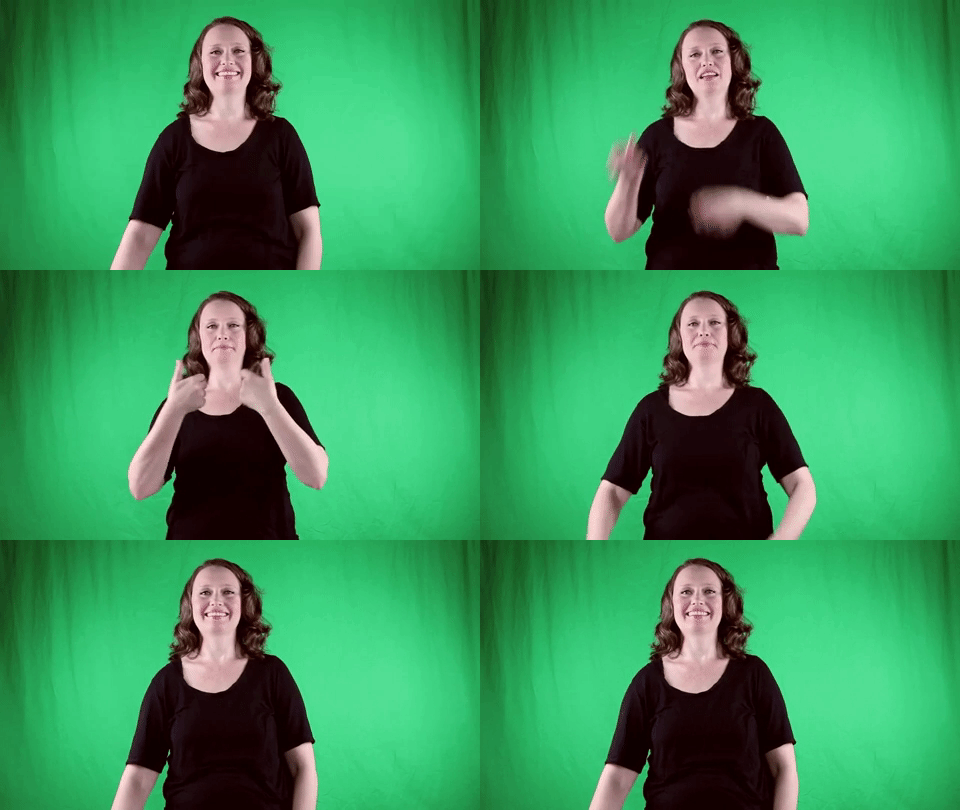
Sign for BALLGAME in ASL | ⛹️‍♀️ ASL Dictionary

Definition: A game involving a ball.

Sign for BALLGAME in ASL 

YouTube player

Practice Activities:

To practice the sign for BALLGAME in ASL effectively, start by signing it several times in front of a mirror. Focus on the handshape and movement so that it feels natural and fluid. Slow repetition helps build muscle memory and increases accuracy.

Next, try using the sign for BALLGAME in ASL within short phrases. Say things like “I like ballgame,” “We watch ballgame,” or “Ballgame tomorrow.” Signing in context helps strengthen your ability to use vocabulary in conversation and improves comprehension.

Incorporate storytelling by describing a recent or imaginary sports event. For example, describe a baseball game you went to or a football match between two favorite teams. Use the sign for BALLGAME in ASL as part of that narrative to reinforce its meaning and usage alongside other signs like “play,” “team,” or “win.”

Flashcard drills can help increase recognition speed. Create a set with sports-related signs and include the sign for BALLGAME in ASL. Show the cards to a partner or teacher and sign each one in response. This enhances vocabulary recall and keeps practice engaging.

Act out different scenes involving sports events using the sign for BALLGAME in ASL. For example, mimic someone buying tickets, cheering for a team, or inviting a friend to attend. This helps learners grasp natural scenarios where the sign may be used.

Partner up for a conversation activity. Take turns asking, “Do you like ballgames?” or “Which ballgame is your favorite?” Respond using variations like “I love basketball,” or “Football is fun.” Practicing with a partner reinforces both expressive and receptive language skills.

End each practice session with a mini performance or story where the sign for BALLGAME in ASL is used at least three times. This encourages application in flexible ways and builds confidence with the sign in both casual and structured communication.

Cultural Context:

In American Sign Language, the sign for BALLGAME in ASL carries more than just the literal meaning of a sporting event. It captures the cultural and social significance that ballgames hold in American society, especially among Deaf communities who are passionate about sports and community gatherings.

For many in the Deaf community, going to a ballgame isn’t just about watching a sport—it’s a chance to connect with friends and participate in a shared experience. The sign for BALLGAME in ASL makes it easy to share plans, express excitement, and recount memorable events with others in the community. Whether it’s baseball, basketball, or football, these games are a common topic of conversation and cultural engagement.

The sign for BALLGAME in ASL may vary slightly depending on the region, but most versions draw from the signs for BALL and GAME. This fusion reflects the way the Deaf community often combines basic concepts to describe more specific events. It’s a natural evolution of the language that mirrors how new slang and terms develop in spoken English.

Sports are an important part of American culture, and this is no different in Deaf culture. Attending a ballgame, whether in person or virtually, is often a group activity for Deaf individuals, complete with unique ways to cheer and celebrate plays. The sign for BALLGAME in ASL is frequently used in social media posts, event invites, and casual conversation before and after a big game.

ASL interpreters are commonly seen on the sidelines of major sporting events, making it easier for Deaf fans to stay engaged. This inclusion reflects the growing recognition of Deaf community needs and adds to the cultural relevance of learning signs like BALLGAME in ASL. It also underscores how vital it is to have a standardized and widely understood sign for these shared experiences.

Because ASL is a visual language, the sign for BALLGAME in ASL effectively conveys the excitement and energy of the event. It allows users to express not just the activity, but also their enthusiasm about attending or watching a ballgame. From little league matches to national championships, the sign can bridge communication gaps and foster deeper social interactions.

In classroom settings or Deaf education programs, the sign for BALLGAME in ASL is often taught alongside related vocabulary like TEAM, COACH, and SCORE. This thematic learning approach supports better retention and encourages real-world usage. It also helps younger Deaf children or new ASL learners quickly build confidence when talking about their favorite sports.

Understanding the cultural meaning behind the sign for BALLGAME in ASL also helps hearing people

Extended Definition:

The sign for BALLGAME in ASL combines two individual concepts—BALL and GAME. To express it, you typically use the sign for BALL, which mimics the shape of a ball held between two clawed hands, and then follow it with the sign for GAME, which shows two fists bumping together. This two-part sign captures the meaning literally and visually, making it easy for learners to understand.

In American Sign Language, many compound signs build meaning from smaller parts, and the sign for BALLGAME in ASL is a great example. When signing, there may be slight variations based on region or signer preference, but combining BALL and GAME is generally understood across the Deaf community. It’s important to use clear handshapes and facial expressions to maintain accuracy and context.

The BALL part of the sign represents a round object, such as a baseball, soccer ball, or basketball. The GAME portion focuses on interaction and competition. When you put the signs together, you clearly convey that you are talking about a sport or event that involves a ball and players participating.

This sign is often used during conversations about upcoming sporting events or when discussing favorite teams. For example, you might say, Are you going to the BALLGAME? or What’s your favorite BALLGAME? in ASL. The gesture becomes especially common during seasons like baseball or football when many Deaf and hard-of-hearing people engage in sports-related discussions.

Facial expressions help bring emphasis and tone to the sign for BALLGAME in ASL. If you’re excited, your expression might be enthusiastic and animated. If you’re tired after attending a long game, your expression should reflect that energy. ASL is a visual and expressive language, so your emotions play a big part in communication.

When using the sign in sentences, context matters. If you’re talking about attending a game, you might pair the sign with verbs like GO or WATCH. If you’re talking about playing, you might use PLAY paired with BALLGAME. These combinations create fuller meaning and help keep your sentence clear.

In ASL classes and Deaf community events, the sign for BALLGAME in ASL is common during lessons about hobbies and activities. Teachers often incorporate it when teaching vocabulary related to leisure, sports, and seasons. Connecting signs to real-life activities helps learners remember them better.

Like many ASL signs, BALLGAME can be adjusted slightly based on the type of game. Some signers might clarify by adding a specific type of ball after the general sign. For example, after

Synonyms: match, sports event, sporting contest, athletic game, sports match

Educational resources: Find related learning materials in our course bank!

Want more? Check out some of our popular learning activities on the homepage!

Need to look up a sign? Use our highly rated dictionary: https://aslinteractive.com/best-asl-dictionary/

Follow us on tiktok: https://www.tiktok.com/@aslinteractive. More social media links at the bottom of this page!

Long-tail Keywords: What is the sign for ballgame in ASL, How do you sign ballgame in American Sign Language, Learn how to sign ballgame in ASL

Categories:

tags: sports, activities, objects, games, events

Parameters

*Handshape*:

The handshape for the sign for BALLGAME in ASL begins with both hands forming clawed “5” handshapes, resembling the shape of a ball. The fingertips of both hands face each other as if holding an imaginary ball in front of the body .

To complete the sign for BALLGAME in ASL, transition into a gesture that uses both hands in “S” handshapes, mimicking the concept of teams or sides coming together for a game. The movement emphasizes the interactive nature inherent in a ballgame.

*Palm Orientation*:

For the sign for BALLGAME in ASL, the palm orientation begins with both hands forming the letter “S” facing each other, as if holding an invisible ball. The fingers of both hands are curved inward, and the knuckles touch each other lightly.

In the second part of the sign, representing “GAME,” both hands remain in the “S” handshape but shift apart slightly, still maintaining inward-facing palms. This positioning is essential to clearly convey the full sign for BALLGAME in ASL ⚾ .

*Location*:

The sign for BALLGAME in ASL takes place primarily in the neutral space in front of the torso. The movement starts close to the body and then transitions outward, but it remains at chest level throughout. Since the sign combines the concepts for “ball” and “game,” the location allows for clear articulation of both base signs.

When performing the sign for BALLGAME in ASL, keep the hands positioned away from the face and below the shoulders. The space in front of the chest is ideal for the clarity and visibility needed in this compound sign.

*Movement*:

To show the sign for BALLGAME in ASL, first form both hands into the shape of the number 5, keeping the fingers curved like you’re holding a ball. Clap the fingertips together twice in front of your chest to represent the concept of “ball.”

Next, transition to the sign for “game” by forming both hands into the A handshape and bringing the knuckles together twice in front of the body. This full motion completes the sign for BALLGAME in ASL .

*Non-Manual Signals*:

When using the sign for BALLGAME in ASL, the facial expression should show anticipation or excitement, reflecting the energy of a sports event. Raise your eyebrows slightly to express interest and keep your eyes focused on the action of the hands to support the concept of a game or match ⚾ .

Mouth movements like “ball” or a puff of air can add clarity and show the separation between the two concepts in the compound sign. A slight forward head tilt can enhance engagement when signing the sign for BALLGAME in ASL.

*Prosody, Dominant/Non-Dominant Hand*:

The sign for BALLGAME in ASL uses both hands. First, form both hands into open curved shapes like holding a ball and bring them together in front of the body to show BALL. Then transition into the sign for GAME by forming both hands into A-handshapes and bringing the knuckles together twice. This combination clearly conveys the sign for BALLGAME in ASL with a natural flow.

The dominant hand typically leads with slightly more emphasis during the transition between BALL and GAME. Both hands move in unison for balance and clarity. Consistency in hand movement is key to effectively expressing the sign for BALLGAME in ASL.

Tips for Beginners:

When learning the sign for BALLGAME in ASL, beginners should first be comfortable with the signs for BALL and GAME individually. BALL is made by miming the shape of a small ball with both hands, using slightly curved fingers and tapping the fingertips together. GAME is formed by making two A-handshapes (fists with thumbs extended) and bringing them together twice at the knuckles in front of your chest. Practicing each part separately can help build muscle memory for the entire concept.

To accurately sign BALLGAME, ensure each handshape is clear and the motions are deliberate. Avoid rushing the transitions between the two signs—clear articulation is crucial for communication. A common mistake is blurring the line between the individual signs, which can confuse the viewer. Make sure your non-manual markers (facial expressions) reflect context as it can help reinforce clarity and meaning.

It’s helpful to watch fluent signers perform the sign for BALLGAME in ASL in slow motion, whether through online video resources or in a classroom setting. Mimicking correct facial expressions and timing will improve your fluency. Recording yourself signing and analyzing it can also reveal small tweaks that might improve your accuracy and flow.

Focus on hand placement, especially when signing the word GAME. If the knuckles don’t meet correctly, it may look like another sign. Also, pay attention to the space between your hands when signing BALL. Consistency helps develop reliable spatial awareness—a key component of ASL communication.

Don’t be afraid to ask a Deaf ASL user or experienced signer to give feedback. Incorporating real-life practice through conversations or games will reinforce your understanding of the sign for BALLGAME in ASL and build confidence . Repetition and immersion will make the sign second nature over time.

Connections to Other topics:

The sign for BALLGAME in ASL is a compound sign made by combining the sign for BALL and the sign for GAME. This demonstrates how ASL often builds more complex meanings from foundational vocabulary, maintaining visual clarity while expanding meaning. Understanding how to deconstruct compound signs helps learners deepen their fluency and recognize patterns in sign formation.

This sign connects closely to other sports and recreational activity signs, like BASEBALL, BASKETBALL, or TEAM. These related concepts often use classifiers, movement patterns, or specific handshapes to visually convey the activity involved. The sign for BALLGAME in ASL can be contextualized further with directional signs or expressive body language to indicate competition, team involvement, or casual play.

Additionally, the sign for BALLGAME in ASL highlights the importance of topic-comment structure in ASL grammar. For example, one might sign “YESTERDAY BALLGAME FUN” or “FUTURE BALLGAME CANCEL” to convey more nuanced thoughts. Compound signs like this often appear in topic-oriented sentences where the context drives the meaning of the visual message.

The concept of games in general relates to a wide variety of ASL signs showing play, fun, competition, or sports. BALLGAME as a category can also connect to SCHOOL-related signs where games are part of physical education, or to FRIEND interactions where group sports are discussed. The visual language makes these social connections vivid and accessible.

In storytelling or interpreting, the sign for BALLGAME in ASL can be stylized or modified to indicate different cultural or emotional contexts, such as a historic game, a rivalry, or a personal event. Producers and interpreters frequently use facial expressions and spatial referencing to add detail. This flexibility demonstrates how the sign fits into a broader network of sports and event-related vocabulary. ⚾

Summary:

The sign for BALLGAME in ASL is a compound of two familiar signs: BALL and GAME. Each component sign is performed distinctly before they are combined for fluency and expression. The sign for BALL uses both hands formed into claws, mimicking the shape of holding a ball, and bouncing them toward each other a couple of times.

GAME uses two closed fists with thumbs extended, bringing them together in a tapping motion that suggests competition or interaction. When these two signs are performed together, the sign for BALLGAME captures the concept of a physical, competitive activity involving a ball. The combination flows naturally and is widely understood in the Deaf community.

This sign is a perfect example of how American Sign Language forms compound vocabulary. By placing two concept signs in sequence, new meaning is generated. The visual and spatial modality of ASL allows such combinations to evoke real-world experiences effectively.

Culturally, ballgames hold an important role in both Deaf and hearing communities. From school sports to professional teams, ballgames are communal events. In Deaf culture, visual access during these games is vital; adaptations like visual scoreboards and clear refereeing enhance inclusion.

ASL users often embellish or modify the sign for BALLGAME depending on context. Speed, facial expression, or directional movement can convey excitement, the type of game, or team rivalries. Linguistically, this showcases the use of non-manual markers in ASL grammar to add layers of meaning.

In practice, someone might sign the team involved or the type of sport immediately before or after the sign for BALLGAME. For example, adding BASKETBALL or SOCCER ahead of BALLGAME clarifies the specific context. This makes the sign more dynamic and responsive to real-world usage.

The sign is useful in educational, media, and conversational contexts. Teachers, interpreters, and sports fans alike use this sign frequently. It appears during ASL storytelling, especially in sports-themed narratives where game events are described in rich visual language.

The grammatical function of the sign for BALLGAME in ASL operates like a noun. It refers to the event or activity itself. Signs like PLAY or WATCH can precede it to build full sentences like “I WATCH BALLGAME” or “WANT PLAY BALLGAME”.

It integrates smoothly into ASL syntax, which follows a subject-object-verb order in many informal contexts. Placement and usage of BALLGAME also vary depending on whether the signer incorporates spatial referencing to show who is playing or watching. Such techniques enrich the sign’s communicative power.

ASL learners benefit from mastering the sign for BALLGAME as it teaches how compound signs operate. By understanding how smaller signs connect, new learners begin to see ASL’s visual logic. It’s a strong entry point for working with other compound signs like BASEBALL-GAME or FOOTBALL-GAME.

From a linguistic structure standpoint, the sign for BALLGAME exemplifies iconography in ASL. Both components of the sign are iconic representations—the hand shapes and movements evoke the objects and actions they describe. This aligns ASL with other signed languages where visual mimicry enhances meaning.

Applied linguistics explores how compound signs are taught and acquired in language learning. The sign for BALLGAME is often taught early in ASL classrooms due to its relatable content. Students can associate it with concrete, physical experiences, which aids memory retention.

Games involving balls are universal across cultures, and this universality is reflected in how ASL incorporates signs related to them. BALLGAME becomes a site of cultural exchange when Deaf and hearing communities interact over sports. Events like Deaf sports tournaments or interpreted pro games highlight this bridge-building.

Technology has expanded the visibility of the sign for BALLGAME in ASL, especially on social media. Deaf content creators use it in vlogs reviewing games or sharing highlights. The sign has also appeared in interpreted sports broadcasts, enhancing accessibility.

Children who grow up using ASL often learn the sign for BALLGAME early due to its relevance in school and play. It can be applied during recess, PE classes, or family playtime. Its repetition in real-world settings helps reinforce language development.

In terms of related signs, SPORT, TEAM, and TOURNAMENT often follow or precede the sign for BALLGAME. These help create more precise or expanded contexts. Anchoring the sign in temporal or spatial references helps build narratives in ASL storytelling.

The use of classifiers in ASL allows for further elaboration after introducing the sign for BALLGAME. For example, a ball’s movement or a player’s action can be mimicked using handshapes and directional motion after stating BALLGAME. Such techniques personalize and animate storytelling.

The regional and generational variation in ASL does not significantly alter the sign for BALLGAME. It enjoys consistent use across communities in the United States. Its clarity and logical formation help maintain uniformity.

ASL poetry and performance sometimes incorporate BALLGAME to tell stories of competition, community, and social bonding. Performers may highlight the emotional highs and lows of a game

Want more? Check out some of our popular learning activities!

ASL Interactive Resources

ASLInteractive YouTube Channel

Follow us on tiktok: @aslinteractive.com

Follow us on Instagram: aslinteractive

Facebook page: aslinteractive

Facebook group: aslinteractive

LInkedIn: ASL Interactive LLC

Twitter: @ASL_interactive

*Some information on this page is AI-generated. AI can make mistakes. Please check the information.

Sign for BALLGAME in ASL 

Responses