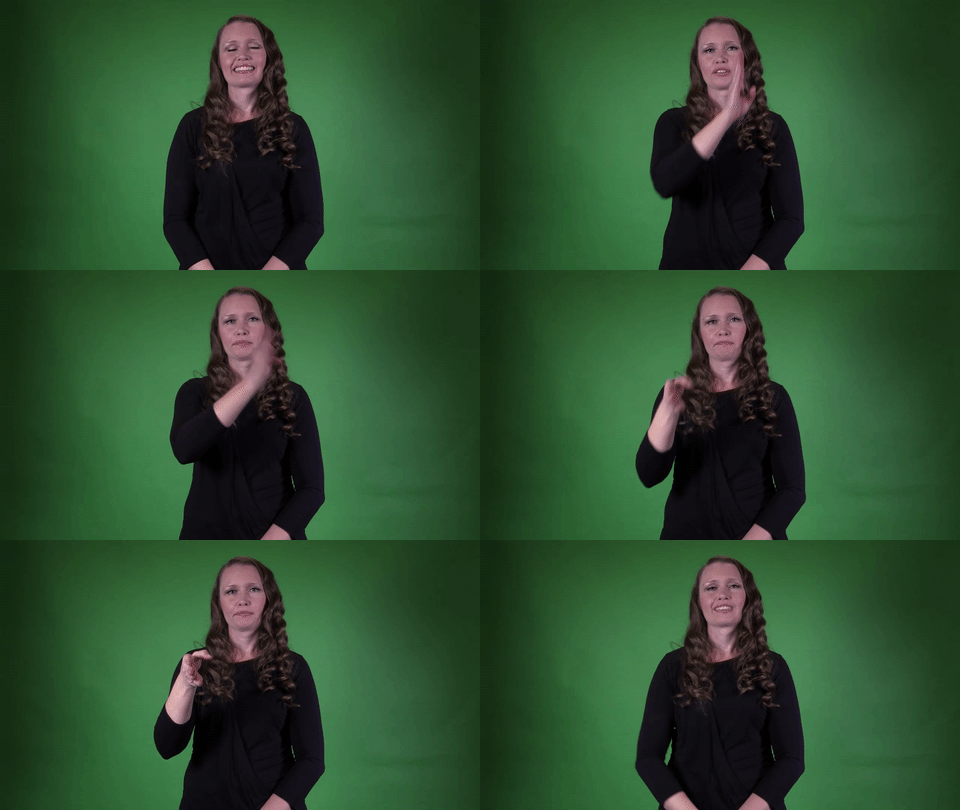
Definition: A city in Maryland, USA.
Sign for BALTIMORE in ASL

Practice Activities:
Start by practicing the sign for BALTIMORE in ASL in isolation. Use a mirror to watch your handshape and movement to ensure they match the correct parameters. Repeat the sign multiple times slowly, then gradually increase your speed while maintaining accuracy.
Next, try using the sign in simple sentences. For example, sign “I live in BALTIMORE” or “My friend is from BALTIMORE.” Practice switching out the place name with other cities to get comfortable using BALTIMORE in various contexts and to work on comparison.
Create a short narrative about a trip or event in Baltimore. Include details like visiting the Inner Harbor, going to a museum, or attending a sports game. Sign your story to a peer or record yourself and check for smooth transitions and clarity, especially when incorporating the sign for BALTIMORE in ASL multiple times.
With a partner, play a geography-based game. One person signs a fact about a city, and the other guesses what city it is. Include facts about Baltimore like “crab cakes,” “Maryland,” or “baseball stadium.” This keeps the sign for BALTIMORE in ASL fresh in your mind while encouraging receptive and expressive skills.
Use flashcards or a digital quiz to test your recall of city name signs, including BALTIMORE. You can categorize them by region or size to add a vocabulary-building element. Revisit and incorporate the sign for BALTIMORE in ASL every few cards to reinforce memory.
Write a short dialog where two people meet and talk about where they’re from. Include exchanges like “Where are you from?” and “I’m from BALTIMORE.” Practice this conversation with a classmate or tutor to build fluency and confidence using the sign naturally in real communication.
Cultural Context:
The sign for BALTIMORE in ASL reflects the city’s cultural significance and regional identity. American Sign Language often incorporates location-based signs that connect directly to a city’s personality and history.
Baltimore is known for its rich African-American heritage, vibrant arts, crab culture, and historic seaport. The sign for BALTIMORE in ASL is widely used across Deaf communities in Maryland and by ASL users nationwide who reference the city in conversation.
Understanding the sign for BALTIMORE in ASL helps bridge language barriers and ensures accurate geographic references in communication. This sign captures the essence of local identity and is often included when discussing Maryland landmarks or major cities in the northeastern United States.
Because ASL is a visual language that stems from community usage, regional signs like the sign for BALTIMORE in ASL may have variations. However, most Deaf individuals in the United States recognize a standardized version, especially in educational settings and media.
Baltimore holds cultural relevance in the Deaf community with schools, programs, and organizations that serve Deaf and hard-of-hearing individuals. Knowing the correct sign for BALTIMORE in ASL is especially useful for those attending local events, interpreting, or navigating the state’s community spaces.
Using regional signs such as the sign for BALTIMORE in ASL shows respect for place-based language and improves communication accuracy. It also deepens understanding of how ASL reflects not just language but lived experiences tied to specific areas.
Incorporating place names like the sign for BALTIMORE in ASL in conversation helps tell stories, provide context, and honor cultural roots. Whether discussing sports teams like the Orioles or Ravens, renowned universities, or Charm City’s unique neighborhoods, this sign supports meaningful interaction.
When traveling through Maryland or discussing East Coast culture in ASL, the correct use of the sign for BALTIMORE in ASL becomes essential. It’s a simple way to connect with local culture and show awareness of regional differences in sign usage.
The Deaf community in Baltimore has contributed significantly to local advocacy and culture, making the sign for BALTIMORE in ASL more than just a location indicator—it’s a symbol of community life. This makes learning and using the sign both practical and culturally enriching.
Whether you’re a student, interpreter, or ASL learner, understanding and using the sign for BALTIMORE in ASL opens up better connections with people and stories that shape the area. It’s one of many city signs infused with cultural and emotional resonance
Extended Definition:
The sign for BALTIMORE in ASL is a localized sign that represents the city of Baltimore, Maryland. Like many city name signs in American Sign Language, it holds cultural and regional significance for Deaf communities familiar with U.S. geography. When using the sign for BALTIMORE in ASL, context is important, as regional variations sometimes affect how a name sign is expressed.
This city sign is typically made by forming the dominant hand into a specific handshape and moving it in a pattern unique to Baltimore. Because this sign represents a proper noun, it’s not uncommon for it to appear slightly different among native ASL users depending on location, background, or community affiliation. However, the most widely accepted version remains consistent across educational and social settings.
When teaching or learning the sign for BALTIMORE in ASL, it’s good practice to compare it with signs for other major cities. This helps differentiate each city, since many metro area signs may look similar without context. Teachers often start with common city signs to familiarize students with the structure and patterns found in place name signs across ASL.
Incorporating the sign for BALTIMORE in ASL into conversations adds cultural relevance, especially when discussing geography, travel, current events, or personal stories involving the mid-Atlantic region. It also serves as a key term in academic conversations or storytelling within the Deaf community. Accurately using city signs demonstrates fluency and cultural awareness.
This sign appears often in weather reports, news summaries, or travel discussions translated into ASL. When Deaf performers, interpreters, or educators refer to historic or major events in Baltimore, they use the city’s ASL sign to anchor the narrative. Visual storytelling is central to ASL, and place signs like BALTIMORE serve an essential role in time-space referencing.
Learning the sign for BALTIMORE in ASL can be particularly important for interpreters working in Maryland or in schools where students might have ties to the area. Since names and places are common in casual and formal use, these signs form a core part of the interpreter’s and student’s vocabulary. Including the city’s sign during map activities or U.S. geography lessons also helps students retain information more vividly.
Deaf residents of Maryland often use the sign for BALTIMORE in ASL when identifying where they’re from. It creates a visual identity and builds connections during introductions or group settings. Signing one’s hometown or state capital is a natural practice in ASL and
Synonyms: Baltimore City, Charm City, Ravenstown, Bmore, The Monumental City
Educational resources: Find related learning materials in our course bank!
Want more? Check out some of our popular learning activities on the homepage!
Need to look up a sign? Use our highly rated dictionary: https://aslinteractive.com/best-asl-dictionary/
Follow us on tiktok: https://www.tiktok.com/@aslinteractive. More social media links at the bottom of this page!
Long-tail Keywords: what is the sign for baltimore in ASL, how do you sign baltimore in ASL, baltimore sign language translation
Categories:
tags: Cities, Geography, Travel, Landmarks, Places
Parameters
*Handshape*:
The handshape for the sign for BALTIMORE in ASL uses the dominant hand in the “B” handshape. The fingers are extended and together while the thumb is tucked across the palm. This handshape is consistent throughout the movement of the sign.
In the sign for BALTIMORE in ASL, the “B” hand bounces in a small up-and-down motion in front of the chest, generally moving slightly from side to side. This repeating handshape represents the city name and is commonly recognized in regional dialects. ️
*Palm Orientation*:
The palm orientation for the sign for BALTIMORE in ASL involves the dominant hand forming the letter “B” with the palm facing forward or slightly to the side. The hand moves in a small arc or a slight bounce across the chest area, typically from the dominant side toward the center.
When performing the sign for BALTIMORE in ASL, make sure your fingers stay together and the flat surface of the palm maintains a consistent outward orientation. This helps clearly indicate the handshape while preserving the motion that distinguishes the city-specific sign.
*Location*:
The location for the sign for BALTIMORE in ASL is in front of the torso, usually at mid-chest level. The dominant hand makes the letter “B” handshape and taps back and forth between two points in the air, horizontally aligned with the chest.
This placement ensures the sign remains visible and within the signer’s signing space. Since the movement is subtle, keeping it centered helps maintain clarity when using the sign for BALTIMORE in ASL ♂️.
*Movement*:
The sign for BALTIMORE in ASL uses the dominant hand in the “B” handshape. The hand moves in small, controlled taps from side to side, typically across the midsection or chest area. The movement is quick and rhythmic, usually two to three taps shifting left to right.
This motion helps identify the sign for BALTIMORE in ASL specifically and is associated with the city’s abbreviation. Make sure the “B” hand remains upright and consistent throughout the side-to-side motion for accurate signing.
*Non-Manual Signals*:
When signing the sign for BALTIMORE in ASL, the facial expression is typically neutral but engaged, showing attentiveness to the conversation. Slight eyebrow movements might accompany the sign to indicate clarity or confirmation, especially in casual or explanatory contexts.
Head may tilt slightly forward or remain upright, matching the flow of signing. Consistent eye contact is important to convey connection when using the sign for BALTIMORE in ASL ♂️. Mood stays neutral unless emphasizing a specific detail.
*Prosody, Dominant/Non-Dominant Hand*:
The sign for BALTIMORE in ASL uses the dominant hand in a “B” handshape. The hand moves side to side in a small arc, similar to a slight waving motion at shoulder height. The non-dominant hand does not participate in this sign.
This sign is commonly accepted and understood in the Deaf community when discussing locations. If clarity is needed, fingerspelling is also an option. When demonstrating the sign for BALTIMORE in ASL, facial expression and prosodic timing help emphasize the geographic reference ️.
Tips for Beginners:
When learning the sign for BALTIMORE in ASL, it’s essential to recognize that this city name is fingerspelled. This means you’ll use the handshape for each letter in B-A-L-T-I-M-O-R-E sequentially. Practice your fingerspelling fluency so your movements are smooth but not rushed, as clarity is more important than speed.
Beginners often struggle with the transition between letters, especially from L to T and from M to O. Try isolating these transitions and drilling them repeatedly. Record yourself and watch to make sure each letter is clear and distinct. Practicing in front of a mirror can also help you self-correct.
Remember that the sign for BALTIMORE in ASL is typically used in conversation when identifying the city or someone’s origin, so you’ll likely be fingerspelling it in full. Some local signs may exist for Baltimore, but the standard accepted version is fingerspelling, especially in formal or general settings. Stick with fingerspelling to maintain clarity for all audiences.
Be sure to maintain consistent hand positioning in your signing space. Your hand should stay in a stable area near shoulder height without bouncing or moving excessively. Keep your palm facing the viewer and avoid twisting it mid-word, which can make reading your sign more difficult.
Common mistakes include dropping letters or rushing through the entire word. If someone asks you to repeat yourself, don’t be discouraged—just slow down and ensure each letter is shaped correctly. Spelling out city names like the sign for BALTIMORE in ASL takes patience, so give yourself time to build confidence and accuracy.
Once you’re comfortable, practice by incorporating this sign into full sentences like “I live in Baltimore” to build fluency and comfort with real-life use.
sign for BALTIMORE in ASL, fingerspelled city names in ASL, how to sign Baltimore in American Sign Language, ASL fingerspelling Baltimore, ASL sign for Baltimore
Connections to Other topics:
The sign for BALTIMORE in ASL connects directly to other geographic signs, especially those using initialized movements. This form of regional identification is common in ASL, such as the signs for cities like Boston, Chicago, or Phoenix, which also use initial letters and specific directional motions. The sign for BALTIMORE in ASL enhances understanding of city-specific signs that follow similar patterns, promoting visual and spatial memory through location-based context.
In terms of conceptual connections, the sign for BALTIMORE in ASL is part of a broader category of location identifiers. Learning this sign helps users distinguish between general and proper nouns in ASL. For example, understanding the sign for a city can support the use of compound signs like BALTIMORE-SCHOOL, where the name of the city combines with the institution to create a more precise meaning.
Signs for cities and states, including the sign for BALTIMORE in ASL, often serve as cultural references in conversation. They appear frequently in discussions about travel, residence, sports, and regional identity. Knowing how to sign BALTIMORE allows for easier engagement when topics like Maryland, the East Coast, or local sports teams such as the Ravens or Orioles are introduced in conversation.
The use of initialized city signs also relates to classifier use in ASL. For instance, when signing a story involving movement from BALTIMORE to another location, a directional verb may be infused with the initialized sign to clarify the journey. This usage deepens the grammatical structure of signing locations.
Additionally, city signs like the sign for BALTIMORE in ASL help learners grasp the importance of handshape and location in differentiating between signs with similar movements. With continuing study, learners recognize patterns in regional signs, supporting quicker recall and more fluent signing among urban place names. Through repetition and exposure to these city signs, users build linguistic efficiency and regional awareness in everyday ASL conversation.
Summary:
The sign for BALTIMORE in ASL is primarily a location-specific sign that carries both geographic and cultural meaning. It is typically produced using the dominant hand in a “B” handshape moving side to side in front of the torso. This motion symbolizes the city’s initial and places it clearly within a family of city-name signs in ASL.
The sign for BALTIMORE in ASL reflects a broader pattern in American Sign Language where cities and regions receive their own distinct, usually abbreviated, markers. These signs often originate from local Deaf communities and then gain traction through regional use and social interaction across signing communities. The “B” handshape is a common classifier when referencing cities that start with the letter B, grounding the sign linguistically in abbreviation and regional categorization.
Deaf users in Maryland, especially in the Baltimore metropolitan area, use the sign for BALTIMORE in ASL frequently in both casual and formal contexts. Conversations about travel, hometowns, or discussing Deaf events often invoke this sign. It functions grammatically as a proper noun and can serve as a subject or object in typical ASL sentence structure.
The movement of the sign—usually a gentle side-to-side motion—can vary depending on the region. Some signers may add a slight bounce or downward arc, but the “B” handshape remains consistent. Variation in how the sign is produced can sometimes reflect a signer’s local dialect or where they learned ASL.
Culturally, BALTIMORE has a strong presence in the East Coast Deaf community. The city is home to schools for the Deaf, including programs at Gallaudet-affiliated institutions and public awareness events where Deaf culture is highlighted. The sign for BALTIMORE in ASL, then, is not purely geographical; it carries associations with Deaf heritage, educational institutions, and social movements.
When teaching the sign for BALTIMORE in ASL, instructors highlight that it’s a lexicalized sign, meaning it’s not fingerspelled but rather has taken on a distinct movement and form. That differentiates it from lesser-known cities, which are often fingerspelled. This distinction offers insight into how ASL prioritizes certain terms for efficiency and repetition based on social and cultural prominence.
Linguistically, the sign operates as a toponym. Like many place names in ASL, it demonstrates how economy of motion and recognizability guide the evolution of signs. The encoding of a city’s name into a handshape and movement allows for shared understanding even among signers who may never have visited the location.
The sign for BALTIMORE in ASL also lends itself to variations when used as part of larger constructs. For example, “BALTIMORE CITY” may incorporate additional classifiers or mouth morphemes. In storytelling or narrative ASL, the sign often becomes part of a visual sequence, showing movement toward or away from the city.
The semantic value of the sign pairs with visual storytelling cues. An actor or poet in ASL might juxtapose the sign for BALTIMORE with mood indicators, facial expressions, or directional shifts in narrative space. This expands the sign’s meaning from just a place name to a symbol of personal experience or emotional memory.
In terms of signed discourse, seeing the sign for BALTIMORE in ASL often cues the topic of urban Deaf life. This may evoke ideas about accessibility, community spaces, or political movements tied to city structures. The sign frequently appears in conversations about education, given the presence of institutions that serve Deaf youth and emerging leaders.
Because ASL is a spatial language, the location of the sign in signing space affects its grammatical function. When BALTIMORE is introduced in a conversation, its spatial location is established with the sign. Afterward, pronouns or directional verbs can point toward that space to reference the city without repeating the name.
For students of ASL linguistics, the sign for BALTIMORE in ASL provides insight into regional variations, iconicity, and phonological minimal pairs. For example, though the “B” handshape is used in other signs, such as BUS or BLUE, the movement and placement in BALTIMORE differentiate it completely. This makes it a good example to demonstrate contrastive features in handshape, orientation, and motion.
The sign is also a great example for discussions of ASL phonology. Its parameters—handshape, palm orientation, location, movement, and non-manual signal—obey consistent rules that apply broadly across the language. The “B” handshape, combined with the motion across the torso, integrates form and function effectively.
From a sociolinguistic perspective, how signers use and modify the sign for BALTIMORE in ASL reveals layers of identity. Whether someone chooses to fingerspell BALTIMORE or use the lexicalized version might indicate age, region, or level of fluency. Older signers or those from areas outside of Maryland
Want more? Check out some of our popular learning activities!
ASL Interactive Resources
ASLInteractive YouTube Channel
Follow us on tiktok: @aslinteractive.com
Follow us on Instagram: aslinteractive
Facebook page: aslinteractive
Facebook group: aslinteractive
LInkedIn: ASL Interactive LLC
Twitter: @ASL_interactive
*Some information on this page is AI-generated. AI can make mistakes. Please check the information.


Responses