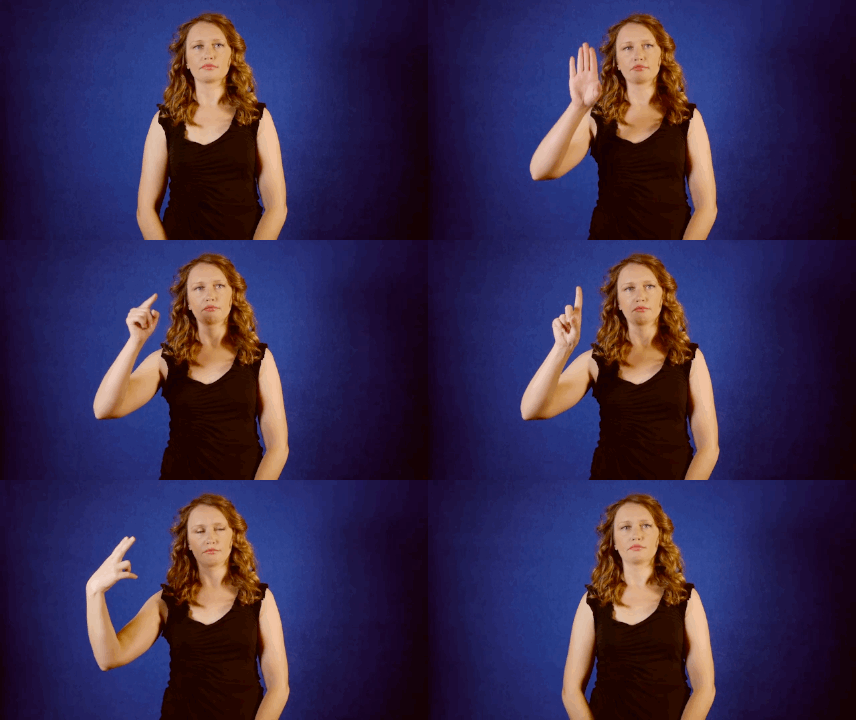
Sign for BANGLADESH in ASL | 🇧🇩 ASL Dictionary

Definition: A country in South Asia.

Sign for BANGLADESH in ASL 

YouTube player

Practice Activities:

To practice the sign for BANGLADESH in ASL, begin by isolating the sign and repeating it in front of a mirror. Focus on the shape of the hand, movement, and facial expression. Try signing the word slowly at first, then increase your speed while maintaining clarity. Do short drills by alternating between the sign for BANGLADESH in ASL and names of other countries you have learned.

Use flashcards to test yourself, mixing in various country names and seeing if you can quickly produce the correct sign. Create a list of countries from South Asia and practice signing each one to help mentally link geography with signs. Record yourself signing the word and compare it to a fluent signer’s example to self-correct.

Incorporate the sign into simple ASL sentences. Examples include: “I want to visit BANGLADESH,” “My friend is from BANGLADESH,” and “The culture in BANGLADESH is beautiful.” Practice presenting each sentence with proper facial grammar and expression. Think about the tone or emotion you want to convey.

Storytelling is a great tool for building fluency. Create a short visual story—about a family trip, a cultural celebration, or a school report—and integrate the sign for BANGLADESH in ASL mid-story. This helps cement the sign in a realistic and engaging context. You can describe traditional foods, clothing, or festivals as part of your narrative.

With a partner, take turns describing a world map using ASL, pausing on each country’s name. When one signs a country, the other responds with a fact or question about it. Include the sign for BANGLADESH in ASL multiple times in each session to reinforce your memory.

For a creative activity, try drawing the flag of Bangladesh and then signing it while explaining what the colors and design represent, using ASL classifiers and descriptions.

Cultural Context:

The sign for BANGLADESH in ASL carries more than just a meaning—it reflects a bridge between cultures. For many members of the Deaf community, learning geographic and national signs like the sign for BANGLADESH in ASL helps foster better global understanding and cultural respect.

The sign for BANGLADESH in ASL is typically used in educational settings, travel conversations, and global news discussions. It allows Deaf individuals to express the name of this South Asian country accurately while participating in conversations about world affairs, heritage, and culture.

BANGLADESH has a rich history, with deep roots in language, the arts, and resilience. Including the sign for BANGLADESH in ASL in everyday usage helps to validate the cultural importance of the country within the global Deaf and hearing communities. It emphasizes inclusion by making space for international and multicultural references in American Sign Language.

Using the sign for BANGLADESH in ASL also promotes awareness of the diverse Deaf communities around the world. Bangladesh has its own Deaf population with unique signs and cultural traits. When using this sign, it’s not just about a destination—it’s about honoring the people who live there and their experiences, including Deaf Bangladeshis.

The Deaf community in the U.S. often uses ASL geography signs for classroom instruction and storytelling. Teaching the sign for BANGLADESH in ASL supports a broader curriculum and introduces students to important countries with strong historical and social significance. This helps develop a worldly mindset, even in early language learners.

Understanding how to use the sign for BANGLADESH in ASL correctly also means respecting regional and cultural identities. Signs can change with time or may vary based on regional use, so learning from current and reliable sources matters. This reinforces communication that is both accurate and culturally sensitive.

Sometimes, the sign for BANGLADESH in ASL may be fingerspelled, particularly when there is no widely accepted standardized sign. Fingerspelling reflects the growing exchange between American Sign Language and world geography. It helps users develop confidence as they build vocabulary that connects them to international dialogues.

When representing BANGLADESH through sign language, it’s also valuable to explore its landmarks, cuisine, and traditions. Using the sign for BANGLADESH in ASL can spark conversations about Dhaka, the Sundarbans forests, or Bengali culture. This reinforces not only language learning but also a global perspective through visual communication.

In social environments where people share their travel experiences, cultural roots, or academic interests

Extended Definition:

The sign for BANGLADESH in ASL is a culturally specific sign that represents the country of Bangladesh in American Sign Language. It is commonly used in conversations related to geography, international relations, and world cultures. Learning the correct sign for BANGLADESH in ASL is helpful for students, travelers, and anyone communicating about global topics in sign language.

This ASL sign may vary slightly depending on region or community, but it generally reflects a consistent motion recognized across most Deaf communities in the United States. The sign incorporates visual elements that distinguish it from other country signs, ensuring it does not get confused with nearby nations or similar-sounding names. When using the sign for BANGLADESH in ASL, it’s important to be aware of facial expressions and context, as these elements enhance clarity and meaning.

Understanding the sign for BANGLADESH in ASL can also help when discussing news stories, educational material, or cultural events related to South Asia. Whether you are interpreting at a conference or teaching a classroom of Deaf students, having accurate signs for countries improves communication. ASL learners benefit from exposure to a wide range of vocabulary, including specific country names like Bangladesh.

When you use the sign for BANGLADESH in ASL correctly, you show respect for the culture and geography of the region. Accurate location signs are essential for clarity, especially in academic or professional discussions. Teachers often include country signs in geography lessons using ASL to support interactive and visual learning.

In everyday conversations, the sign for BANGLADESH in ASL may come up when talking about travel, family heritage, or cultural celebrations. Deaf individuals from or connected to Bangladesh rely on this sign to represent their identity and homeland. It acts as both a functional communication tool and a symbol of cultural recognition.

If you’re a content creator, interpreter, or educator, incorporating the correct sign for BANGLADESH in ASL into your material enhances accessibility. Videos, presentations, and workshops should include ASL visuals whenever possible to support Deaf and hard-of-hearing audiences. Featuring accurate country signs also boosts trust and engagement in multilingual or multicultural educational environments.

Practice is key when learning the sign for BANGLADESH in ASL. Watch video demonstrations, attend ASL classes, or engage with fluent signers who can provide helpful corrections. The more you use it in real-life settings, the easier it becomes to recall and include naturally in conversations.

Using the sign for BANGLADESH in ASL also provides an opportunity

Synonyms: Bangladesh, People’s Republic of Bangladesh, BD, Bangla, Bengal

Educational resources: Find related learning materials in our course bank!

Want more? Check out some of our popular learning activities on the homepage!

Need to look up a sign? Use our highly rated dictionary: https://aslinteractive.com/best-asl-dictionary/

Follow us on tiktok: https://www.tiktok.com/@aslinteractive. More social media links at the bottom of this page!

Long-tail Keywords: what is the ASL sign for Bangladesh, how do you sign Bangladesh in American Sign Language, what does Bangladesh look like in ASL

Categories:

tags: Countries, Geography, Asia, Travel, Cultures

Parameters

*Handshape*:

The handshape for the Sign for BANGLADESH in ASL uses the dominant hand in an open “B” shape. This handshape is common for fingerspelling and is the starting point since BANGLADESH is typically fingerspelled in American Sign Language.

To produce the Sign for BANGLADESH in ASL, each letter of the country’s name is spelled out sequentially using the standard ASL alphabet. The “B” handshape transitions through the rest of the fingerspelled letters to accurately represent BANGLADESH. Consistent handshape control is key for clarity and legibility.

*Palm Orientation*:

The palm orientation for the sign for BANGLADESH in ASL typically faces inward toward the center of the body. When fingerspelling BANGLADESH, each handshape transitions smoothly, with the palm orientation adjusting slightly to maintain fluid motion, but generally stays neutral or inward-facing.

Throughout the sign for BANGLADESH in ASL, the palms remain perpendicular to the ground, ensuring clarity during communication. This orientation helps maintain visibility for each letter as it is being fingerspelled.

*Location*:

The sign for BANGLADESH in ASL is typically fingerspelled, so the location is centered in the neutral space directly in front of the chest. The hands should be positioned between the upper chest and chin level to ensure clarity and visibility while fingerspelling each letter.

When producing the fingerspelled sign for BANGLADESH in ASL, keep your elbows relaxed and hands at a comfortable angle in front of the torso. This neutral signing space allows for smooth transitions between the letters and promotes clear communication.

*Movement*:

The sign for BANGLADESH in ASL is typically fingerspelled. Start by holding your dominant hand in the neutral space in front of your body. Then proceed to fingerspell each letter: B-A-N-G-L-A-D-E-S-H. Be sure to keep the hand steady and maintain a smooth rhythm between each letter to ensure clarity.

Since the sign for BANGLADESH in ASL is fingerspelled, there is no additional specific movement beyond the spelling. The fingers should stay relaxed, and your palm orientation generally faces outward or slightly to the side depending on your comfort and visibility.

*Non-Manual Signals*:

The non-manual signals used in the sign for BANGLADESH in ASL typically include a neutral facial expression, which aligns with the informational or geographic nature of the sign. There is usually no exaggerated emotion unless you are emphasizing the country for contrast or clarification in context.

Head movement may include a slight nod if the sign for BANGLADESH in ASL is being affirmed or acknowledged in conversation. Eye gaze should remain focused on the conversation partner or slightly forward to maintain clarity and engagement .

*Prosody, Dominant/Non-Dominant Hand*:

The sign for BANGLADESH in ASL typically involves a fingerspelled approach using the letters B-A-N-G-L-A-D-E-S-H. The dominant hand spells out each letter clearly with palm facing outward, while the non-dominant hand remains relaxed at the side or neutral space.

When using the sign for BANGLADESH in ASL, ensure smooth pacing and clarity, especially because it’s fingerspelled. Emphasize each letter without rushing to maintain accuracy and comprehension. ‍♂️

Tips for Beginners:

The sign for BANGLADESH in ASL is typically fingerspelled, as it’s a proper noun and the name of a country without a standard established sign. When fingerspelling BANGLADESH, it’s crucial to keep your dominant hand steady and the movement fluid. Beginners should practice the individual letters: B-A-N-G-L-A-D-E-S-H slowly at first, focusing on hand positioning and transitions between letters.

One key tip for the sign for BANGLADESH in ASL is to maintain clear visibility. Your hand should stay within the neutral signing space, approximately from the chest to the chin in height. Avoid bouncing your hand or making your fingers too stiff—fingerspelling should be smooth and controlled. Practice in front of a mirror or film yourself to spot inconsistencies in handshape or motion.

Also, be aware of the rhythm and flow. Fingerspelling long words like BANGLADESH can challenge your fluency. Start slowly and gradually increase speed as your muscle memory improves. You can break the word into parts mentally (like BAN-GLA-DESH) to help structure fluency.

Don’t forget eye contact. When you’re fingerspelling the sign for BANGLADESH in ASL during conversation, always keep your eyes on the listener or signer, not on your hand. This promotes natural communication and makes the exchange feel more fluent.

Common beginner mistakes include misplacing letters or forming them incorrectly, especially for unfamiliar ones like G or S. Watching experienced signers or using ASL learning apps can help reinforce correct techniques. Consistent, mindful practice will build your confidence over time.

Finally, be patient with yourself! Mastering the fingerspelled sign for BANGLADESH in ASL takes repetition and awareness. Practice during real interactions when possible to make the fingerspelling more automatic.

Connections to Other topics:

The sign for BANGLADESH in ASL is closely tied to other country signs and regional identifiers. Many country names in ASL are either fingerspelled or based on specific cultural, geographical, or linguistic markers. Similar to the sign for BANGLADESH in ASL, neighboring countries such as INDIA or PAKISTAN may use distinct motions or gestures that reflect clothing styles, cultural elements, or geography, helping learners group them as regional signs.

Understanding the context in which country names are used is essential. The sign for BANGLADESH in ASL may be used with signs for cities (like DHAKA), national identity (such as BENGALI), or cultural references (like LANGUAGE or HISTORY). This helps students learn how to build phrases and sentences that reflect more complex ideas, such as describing a person’s national background or cultural heritage.

The sign for BANGLADESH in ASL also connects to broader topics like international relations and world geography in ASL discussions. For example, when signing about global events or United Nations topics, BANGLADESH is often combined with signs for topics like CLIMATE, ECONOMY, or IMMIGRATION. This gives learners opportunities to use country signs in higher-level discourse.

Many signs for countries, including the sign for BANGLADESH in ASL, follow patterns that make them easier to remember. Some are initialized, using the first letter of the country, while others are iconic or loosely based on visual patterns. Exploring these linguistic trends helps in retaining not just BANGLADESH but other country name signs effectively.

Geopolitical and cultural themes further expand the use of the sign for BANGLADESH in ASL. Students might use it in narratives about travel, ancestry, or refugee experiences. Combining the sign with TIME concepts like PAST or FUTURE allows for storytelling that roots BANGLADESH in personal or historical context, enriching both language skills and cultural competence.

Summary:

The sign for BANGLADESH in ASL typically involves fingerspelling, as many country names in American Sign Language default to this method unless a culturally agreed-upon sign is widely recognized and used by the Deaf community. The fingerspelled version spells B-A-N-G-L-A-D-E-S-H, using clear and deliberate handshapes to reduce ambiguity. When used in fluid conversation, the fingerspelling might be abbreviated or accompanied by contextual clues, especially when the country is mentioned multiple times.

Fingerspelling BANGLADESH requires proficiency in ASL’s alphabet, particularly because the word is long and includes a mix of consonants and vowels that may be unfamiliar to novice signers. Consistent handshape transitions and facial expressions help communicate the country name with confidence and respect. In some Deaf international contexts, there may exist a regionally recognizable sign for Bangladesh, though these signs are often not standardized across all ASL users.

Within the grammatical structure of ASL, the sign for BANGLADESH in ASL typically appears at either the beginning or end of a sentence, following topicalization rules. ASL syntax places topical subjects at the front of the phrase, which means BANGLADESH often comes first when the signer is emphasizing the location. One might sign “BANGLADESH MY FRIEND FROM” to structure a sentence grammatically in ASL.

The cultural relevance of signing BANGLADESH appropriately in ASL cannot be overstated. Naming countries carries meaning, especially when representing people from those regions. A person who signs BANGLADESH must do so with care and accuracy to show respect to a group that is often underrepresented in Deaf spaces.

BANGLADESH is a country rich in linguistic history, and that richness should be mirrored in how it is conveyed in ASL. The inclusion of countries like Bangladesh in Deaf conversations reflects the growing inclusivity and global awareness of the Deaf community. Signing country names also offers a valuable opportunity to bridge cultural gaps between Deaf individuals from different national backgrounds.

While the sign for BANGLADESH in ASL involves fingerspelling, it may often be situated alongside regional signs like for INDIA, PAKISTAN, or NEPAL. This spatial usage helps to geographically anchor the conversation and may be accompanied with directional or indexing gestures to identify transnational identities. Such gestures support spatial grammar, one of the most unique qualities of ASL.

In storytelling, using the sign for BANGLADESH in ASL can enrich a narrative by highlighting background, origin, or diaspora. It gives space for discussing identity, migration, and multiculturalism in Deaf conversations. It also enables personal connections, as more diverse individuals are represented and acknowledged.

Historically, Deaf communities in South Asia have developed their own sign languages, such as Bangla Sign Language (BdSL). Although the sign for BANGLADESH in ASL might not overlap directly with the sign in BdSL, it opens a conversation about language variation within the Deaf world. The sign for BANGLADESH in ASL bridges American Deaf identity with South Asian Deaf identity, enabling cross-cultural dialogue.

From a linguistic perspective, fingerspelling long words like BANGLADESH exercises morphophonemic awareness. Each letter signed connects to a larger unit of meaning and sound, demonstrating how manual alphabets interface with language fluency. For learners, mastering long fingerspelled country names can boost literacy parallels between ASL and written English.

Discussions surrounding BANGLADESH in ASL often broaden into themes of global Deaf education and representation. Access to education in sign languages varies significantly across nations, and mentioning BANGLADESH can invite deeper exchanges about linguistic access in that country. This makes it more than just a name; it becomes a symbol for advocacy and equity in the international Deaf community.

In terms of applied linguistics, recognizing when to fingerspell BANGLADESH versus when to use classifiers or directional verbs is central to integrating the name fluently. For example, a signer might fingerspell BANGLADESH and then use a classifier handshape to refer to people or situations unfolding in that country. This use of cohesive devices maintains discourse clarity and visual flow.

The frequency of the fingerspelled sign for BANGLADESH in ASL may not be as common as signs for countries with closer American political or economic ties. However, its usage is growing in increasingly diverse Deaf communities, especially in cities with significant Bangladeshi populations like New York City or London, where cross-linguistic exchanges are prevalent. Its growing visibility supports the globalizing fabric of ASL.

Emojis in digital conversations are sometimes used to supplement or emphasize places like to signify BANGLADESH in text-based chatting among Deaf users. In this way, the sign for BANGLADESH in ASL extends its presence into visual and social digital communication, reflecting modern adaptation. These practices contribute to emergent, dynamic forms of digital signing.

Signers who frequently engage in

Want more? Check out some of our popular learning activities!

ASL Interactive Resources

ASLInteractive YouTube Channel

Follow us on tiktok: @aslinteractive.com

Follow us on Instagram: aslinteractive

Facebook page: aslinteractive

Facebook group: aslinteractive

LInkedIn: ASL Interactive LLC

Twitter: @ASL_interactive

*Some information on this page is AI-generated. AI can make mistakes. Please check the information.

Sign for BANGLADESH in ASL 

Responses