Sign for BANGS in ASL | 🧒 ASL Dictionary

Definition: Hair that hangs down over the forehead.

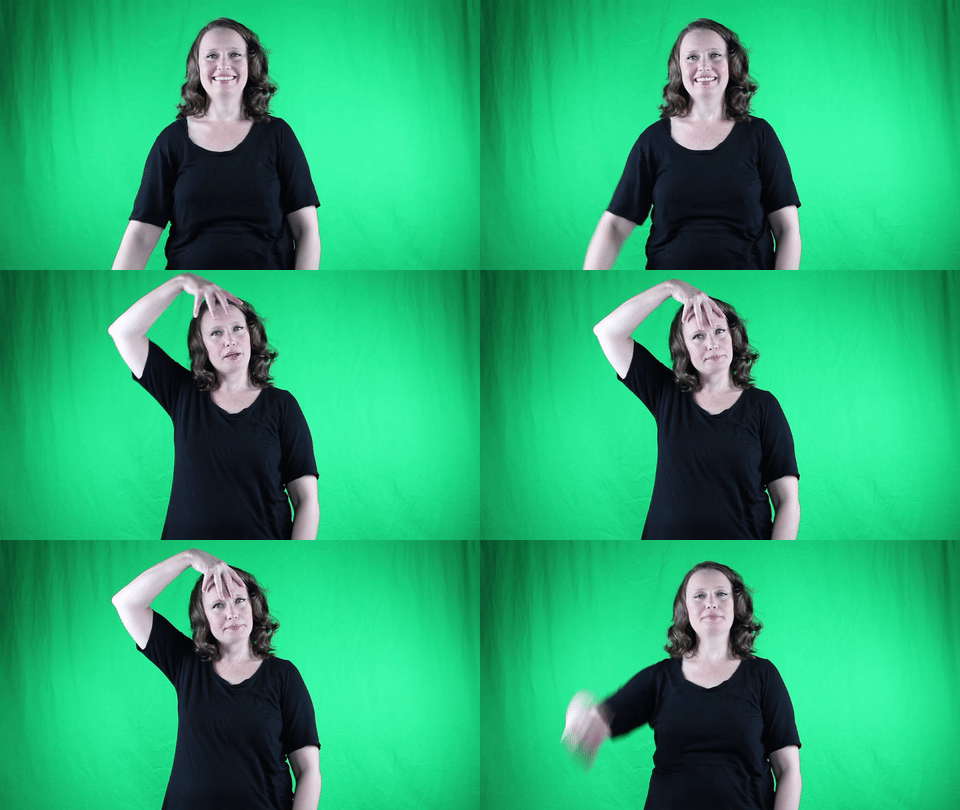
Sign for BANGS in ASL

YouTube player

Practice Activities:

To practice the sign for BANGS in ASL, begin by standing in front of a mirror. Sign the term repeatedly to focus on the correct handshape and movement, especially the motion toward the forehead to indicate the specific location. Make sure your facial expression is natural and your movements are clear and deliberate.

Next, combine the sign for BANGS in ASL with other signs related to hair, such as HAIR, LONG, CURLY, or CUT. Practice creating simple sentences like “I have bangs,” “She cut her bangs,” or “His bangs are long.” These help build fluency and comfort when using the sign in everyday conversations.

Try storytelling exercises. Describe a visit to a hair salon, emphasizing the moment when someone chose to get bangs. Prompt yourself or learners to tell a short story about a friend or family member with bangs, using descriptive classifiers for hairstyles and face shapes. Visual storytelling in ASL builds expressive skills and helps memorize vocabulary in context.

Partner activities are also useful. Take turns describing people in photos where someone is clearly wearing bangs and have your partner guess who you’re describing. Reverse roles and analyze one another’s sign production for accuracy. Engage in quick description games such as “Guess Who?” using hairstyle clues, including the sign for BANGS in ASL.

Video recording helps refine your signing. Record yourself using the sign in multiple full sentences and watch for consistent placement and clarity. Practice signing before and after a haircut to reinforce the vocabulary in real-life scenarios.

Lastly, watch vlogs or ASL videos online where hairstyles or personal descriptions are mentioned. Pause and repeat the sign for BANGS in ASL each time it appears. This builds comprehension and reinforces correct usage in context.

Cultural Context:

In American Sign Language, how concepts are signed often reflects cultural norms and visual descriptions. The sign for bangs in ASL is no exception, as it uses visual elements to mimic the appearance of hair over the forehead. This makes the sign easy to understand for both native signers and ASL learners.

Bangs are a common hairstyle in many cultures and carry different meanings depending on context, fashion trends, and even personality expression. When learning the sign for bangs in ASL, it’s helpful to understand how hair and hairstyles are visually represented in Deaf culture. ASL heavily relies on iconic signs that match real-world visuals, so the gestures for hairstyles often align with these visual cues.

The sign for bangs in ASL typically involves a hand motion near the forehead, mimicking the straight or styled line of hair that defines bangs. Depending on the type of bangs—straight across, side-swept, or layered—the sign may slightly vary. Being aware of these variations can enhance communication in social or fashion-related conversations within the Deaf community.

In many Deaf communities, personal appearance and style, including hair choices like bangs, are often discussed just as they are in hearing cultures. Being able to express details like having bangs, growing them out, or changing the style is useful for casual conversation, storytelling, or describing someone’s look clearly in sign language. The sign for bangs in ASL fits into broader vocabulary about grooming, self-image, and identity.

When teaching ASL to students or to children in bilingual settings, signs like the one for bangs in ASL are valuable for vocabulary building in everyday life. These types of body-related signs create a stronger link between language and personal experience. Signing hairstyles like bangs helps users describe themselves more accurately in ASL.

Hair is also linked to cultural identity, and styles like bangs can signal generational trends or cultural affiliations. In the Deaf community, just like in the hearing world, these style choices are part of personal expression. Knowing the sign for bangs in ASL allows individuals to share these aspects of their identity more freely when communicating visually.

In entertainment and media, characters are often described in sign language using physical traits, including their hairstyle. Knowing how to sign bangs in ASL makes narrative signing richer and helps with developing descriptive language. Whether you’re interpreting a movie, a classroom video, or a conversation, a clear sign for bangs makes descriptions more vivid.

Visual accessibility is central to ASL. The sign for bangs in ASL provides a way to translate visual elements into

Extended Definition:

The sign for bangs in ASL refers to the hand gesture used in American Sign Language to describe the fringe of hair that falls over the forehead. When using the sign for bangs in ASL, the signer typically uses both hands to mimic the shape or position of bangs across the forehead, usually with a downward motion that represents where bangs rest above the eyebrows.

Bangs are a popular hairstyle feature, so it’s helpful to know how to express them clearly in ASL. Whether you’re describing your own hairstyle, someone else’s, or discussing haircuts at the salon, the sign for bangs in ASL helps create accurate visual communication.

In conversations about appearance or personal grooming, the sign for bangs in ASL can also be paired with other descriptive signs. For example, signers might combine it with signs like hair, curly, straight, short, or long to give a fuller picture of someone’s style or look.

Context is important when using this sign so that it’s not confused with other forehead-related gestures. Facial expressions also play a role in ASL, so the signer’s face often reflects the type or style of bangs being discussed, such as dramatic, soft, or childlike bangs.

The sign for bangs in ASL is particularly helpful in social or professional environments where discussing physical features matters. Hairstylists who cater to Deaf clients may use this sign to understand haircut preferences or to make recommendations during consultations.

Learning the sign for bangs in ASL is a great addition to vocabulary related to physical descriptions. It’s especially useful for students, interpreters, educators, and parents who regularly use ASL and want to be fluent in everyday terms, including hairstyles and fashion.

When teaching children or students about personal appearance, including signs like the one for bangs reinforces diversity in expression. It also encourages more inclusive, accessible conversations in educational settings about self-expression and identity.

In media and pop culture, bangs are often associated with showcased styles, so being able to discuss trend-focused hairstyles in ASL is relevant. Signing about a celebrity haircut or a favorite character is part of many conversations in youth and fan communities.

Videos and tutorials are useful when learning the sign for bangs in ASL, especially those that show the gesture from multiple angles. These resources often use slow motion or step-by-step breakdowns that make it easier to copy the correct handshape and movement.

Using the correct facial expression, hand movement, and palm orientation ensures that the sign for bangs in ASL is understood clearly. While some variations might exist depending

Synonyms: Fringe, front hair, forehead bangs, hair fringe, blunt bangs

Educational resources: Find related learning materials in our course bank!

Want more? Check out some of our popular learning activities on the homepage!

Need to look up a sign? Use our highly rated dictionary: https://aslinteractive.com/best-asl-dictionary/

Follow us on tiktok: https://www.tiktok.com/@aslinteractive. More social media links at the bottom of this page!

Long-tail Keywords: what is the sign for bangs in ASL, how do you sign bangs in American Sign Language, ASL sign for bangs

Categories:

tags: Appearance, Hairstyles, Language Learning, Describing People, Everyday Activities

Parameters

*Handshape*:

The handshape for the sign for BANGS in ASL involves using the index fingers of both hands. Form both hands into the 1-handshape, where only the index finger is extended and the rest of the fingers are tucked in. Position the hands near the forehead, with palms facing in, and gently curve or move the fingers downward to indicate the shape of bangs on the forehead.

This visual representation closely mirrors the appearance of bangs falling on the face, making the sign for BANGS in ASL both descriptive and intuitive. Keep the movement small and near the brow line for clarity.

*Palm Orientation*:

The palm orientation for the sign for BANGS in ASL typically has both hands in a modified “4” handshape, with fingers spread and slightly curved. Palms face downward or slightly inward toward the face to mimic the shape and placement of bangs on the forehead.

When making the sign for BANGS in ASL, the hands hover near the forehead, and the tips of the fingers may gently curve downward, symbolizing strands of hair. This orientation helps visually convey the appearance of bangs covering the front part of the head. ‍♀️

*Location*:

The location for the sign for BANGS in ASL is at the forehead, just above the eyebrows. The dominant hand starts near the top center of the forehead, the area where bangs typically fall.

This sign mimics the natural placement of hair above the eyes, emphasizing the forehead region. The sign for BANGS in ASL is clearly localized to this area to show where bangs lie on the face. ‍♀️

*Movement*:

Using the sign for BANGS in ASL, start with both hands in a modified “4” handshape with the fingers pointing downward in front of your forehead. Your fingertips should start slightly apart and come downward just above the eyebrows, as if outlining where bangs would hang.

The movement mimics the framing of actual fringe on the forehead. This sign visually represents the concept of bangs by showing how the hair would fall on the face, making the sign for BANGS in ASL both clear and iconic. ‍♀️

*Non-Manual Signals*:

When demonstrating the sign for BANGS in ASL, the facial expression typically shows interest or a questioning look, especially if asking someone about their hairstyle. Eyebrows may be slightly raised and eyes focused on the forehead area to indicate attention to detail.

Non-manual signals help reinforce that the topic is related to hair or appearance. A slight head tilt forward or to the side, paired with a soft, engaged look, supports the clarity and meaning of the sign for BANGS in ASL. ‍♀️

*Prosody, Dominant/Non-Dominant Hand*:

The dominant hand uses a bent “V” handshape, resembling scissors, palm facing inward. It starts at the forehead and taps or lightly brushes the area just above the eyebrows, mimicking the action of trimming fringe. The non-dominant hand is not used in most versions of the sign for BANGS in ASL. This gesture visually references the location and shape of bangs on a person’s face, making it iconic and easy to understand. ✂️ ‍♀️

Tips for Beginners:

When learning the sign for BANGS in ASL, it’s helpful to start by understanding that this word is often signed using descriptive classifiers rather than a fixed sign. You can use your dominant hand to mimic the shape and location of bangs on the forehead, gently moving the fingers in a sweeping motion across your brow area. Practice in front of a mirror to ensure your handshape and movement clearly suggest hair hanging over the forehead.

One of the most common beginner mistakes with the sign for BANGS in ASL is using unclear classifiers or signing too far from the forehead. To make the meaning clear, keep your movements close to your hairline and visualize where bangs naturally fall. You might need to adjust your sign depending on hair length and style, so don’t be afraid to refine it based on the context.

Facial expression is also important. Since bangs are a feature of appearance, keeping a neutral or mildly expressive face (like indicating whether you like your new bangs) can enhance the clarity of communication. Avoid over-exaggerating the movement, as this can lead to confusion or suggest a different sign entirely.

It helps to ask fluent signers for feedback when you’re unsure if your use of classifiers effectively conveys the meaning. Recording yourself and comparing it to reliable ASL dictionaries or instructors’ videos can offer valuable perspective. Repetition is key, so practice describing different hairstyles using similar classifier strategies.

Lastly, the sign for BANGS in ASL might involve some fingerspelling in more formal or precise settings. Make sure your fingerspelling is fluid and your letters are clearly distinguished. This will ensure you’re ready for times when the descriptive classifier or context isn’t enough on its own.

Connections to Other topics:

The sign for BANGS in ASL connects closely with general signs for hair and hairstyles. Often, the word HAIR is signed first, followed by a gesture at the forehead to specify the particular style, in this case, bangs. This layered approach reflects how ASL visually builds compound ideas using location and movement to add specificity.

This sign is often used in conversations about grooming, fashion, and identity. For example, in discussions about changing hairstyles, the sign for BANGS in ASL may be combined with signs like CUT, STYLE, or NEW. This allows users to express concepts such as getting new bangs or cutting bangs without needing to rely on fingerspelling alone.

The sign for BANGS in ASL also relates to descriptive signs for physical features. For instance, when describing others, especially in storytelling or character description, signers may include features like BANGS to offer a more complete visual picture. This connects to the broader topic of how ASL uses visual descriptions to convey details efficiently.

Learners can also explore how signs for different hairstyles are constructed, such as PONYTAIL, CURLY HAIR, or MOHAWK. These signs often involve similar starting points at the head, with modifications in handshape, movement, or location to show different styles. This helps reinforce the general structure used in the sign for BANGS in ASL.

Additionally, in media interpretation or performance, the sign for BANGS in ASL becomes useful when interpreting dialogue about appearances or makeovers. Understanding how to clearly convey specific hair details adds depth and visual accuracy to translations. Signs related to grooming or appearance—like BRUSH-HAIR or FASHION—can be naturally paired with BANGS to enrich the conversation.

Overall, the sign for BANGS in ASL exemplifies how physical descriptors integrate with broader categories, like personal care or self-expression, in a visual and intuitive way.

Summary:

The sign for BANGS in ASL is generally produced by using both hands in a flat “B” handshape and mimicking the placement or cutting of hair across the forehead. Positioned near the front of the head, fingertips pointing downward, the motion can resemble the way bangs sit or how they are adjusted. The sign visually conveys the shape and location of bangs, reinforcing ASL’s rich use of iconicity.

This sign is often accompanied by facial expressions that suggest aesthetics or styling. Use of facial markers in ASL isn’t arbitrary—they help provide context and emotional tone, especially in topics related to fashion or appearance. A slight raised eyebrow or a smile signals attention to personal grooming or style.

For learners of ASL, the sign for BANGS in ASL illustrates the language’s powerful visual-spatial representation. Rather than spelling out an English concept, ASL captures the ideas physically, tying meaning to deliberate movement and space. This also reflects ASL’s strong relationship between form and meaning, a key concept in linguistic study.

In grammatical terms, this sign typically functions as a noun. It might be included in descriptive clauses, such as when explaining someone’s hairstyle. For example, the sign for BANGS in ASL might follow descriptors like “brown hair” or “short hair” to complete a full visual depiction.

It’s important to distinguish that this is not fingerspelled unless context requires extreme specificity or the sign is unknown to a particular audience. In Deaf culture, signs related to appearance, grooming, and fashion are frequently discussed, contributing to self-identity and cultural expression. The sign for BANGS in ASL becomes part of a larger visual vocabulary that allows for detail-rich dialogue about personal style.

Cross-linguistically, ASL often borrows heavily from visual cues rather than lexical roots common in spoken English. Analyzing the sign for BANGS in ASL through the lens of applied linguistics, one can see the spatial mapping from real-world referents to signing space, a hallmark of signed languages. This direct correlation enhances speed and clarity in communication.

From a cultural perspective, discussing hairstyles like bangs isn’t trivial. Hairstyles hold meaning across communities, and for members of the Deaf community, expressing these ideas fluently in ASL supports individuality and cultural presence. The sign for BANGS in ASL is a small yet meaningful part of conversations around self-presentation.

In educational settings, learning the sign for hairstyles like bangs adds depth to vocabulary lessons. Students are encouraged to explore signs relating to fashion, identity, and self-care. This enriches expressive capabilities and encourages students to observe how societal norms are reflected in language.

Deaf signers often emphasize the importance of culturally accurate and community-approved signs over invented or overly literal versions. The sign for BANGS in ASL, like many descriptive signs, has been shaped over time through consistent and shared use. Community feedback plays a strong role in how signs develop and are preserved.

The evolution of ASL is tied closely to the visibility of everyday concepts. As trends like curtain bangs or micro bangs gain popularity, the sign for BANGS in ASL may be elaborated upon with modifications or added descriptors. This highlights ASL’s flexibility and responsiveness to societal trends.

For interpreters, distinctions in hairstyles can be visually represented by more than one sign depending on how much detail the situation calls for. A general sign may suffice, but in scenarios like fashion shows or salon contexts, the sign for BANGS in ASL may need clarification through classifiers or descriptions. This requires fluency not only in signs but in how to manipulate space to convey nuanced narratives.

Classifier use is another way to expand upon the sign for BANGS in ASL. A signer might use a bent “V” classifier above the eyes to show layered bangs or swiping classifiers to indicate thick or side-swept bangs. Such expansions show the creativity possible in ASL and the tools signers use to build detail.

The sign also fits into broader linguistic debates about iconicity in signed versus spoken languages. While spoken languages use arbitrary sounds, signs like the one for bangs utilize natural visual resemblance to referents, making the learning curve more intuitive in some cases. This supports the argument that sign languages may, in certain respects, be more accessible through sensory mimicry.

Media representation and social media platforms featuring Deaf influencers and hairstylists have increased the visibility of the sign for BANGS in ASL. As more Deaf adults showcase styling content, the need to accurately and expressively describe details like bangs pushes language growth. Community-led innovations enrich the visual vocabulary.

Because ASL strongly incorporates the body into its grammar, signs like this one are also an excellent illustration of embodied cognition. Signers use the forehead as a physical map to describe the location and shape of bangs. The embodiment of meaning enhances retention and semantic clarity.

It’s worth noting that variations to the sign for BANGS in ASL may exist depending on region.

Want more? Check out some of our popular learning activities!

ASL Interactive Resources

ASLInteractive YouTube Channel

Follow us on tiktok: @aslinteractive.com

Follow us on Instagram: aslinteractive

Facebook page: aslinteractive

Facebook group: aslinteractive

LInkedIn: ASL Interactive LLC

Twitter: @ASL_interactive

*Some information on this page is AI-generated. AI can make mistakes. Please check the information.

Sign for BANGS in ASL

Responses