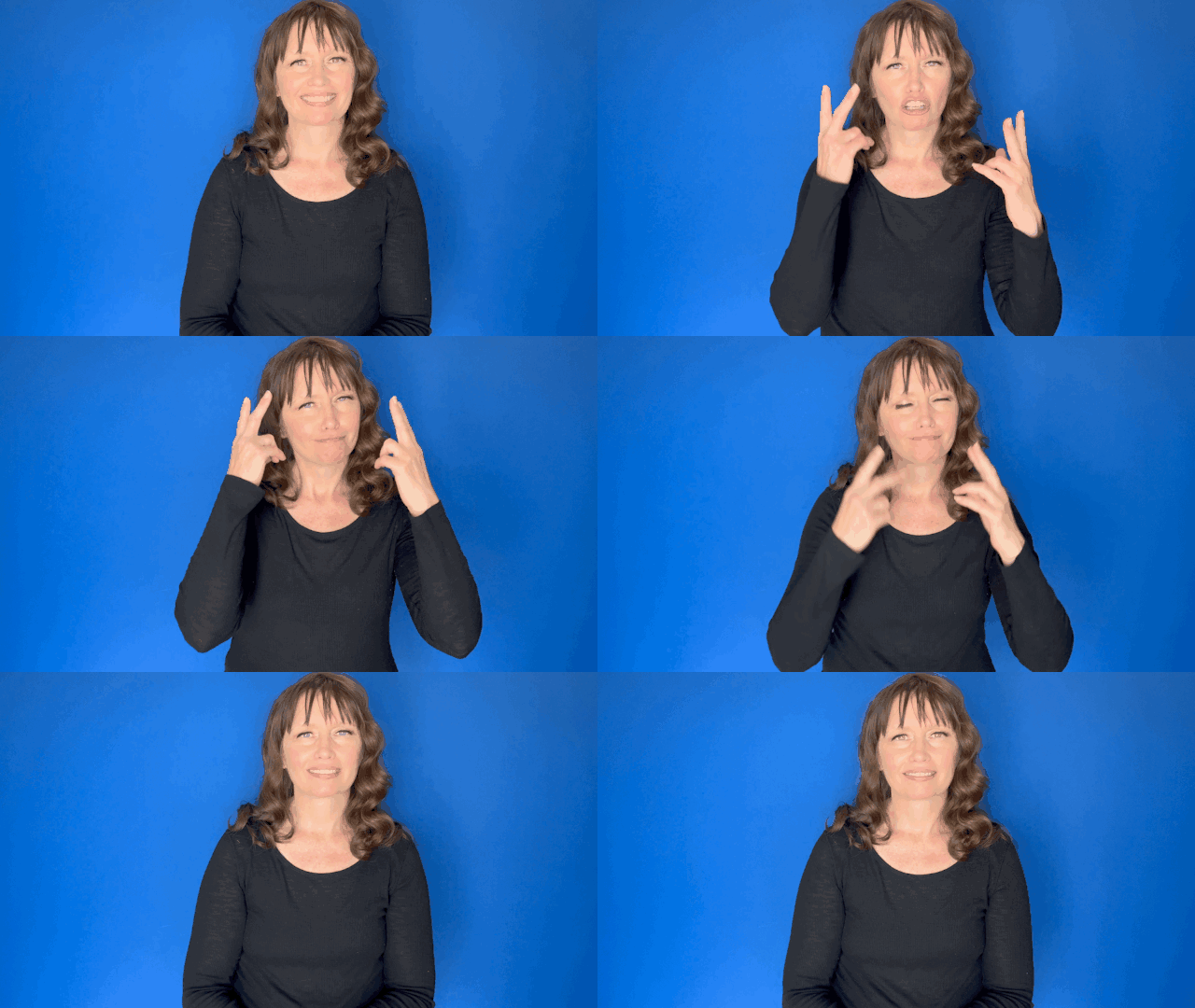
Definition: A place where hair is cut and styled.
Sign for BARBER HAIR SALON in ASL

Practice Activities:
To practice the sign for BARBER HAIR SALON in ASL, start by signing it slowly in front of a mirror. Focus on handshape, placement, and movement, making sure each part of the compound sign is clear. Repeat it several times, gradually increasing speed while keeping the sign accurate and fluid.
Next, incorporate the sign into short phrases or sentences. For example, you can sign: I GO TO BARBER HAIR SALON EVERY MONTH, or MY BROTHER WORKS IN BARBER HAIR SALON. Practice expressing different tenses and situations involving a barber or hair salon. Try signing: YESTERDAY HAIRCUT FROM BARBER HAIR SALON or NEXT WEEK I VISIT BARBER HAIR SALON.
Role-play with a partner to improve conversational use. One of you can be the customer and the other the barber. Take turns signing phrases like: YOU WANT HAIRCUT?, SHAVE TOO?, or WHAT STYLE YOU WANT?. Add common responses using yes/no and WH- questions to build up fluency and comprehension in context.
For storytelling practice, create a simple narrative where a person prepares for an important event and decides to go to the barber hair salon. Use signs describing actions like ENTER, SIT, WAIT, GET HAIRCUT, FEEL HAPPY. This will help blend the sign for BARBER HAIR SALON in ASL naturally into a sequence of related signs.
Finally, as a solo activity, watch videos with related vocabulary and pause to copy what you see. Then sign your own sentences to describe people you know who go to a barber hair salon, or share your typical experience. Using the sign in varied formats strengthens your recall and expressive signing skills.
Cultural Context:
In the Deaf community, visual communication plays a crucial role in everyday life. Knowing the sign for barber hair salon in ASL helps make self-care routines more accessible and inclusive. This sign is useful when discussing hair appointments, grooming preferences, or recommending salons to friends or family members in the Deaf community.
Many Deaf people value salons that are Deaf-friendly or that employ staff who know basic ASL. Signing barber hair salon in ASL not only helps bridge communication gaps but also promotes more comfortable and respectful environments in personal care spaces.
The concept of grooming, hairstyling, and personal appearance holds cultural significance across many communities, including the Deaf and hard-of-hearing communities. By using the correct sign for barber hair salon in ASL, individuals can express preferences clearly, such as requesting a specific haircut, beard trim, or color service.
Salons and barbershops often serve as social settings in many cultures. In the Deaf community, they can also become hubs of connection if communication barriers are reduced. By learning how to sign barber hair salon in ASL, both Deaf clients and hearing professionals can contribute to more inclusive interactions.
The sign for barber hair salon in ASL incorporates concepts related to hair, grooming, and the tools used in a salon setting. Understanding regional variations or slight differences in signing based on context helps increase fluency and cultural competence when discussing these services.
Parents or teachers working with Deaf children may use the sign for barber hair salon in ASL as part of routines about hygiene or role-playing real-world experiences. This can make daily activities more meaningful by connecting language learning to practical life skills.
Knowing how to sign barber hair salon in ASL is also helpful when trying to locate businesses that are welcoming and knowledgeable about Deaf culture. It can be used in conversations, vlogs, or social media posts within the Deaf community that share recommendations and reviews of local services.
Many Deaf influencers and content creators include signs for everyday services like barber hair salon in ASL to increase awareness among their audiences. When used consistently, it helps normalize ASL vocabulary in conversations both online and offline.
Barbershops and salons that make the effort to learn the sign for barber hair salon in ASL show a commitment to accessibility and inclusion. This not only improves customer satisfaction but also opens the door for more diverse communities to feel seen and respected.
Whether you’re a student learning ASL, a Deaf adult navigating daily life, or a salon owner wanting to better communicate, the sign for barber hair salon in AS
Extended Definition:
The sign for barber hair salon in ASL is a visual representation used in American Sign Language to indicate a place where people go to get haircuts, shaves, and other grooming services. This sign combines concepts for haircut or hair with those for location or business, depending on context and conversation.
Understanding the sign for barber hair salon in ASL requires familiarity with some basic grooming-related vocabulary in ASL. In many cases, signers will mime the scissors or clippers motion near the head, then indicate the idea of a place or shop, reinforcing the location aspect of the business.
The sign may vary slightly depending on the region or if the signer is indicating a barber specifically versus a general hair salon. The typical motion often includes a cutting gesture near the side of the head, which is universally understood to mean hair being trimmed. This is then followed by a sign indicating a location such as a shop or establishment.
In ASL, concepts are often signed descriptively, so the sign for barber hair salon in ASL might also include classifiers showing chairs, mirrors, or the physical layout of a salon setting. This method helps provide a clearer image of the type of location being described and makes the sign more precise in meaning.
When teaching or learning the sign for barber hair salon in ASL, it’s helpful to watch videos or demonstrations by fluent signers. This allows learners to understand nuances in movement, facial expressions, and handshape. Context plays a big role in conveying the exact meaning, especially when differentiating between a barber and a typical beauty salon.
The sign works well in both formal conversations and casual dialogue. If someone wants to say they’re going to the barber or hair salon, they would include the time, they would mention the action like haircut, and then use the location sign to complete the sentence. ASL often puts the time or action before the place in sentence structure.
Using the correct sign for barber hair salon in ASL helps in everyday communication with Deaf individuals and supports full language inclusion. Knowing how to sign common places shows respect for Deaf culture and encourages more accessible community interactions.
Kids learning ASL and adults becoming fluent can both benefit from mastering signs like this, as personal grooming and hygiene topics come up often in daily life. Role-playing conversations involving a trip to the barber or salon is a great way to reinforce vocabulary and encourage expressive use of the language.
The sign for barber hair salon in ASL may also appear in signed storytelling, especially when characters are being described or
Synonyms: barber shop, hairdressing salon, grooming studio, hair stylist business, beauty salon
Educational resources: Find related learning materials in our course bank!
Want more? Check out some of our popular learning activities on the homepage!
Need to look up a sign? Use our highly rated dictionary: https://aslinteractive.com/best-asl-dictionary/
Follow us on tiktok: https://www.tiktok.com/@aslinteractive. More social media links at the bottom of this page!
Long-tail Keywords: what is the sign for barber hair salon in ASL, how do you sign barber hair salon in American Sign Language, ASL sign for barber hair salon
Categories:
tags: facilities and other locations/needs, objects, activities, everyday activities, food and drink
Parameters
*Handshape*:
The handshape used in the sign for BARBER HAIR SALON in ASL typically involves both hands forming scissors ✂️ with the index and middle fingers extended and separated, mimicking the motion of snipping. This movement represents cutting hair and is central to the imagery of a barber or stylist at work.
The handshape visually communicates the concept of haircutting, which aligns directly with the sign for BARBER HAIR SALON in ASL. This scissor-like formation adds clarity when referencing grooming environments or haircare services.
*Palm Orientation*:
In the sign for BARBER HAIR SALON in ASL, the palm orientation plays an important role in clearly conveying the idea. The dominant hand forms a modified “X” or “cutting” handshape, with the palm facing upwards or slightly inward, depending on how the motion mimics trimming hair around the head.
For HAIR, the palm typically faces the signer as fingers gently tug at an imaginary strand of hair. In the sign for SALON, hands move around the side of the head with palms usually facing inward or toward each other, resembling styling. The combination of these signs helps express the full concept of the sign for BARBER HAIR SALON in ASL. ♂️
*Location*:
The sign for BARBER HAIR SALON in ASL is typically made near the side of the head, close to the temple or above the ear—mirroring where hair is commonly cut. This location helps visually reinforce the meaning of the sign, connecting it to grooming and haircutting activities.
Since the concept combines both barber and salon, the signer may use both handshapes and movement near the head to represent scissors ✂️ or trimming actions. The sign remains in the neutral space or slightly elevated to align with facial and scalp level, keeping the placement close to where actual barbering would occur.
*Movement*:
The sign for BARBER HAIR SALON in ASL involves using both hands to mimic scissors cutting hair. Your dominant hand forms a “V” shape to represent scissors, opening and closing at the side of your head. This movement reflects the action of cutting hair, often near the temple area.
To specify the salon aspect, follow the scissor gesture by drawing a small circular motion near the top of the head with a flat “B” hand. This creates the overall concept of a place where haircuts happen. The sign for BARBER HAIR SALON in ASL may vary slightly by region but typically combines gesture and location to indicate a hair salon. ♂️
*Non-Manual Signals*:
When signing the Sign for BARBER HAIR SALON in ASL, your facial expression should remain neutral to slightly inquisitive, especially if you’re using it within a question. Slight head tilt can help emphasize location context or clarification.
Use natural facial movement to match the context—such as a slight smile when discussing a specific place or friendly experience. Eye gaze should follow the movement of your dominant hand, especially during classifiers representing scissors or trimming ✂️.
*Prosody, Dominant/Non-Dominant Hand*:
The sign for BARBER HAIR SALON in ASL typically uses the dominant hand in a scissor motion near the head, mimicking the action of cutting hair ✂️. The non-dominant hand may act as the “hair” by staying stationary or shaped like a basic flat hand near the head to set the context.
To express the sign for BARBER HAIR SALON in ASL fluidly, maintain rhythm and clarity between the motions. The dominant hand remains active throughout, guiding the prosodic flow with consistent movement, while the non-dominant hand gives spatial reference or stays in a supportive role.
Tips for Beginners:
When learning the sign for BARBER HAIR SALON in ASL, it’s important to become comfortable with combining multiple concepts. Typically, this sign is expressed by using the sign for “hair” followed by a classifier motion mimicking scissors cutting near the top or sides of the head. Another version may involve a quick fingerspelled BARBER or HAIR SALON depending on regional or personal preference. It’s always best to observe how Deaf signers in your community express this term.
Maintain consistency in handshape and movement when performing the scissor motion. Beginners sometimes hold their hands too stiffly or don’t angle them correctly near the head, which can lead to confusion. Try practicing in front of a mirror to make sure your motion is smooth, clear, and properly placed. Keep your facial expression neutral to friendly—this supports the tone of the conversation, especially in professional service contexts like hair salons.
Avoid rushing through the fingerspelled parts if you choose to use fingerspelling for BARBER or HAIR SALON. Keep your hands steady and make sure each letter is identifiable. Practice spelling slowly and with fluid transitions between letters to build muscle memory.
Knowing whether the person you’re speaking with uses more initialized signs or relies on classifiers can influence which version of the sign for BARBER HAIR SALON in ASL you choose. Pay attention during interactions and adapt accordingly. Regional and cultural differences might influence preferences, so being observant and flexible is key.
Practice signing with others in simulated conversations, such as setting up an appointment or asking where the nearest salon is. These real-life scenarios help reinforce your grasp of the sign for BARBER HAIR SALON in ASL while boosting your fluency in context-based communication ✂️
Sign for BARBER HAIR SALON in ASL, barber in sign language, ASL sign for hair salon, how to sign barbershop ASL, fingerspell barber ASL, haircut sign ASL, sign for salon in American Sign Language, ASL vocabulary barber salon.
Connections to Other topics:
The sign for BARBER HAIR SALON in ASL connects directly with signs for occupation and services, such as HAIR, CUT, STYLE, SHOP, and JOB. These concepts often combine to create compound signs that reflect professional services or establishments, helping users clarify context in conversation. For example, signs for DOCTOR OFFICE or DENTIST CLINIC use similar sign-building strategies by pairing a specific profession with the location or environment where it operates.
A useful connection is the sign for HAIRCUT, which is often a base component of the sign for BARBER HAIR SALON in ASL. It typically uses a scissor-like handshape near the head, and when combined with a sign indicating a place or profession (like a modified version of PERSON or SHOP), the meaning becomes clearer. This approach reflects a common ASL pattern of combining action and place or occupation to form rich semantic units.
Learners can also explore how gender or description might be added. For instance, pairing BARBER with MAN or WOMAN helps specify which type of hair salon one is referring to. Similarly, signs like BEAUTY, STYLE, or MAKE-UP can be incorporated depending on whether the salon focuses on cosmetic services beyond cutting hair.
In everyday conversation, the sign for BARBER HAIR SALON in ASL can link to discussions about appointments, health (related to cleanliness or grooming), or accessibility services. This offers learners a way to practice integrating time and location concepts, such as FUTURE, YESTERDAY, or NEAR, when discussing visits or routines.
Another insightful connection lies in community and culture. Hair salons and barbershops often serve as cultural hubs, especially in Black and Latinx communities. Using the sign for BARBER HAIR SALON in ASL within these contexts may involve discussions of community roles, storytelling, or social bonding, enriching both sign comprehension and cultural fluency.
Summary:
The sign for BARBER HAIR SALON in ASL combines visual elements that convey cutting and personal grooming in one concept. This sign draws from classifiers and iconic signing that mimic cutting hair, often incorporating scissors or a combing gesture near the head. Some signers begin by miming scissors with the H-handshape around the top or side of the head to specify hair services.
In many instances, this compound concept blends two movements. The first part mimics a haircut using an open and shut hand action, like scissors, and the second includes gestures toward or around the head to specify the part being styled or trimmed. Together, they create the contextual meaning for BARBER HAIR SALON.
Fingerspelling is often used for clarity or specific names of businesses. While there are general signs for hairstylist or haircut, BARBER HAIR SALON as a full phrase is sometimes fingerspelled when identifying distinct establishments or when specificity is necessary. This combination allows space for both general reference and individual business names.
Culturally, the sign for BARBER HAIR SALON in ASL aligns with the Deaf community’s focus on visual accuracy. Salons and barbershops are important gathering places, and reflecting them accurately in sign supports social cohesion. The signs also show how ASL adapts through cultural need, forming new compound signs as contexts evolve.
A classic approach is to use the sign for HAIR followed by a haircut sign or the profession sign for PERSON cutting with scissors. This slightly formal structure mirrors how compound nouns are formed in ASL. It allows for flexibility depending on the conversation’s focus.
Modern usage often blends casual signs for haircut or barber with PERSON or PLACE classifiers to indicate a shop. ASL’s linguistic structure allows for pluralization and spatial referencing to distinguish between multiple salons. The use of directional verbs such as GO or VISIT helps embed this term naturally in signed sentences.
Children learning the sign for BARBER HAIR SALON in ASL are often taught through role play activities that integrate real-world experiences. Teachers may use toy scissors and activities that reinforce the visual meaning of the sign. This approach supports early language acquisition and semantic connections.
In Deaf culture, appearance services have important roles, especially in profession-centered discussions. Signing BARBER HAIR SALON in ASL not only conveys a service but often carries connotations of self-care and social interaction. Salons also serve as community information centers in many Deaf communities.
Linguistically, the iconic nature of the cutting motion used in the sign for BARBER HAIR SALON in ASL demonstrates how ASL uses visual representation. This mirrors broader patterns found in sign languages internationally, where hair cutting is usually signed through pantomimic gestures. These mirror real-world actions, increasing intelligibility.
Applying applied linguistics to this sign shows the impact of multimodal communication. Deaf consumers understand the semantics due to embodied cognition—the brain’s processing of movement and bodily actions as meaning. These embodied elements translate into highly interpretable signs across regional variations.
Regional differences in signing BARBER HAIR SALON in ASL often rest more in facial expressions or emphasis rather than entirely different signs. Some regions emphasize the scissor gesture more vigorously, while others slow down the combing gesture to represent longer sessions. Understanding these differences aids interpreters in cross-regional communication.
When translating for DeafBlind individuals, tactile adaptations of the sign focus on placing hand shapes in the hair area and light squeezing to imply scissors. This sensory approach adapts the movement into shared touch patterns. Interpreters use gentle tapping to symbolize the snipping of hair.
The sign for BARBER HAIR SALON in ASL intersects with other grooming-related signs, like SHAVE, WASH, or STYLE. Combining these signs allows Deaf users to talk about full grooming routines or preferences. It also integrates smoothly into concurrent discussions of self-care or beauty routines.
In professional interpreting, especially medical or vocational settings, clarity around the sign for BARBER HAIR SALON in ASL becomes essential. Misuse of a general haircut sign may confuse listeners expecting a location or service reference. Accurate use reinforces trust and precise meaning in translated conversations.
Deaf entrepreneurs who run salons may innovate how they use the sign professionally. Some personalize the sign for their salon’s brand by adjusting the motion slightly or introducing unique classifiers. This showcases the flexibility and creativity within ASL for business and branding expressions.
Social media content from Deaf influencers often features this sign, especially in beauty and grooming tutorials. It contributes to digital representation of Deaf culture and allows Follow-Along content for ASL users. Hashtags incorporating BARBER HAIR SALON signs are frequently shared in short form videos.
Linguistics studies find that signs like BARBER HAIR SALON in ASL highlight the merging of morphology and classifier constructions. The location of signing near the head, the handshape mimicking tools, and directionality together form a cohesive visual semantic unit. Such studies contribute to deeper understanding of sign
Want more? Check out some of our popular learning activities!
ASL Interactive Resources
ASLInteractive YouTube Channel
Follow us on tiktok: @aslinteractive.com
Follow us on Instagram: aslinteractive
Facebook page: aslinteractive
Facebook group: aslinteractive
LInkedIn: ASL Interactive LLC
Twitter: @ASL_interactive
*Some information on this page is AI-generated. AI can make mistakes. Please check the information.


Responses