Sign for BATHE in ASL | 🛀 ASL Dictionary

Definition: To wash oneself.

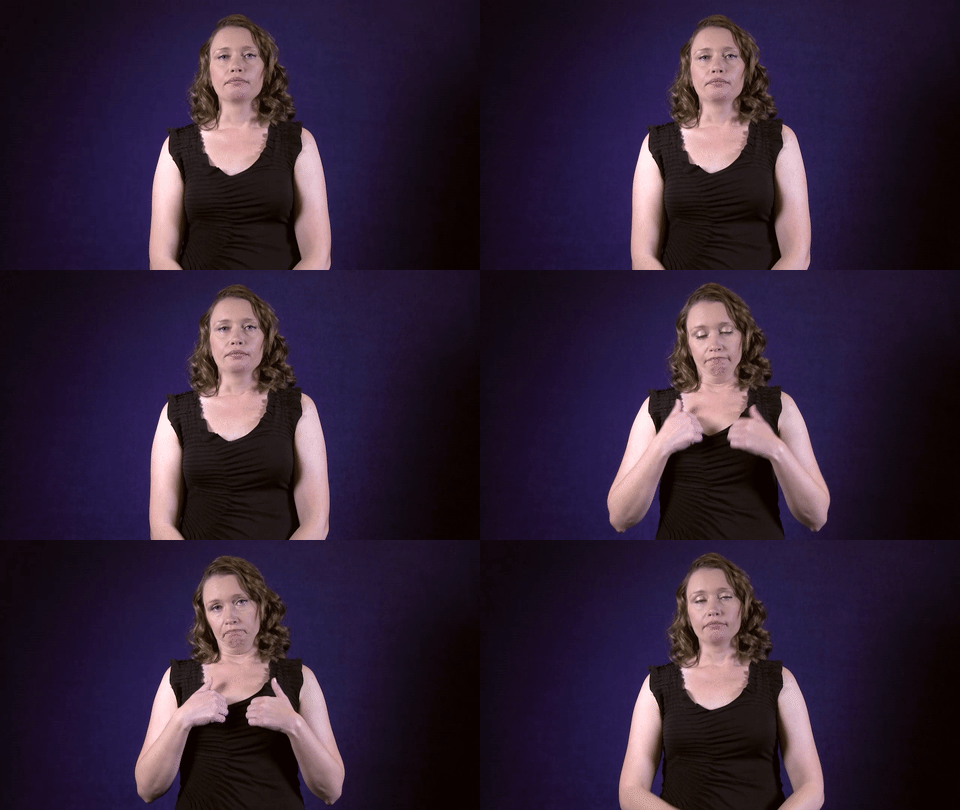
Sign for BATHE in ASL

YouTube player

Practice Activities:

To get comfortable with the sign for BATHE in ASL, begin by practicing it in front of a mirror. Focus on the motion and the emotional context—this sign often conveys self-care or a daily routine, so keep your expression natural and relaxed. Repetition is key. Sign it 10-15 times slowly to ensure handshape and movement are correct.

Once comfortable signing in isolation, try incorporating the sign for BATHE in ASL into simple sentences. For example, sign “I BATHE every morning” or “She BATHE before bed.” Use ASL structure, such as “MORNING I BATHE” or “NIGHT HE BATHE.” Record yourself and review the flow of each sentence.

A great solo activity is to describe your daily routine in ASL. Include the sign for BATHE in ASL along with other routine-related signs such as WAKE-UP, BRUSH-TEETH, and EAT. Keep your signs clear and timed with your facial expressions. Try to sign your routine without voicing to strengthen fluency.

Practice with a partner by asking and answering questions. For example, one person signs “WHEN YOU BATHE?” and the other signs back “MORNING I BATHE.” Expand this dialogue by adding signs for different people, such as “YOUR BABY BATHE WHEN?” and developing short discussions using relevant vocabulary.

Storytelling helps reinforce retention. Create a short story with a character who has to hurry in the morning. Include the sign for BATHE in ASL alongside signs like LATE, ALARM, and SHOWER. Sign the story in front of someone or record and review your performance.

To reinforce learning, watch native signers tell stories or explain routines and note how they use the sign for BATHE in ASL. Mimic their fluency and expression to take your signing to the next level. Regular daily practice will help the sign become second nature.

Cultural Context:

In Deaf culture, personal hygiene is just as important as in any other community, and discussing routines like bathing happens naturally in everyday signed conversations. Understanding the sign for bathe in ASL is key when talking about daily self-care and health-related topics with fluency and cultural respect.

The sign for bathe in ASL is typically used when describing actions such as getting ready for the day, establishing routines with children, or discussing care schedules. This sign often comes up in family settings, caregiving environments, and education settings, where life skills and independence are common topics.

When learning the sign for bathe in ASL, it’s also helpful to understand the nuances of context in Deaf culture. Signs can shift slightly in meaning based on social context, facial expressions, and role-shifting. For example, bathe might be signed differently when referencing bathing a pet versus someone bathing themselves, emphasizing who is performing the action.

Within ASL storytelling and visual descriptions, actions like bathing are often incorporated into rich narrative sequences. Someone using the sign for bathe in ASL might also mime scrubbing with soap, rinsing, or wrapping up in a towel to give full visual detail, staying true to the expressive nature of the language. These added expressions give more nuance and help convey complete ideas without needing spoken words.

In Deaf households, particularly within Deaf-parented households, young children learn signs like bathe early on as part of their daily routines. Caregivers use signs such as time to bathe or let’s go bathe as part of teaching structure and routine, helping children build communication skills from a young age.

The sign for bathe in ASL is not just about cleanliness—it also represents independence and personal responsibility. In schools and life-skills programs for Deaf students, learning self-care vocabulary like bathe is part of developing autonomy and confidence, essential values in Deaf culture and community life.

In some Deaf community events or summer programs, workshops teach younger participants how to sign daily tasks, and the sign for bathe in ASL is included alongside brush teeth, get dressed, and eat breakfast. These lessons reinforce both language development and practical life skills, keeping learning language grounded in real-life experiences.

Understanding the cultural use of signs like bathe in ASL helps bridge communication gaps between Deaf and hearing people. It’s also essential for interpreters, ASL students, and educators to recognize how commonly this sign is used in routine conversations, reinforcing just how central these actions are in visual language.

To

Extended Definition:

The sign for bathe in ASL is a clear and expressive movement that represents the act of washing the body. This sign usually involves using both fists in a scrubbing motion across the chest to mimic the action of bathing. It’s a very intuitive sign that reflects the daily routine of cleanliness and self-care.

In American Sign Language, concepts related to daily hygiene are often acted out visually using gesture-based signs. The sign for bathe in ASL is commonly used when describing someone’s routine, giving instructions, or asking if someone has bathed. Because the sign mimics an action, it’s easy for new learners to pick up and remember.

Bathe is different from related signs like shower or wash. While the sign for shower typically represents water falling from above, the sign for bathe focuses more on the scrubbing portion of the washing process. These subtle differences are part of what makes ASL a rich and detailed language that relies heavily on context and visual representation.

Understanding the sign for bathe in ASL is especially useful for parents, caregivers, and educators working with Deaf children. It helps reinforce a daily schedule and promote healthy habits. It is also frequently used in storytelling or classroom settings where characters perform routine tasks.

The sign for bathe in ASL can be modified slightly to reflect the subject of the sentence. Facial expressions and body language help clarify who is bathing and how the action is taking place. For instance, adding a questioning expression can turn the sign into a yes/no question, asking if someone has bathed already.

This sign is also a great example of ASL’s use of classifier-like gestures. When discussing animals or objects that need washing, the same motion can be used in different spatial directions to visually convey the scenario. Those learning the sign for bathe in ASL can experiment with directional signing to enhance their fluency and expressiveness.

In social media and digital content, using the correct ASL signs for daily activities like bathing helps raise awareness about the language while providing access to practical vocabulary. Including the sign for bathe in ASL in your content can connect with a wider audience and support accessible communication.

When using this sign in a sentence, it’s common to pair it with time indicators, like “every morning” or “at night,” to give context. This helps form complete ASL sentences while respecting the unique grammar of the language. It’s important to remember that word order in ASL often differs from English, emphasizing a more visual and spatial structure.

Learning

Synonyms: wash, soak, cleanse, rinse, immerse

Educational resources: Find related learning materials in our course bank!

Want more? Check out some of our popular learning activities on the homepage!

Need to look up a sign? Use our highly rated dictionary: https://aslinteractive.com/best-asl-dictionary/

Follow us on tiktok: https://www.tiktok.com/@aslinteractive. More social media links at the bottom of this page!

Long-tail Keywords: what is the sign for bathe in ASL, how do you sign bathe in ASL, ASL sign for bathe

Categories:

tags: Activities, Everyday activities, Chores, Verbs, Commands

Parameters

*Handshape*:

The handshape used in the sign for BATHE in ASL involves both hands forming the letter “A” handshape, which means the fingers are curled into a fist with the thumb resting on the side. These “A” hands move in a scrubbing motion on the upper chest or shoulders, mimicking the act of washing the body .

This movement helps convey the meaning tied to personal cleanliness. The sign for BATHE in ASL clearly reflects the action of bathing or cleaning oneself through deliberate motion and proper handshape.

*Palm Orientation*:

For the sign for BATHE in ASL, both hands form the letter “A” and move in small circular scrubbing motions across the chest. The palms face inward toward the body throughout the motion.

The palm orientation remains consistent, with the knuckles pointing outward and the thumbs angled slightly upward. This helps visually simulate the action of washing the torso, which is central to the sign for BATHE in ASL .

*Location*:

The sign for BATHE in ASL is typically performed in the upper chest area, centered just below the shoulders. Both closed “A” hands represent scrubbing motions, simulating the act of washing the body.

This location near the torso mirrors the action of taking a bath, enhancing the visual clarity of the sign for BATHE in ASL. The movement stays close to the body, emphasizing personal hygiene actions.

*Movement*:

To perform the sign for BATHE in ASL, form both hands into “A” handshapes with thumbs extended. Place the fists just above either side of the chest. Move the fists in a small alternating circular motion that mimics the act of scrubbing the chest region, as if bathing .

This signing motion is typically repeated twice to clearly convey the meaning. The natural gesture helps reinforce the concept while maintaining the visual nature of the sign for BATHE in ASL.

*Non-Manual Signals*:

When performing the sign for bathe in ASL, the facial expression is generally neutral and relaxed, reflecting the everyday, routine nature of the activity. There’s usually no exaggerated expression unless you’re adding emphasis or showing preference.

Keep your posture upright and your head steady, adding a slight nod if you’re emphasizing the act. The non-manual signals help reinforce that the sign for bathe in ASL refers to a habitual or personal action .

*Prosody, Dominant/Non-Dominant Hand*:

The sign for BATHE in ASL uses both hands in the dominant and non-dominant roles. Both hands are in A-handshapes, with thumbs extended and move in a circular, scrubbing motion across the chest and upper body area, mimicking the action of washing oneself.

The dominant hand typically leads the motion and provides more pressure or exaggerated movement, while the non-dominant hand supports the rhythm. Facial expression can enhance the meaning in the sign for BATHE in ASL .

Tips for Beginners:

When learning the sign for BATHE in ASL, it’s important to focus on the handshape and movement. Use both hands in the “A” handshape (fist with thumb on the side), and mimic a scrubbing motion across your chest, as if you’re washing your upper body. Keep the movement smooth and natural, not stiff, to help reflect the real-life action of bathing.

Beginners often make the mistake of using incorrect hand placement or signing too high or too low on the body. Remember that the sign for BATHE in ASL happens in the upper torso area, not near the neck or the stomach. Signing too far off-position can make your message harder to understand.

Facial expression may seem trivial, but it plays a subtle role in ASL. Even for action signs like the sign for BATHE in ASL, a neutral facial expression or a relaxed look enhances the clarity of the message. Avoid exaggerated expressions unless the context of your conversation calls for it.

Practice in front of a mirror can be very helpful. Watching yourself sign gives you a clearer idea of how your movements look from the viewer’s perspective. Repetition with correct technique trains your muscle memory, which is essential for smooth communication in real conversations.

Try not to sign too fast. Beginners sometimes rush, thinking it makes them look more fluent. Clarity is more important than speed. Signing at a comfortable pace helps you maintain proper form and makes your signing easier to understand.

Whenever possible, watch native or fluent signers demonstrate the sign for BATHE in ASL. Real-time visual input helps reinforce correct movement and pacing. Follow professional ASL content creators or attend deaf community events to see signs used naturally.

Connections to Other topics:

The sign for BATHE in ASL connects closely to other daily routine signs, such as SHOWER, WASH, and CLEAN. These signs form a cluster within the category of personal care and hygiene, and understanding one can support the acquisition of others. For example, both the signs for BATHE and SHOWER involve mimicking movements used in the actual activities, making them highly iconic and intuitive.

This sign also relates to concepts of self-care and wellness. In storytelling or conversation about health, cleanliness, or routines, using the sign for BATHE in ASL can be paired with health-related signs like SICK, DOCTOR, or MEDICINE to show cause and effect or to describe habits. This allows for better narrative flow and richer expression in ASL conversations about taking care of one’s body.

Compounding is seen when expressing ideas such as TAKE-A-BATH by combining TAKE and BATHE. While not always a true ASL compound, such combinations are used contextually to emphasize agency or sequence. Similarly, the sign for BATHE is used contextually in more abstract uses—like “washing away sins” in religious discussions or when referencing spiritual cleansing—by using facial expressions and classifiers.

Classifier use also enhances the expression of the sign for BATHE in ASL. For instance, describing multiple people bathing or a child being bathed uses classifiers to add detail about positioning or interaction. This skill ties the sign into the broader ASL grammar system and shows the importance of body space, role shifting, and narrative techniques.

Learning the sign for BATHE in ASL is a step toward fluency in describing routines, experiences, and emotional states. It’s foundational in understanding how everyday actions are expressed visually and how they integrate with emotions and contexts. This creates opportunities for learners to build more nuanced conversations in ASL.

Summary:

The sign for BATHE in ASL utilizes both hands in a movement that symbolizes the act of scrubbing the chest. You begin with A-handshapes on both hands, placed against your torso, and move them in small, alternating circular motions across your upper chest area. This motion visually mimics the pattern of washing oneself, emphasizing the cultural importance of embodiment in ASL.

This sign is iconic, meaning it closely resembles the action it represents. It captures the concept of bathing through the visual and kinesthetic representation of scrubbing the body. Iconicity in this case strengthens understanding, especially for beginner signers and children learning through visual context.

In terms of grammatical function, the sign for BATHE in ASL can act as a verb, typically used in present tense syntax unless temporal markers indicate otherwise. ASL tends to rely on contextual and spatial indicators to convey tense. Facial expression and non-manual markers help establish whether the action is habitual, completed, or ongoing.

The sign is closely tied to classifier usage in more advanced signing. One may use body classifiers or location classifiers to describe where someone is bathing or how someone is bathing, such as in a tub, river, or shower. Classifiers allow more descriptive and dynamic sign phrasing surrounding the concept of bathing.

Culturally, the concept of bathing in Deaf communities transcends hygiene and incorporates considerations of independent living and self-care. Signing about bathing is important in educational and medical contexts, emphasizing ASL’s adaptability in handling domestic activities. The sign effectively portrays private and essential daily functions while maintaining linguistic dignity and respect for personal routines.

The sign for BATHE in ASL blends well with related domestic action signs such as WASH, SHOWER, CLEAN, and TOILET. These signs collectively form a set of vocabulary surrounding routine personal care and can be used in sequential phrases for describing daily schedules or tasks. Their similar phonological structures create a thematic family of signs useful in narratives.

ASL often groups related concepts spatially or temporally. When telling narratives detailing one’s day, the sign for BATHE in ASL often appears at the start of sequences to signify the beginning of morning routines. The placement of this sign can establish context that guides subsequent signs like CLOTHES, EAT, and LEAVE.

In academic ASL studies, this sign serves as an example of how phonology and movement work cohesively to convey meaning. The alternation of hand movements mirrors the back-and-forth rhythm involved in bathing, supporting the idea that ASL signs often tap into rhythmicity and repetition for both aesthetic and functional reasons. This repetition also heightens memory retention.

Morphologically, the sign for BATHE in ASL does not inflect in traditional spoken language terms, but can be modified by speed, intensity, and repetition. Emphasizing force in the movement can show a vigorous bath, while slow and gentle movement can depict a relaxed bath. These modifications create nuances that express attitude and context without changing the base sign.

Applied linguistics research often uses signs like BATHE to reason about how gesture and language intersect. Because the sign closely ties to an embodied action, it serves as a prime example of how ASL borrows from lived experience. Linguists studying embodiment and gesture can gain insight into how signers blend physical experience with conceptual categorization.

The sign also demonstrates the affordance of space in ASL. A signer can shift their body or direct the signing forward or to another location to indicate who is bathing or where the bathing is occurring. Role-shifting is often incorporated to act out the behavior of someone bathing, adding greater depth to depiction.

Children acquiring ASL tend to learning bathing-related terminology early, especially in structured environments such as preschools or Deaf education programs. The sign for BATHE in ASL becomes a practical and essential part of early vocabulary. It helps educators build routines and expectations in linguistic and cultural contexts.

In storytelling, BATHE is a common trope used to transition into a narrative setting. It often suggests peace, preparation, or vulnerability depending on plot direction. Sign poets and performers may use the sign to evoke imagery associated with relaxation, privacy, or ritual.

The sign also pairs well with time signs like MORNING or NIGHT when building temporal routines. Temporal indexing is visual and spatial in ASL, positioning the sign properly within a timeline to reflect real-life sequences. These thematic integrations help anchor signs like BATHE within broader communicative structures.

In discourse analysis, the sign can be used to track referents through spatial representation. If a signer introduces two characters and then shows each taking a bath at different locations, they can set spatial anchors and direct the sign accordingly. This demonstrates how ASL employs spatial linguistics in dynamic and efficient ways.

Variations of the sign may exist depending on region or context. While the standard uses A-hands, some signers might use slightly different handshapes or locations to emphasize the area of scrubbing more specifically, such as higher on the chest or

Want more? Check out some of our popular learning activities!

ASL Interactive Resources

ASLInteractive YouTube Channel

Follow us on tiktok: @aslinteractive.com

Follow us on Instagram: aslinteractive

Facebook page: aslinteractive

Facebook group: aslinteractive

LInkedIn: ASL Interactive LLC

Twitter: @ASL_interactive

*Some information on this page is AI-generated. AI can make mistakes. Please check the information.

Sign for BATHE in ASL

Responses