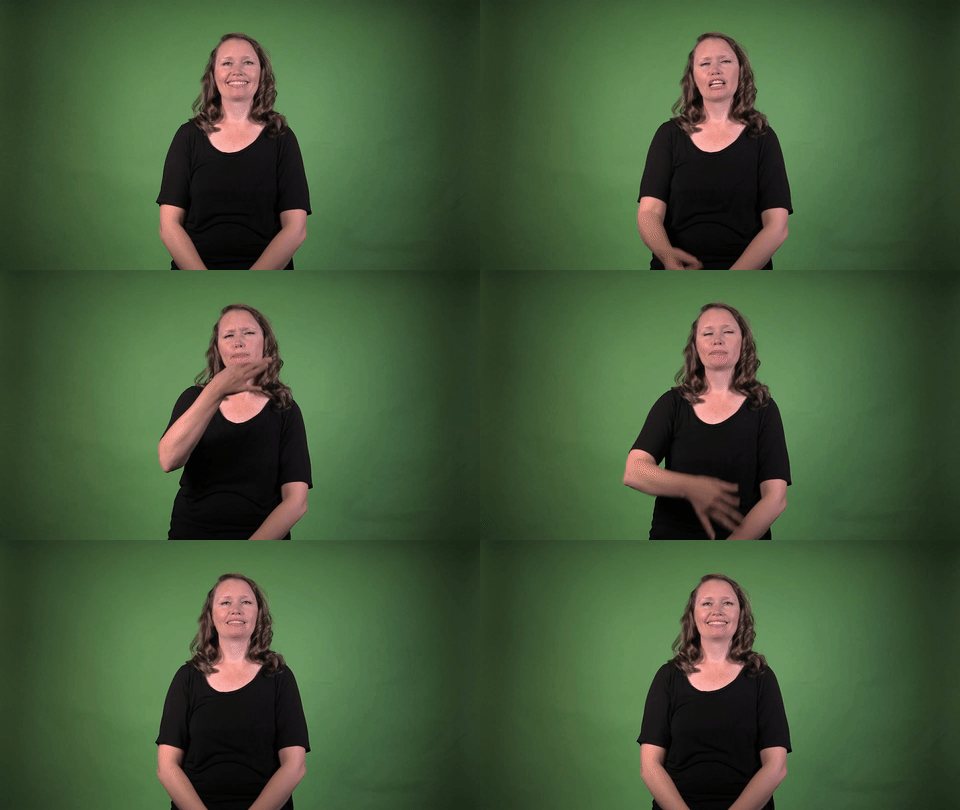
Definition: To be exceptionally skilled at something.
Sign for BE EXCEPTIONALLY SKILLED (EXPERT) in ASL

Practice Activities:
Cultural Context:
In American Sign Language, expressing the concept of being highly capable or knowledgeable often goes beyond a direct translation. The sign for BE EXCEPTIONALLY SKILLED (EXPERT) in ASL represents a deep understanding or mastery, and it’s commonly used to describe someone with advanced experience or training in a particular area. This sign carries cultural meaning and emphasizes a high level of respect for someone’s ability.
Deaf culture places strong value on visual communication and depth of skill, especially within the community. When someone is described using the sign for BE EXCEPTIONALLY SKILLED (EXPERT) in ASL, it conveys not just technical proficiency, but a recognition of accomplishment and dedication. It’s a meaningful way to honor someone’s commitment to learning and doing something at an expert level.
The sign for BE EXCEPTIONALLY SKILLED (EXPERT) in ASL may be used in conversations about work, hobbies, or academic achievement. Whether describing a skilled artist, a talented teacher, or an experienced interpreter, this sign shows genuine appreciation for someone who stands out in their field. It can also elevate a person’s reputation within the Deaf community because of the value placed on excellence and contribution.
In educational settings, instructors might use the sign for BE EXCEPTIONALLY SKILLED (EXPERT) in ASL to praise students who show significant improvement or master ASL concepts quickly. In everyday interactions, someone might refer to a friend or colleague using this sign to highlight their standout abilities. It is a way of acknowledging both natural talent and the effort behind learning something complex.
This sign fits seamlessly into the value Deaf culture places on accessibility, communication, and contribution. Being labeled with the sign for BE EXCEPTIONALLY SKILLED (EXPERT) in ASL suggests a community-based acknowledgment of someone’s role and importance. It encourages learning, mentoring, and sharing knowledge within the community.
It’s important to understand the context in which this sign appears. Using the sign for BE EXCEPTIONALLY SKILLED (EXPERT) in ASL casually without that deeper meaning can come off as insincere. The sign is best reserved for moments when true respect and admiration are intended.
In storytelling, Deaf performers and speakers often use the sign for BE EXCEPTIONALLY SKILLED (EXPERT) in ASL as part of character development. It helps show growth, transformation, and achievement. It also contributes to the richness and emotional depth in ASL narratives.
This culturally significant sign carries weight in social gatherings
Extended Definition:
The sign for BE EXCEPTIONALLY SKILLED (EXPERT) in ASL conveys the idea of someone who possesses advanced abilities or deep knowledge in a specific subject or skill. This sign is commonly used when describing individuals who are considered professionals or extremely talented in a particular area. Whether it’s a craft, job, or academic subject, this ASL sign effectively communicates that someone has gone beyond the basics to gain true mastery.
To create the sign for BE EXCEPTIONALLY SKILLED (EXPERT) in ASL, handshape and movement matter a lot. Typically, the dominant hand starts in a specific formation, like the dominant hand gripping the fingertips of the non-dominant hand and pulling away, representing the concept of pulling out what is superior. This visual metaphor helps reinforce the idea of someone who stands out from others in their field due to their expertise.
This ASL sign is also used in educational settings and workplace discussions to describe people with qualifications or years of experience. You might see it used when talking about a specialist, a consultant, or someone who has spent a lot of time refining their technique. In casual conversations, the sign for BE EXCEPTIONALLY SKILLED (EXPERT) in ASL can replace a lengthy explanation by simply identifying someone as the best or highly competent.
The sign works well in storytelling and expressive signing because it pairs visual clarity with meaning. For instance, when describing an award-winning chef, a skilled athlete, or a seasoned teacher, this ASL sign delivers the message quickly and clearly. It’s a valuable sign for ASL learners because it adds precision to everyday communication.
In Deaf culture, recognizing expertise is important, whether in art, education, science, or community leadership. The sign for BE EXCEPTIONALLY SKILLED (EXPERT) in ASL not only honors someone’s skill level but also shows respect for the effort and dedication behind it. ASL users value contributions from those who demonstrate excellence and take time to develop their talents.
This sign isn’t limited to professional settings. It can also describe hobbies or personal achievements, such as being an expert in gardening, photography, or fixing cars. Using the sign for BE EXCEPTIONALLY SKILLED (EXPERT) in ASL in these contexts reflects admiration for someone’s passion and self-taught abilities.
It’s also a helpful sign to teach early in ASL education, as it connects well with the idea of setting goals and striving for improvement. When discussing future plans or dreams, learners
Synonyms: masterful, adept, proficient, highly skilled, accomplished
Educational resources: Find related learning materials in our course bank!
Want more? Check out some of our popular learning activities on the homepage!
Need to look up a sign? Use our highly rated dictionary: https://aslinteractive.com/best-asl-dictionary/
Follow us on tiktok: https://www.tiktok.com/@aslinteractive. More social media links at the bottom of this page!
Long-tail Keywords: What is the sign for Be exceptionally skilled in ASL?, How do you sign Be exceptionally skilled in American Sign Language?, ASL sign for Be exceptionally skilled
Categories:
tags: expertise, skills, proficiency, language learning, education
Parameters
*Handshape*:
The handshape used in the Sign for BE EXCEPTIONALLY SKILLED (EXPERT) in ASL typically involves forming a dominant “F” handshape. The tips of the thumb and index finger come together to make a circle, while the remaining fingers are extended upward. This “F” hand contacts the non-dominant flat hand, usually at the base, and then moves away slightly, showing precision and mastery.
This specific handshape symbolizes a high level of skill or expertise, which aligns with the meaning of the Sign for BE EXCEPTIONALLY SKILLED (EXPERT) in ASL. The circular connection conveys accuracy and top-level proficiency, key concepts represented in this sign.
*Palm Orientation*:
For the sign for BE EXCEPTIONALLY SKILLED (EXPERT) in ASL, the dominant hand typically starts with the palm facing down. As the hand pulls away from the non-dominant flat hand (which remains horizontal), the palm orientation of the dominant hand may shift slightly inward or remain downward depending on the signer’s style.
This change in palm orientation helps emphasize the action of extracting or pulling expertise out, central to the meaning of the sign for BE EXCEPTIONALLY SKILLED (EXPERT) in ASL. This dynamic movement adds intensity to express a high level of skill or mastery.
*Location*:
The sign for BE EXCEPTIONALLY SKILLED (EXPERT) in ASL takes place near the dominant side of the lower face, close to the chin or jawline. The dominant hand typically moves away from or off the non-dominant fist in a single, deliberate motion.
This location near the jawline symbolizes pulling refined knowledge or skill from an internal source. Using this part of the face helps reinforce the concept of someone who is highly capable or proficient. The sign for BE EXCEPTIONALLY SKILLED (EXPERT) in ASL relies heavily on spatial orientation to express mastery.
*Movement*:
Start with your non-dominant hand held steady in front of you, palm facing down and fingers extended. Form the dominant hand into the “F” handshape, then place the tips of the “F” fingers against the back of the non-dominant hand. With a quick, firm motion, pull the “F” hand away diagonally down and outward.
This movement in the sign for BE EXCEPTIONALLY SKILLED (EXPERT) in ASL mimics pulling something of high value or expertise from a solid foundation. The sign emphasizes proficiency and mastery, reinforcing the concept that someone is truly skilled.
*Non-Manual Signals*:
To express the sign for BE EXCEPTIONALLY SKILLED (EXPERT) in ASL, the face commonly shows confidence and intensity. The eyebrows may be slightly raised to convey pride or mastery, and lips are often pressed or pursed slightly to show precision and certainty .
A slight head nod or tilt can indicate assurance and authority, reinforcing the meaning of the sign for BE EXCEPTIONALLY SKILLED (EXPERT) in ASL. Eye contact is direct, showing confidence and skill level.
*Prosody, Dominant/Non-Dominant Hand*:
For the sign for BE EXCEPTIONALLY SKILLED (EXPERT) in ASL, the dominant hand is typically in a flat “O” handshape and moves quickly downward from the non-dominant flat hand, which serves as a base or surface. The motion ends with the dominant hand pulling away, indicating mastery. ✋
The non-dominant hand remains stationary and horizontal, representing a field or area of knowledge. This powerful motion illustrates the concept of someone being pulled out or above—symbolizing the idea of being an expert. The sign for BE EXCEPTIONALLY SKILLED (EXPERT) in ASL relies on clean, sharp movement to emphasize skill level.
Tips for Beginners:
When learning the sign for BE EXCEPTIONALLY SKILLED (EXPERT) in ASL, it’s important to focus on hand positioning and movement precision. This sign involves a specific motion that mimics pulling something sharp or specific out of a group, symbolizing someone who’s above the rest in skill. Make sure your dominant hand starts in a flat “O” handshape and pulls downward smoothly from the non-dominant hand, which should be held flat and steady like a base.
Beginners often make the mistake of rushing the movement or forming the “O” hand too loosely, which can muddle the meaning. Accuracy is key—keep your handshape tight and your movement deliberate. Since the sign for BE EXCEPTIONALLY SKILLED (EXPERT) in ASL is metaphorical, imagine yourself pulling out a top-quality item from a group to help visualize the sign correctly.
Clarity counts, so keep your facial expressions neutral or slightly impressed—depending on context—to reinforce the idea of expertise. Don’t exaggerate the motion or make it too soft. Both extremes can confuse your meaning. Practice in front of a mirror regularly, focusing on consistent form and motion.
It helps to observe native or experienced signers and replicate their precision. Watching ASL videos and using slow-motion playback can deepen your understanding of the sign for BE EXCEPTIONALLY SKILLED (EXPERT) in ASL. Make note of how seasoned signers use their body to reinforce visual clarity.
Lastly, remember the cultural value of this concept in the Deaf community. Being labeled an expert carries weight, so use the sign appropriately and contextually. Repeating the sign unnecessarily can feel unnatural, so stick to genuine situations when describing someone as exceptionally skilled. Repeated exposure and practice will help you gain confidence in signing it correctly .
sign for BE EXCEPTIONALLY SKILLED (EXPERT) in ASL, ASL expert sign, sign for expert in American Sign Language, how to sign exceptionally skilled in ASL
Connections to Other topics:
The sign for BE EXCEPTIONALLY SKILLED (EXPERT) in ASL connects closely with signs related to mastery, talent, and advanced ability, such as SKILL, TALENTED, and KNOWLEDGEABLE. These signs often use similar handshapes or locations, especially around the forehead or dominant hand indicating a strong capacity or proficiency in a field. This semantic group promotes deeper understanding of how ASL visually categorizes experience or adeptness.
This sign is also related to occupational or academic roles where high skill is implied. For example, when describing a DOCTOR or ENGINEER as extraordinarily proficient, the sign for BE EXCEPTIONALLY SKILLED (EXPERT) in ASL can be used in combination to emphasize their elite status. It can be paired with the sign AREA-OF-EXPERTISE to describe someone’s specialized field or knowledge domain.
In storytelling or describing personal attributes, this sign often functions within larger descriptive phrases. For instance, combining it with signs such as TEACH, COOK, or DANCE can illustrate not just action but excellence in performing that action. This kind of compounding gives learners a way to elevate descriptions naturally within discourse.
The concept also links with comparisons and degrees of ability in ASL. Paired with signs like BETTER, BEST, or SKILL-LEVEL, the sign for BE EXCEPTIONALLY SKILLED (EXPERT) in ASL helps build nuanced conversations about capability. This is particularly useful in academic, professional, or sporting contexts where ranking and recognition are common.
This sign can help learners distinguish between general competence (e.g., ABLE) and top-tier expertise. Through making these distinctions, interpreters or signers can more accurately convey meaning, especially in professional or detailed educational interpretations. This depth supports fluency and critical thinking in both expressive and receptive skills.
Summary:
The sign for BE EXCEPTIONALLY SKILLED (EXPERT) in ASL is rich in both expression and meaning. It conveys a high level of ability, mastery, or profound knowledge in a particular area or craft. This concept is integral to many cultural interactions in the Deaf community.
To perform the sign, one hand—usually the dominant hand—is shaped into the letter “F” from the ASL fingerspelling alphabet. The tips of the fingers and thumb in the “F” handshape touch the underside or edge of the non-dominant flat hand, typically near the edge of the palm. The motion often includes a slight pull or drag away from the hand, emphasizing removal or selection, symbolizing expertise pulled from general knowledge.
The “F” handshape is significant. In addition to representing “fine” or “expert” as part of the larger ASL lexicon, it implies a level of refinement, precision, and selection—emphasizing that being an expert involves discernment. It draws a visual metaphor for someone being picked out from the rest for their excellence.
This sign is commonly used in both casual and formal ASL contexts. In the workplace, one might use the sign to introduce someone with advanced knowledge in a specific field. In educational settings, the sign illustrates a person with deep understanding, especially when describing mentors or skilled teachers.
The cultural significance of the sign for BE EXCEPTIONALLY SKILLED (EXPERT) in ASL can’t be overstated. Within the Deaf community, where sharing knowledge and skills is highly valued, identifying someone as an expert carries genuine respect and admiration. It reinforces cultural values around mentorship, collective learning, and trust in community leaders.
Grammatically, the sign functions as an adjective or noun depending on the context. When used as a noun, it might describe someone as “an expert in biology.” As an adjective, it can emphasize a high level of proficiency, like being an “expert dancer” or “expert interpreter.”
The timing, facial expressions, and speed of the sign also convey nuances. For example, raising eyebrows and using a deliberate motion adds emphasis and gravitas, showing deep respect or amazement at someone’s level of expertise. A more casual expression and quick movement convey recognition in everyday settings.
The sign for BE EXCEPTIONALLY SKILLED (EXPERT) in ASL is closely related to signs like “skilled,” “know,” “smart,” and “master.” These related signs provide contextual richness and subtle gradations of meaning. For example, “master” often implies a higher, more formal level of expertise than the general “expert.”
From a linguistic standpoint, the sign is categorized as iconic and somewhat metaphorical. It doesn’t just represent the concept literally—it uses spatial and physical metaphor to represent the process of “pulling out” an expert from a broader context.
Applied linguistics has found interest in signs like this for their metaphorical and spatial dimensions. The concept of expertise is abstract, but ASL allows that abstractness to be communicated visually by embodying the act of selecting or extracting the skilled individual. This ties into studies on how the brain processes sign language’s unique use of space and motion.
One reason this sign is so efficient is due to ASL’s inherently visual and gestural structure. There’s no need for multiple modifiers or supporting words. The single gesture, combined with facial cues and body language, does all the work. This economy of language is one reason ASL is admired for its expressiveness.
The sign also provides important insights into how Deaf people understand knowledge. Expertise is not just about what someone knows—it’s about an individual being recognized within their community. The sign communicates this acknowledgment visually, celebrating not just intelligence, but community acknowledgment of that intelligence.
When teaching the sign for BE EXCEPTIONALLY SKILLED (EXPERT) in ASL, especially to ASL 2 or 3 learners, instructors often encourage role-play and storytelling. This allows learners to naturally incorporate the sign into situations that demand deeper context, such as interviews or biographies. This also helps cement its grammatical usage and positioning within ASL sentences.
The broader thematic implications of this sign relate to recognition and validation. In an educational or professional context, recognizing someone as an expert validates their contribution—and in Deaf culture, that carries social and communal weight. The sign becomes a social tool as much as a linguistic one.
Emoji contexts can help visualize the sign, especially in mixed media or storytelling settings. You might see or paired with it in visual aids. These help make the sign more accessible to learners or audiences transitioning from spoken to signed environments.
The visual nature of the sign gives it flexibility in narrative ASL. In storytelling or performance (especially within Deaf poetry or ASL slam), modifying the size and movement of the sign can indicate degrees of expertise. This artistic variation enhances the emotional and aesthetic richness of the signed experience.
When compared across languages, some
Want more? Check out some of our popular learning activities!
ASL Interactive Resources
ASLInteractive YouTube Channel
Follow us on tiktok: @aslinteractive.com
Follow us on Instagram: aslinteractive
Facebook page: aslinteractive
Facebook group: aslinteractive
LInkedIn: ASL Interactive LLC
Twitter: @ASL_interactive
*Some information on this page is AI-generated. AI can make mistakes. Please check the information.


Responses