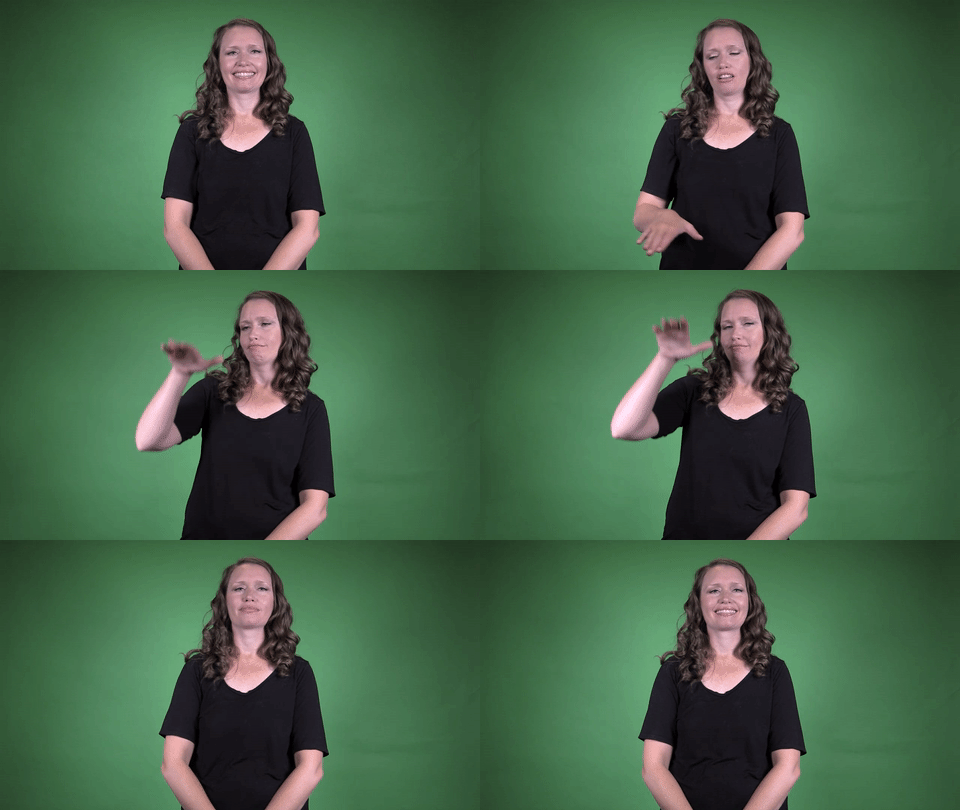
Definition: To be brought up or nurtured.
Sign for BE RAISED in ASL

Practice Activities:
To practice the sign for BE RAISED in ASL, start by using a mirror to observe your facial expressions and hand positioning. Sign the word repeatedly in isolation, either while standing or sitting comfortably. Practice switching between similar directional verbs like “grow up,” “develop,” and “be raised” to develop clarity. Pay special attention to movement and facial grammar to denote the correct subject or context.
Use flashcards with written English prompts like “I was raised in Texas” or “He was raised by his grandparents.” Sign each sentence clearly, focusing on how BE RAISED connects to past experiences. You can also record yourself signing and compare it to model videos, helping to refine your accuracy and fluency. Make up five personal sentences using childhood or life history details to embed the sign into natural narratives.
Storytelling is a powerful way to practice. Create a short story about growing up, such as describing your hometown, people who raised you, or how your upbringing influenced your values. Incorporate the sign for BE RAISED in ASL naturally within your narration. Challenge yourself to tell the same story in the third person, switching perspectives from “I” to “he” or “she” to reinforce directional signing.
Pair with a partner for a “Then and Now” dialogue. One person describes their childhood and how they were raised, while the other asks clarifying questions using WH-signs. Try to include the sign for BE RAISED in ASL multiple times in your conversation to strengthen fluency.
For a creative challenge, watch a silent movie scene involving a child and narrate the upbringing as if you are the character. This builds expressive storytelling muscles and situational use of the sign. Whether using personal stories or role-play, always aim for clarity in your sentence structure and natural use of the sign for BE RAISED in ASL.
Cultural Context:
The sign for be raised in ASL often carries deep cultural meaning within the Deaf community. It can refer to being brought up in a Deaf family or growing up in a Deaf-centered environment, which resonates strongly with identity and values. This makes the sign for be raised in ASL more than just a literal expression—it’s tied to personal history and community belonging.
When someone uses the sign for be raised in ASL, they’re often sharing more than developmental background. In Deaf culture, being raised in a signing household is considered a privilege. It often implies early access to language, education, and cultural norms that shape self-awareness and connection to the broader Deaf community.
The concept of being raised in ASL isn’t strictly about physical age or upbringing. It expresses emotional and sociocultural roots, especially when referring to how a person was brought up within Deaf culture. When the sign for be raised in ASL is used in conversation, it may highlight a sense of pride or deep connection with Deaf values.
Some individuals who learn ASL later may use the phrase to indicate their journey into the culture. While they may not have been born into a signing environment, the sign for be raised in ASL might take on a symbolic meaning as they become fully immersed in Deaf life. This reflects how ASL allows for nuanced communication even in signs associated with simple ideas like “to be raised.”
The sign for be raised in ASL also often appears in narratives about family history, educational experiences, and social bonding. It’s common in storytelling to describe how one’s environment shaped who they became. For example, someone might say they were raised in a Deaf school setting, using the sign for be raised in ASL to frame pivotal experiences.
Different regions may adapt the sign slightly depending on local dialects, but cultural significance remains constant. This sign links a person to their ongoing identity story. For heritage signers, using the sign for be raised in ASL marks continuity between generations, often passed down from parents or grandparents.
In mainstream culture, the idea of being raised centers on upbringing and background. In Deaf culture, this concept goes deeper, incorporating both language acquisition and the environment that supports Deaf identity. Using the sign for be raised in ASL can carry emotional depth and communal meaning.
Good cultural understanding is key when using this phrase. It’s more than just a translation—it’s a connection to values, traditions, and shared experiences. The sign for be raised in ASL serves as a bridge between
Extended Definition:
The sign for be raised in ASL can express the concept of physically growing up or being brought up in a certain environment. It’s often used in conversations about someone’s upbringing, such as where they were raised or the type of household they grew up in. This sign is also commonly used when talking about childhood experiences and background.
To sign be raised in ASL, one hand usually starts near the waist and moves upward to indicate growth or elevation. The motion represents a rising or lifting through time, often visualizing how someone develops or matures. It’s a useful concept sign that captures life development rather than just a single action.
When discussing origins, the sign for be raised in ASL typically pairs with place signs like “city,” “state,” or “country” to provide context. For example, signing “I be raised in Texas” communicates both your childhood location and a part of your identity. These phrases help build a clear picture of someone’s background.
In family and personal stories, the sign for be raised in ASL brings depth to narratives by showing emotional or environmental growth. You can describe being raised in a Deaf family, a bilingual household, or a rural setting to give richer context to your story. This sign is particularly useful when you want to express more than a physical place—you’re sharing life experience.
People often combine the sign with facial expressions to add emotional layers. For example, a proud smile might show a positive upbringing, while a more serious look can imply challenges faced during childhood. Non-manual signals in ASL play a big role in how be raised is interpreted socially and emotionally.
When learning the sign for be raised in ASL, it’s helpful to see it used in different sentence structures. Watching native signers use it in real life or video conversations will show how the meaning adjusts based on context. This is a dynamic, story-based sign that grows in richness with more usage.
The phrase is also used figuratively in some ASL dialogues. You might encounter it when people reflect on how they were raised to believe certain things or follow particular cultural values. In these examples, the sign doesn’t just refer to physical growth but also to mental and social development.
Understanding the sign for be raised in ASL helps learners communicate more personally and vividly. It’s a key concept to know when telling life stories, sharing personal identity, or connecting through cultural background. Using this sign properly helps create meaningful connections in conversations.
If you’re teaching or learning ASL, including the sign
Synonyms: Lifted, Elevated, Hoisted, Uplifted, Raised
Educational resources: Find related learning materials in our course bank!
Want more? Check out some of our popular learning activities on the homepage!
Need to look up a sign? Use our highly rated dictionary: https://aslinteractive.com/best-asl-dictionary/
Follow us on tiktok: https://www.tiktok.com/@aslinteractive. More social media links at the bottom of this page!
Long-tail Keywords: what is the sign for be raised in ASL, how do you sign be raised in American Sign Language, be raised in ASL translation
Categories:
tags: verbs, actions, sign parameters, commands, language learning
Parameters
*Handshape*:
The handshape for the sign for BE RAISED in ASL typically uses flat-B hands . Both hands are open with fingers together and thumbs tucked in slightly along the side of the palm.
To express the sign for BE RAISED in ASL, start with the dominant hand placed below the non-dominant hand, then move it upward in a lifting motion. This upward motion reflects the meaning of being elevated or brought to a higher level.
*Palm Orientation*:
The palm orientation for the sign for BE RAISED in ASL typically involves both hands starting with palms facing down. As the motion progresses, the dominant hand moves upward with the palm remaining down, mimicking the action of something rising or being elevated.
In another variation, the palm may begin slightly angled and still face downward throughout the lift. This sign for BE RAISED in ASL expresses elevation or growth clearly through that upward motion.
*Location*:
The sign for be raised in ASL takes place in the area in front of the torso, typically between the midsection and upper chest. Both hands usually begin near the lower stomach or waist area and then move upward, mirroring the concept of rising or being elevated.
Most of the movement for the sign for be raised in ASL occurs in neutral space, with the hands clearly visible to the viewer. The location stays centralized, making it easily manageable for smooth execution and clarity.
*Movement*:
To show the sign for be raised in ASL, begin with your dominant hand in a flat-B handshape, palm facing down at waist level. Move the hand upward in a steady motion until it reaches chest level. This upward movement symbolizes elevation or being brought up.
The sign for be raised in ASL uses a smooth, controlled lift, often accompanied by a neutral or slightly affirming facial expression to emphasize the idea of rising or increase. Make sure the hand stays horizontal throughout.
*Non-Manual Signals*:
For the sign for BE RAISED in ASL, the non-manual signals include a slight head tilt upward to indicate elevation or growth. Raised eyebrows are typically used to suggest a developmental or progressive state, especially when referring to being brought up or nurtured.
Facial expression is often neutral to slightly positive, depending on the context. When describing someone’s upbringing or an increase in position or rank, a nod or subtle widening of the eyes may accompany the sign for BE RAISED in ASL to add clarity and emphasis.
*Prosody, Dominant/Non-Dominant Hand*:
The sign for be raised in ASL uses the dominant hand in a flat-B palm shape, starting palm down below chest level. The dominant hand moves upward in a smooth, lifted motion toward the chest or head area, indicating elevation or upbringing. The non-dominant hand typically remains at rest or supports the initial position depending on context.
This motion visually represents the concept of rising or elevating. When using the sign for be raised in ASL, facial expression and body position enhance the meaning, especially in storytelling or discussions about growth and development.
Tips for Beginners:
When learning the sign for BE RAISED in ASL, it’s important to understand the context in which it’s used. This phrase can mean to be brought up in a particular environment or to literally move upward. Focus on learning how the meaning changes depending on the sentence because ASL relies heavily on context and facial expressions for clarity.
A common way to sign this concept is by combining signs based on meaning. For example, to express being raised in a place, you might use the sign for “GROW UP” or “RAISE” with appropriate non-manual signals. Keep facial expressions calm and neutral unless the sentence requires strong emotional expression. Watch native signers to see how they modify the sign for BE RAISED in ASL in different settings.
Practice consistency in your handshape and movement. Signs that go upward may use flat hands or cupped hands rising toward the chest or above the head, depending on the phrase. Beginners often mix up signs like “RAISE,” “LIFT,” and “GROW,” so be sure to double-check any sign you’re learning using a trusted ASL dictionary or video resource.
Spatial awareness helps a lot. Signing too low or too fast can make the meaning unclear. When signing across the body or upward, make sure the motion is deliberate and smooth. For example, if signing a child being raised by parents, show the child’s metaphorical growth clearly using a rising motion near your torso.
Record yourself signing or sign in front of a mirror to catch mistakes in movement or expression. Repeat the sign for BE RAISED in ASL slowly at first and then speed up to conversational pace. Practicing in real dialogues or role-play scenarios will give you a better sense of how to use the sign naturally. Practice often, and don’t be afraid to ask for feedback.
sign for BE RAISED in ASL, asl sign for BE RAISED, BE RAISED in American Sign Language, how to sign BE RAISED in ASL, BE RAISED asl meaning
Connections to Other topics:
The sign for BE RAISED in ASL connects closely to concepts like development, upbringing, and personal history. It often appears in narratives and storytelling when someone describes where or how they grew up. This sign is contextually related to “grow up,” which often uses a similar upward movement near the body.
This expression is commonly combined with signs like CHILD, HOME, or AREA to form compound ideas such as “raised in a home” or “raised in this area.” When someone says they were raised in a certain cultural or linguistic background, the sign for BE RAISED in ASL appears along with signs for language, family, or school. These combinations help deepen personal connections and convey one’s background in a rich, visual way.
In educational environments, this concept overlaps with signs for LEARN, EDUCATE, and EXPERIENCE. A child who was raised in a Deaf household, for example, may use the sign for BE RAISED in ASL in conjunction with DEAF and SIGN to express a bilingual upbringing. This builds narrative fluency and gives stronger context to life experiences.
The upward direction of the sign metaphorically represents growth, paralleling other signs like GROW and BECOME. In storytelling, this visual metaphor strengthens how stages of life are described and adds natural flow. It also supports physical storytelling techniques where spatial placement and hand orientation matter.
The sign also intersects with discussions around identity and community. When talking about cultural values or traditions someone was raised with, the sign for BE RAISED in ASL often precedes references to specific practices or beliefs. This reinforces the importance of formative experiences and the way ASL expresses deeper meaning through movement and space.
Using this sign alongside family structure signs like MOTHER, FATHER, or SIBLING helps create detailed contexts tied to upbringing, making it an essential part of comprehensive self-description in ASL.
Summary:
The sign for BE RAISED in ASL commonly refers to being brought up or brought into maturity—often in the context of childhood development, culture, or environment. This sign generally uses flat hands moving upward to suggest the act of being nurtured or elevated over time. It is frequently associated with family background or upbringing when used in storytelling or personal narratives.
In terms of visual structure, the sign often involves placing a dominant B-handshape at waist level and raising it gradually to the chest, palm down, to symbolize growth or elevation. The movement upwards parallels the idea of a child growing up or a value being instilled. This movement may be repeated slightly depending on the emphasis or context.
Grammatically, the sign for BE RAISED in ASL can function as part of a compound or a complete sentence. It is typically used in past tense narratives, often in statements involving WHERE or HOW someone was raised. For example, “I BE RAISED CITY WHICH?” can be used to set up a statement about one’s hometown or childhood.
Its use is prominent in ASL storytelling where background or bios are shared as part of identity. Deaf culture places high emphasis on shared experiences, so discussing how one was raised—especially in relation to sign language exposure or Deaf schools—is culturally significant. This sign can carry strong emotional weight depending on the experience being conveyed.
In some dialects within the Deaf community, minor variations of the sign for BE RAISED in ASL might include slight changes in the location or the incorporation of facial grammar to reflect the environment (urban, rural, oppressive, nurturing). These modifications highlight the richness and flexibility of ASL’s visual modality, which often encodes deeper meaning through facial expression.
The sign is not only utilized in individual identity declarations but can also appear in formal discourse about generational change, parenting, or the development of communities. In such contexts, the sign becomes metaphorical, signifying progress or cultural upbringing rather than literal child-rearing. This is where applied linguistics meets cultural semiotics.
From a linguistic standpoint, the sign for BE RAISED in ASL reflects principles of iconicity and temporal indexing. It uses spatial movement to represent the concept of elevation through time, bearing a high degree of semantic transparency. This visual-motor design makes it easier for signers to communicate abstract concepts linked to time and personal development.
Applied linguistics research in ASL reveals how this sign fits within broader verbal aspect systems. The smooth, linear movement upwards can be modified to suggest continuous, habitual, or even interrupted actions. A sharp upward flip might imply a sudden or unexpected upbringing, while a slow, fluid rise might suggest a nurturing environment.
The connection with other signs such as GROW-UP, CHILDHOOD, or PARENTS further builds conceptual networks that make the sign for BE RAISED in ASL more interpretable in context. In many cases, PARENTS and BE RAISED are used in sequence to express ideas like “My parents raised me…” enriching the syntactic and semantic expression in ASL.
Interestingly, signers often localize the movement of the sign relative to body space to reflect the location of the upbringing. Rural settings might be modified by adding classifiers or environmental context, such as trees or animals, while urban settings might include classifiers for buildings or crowds. These contextual cues enhance narrative vividness.
In teaching environments, particularly within Deaf education, the sign is introduced early to help learners contextualize personal experiences. It enables students to describe their background and relational ties, fostering identity formation and cultural pride. Its importance in educational curricula also reinforces the sociolinguistic value of childhood in the Deaf experience.
Some signers also use nonmanual markers such as raised eyebrows or head tilts during the sign for BE RAISED in ASL to add nuance. These features can indicate uncertainty, pride, disbelief, or fondness, depending on the emotion tied to the upbringing described. This demonstrates the layering of ASL communication beyond just hand movement.
The sign interacts intriguingly with fingerspelled concepts like (FS)R-A-I-S-E-D, which might be used when referring to the word in a different context—such as fundraising or salary increases. The context of the conversation determines whether the standard sign or a fingerspelled loan is appropriate, and this outlines how the sign situates within the larger lexicon.
In digital ASL, such as in vlogs or virtual Deaf storytelling, the sign for BE RAISED in ASL remains prevalent. It offers narrative consistency that bridges personal history with cultural analysis. Many vloggers in the Deaf community use it to frame identity-focused storytelling, especially when addressing issues of language deprivation or bilingual upbringing.
Culturally, being raised in a signing family versus a non-signing family affects language immersion. The sign is often a linguistic marker that distinguishes Deaf-of-Deaf signers from Deaf-of-hearing signers. Thus, it does more than reference childhood—it signifies
Want more? Check out some of our popular learning activities!
ASL Interactive Resources
ASLInteractive YouTube Channel
Follow us on tiktok: @aslinteractive.com
Follow us on Instagram: aslinteractive
Facebook page: aslinteractive
Facebook group: aslinteractive
LInkedIn: ASL Interactive LLC
Twitter: @ASL_interactive
*Some information on this page is AI-generated. AI can make mistakes. Please check the information.


Responses