Sign for BED in ASL | 🛏️ ASL Dictionary

Definition: A piece of furniture for sleeping.

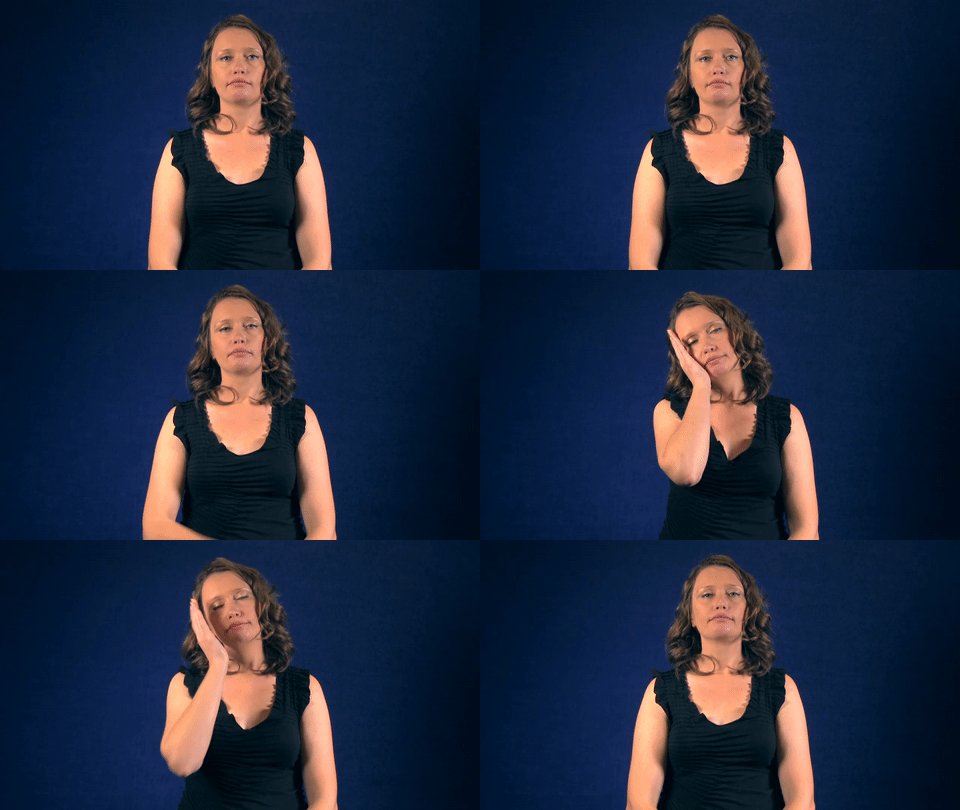
Sign for BED in ASL

YouTube player

Practice Activities:

To practice the sign for BED in ASL, start by using a mirror to focus on correct hand placement and facial expressions. Slowly sign the word in isolation, paying close attention to the motion of pressing your hand near the side of your head as if resting it on a pillow. Repeat this several times until the movement feels natural and fluid.

Move on to incorporating the sign into full sentences. Try signing sentences like “I go to bed at 10”, “The bed is soft”, or “Where is your bed?” Creating five to ten short, personal sentences will deepen your ability to use the sign in various contexts. Practice signing these in front of a mirror or record a video to check your clarity and fluency.

Use flashcards to reinforce vocabulary. On one side, write the English word BED, and on the other, draw a picture or describe the motion for the sign. Mix it with flashcards of other home-related signs to improve recognition and recall through quick drills.

You can also try storytelling. Describe a bedtime routine using signs such as brush teeth, pajamas, read, and the sign for BED in ASL. Keep the story simple and consistent. Use this routine to practice daily so the sign becomes firmly associated with the concept and actions surrounding bedtime.

Practice with a partner by acting out scenes. One partner can mime feeling tired, and the other can respond with suggestions involving the sign for BED in ASL. For example, “You look tired, go to bed” or “Your bed is ready.” This builds conversational fluency and comfort using the sign in real-life scenarios.

Use emojis ️ in digital practice or games to serve as visual cues. Assign the sign for BED in ASL to the bed emoji and challenge yourself or others to sign as quickly as possible when they appear. This adds a fun element and encourages quick recall.

Cultural Context:

In American Sign Language, understanding the sign for BED in ASL goes beyond simply learning a handshape. It connects deeply with everyday life, routines, and the concept of rest and comfort in Deaf culture. The way this sign is used reflects shared experiences and cultural norms around sleep and private spaces.

The sign for BED in ASL is commonly introduced early to ASL learners because it’s part of basic daily conversations. Whether discussing bedtime, describing a bedroom, or talking about feeling tired, this sign is frequently used. Deaf individuals may use the sign in different ways depending on the context, from casual conversations to storytelling with children.

In Deaf culture, storytelling plays a big role, and references to sleep or bedtime often include the sign for BED in ASL. This sign can set the scene for fairy tales, personal narratives, or jokes. Since body language is such a central part of ASL, the sign has a visual and expressive function that ties closely to ASL’s three-dimensional nature.

Parents in Deaf families regularly use the sign for BED in ASL when engaging with young children during bedtime routines. It’s a comforting, familiar sign, reinforcing daily rituals and emotional bonding. This creates consistency and encourages children’s language development in ASL from an early age.

The sign for BED in ASL is typically made by placing both hands together like a pillow, using body and facial expressions to convey the meaning clearly. This visualization matches the concept of sleeping, making it intuitive both for native signers and second-language learners. It shows how ASL often reflects the physical world in expressive ways.

When communicating about home, rest, or health, the sign for BED in ASL is relevant not just for its literal meaning but also symbolically. In Deaf storytelling, bedtime can represent peace, transition, or even dreams, with the sign used creatively to enhance the narrative. ASL grammar allows this kind of rich layering of meaning through visual language.

This sign is also practical in healthcare or educational settings where communication must be clear about daily routines. Using the sign for BED in ASL helps ensure Deaf individuals or ASL users understand schedules or needs, particularly in schools, hospitals, or group homes where staff and caregivers use ASL as part of daily interaction.

It’s not uncommon to see the sign paired with other signs like SLEEP, TIRED, or WAKE as part of a broader sentence. The sign for BED in ASL functions well within these common sentence structures in conversations about personal needs or preferences. AS

Extended Definition:

The sign for bed in ASL is a common and essential vocabulary word for everyday use, especially when discussing nighttime routines, sleeping habits, or home settings. In American Sign Language, this sign mimics the act of lying one’s head on a pillow. It’s a simple visual representation that makes it easy to remember and use.

To make the sign for bed in ASL, place your hands together, palms touching, and rest the side of your head on them like you’re going to sleep. The motion and position are intuitive, which makes it a great sign for both beginners and advanced learners. Some variations might use just one hand if context makes the meaning clear.

This sign doesn’t involve complex motion, which makes it ideal for toddlers learning ASL, deaf individuals of all ages, or parents communicating with their children using sign language. Because it’s a basic noun, you’ll often use the sign for bed in ASL when forming sentences about sleep, rest, or bedtime. It’s also frequently used in educational settings to introduce the concept of sleep in a visual and interactive way.

You may see this sign used with non-manual markers that express emotions like tiredness , relaxation , or even resistance to bedtime . The expression on the signer’s face adds depth and tone to the conversation. In ASL grammar, facial expressions are just as important as the hand signs, so don’t forget to include them when signing.

Learners can incorporate the sign for bed in ASL into practical conversations like “go to bed,” “stay in bed,” or even “make the bed.” Combining signs in this way helps users expand their vocabulary while grounding them in real-life situations. It’s also a useful sign in medical or caregiving environments where communication about rest or patient care is necessary.

In storytelling, using the sign for bed in ASL can effectively indicate the start of a bedtime story or help illustrate characters who are sleeping or dreaming. It adds depth to visual narratives and is easy for audiences of all ages to understand. Whether you’re practicing story time in a classroom or at home, this sign becomes a helpful storytelling tool.

The clarity of the sign helps deaf and hard-of-hearing children make strong connections between spoken concepts and visual language. It serves as an anchor word in learning routines, and can foster independence as kids begin to recognize when it’s time to prepare for sleep. ASL users often include signs like bed in daily routines to create structure and predictability.

For English-to-ASL

Synonyms: Bed, sleeper, resting place, mattress, cot

Educational resources: Find related learning materials in our course bank!

Want more? Check out some of our popular learning activities on the homepage!

Need to look up a sign? Use our highly rated dictionary: https://aslinteractive.com/best-asl-dictionary/

Follow us on tiktok: https://www.tiktok.com/@aslinteractive. More social media links at the bottom of this page!

Long-tail Keywords: what is the sign for bed in ASL, how do you sign bed in ASL, ASL sign for bed

Categories:

tags: Housing, Describing Residence, Objects in the Classroom, Language Learning, Everyday Activities

Parameters

*Handshape*:

The handshape for the sign for BED in ASL uses a flat hand, with all fingers extended and held together, resembling the shape of a pillow. The palm generally faces inward toward the side of the head.

To perform the sign for BED in ASL, rest the side of your head slightly against your flat hand as if you were lying down to sleep. This relaxed handshape imitates the natural posture of resting your head on a bed.

*Palm Orientation*:

For the sign for BED in ASL, the palm orientation typically faces inward, toward the side of the signer’s head. The dominant hand is open and flat, with the palm gently touching the cheek near the side of the face.

This orientation mimics the motion and positioning of resting your head on a pillow, an iconic gesture that represents sleeping or lying down—key visuals in the sign for BED in ASL ️.

*Location*:

The location for the sign for BED in ASL is the side of your head, near the cheek or temple area. The dominant hand starts with fingers together and palm facing in, as if mimicking the act of resting your head on a pillow during sleep.

For the sign for BED in ASL, this position reflects the natural gesture of lying down. It effectively connects the concept of a bed with the physical sensation of resting one’s head. ️

*Movement*:

To perform the sign for BED in ASL, place your dominant hand flat with fingers together, mimicking the shape of a pillow. Bring the side of your head down to rest on your open hand, as though laying your head on a pillow to go to sleep.

The movement is gentle and minimal—slight contact and a tilt of the head convey the meaning clearly. This visual representation makes the sign for BED in ASL intuitive and easy to remember ️.

*Non-Manual Signals*:

When demonstrating the sign for BED in ASL, maintain a relaxed and calm facial expression to reflect the concept of rest or sleep. A slight head tilt to one side as if laying your head on a pillow reinforces the meaning clearly.

Avoid exaggerated expressions or high energy. The sign for BED in ASL relies heavily on the context and gentle non-manual cues to convey comfort and tranquility .

*Prosody, Dominant/Non-Dominant Hand*:

To produce the sign for bed in ASL, use your dominant hand and place it flat, palm facing down. Position your dominant hand beside the side of your face as if mimicking the act of laying your head on a pillow. The non-dominant hand is not involved. This simple gesture helps convey the concept clearly.

The sign for bed in ASL is typically performed with a gentle head tilt and slight eye closure to visually reinforce the meaning. This prosodic feature adds natural expression and helps learners better capture the intent behind the sign.

Tips for Beginners:

When learning the sign for BED in ASL, one of the most helpful things to focus on is using clear hand placement. The sign mimics resting your head on your clasped hands, so make sure your dominant hand forms a flat “B” or relaxed open hand and comes to rest gently on the side of your head. This visual mimicry of sleep is what makes the sign so intuitive—use it to your advantage when remembering the motion.

Try to avoid making the movement too fast or throwing your hand in the general direction of your head. The intention should be calm and steady. The sign for BED in ASL is meant to express a place of rest ️, so your movement should reflect that calmness. Keep your facial expression neutral or slightly relaxed, which mirrors the concept you’re conveying.

Beginners often forget to use their non-dominant hand for emphasis or clarification. While it’s not necessary to use both hands for this sign, making sure your dominant hand is properly shaped and positioned is key. Stand in front of a mirror to practice, checking that your hand rests flat against the side of your face and your elbow doesn’t flare out too high.

Repetition is your friend—aim to practice the sign for BED in ASL within the context of a sentence, like “I go to bed” or “My bed is soft.” This repetition will help you use the sign naturally in conversations. Watching native signers in videos can help you observe how small hand and facial details change meaning.

Finally, always maintain spatial awareness. The more confident you feel with space, the more natural and accurate your sign for BED in ASL will become over time. Be consistent with your dominant hand and stay mindful of your angles for clear communication.

Connections to Other topics:

The sign for BED in ASL is closely connected to other signs within the category of daily routines and locations in the home. Knowing this sign can help learners recognize and express concepts related to sleeping, resting, or nighttime routines. For instance, it often combines with time-related signs like NIGHT or SLEEP to form phrases such as “go to bed” or “time for bed.”

In compound expressions, the sign for BED in ASL may be used with directional verbs to indicate who is going where, such as “you go to bed” or “I went to bed early.” This interaction encourages a deeper understanding of how spatial referencing and body classifiers work in ASL. It’s also integral in educational contexts, where teachers use it to help children identify household objects and recognize the sequence of daily activities.

The sign is semantically linked with actions and settings, including REST, SLEEP, DREAM, and WAKE-UP. These signs form a conceptual network revolving around the idea of rest and recovery. For example, in storytelling or visual narratives, one can transition from the sign for BED to signs such as DREAM or SNORE to describe what happens once someone is asleep.

The classifier handshape used in the sign for BED in ASL also appears in signs like PILLOW, demonstrating how physical space and body language illustrate contextual meaning. This overlap helps students see how classifiers can express a wide range of nuances. Additionally, the sign is commonly taught with others in the same category, like BATHROOM and KITCHEN, to describe rooms within a house—a foundational set of vocabulary for beginners.

Understanding the sign for BED in ASL provides a gateway into larger themes such as health, personal space, and family life . It also reinforces common sentence structures involving location and action, paving the way for learners to describe bedtime routines and preferences in more detail.

Summary:

The sign for BED in ASL is a simple and expressive representation of the concept of sleeping or resting. To perform the sign, place your dominant hand flat, palm facing in, and bring the side of your head to rest against it, as if you are mimicking laying your head on a pillow. The motion communicates the idea of sleep and is generally universal in its portrayal.

This sign is often accompanied by a gentle head tilt or body lean to the side, reinforcing the meaning through body language. Non-manual signals like soft facial expressions or miming exhaustion can further clarify the context. It is intuitive even for ASL learners due to its iconic nature.

The sign is used frequently in daily conversation, especially when describing routines, schedules, or talking about comfort and rest. Phrases including “go to bed,” “get out of bed,” or “stay in bed” rely on incorporating the sign for BED in ASL along with temporal or action signs. This allows for vivid, fluid communication about common human experiences.

Grammatically, the sign for BED in ASL functions like a noun and can be modified with directional verbs or temporal aspects. For instance, when sharing about returning to bed, one might sign GO-TO followed by the sign for BED. In ASL, verbs and nouns can relate closely, yet the noun often uses a repeated movement when compared to its verb counterpart.

This sign connects to a broader semantic field including signs like SLEEP, DREAM, PILLOW, BLANKET, and REST. These associated signs often appear in clusters when discussing sleep habits or home environments. Each sign shares common visual-spatial properties, enhancing the cohesive feel of sleep-related vocabulary in ASL.

Culturally, the concept of bed ties into strong associations with health, wellbeing, and routine. In the Deaf community, discussing daily routines with signs like BED reinforces shared lifestyle and accessible communication norms. The sign also facilitates storytelling, where characters may wake, sleep, or dream — vivid narratives that rely on this cornerstone sign.

The depiction of the bed as a hand against the head emphasizes the body-space priorities in ASL. Since facial grammar and body language are integral, this sign works as both a noun and part of rich expressions. The use of real-world space to visualize abstract and concrete ideas gives this sign universal subtext.

The sign for BED in ASL demonstrates how ASL often uses pantomimic strategies to mirror real-life elements. Holding the hand beside the head simulates the resting posture, and in many cases, Deaf children pick up the sign naturally through observation. It becomes part of early vocabulary acquisition and bedtime routines.

When used with emotion or narrative force, the sign for BED in ASL can convey different moods. A hastier motion might show exhaustion or urgency, while a lazy or slow movement might portray relaxation. These non-manual cues enrich the concept beyond its static form.

Linguistically, the sign is iconic rather than arbitrary, making it easy to recognize and remember. Iconicity plays a significant role in language learning, particularly in ASL, where many basic nouns like BED are visually matched to their functions. This makes the sign especially critical in early education settings.

Teachers often use the sign for BED in ASL when introducing routine-based vocabulary to children. Visual routines involving SLEEP, WAKE-UP, and BED create meaningful repetitions that aid memory retention. The sign also acts as an anchor point when teaching time-related concepts like night and morning.

From a morphosyntactic perspective, the sign for BED in ASL can be marked for plurality using indexing or indicating space. For instance, to indicate multiple beds in a room, a signer may use location referencing to show different spatial placements. This allows the concept of BED to scale in complexity based on context.

The tactile nature of the sign also lends itself well to tactile signing, used within the DeafBlind community. Physical proximity and consistent movement allow the sign to be clearly understood by touch. The bodily simulation enhances comprehension even when visual access is limited.

The semantic network involving the sign for BED in ASL intersects with broader life concepts such as dreams, comfort, illness, and even intimacy. In ASL storytelling, the bed is often a space where emotional moments occur, such as fear from a nightmare or the safety of rest. These nuanced uses deepen the functional role of the sign.

Additionally, in expressive ASL poetry or performance, the sign for BED may be integrated metaphorically. For example, the bed might symbolize escape, desire, or death depending on narrative context. ASL’s rich classifier and poetic systems allow the sign to transcend its literal meaning.

ASL classifiers can be used to expand on the concept. For example, a Classifier CL:3 might show a person getting into bed, while CL:1 could show someone lying down. These extensions help build visual narratives with the sign for BED as a central reference point.

Related conceptual groups include objects and behaviors tied to night routines — books,

Want more? Check out some of our popular learning activities!

ASL Interactive Resources

ASLInteractive YouTube Channel

Follow us on tiktok: @aslinteractive.com

Follow us on Instagram: aslinteractive

Facebook page: aslinteractive

Facebook group: aslinteractive

LInkedIn: ASL Interactive LLC

Twitter: @ASL_interactive

*Some information on this page is AI-generated. AI can make mistakes. Please check the information.

Sign for BED in ASL
Sign for BED in ASL

Responses