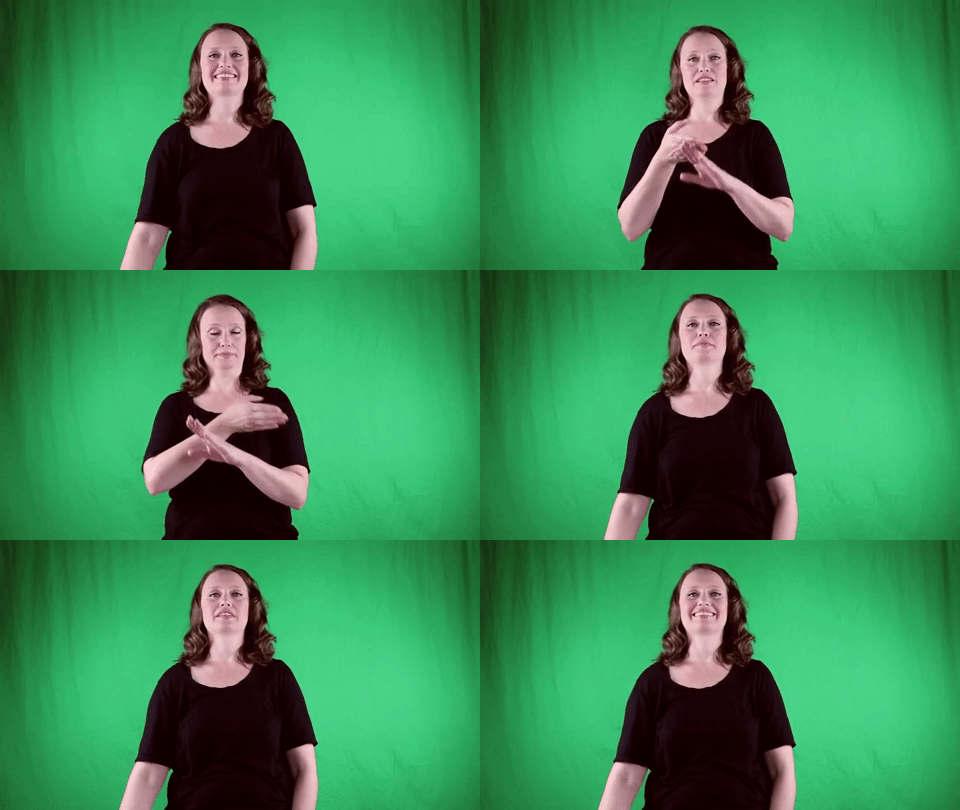
Sign for BEFORE in ASL | 📆 ASL Dictionary

Definition: At an earlier time.

Sign for BEFORE in ASL

YouTube player

Practice Activities:

To practice the sign for BEFORE in ASL, begin by isolating the sign and repeating it several times in front of a mirror. Focus on the handshape, palm orientation, and motion as you watch yourself signing. This helps solidify your muscle memory and offers an opportunity to self-correct.

Next, incorporate the sign for BEFORE in ASL into short phrases or sentences. Practice common sentence structures such as “I eat breakfast before school” or “Before work, I drink coffee.” Sign these slowly and then pick up speed as you gain confidence and fluency. Vary the subject and content in these sentences to expand your vocabulary.

Try visual storytelling using the concept of time. Think of sequences like “Before I went to the park, I found my shoes” or “Before dinner, I did my homework” and sign these mini-stories with expressive facial grammar. This helps tie the time indicator into a broader context, reinforcing its use in describing events.

Working with a partner can be especially helpful. One partner can describe a series of events using the sign for BEFORE in ASL, and the other can guess the order or act out the storyline. This collaborative approach improves comprehension and signing accuracy.

Create flashcards with one half showing an activity, like “brush teeth” and the other half a time marker like “work.” Mix and match to form unique sentence combinations and sign them aloud. This kind of drill promotes flexible thinking and spontaneous use of the sign for BEFORE in ASL.

You can also watch short videos or vlogs in ASL and identify when the sign for BEFORE in ASL is used. Pause and mimic the sign and sentence to match the native signer’s speed and rhythm.

Cultural Context:

In American Sign Language, the sign for BEFORE in ASL carries both a literal and cultural meaning that reflects the language’s visual and spatial foundations. When signing time-related concepts like before, ASL users often use spatial referencing and body orientation to express how one event precedes another.

The sign for BEFORE in ASL isn’t just about time. It’s about framing memories, histories, and stories. Within Deaf culture, storytelling is central, and concepts like past experiences are often shared vividly using visual sharing techniques. This is why the sign for BEFORE in ASL is more than just a gesture—it conveys depth, sequence, and emotional weight.

In ASL grammar, time indicators like before come at the beginning of a sentence to set the timeframe. The sign for BEFORE in ASL uses backward motion to place events visually in the past. This aligns with how ASL unfolds in space and shows how physical expression represents abstract ideas like time.

Time markers like the sign for BEFORE in ASL are deeply rooted in cultural values within the Deaf community. They allow individuals to anchor their stories in context. Whether recalling personal memories or historical events in Deaf history, signing before links people through shared experience.

ASL is its own language with its own rules, and the sign for BEFORE in ASL demonstrates that clearly. Rather than relying on spoken word translations, it shows how ASL creates meaning visually. Each movement and handshape selected reveals the rich storytelling traditions unique to the Deaf experience.

The sign for BEFORE in ASL is often used when retelling life milestones, traditions, or explaining how things were done in the past compared to now. This helps elders in the Deaf community pass down knowledge to younger generations. By teaching signs like before, tradition and historical continuity are preserved.

In Deaf education and social settings, signing clearly and correctly is key to fostering understanding. The sign for BEFORE in ASL serves as a cue to shift to earlier points in conversation or narrative. It becomes a visual bookmark in dialogues, especially where time order matters.

Knowing the sign for BEFORE in ASL also opens the door to understanding ASL storytelling arts. In visual poetry or narratives, time transitions like before enhance pacing and clarity. While hearing audiences rely on vocal tone, Deaf audiences capture the emotional undertones through signs like before used in meaningful ways.

In everyday conversation, the sign for BEFORE in ASL might come up when planning, reminiscing, warning, or comparing. These interactions showcase how ASL users prioritize clear visual structure. Conversations

Extended Definition:

The sign for BEFORE in ASL means something happened earlier in time or took place prior to another event. It’s commonly used when discussing sequences, comparisons, routines, or past situations. This sign is essential when describing actions or experiences that occurred earlier than another moment or action.

To produce the sign for BEFORE in ASL, start with one hand held out in front of you, palm facing in. Then, move your other hand from behind it and swing it slightly forward, as if referencing something that has already gone by. The motion is smooth and usually accompanied by a slight head tilt backward to reinforce the concept of moving back in time.

In American Sign Language, time references often appear at the beginning of a sentence for clarity and context. The sign for BEFORE in ASL can be used to set the timeframe before describing an event. For example, someone might sign BEFORE I EAT, I WASH HANDS to express their habitual routine.

This sign is vital in conversations about past plans, memories, or instructions. When telling a story in ASL, users frequently rely on the sign for BEFORE to establish relationships between events. It helps listeners understand what happened first and what followed after.

The sign for BEFORE in ASL can also be used to compare things. For instance, someone might say THEY ARRIVED BEFORE US to emphasize order or timing. This adds clarity and depth to comparisons and narratives when communicating in sign language.

Vocabulary related to time is foundational in ASL. The concept of BEFORE is closely related to other temporal signs like AFTER, NOW, and FUTURE. Learning and mastering these terms can improve fluency and understanding when engaging in ASL conversations.

The use of facial expressions and body language enhances the sign for BEFORE in ASL. Slight head tilts or raised eyebrows can change the tone or emotion of what’s being communicated. These non-manual signals are just as important as hand shapes and motions when using this sign.

Children and ASL learners often practice sequencing using the sign for BEFORE along with common daily activities. This helps build language structure and comprehension. Educators frequently use simple sentences like WASH HANDS BEFORE EAT to introduce this concept early on.

In storytelling or reports, the sign for BEFORE in ASL functions as a temporal anchor. It sets the scene vertically in time, allowing the communicator to guide the listener clearly through a timeline. This is particularly effective in narratives where order of events matters.

ASL grammar prefers time indicators at the start of a sentence. Using

Synonyms: prior to, earlier than, ahead of, preceding, previous to

Educational resources: Find related learning materials in our course bank!

Want more? Check out some of our popular learning activities on the homepage!

Need to look up a sign? Use our highly rated dictionary: https://aslinteractive.com/best-asl-dictionary/

Follow us on tiktok: https://www.tiktok.com/@aslinteractive. More social media links at the bottom of this page!

Long-tail Keywords: what is the sign for before in ASL, how do you sign before in asl, american sign language sign for before

Categories:

tags: Before, Time, Language Learning, Everyday activities, Sequencing

Parameters

*Handshape*:

The handshape for the sign for BEFORE in ASL typically uses both hands in a flat “B” handshape, with the dominant hand placed just behind the non-dominant hand. The dominant hand then gently moves backward, over and away from the non-dominant hand, indicating the concept of an earlier time ️.

This motion combined with the handshape conveys the concept of the sign for BEFORE in ASL, often used to indicate events in the past. Finger positioning remains relaxed but straight, with palms facing the side.

*Palm Orientation*:

In the sign for BEFORE in ASL, the dominant hand is held in a flat B handshape, palm facing back over the shoulder. The non-dominant hand remains stationary in front of the body, while the dominant hand moves backward over it in a slight arc.

This backward movement is key to conveying the meaning of the sign for BEFORE in ASL. The palm orientation of the dominant hand typically starts in a side-facing or inward-facing position, then turns palm-toward-body as it moves back. ️

*Location*:

The location for the sign for BEFORE in ASL is in the space just in front of the right shoulder. The dominant hand starts near the back of the non-dominant hand, which is held still in front of the body, and then moves backward over the shoulder in a slight arc.

This motion takes place in the area close to the upper chest and shoulder, not far from the torso. The sign for BEFORE in ASL typically stays in the neutral to upper chest zone, emphasizing the concept of a past or preceding event .

*Movement*:

To perform the sign for BEFORE in ASL, start with your non-dominant hand held in front of your body, palm facing to the side. Then bring your dominant hand up behind the non-dominant hand, palm facing your body, and move it slightly backward in an arcing motion over your shoulder.

The movement for the sign for BEFORE in ASL mimics the concept of time passing or something occurring prior to the present. Smooth, backward motion emphasizes the past or a time before now ⏪.

*Non-Manual Signals*:

The non-manual signals for the sign for BEFORE in ASL typically include a slight head tilt backward combined with a subtle lean of the upper body. The eyes may glance behind or upward to visually connect with the idea of a past moment or earlier event.

Facial expressions often show a reflective or thoughtful look, as if recalling something. These non-manual cues help distinguish the temporal concept represented by the sign for BEFORE in ASL ️.

*Prosody, Dominant/Non-Dominant Hand*:

The sign for BEFORE in ASL uses a one-handed backward brushing motion. The dominant hand is placed palm-down near the back of the non-dominant hand, which remains stationary. The dominant hand then brushes back past the stationary non-dominant hand, symbolizing a moment that happened earlier in time.

This movement effectively captures the meaning of the sign for BEFORE in ASL. Ensure that facial expressions match the time-related context, enhancing clarity and natural prosody.

Tips for Beginners:

Learning the sign for BEFORE in ASL can feel simple at first glance, but it requires specific hand placement and fluid movement to convey the correct meaning. Start with both hands open and facing your body—your dominant hand should move slightly backward over your non-dominant hand, simulating a reverse motion in time. This visual of “something happening before” can help you internalize the concept a bit faster.

When practicing the sign for BEFORE in ASL, be sure to keep your movements smooth and controlled. Avoid jerky or overly fast motions, as these can appear unnatural and harder for others to interpret. A calm, deliberate motion allows your conversation partner to clearly understand what you’re saying and keeps the flow of communication strong.

Many beginners forget to match facial expressions to time-related signs. For BEFORE, a slightly reflective facial expression, such as raising your eyebrows or gazing upward slightly, can reinforce the idea of past or earlier events. In ASL, facial expressions play a big role in setting the tone and timeline of what’s being communicated.

One common mistake is reversing the hand movement by accidentally moving the dominant hand forward instead of backward. If you do this, it might look like the sign for AFTER instead, causing confusion. Practice in front of a mirror to ensure your direction is accurate and consistent.

Another great strategy is to use real-life scenarios to apply the sign for BEFORE in ASL. Talk about past events, schedule sequences, or tell short stories involving timelines. Repetitive use will build fluency and confidence. Practice often, even during casual conversations with yourself, to make the motion second nature over time.

sign for BEFORE in ASL, ASL BEFORE sign, American Sign Language sign for BEFORE, how to sign BEFORE in ASL, BEFORE sign language meaning, learn BEFORE in ASL

Connections to Other topics:

The sign for BEFORE in ASL connects closely with the way time concepts are structured in the language. Time-related signs like AFTER, FUTURE, and PAST share similar spatial placements and directional movements, making them easier to group logically when learning. These conceptual groupings help learners understand how time flows visually in ASL, with the body often representing the present moment.

The sign for BEFORE in ASL is also crucial in creating compound signs such as BEFORE SCHOOL or BEFORE WORK. These compounds convey events in sequence and help describe schedules or routines clearly. Such uses show how temporal signs can anchor narratives and give structure to storytelling in ASL.

It also connects to the concept of time indexing, where signers point to various locations in space to refer to different times. This makes the sign for BEFORE in ASL part of a broader spatial grammar unique to sign language. Using space as a timeline, signers can set up events in sequence or contrast them for emphasis.

Grammatically, the sign for BEFORE often plays a role similar to conjunctions in English. It allows for smoother transitions in conversation, helping create more complex sentences that express cause-effect relationships. This kind of sign scaffolding is essential for fluency in ASL.

The movement of the sign for BEFORE also mirrors signs like RECENT or A WHILE AGO, giving learners visual cues associated with time passing. These signs are often taught together to reinforce understanding. They’re helpful when comparing how long ago something happened versus just before another event.

Learning the sign for BEFORE in ASL opens doors to a wide range of useful expressions in everyday dialogue. It enables learners to start sequencing stories, describe changes over time, and participate in more nuanced interactions. Understanding how it’s used in relation to other time signs deepens overall language proficiency .

Summary:

The sign for BEFORE in ASL is rich with temporal meaning and is used frequently in daily conversation. It is often deployed to place an action or event in the past, relative to another point in time. Its motion and facial expressions help convey the subtlety of sequencing or memory.

To produce the sign, the non-dominant hand is held flat, palm-in, stationary in front of the body. The dominant hand, also flat with the palm facing inward, moves backward in an arc away from the non-dominant hand. This backward motion represents something occurring earlier in time.

Facial expressions can greatly influence the sign’s tone. A thoughtful or reflective face may indicate remembering an event, while a casual expression implies chronology without emotional weight. Context and facial grammar work closely together to clarify intent.

Grammatically, the sign for BEFORE in ASL functions as a conjunction or temporal marker. It is commonly used at the beginning or middle of an ASL sentence to establish timing. Just like in English, it’s essential for clarifying sequence in narratives.

The sign is often placed before the main clause to set up a chronological contrast. For example, a signer might use it to indicate that they ate breakfast before they left the house. This allows smoother sentence flow and complexity in ASL storytelling.

In ASL syntax, the topic-comment structure often positions time markers like the sign for BEFORE in ASL near the beginning of a sentence. This helps with comprehension and establishes the framework for understanding the following signs. Temporal sequencing is deeply embedded in ASL grammar.

ASL doesn’t rely solely on sign order. Temporal information like BEFORE can be enhanced or replaced with non-manual markers and verb inflections. This reflects the spatial and visual modality of the language, which utilizes space and motion to encode grammar.

There are related signs and signs with similar movement or meaning. AFTER, PAST, and REMEMBER often appear in sequences that discuss events and their order. Signers need to master the subtle differences and relationships among these concepts for clear communication.

The sign for AFTER also involves motion, but generally moves forward instead of backward. This contrast visually portrays the temporal flow, with BEFORE moving behind the present moment. This intuitive design matches ASL’s emphasis on spatiality and directionality.

Context helps determine if the sign is used to speak about past events or to contrast an upcoming event with something even earlier. The sign for BEFORE in ASL can support both past-tense storytelling and future-tense planning, depending on surrounding elements.

This sign is especially important in re-telling historical or personal narratives. Storytelling in Deaf culture frequently relies on graceful chronological structure. The sign for BEFORE in ASL plays a structural role in those stories, grounding events in proper sequence.

Students who are new to ASL must learn to distinguish this sign not just in movement, but in its semantic application. Understanding when to use BEFORE vs. PAST is crucial, as they vary slightly in function. PAST is often historical, whereas BEFORE is relational and comparative.

Deaf culture places immense value on visual clarity and timing in communication. The sign for BEFORE in ASL aligns with this principle by adding visual timeline framing to shared stories. It enhances narrative flow and supports the group’s collective memory.

Linguistically, the sign for BEFORE in ASL is categorized as a temporal adverb. In applied linguistics research, it serves as a model for studying how signed languages represent time. Its consistent backward motion creates a visual metaphor for earlier moments.

This blending of space and time in ASL is appealing to cognitive scientists and linguists. The brain’s ability to interpret backward hand movement as “prior to” is a unique element of visual languages like ASL. This differs drastically from spoken languages’ tense systems.

Unlike English and many spoken languages that use verb conjugation to indicate time, ASL integrates temporality through signs like BEFORE and spatial modifications. This visual representation is more intuitive for spatial learners and is an area of interest in pedagogical studies.

Children acquiring ASL typically learn the sign for BEFORE in ASL at an early stage due to its utility in conversation. It’s used in common story structures and daily routines, making it an essential sign in early language development for Deaf children.

Teachers of ASL often stress the narrative function of signs like BEFORE. Sequencing is crucial for organizing thoughts and conveying logical order. Therefore, mastering this sign helps learners express increasingly complex ideas as fluency progresses.

In storytelling games and ASL poetry, signs like BEFORE are not only functional but artistic. They can be timed with rhythm, modified in speed, or stylized in movement to match story tone. This adds aesthetic depth to the language and shows ASL’s expressive power.

Furthermore, the sign for BEFORE in ASL plays a cross-linguistic role when Deaf individuals communicate with learners of other sign languages. While signs may vary, the conceptual foundation of representing time visually tends to be similar across many signed languages.

When interpreting spoken English to

Want more? Check out some of our popular learning activities!

ASL Interactive Resources

ASLInteractive YouTube Channel

Follow us on tiktok: @aslinteractive.com

Follow us on Instagram: aslinteractive

Facebook page: aslinteractive

Facebook group: aslinteractive

LInkedIn: ASL Interactive LLC

Twitter: @ASL_interactive

*Some information on this page is AI-generated. AI can make mistakes. Please check the information.

Sign for BEFORE in ASL

Responses