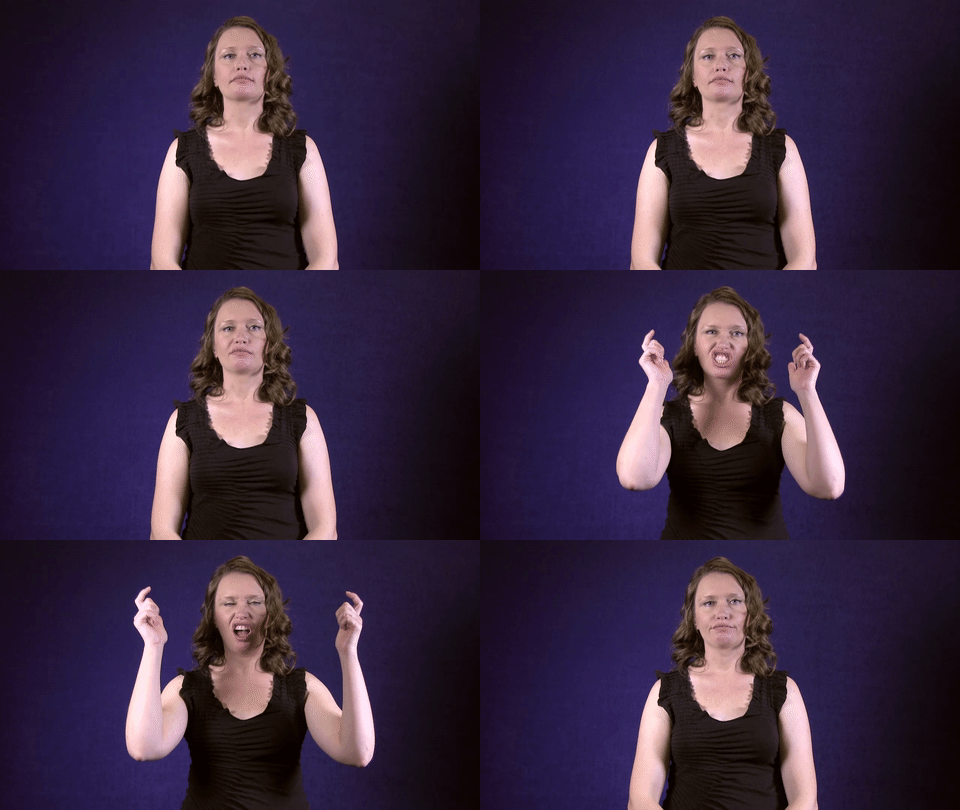
Definition: Arrogant or conceited.
Sign for BIG HEADED in ASL

Practice Activities:
Practice makes perfect when learning the sign for BIG HEADED in ASL. Begin by standing in front of a mirror and practicing the sign in isolation. Repeat it several times, watching your facial expression and hand movement to ensure clarity. This sign involves depicting an exaggerated sense of self-importance, so make sure your facial expression reflects arrogance or bragging.
Next, incorporate the sign into simple phrases to use it in context. Practice sentences such as âHe is big headedâ or âDon’t be big headed,â while maintaining the appropriate facial grammar. This will help reinforce not just the signs, but also the cultural use of the expression in Deaf communication.
Try storytelling exercises where a character is exhibiting big-headed behavior. For example, describe someone who won a race and now thinks they are better than everyone else. In the middle of your story, use the sign for BIG HEADED in ASL to describe their attitude. Try to emphasize exaggerated expressions to clearly convey the meaning of the sign.
Working with a partner, create brief interaction skits where one person plays someone acting arrogant and the other responds. Swap roles to practice using the sign both receptively and expressively. Feedback from your partner on your expression and sign clarity can be very helpful.
Use picture prompts showing proud or boastful characters, and describe the person using the sign for BIG HEADED in ASL. You can also watch ASL storytelling videos or social narratives online that incorporate personality traits and try identifying or copying when the sign appears.
Finally, record yourself signing a short monologue where you describe a fictional âbig headedâ person, then review the video for areas of improvement. Focus on combining the physical sign and the visual attitude to accurately express the concept.
Cultural Context:
In American Sign Language, cultural nuances play a key role in how phrases and expressions are interpreted. The sign for BIG HEADED in ASL reflects more than just a literal description of someone with a large head. It’s often used to describe someone who is arrogant, boastful, or overly confidentâa person who may think too highly of themselves.
Within Deaf culture, the sign for BIG HEADED in ASL is a common way to express this attitude in a visual and meaningful way. Unlike English, where tone and inflection indicate sarcasm or criticism, ASL relies on facial expressions and body language, especially when conveying concepts like ego or pride. The use of this sign is usually expressive and often comes with a knowing look or playful smirk .
ASL is a rich, visual language deeply tied to the identity and experiences of the Deaf community. When someone uses the sign for BIG HEADED in ASL, it clearly communicates more than just words. It captures a judgment or opinion in a way thatâs instantly understood by native signers.
It’s important to remember that this sign should be used appropriately, as it can convey a strong message. The sign for BIG HEADED in ASL may be used jokingly among friends or seriously when someone feels another person is acting superior. Knowing when and how to use this sign correctly shows respect and understanding of Deaf norms and conversational boundaries.
In English-speaking culture, calling someone big-headed can be mean-spirited or humorous depending on the context. In Deaf culture, intent is also essential. When using the sign for BIG HEADED in ASL, facial expression is just as important as the sign itself. Rolling the eyes, raising eyebrows, or showing a smug face can completely change how the message is received .
Deaf humor often makes clever use of signs like this. The sign for BIG HEADED in ASL is commonly seen in playful storytelling, skits, or social commentary shared in Deaf spaces. Itâs culturally understood and even appreciated for its visual wit and clarity.
When teaching learners about ASL and Deaf culture, including signs like the sign for BIG HEADED in ASL helps build not just vocabulary, but cultural knowledge. It demonstrates how ASL reflects real-life interactions, emotions, and social norms that go beyond spoken translations. Understanding this sign supports more fluent and relatable signing in everyday conversations.
The sign for BIG HEADED in ASL is also a great example of conceptual accuracy rather than word-for-word translation. It demonstrates how
Extended Definition:
The sign for BIG HEADED in ASL is a colloquial expression that conveys the idea of someone being arrogant, overly proud, or full of themselves. It’s not meant to describe the physical size of a personâs head, but rather their attitude or ego. When someone is described this way, it typically suggests that they think too highly of their abilities or self-worth.
In American Sign Language, the sign for BIG HEADED captures the metaphorical meaning behind the phrase. It often includes a gesture that mimics a head swelling or puffing up, which visually represents someone having a large ego. This exaggerated visual element in the sign helps underline the figurative meaning and is clear even to newer sign language learners.
This informal sign is widely used in casual conversations across various signing communities. Understanding the context is important, because using the sign for BIG HEADED in ASL could be seen as humorous or mocking, depending on your tone and facial expressions. Facial grammar plays a big role in ASL, and adding a smirk or raised eyebrows can change the tone underneath the sign, emphasizing sarcasm or attitude.
ASL is a rich and expressive language that uses both handshape and facial expression to convey emotion and intention. The sign for BIG HEADED in ASL is a great example of how body language is essential for expressing complex ideas and social commentary. Like idioms in English, this sign doesnât translate word-for-word but carries an implied and familiar meaning.
When learning this sign, it’s a good practice to observe native signers and pay attention to how they use the sign in context. Video dictionaries and ASL conversations are helpful resources for grasping the nuances of usage. While the hand movements are important, watching the face and body movement can help you bring more authenticity to your signing.
The sign for BIG HEADED in ASL is not considered formal or academic, so it is best used among friends or in casual group settings. In more professional or serious environments, signers might choose different phrasing or expressions to convey arrogance or conceit without sounding too flippant. Still, the sign remains widely recognized and understood within the Deaf community.
For those creating ASL content or storytelling, the sign for BIG HEADED offers an expressive way to describe characters with inflated pride or vanity. It adds visual drama and helps build personality in signed narratives. Including it in expressive storytelling can make scenes more engaging and relatable.
New learners interested in slang or idiomatic expressions in ASL often find this sign entertaining
Synonyms: arrogant, conceited, egotistical, self-important, full of oneself
Educational resources: Find related learning materials in our course bank!
Want more? Check out some of our popular learning activities on the homepage!
Need to look up a sign? Use our highly rated dictionary: https://aslinteractive.com/best-asl-dictionary/
Follow us on tiktok: https://www.tiktok.com/@aslinteractive. More social media links at the bottom of this page!
Long-tail Keywords: what is the sign for big headed in asl, how do you sign big headed in asl, asl sign for big headed
Categories:
tags: Describing appearance, compliments, emotions, personality traits, language learning
Parameters
*Handshape*:
The handshape for the sign for BIG HEADED in ASL involves using both hands in a bent “L” handshape, where the thumb and index finger are bent at a right angle. Both hands start near the sides of the forehead and then move outward in a puffing motion to mimic the head growing larger. This conveys an inflated ego or someone being conceited .
In the sign for BIG HEADED in ASL, the bent “L” handshape effectively symbolizes exaggeration or arrogance. The outward movement from the head area helps emphasize the concept of someone thinking very highly of themselves.
*Palm Orientation*:
The palm orientation for the sign for BIG HEADED in ASL typically has both hands in flat “C” handshapes with palms facing toward each other. The hands start at the sides of the head and move outward, exaggerating the expansion of the head to indicate someone being big-headed or conceited .
In the sign for BIG HEADED in ASL, the palms remain mostly facing each other throughout the movement, emphasizing the size or ego being implied. The gesture mimics the visual of an inflated head growing larger.
*Location*:
The sign for BIG HEADED in ASL is produced near the side of the head, typically around the temple or forehead area. This location emphasizes the concept of someone having an inflated ego or being overly proud, referencing the “head” both literally and symbolically.
Using the area near the head helps visually reinforce the meaning behind the sign for BIG HEADED in ASL. Facial expressions, such as a smug or exaggerated look, add to the overall impact of the sign.
*Movement*:
The sign for BIG HEADED in ASL uses both index fingers pointing toward the sides of the head, near the temples. The fingers then move outward and slightly forward in an arcing motion, as if defining a large, swollen head.
This exaggerated outward movement mimics the concept of someone being egotistical or full of themselves. The sign for BIG HEADED in ASL conveys attitude through facial expression, often accompanied by a smirk or raised eyebrow to enhance meaning.
*Non-Manual Signals*:
For the sign for BIG HEADED in ASL, use exaggerated non-manual signals to convey arrogance or self-importance. Puff your cheeks slightly and raise your eyebrows while maintaining a smug or confident facial expression . A slight head tilt or subtle eye roll can help reinforce the idea that someone is conceited or full of themselves. The non-manual signals are key to emphasizing the figurative meaning behind the sign for BIG HEADED in ASL.
*Prosody, Dominant/Non-Dominant Hand*:
The sign for BIG HEADED in ASL uses both hands to illustrate an exaggerated sense of self-importance. The dominant and non-dominant hands are placed near the sides of the head in curved “C” handshapes. Then, both hands puff outward simultaneously, as if indicating the head swelling in size .
This expressive motion visually conveys someone being full of themselves. The sign for BIG HEADED in ASL combines facial expressionâoften an arrogant or smug lookâwith this puffing gesture to enhance clarity.
Tips for Beginners:
When learning the sign for BIG HEADED in ASL, itâs helpful to understand the cultural meaning behind the sign. This expression often refers to someone who is arrogant or has an inflated ego. It’s meant to be humorous or slightly critical, so make sure your facial expression matches the tone.
A common way to sign this is to mime an expanding head. Place both hands near your head and then move them outwards to show it getting bigger. Your facial expression should mimic someone who feels overly proud or “full of themselves.” This helps convey the exact meaning and makes the sign clear in context.
Beginners often forget just how important facial expressions are when signing. Without them, even a correctly formed sign can lose its meaning. For the sign for BIG HEADED in ASL, exaggerating facial features like raised eyebrows or a smirk can add the humor and sarcasm the sign often requires.
Practice in front of a mirror to see how your movements and expressions look together. Itâs very common for new signers to focus only on handshape and movement, but that results in robotic or flat communication. Adding personality is key, especially for idiomatic or expressive signs like this one.
Another tip is to make sure your hand movements are smooth and not too fast. Rushing through the sign can make it look like a different concept, so maintain a rhythm and pacing that emphasizes clarity.
Try watching Deaf signers use the sign for BIG HEADED in ASL during conversation. Observing how it naturally fits into dialogue can give you a better feel for tone and timing. With practice, you’ll be able to use the sign with appropriate context and expression, just like a native signer.
big headed sign in ASL, ASL sign for inflated ego, how to sign arrogant in ASL, sign for big ego in ASL, ASL idioms big headed
Connections to Other topics:
The sign for BIG HEADED in ASL is conceptually rich and closely tied to facial expressions and personality traits. It combines elements of size with ego, illustrating a metaphorical meaning that doesnât directly translate to English without interpretation. This sign is an excellent example of how ASL conveys abstract ideas through physical metaphors.
Itâs connected to other descriptive personality or emotional signs, such as PROUD, ARROGANT, or SMART. These signs often share similar movement or locations around the head, and all rely heavily on non-manual markers like facial expressions to clarify meaning. When learning the sign for BIG HEADED in ASL, understanding these relationships deepens comprehension of nuance in character descriptions.
The sign can also be modified or combined in compound phrases, such as BIG HEADED + ACT-SMART, to describe someone who acts like a know-it-all. This flexible use aligns with ASLâs visual-spatial grammar, where signs around the head can convey intelligence or conceit by modifying handshapes and movement. Itâs important to note context in such compounds, as it influences the intensity or connotation of the message.
Another connection lies in ASLâs use of classifier systems. Though the sign for BIG HEADED in ASL is not a classifier per se, learners familiar with classifiers know how to use exaggerated size to describe concepts like ego or pride. This overlap helps reinforce the meaning and makes it easier to remember.
Interacting with cultural signs like SHOW-OFF or FULL-OF-SELF can also support learning, since they share social commentary or personality critique. The sign for BIG HEADED in ASL becomes a bridge to understanding how ASL users express identity, character judgments, or sarcasmâespecially important in storytelling or informal conversation.
Understanding this sign promotes fluency by training learners to see the connection between metaphors and physical representation, a core aspect of ASL structure. It highlights the unique way ASL uses space, expression, and handshape to convey layered meanings.
Summary:
The sign for BIG HEADED in ASL is a culturally rich expression that doesn’t just describe someone’s physical appearance. It implies arrogance, conceit, or an inflated ego, often used in a slightly humorous but pointed way. This concept is deeply embedded in Deaf culture, where visual language captures abstract ideas vividly.
To produce the sign for BIG HEADED in ASL, one usually starts by forming bent hands (also called clawed hands) near the sides of the forehead. Then, the hands push outward and slightly away from the head, mimicking the idea of a head expanding in size. The facial expression plays a crucial role in the meaning, typically incorporating a smirk or over-exaggerated mock pride.
Meaning is nuanced in the sign for BIG HEADED in ASL. It’s used less to describe someone as simply prideful and more to paint a picture of overbearing self-importance. Facial grammar here is essentialâthe exaggeration helps add sarcasm or critique, depending on context.
In Deaf community interactions, signs like BIG HEADED provide not just information but commentary. These signs often carry a cultural tone and unspoken social message. They illustrate how the community values humility and communal respect.
The sign is idiomatic, meaning a direct English translation doesn’t truly capture its richness. It might be tempting to interpret it literally as describing the size of oneâs head, but ASL communicators know it’s metaphorical. It’s commonly used as a descriptor in storytelling or casual conversation when discussing someone known for self-importance.
Structurally, the sign for BIG HEADED in ASL uses classifier-like spatial expansion. The movement symbolizes growthâspecifically, exaggerated growth of someone’s ego. This spatial manipulation is a powerful tool in ASL, making metaphors tangible and engaging.
This sign is closely related to other expressive signs, such as SMART-ALECK, BRAG, or STUCK-UP. These all function in similar social commentary roles. They may be combined or used in succession to paint a fuller picture of a character or behavior in conversation.
The role of non-manual signals like eyebrow raises, lip patterns, or eye rolls cannot be overstated. They provide the emotional tone and are crucial in distinguishing the sign for BIG HEADED in ASL from a literal meaning involving head size. The difference between derision and praise often lies entirely in expression.
The grammar of ASL allows such signs to function as adjectives or descriptors within a comment about a person. For example, one might sign “HE BIG-HEADED” instead of “He is big-headed,” maintaining word economy and clear expression simultaneously. Sign order and emphasis highlight the insult or humor.
Applied linguistics notes the functionality of signs like this in community regulation. People use them to promote humility through humor or social checking. It tells us how socially adaptive ASL is for conveying not just facts, but values and judgments.
In storytelling, this sign becomes a vivid tool. A Deaf narrator describing a character may use the sign for BIG HEADED in ASL early in a narrative arc, foreshadowing that person’s downfall or embarrassing situation. It’s a form of cultural shorthand for hubris.
This sign also plays a part in school or youth environments, where teasing and social cues are part of bonding. It’s used jokingly among friends and peers to keep one another grounded. The tone of the sign determines whether it’s taken as comedic or corrective.
In ASL poetry or informal performances like Deaf comedy, such signs have even greater value. They offer instant relatable imagery. A performer may exaggerate the sign for BIG HEADED with expressive gyrations or puffed cheeks to draw attention and laughter.
Usage extends to classrooms, especially when Deaf instructors highlight behavioral expectations. Describing a student who brags about knowing everything, a teacher might use this sign to redirect without hard discipline. It becomes a light form of behavioral correction.
The sign for BIG HEADED in ASL also has pedagogical value in teaching figurative language. For hearing ASL students, recognizing that this sign is metaphorical helps bridge understanding between cultures. It emphasizes that ASL isn’t merely gestural English, but its own robust syntax and artistry.
In comparative linguistics, such idiomatic signs are fascinating. Other signed languages may have similar metaphoric expressions, but details vary. For instance, British Sign Language may have a completely different approach to describing arrogance, showing how culture and language shape each other.
Synonyms in ASL context might include signs like CONCEITED or THINKSELF-IMPORTANT, which can appear in different regions or age groups. The sign for BIG HEADED in ASL, however, is one of the most visually intuitive and engaging, making it a favorite among both youth and adult signers.
The evolution of this sign may stem from jokes or commentary that gradually gained standardized form. Its place in modern ASL shows how language evolves metaphorically to reflect both linguistic innovation and social behavior.
In Deaf culture, where humility and community success are emphasized, BIG HEADED
Want more? Check out some of our popular learning activities!
ASL Interactive Resources
ASLInteractive YouTube Channel
Follow us on tiktok: @aslinteractive.com
Follow us on Instagram: aslinteractive
Facebook page: aslinteractive
Facebook group: aslinteractive
LInkedIn: ASL Interactive LLC
Twitter: @ASL_interactive
*Some information on this page is AI-generated. AI can make mistakes. Please check the information.


Responses