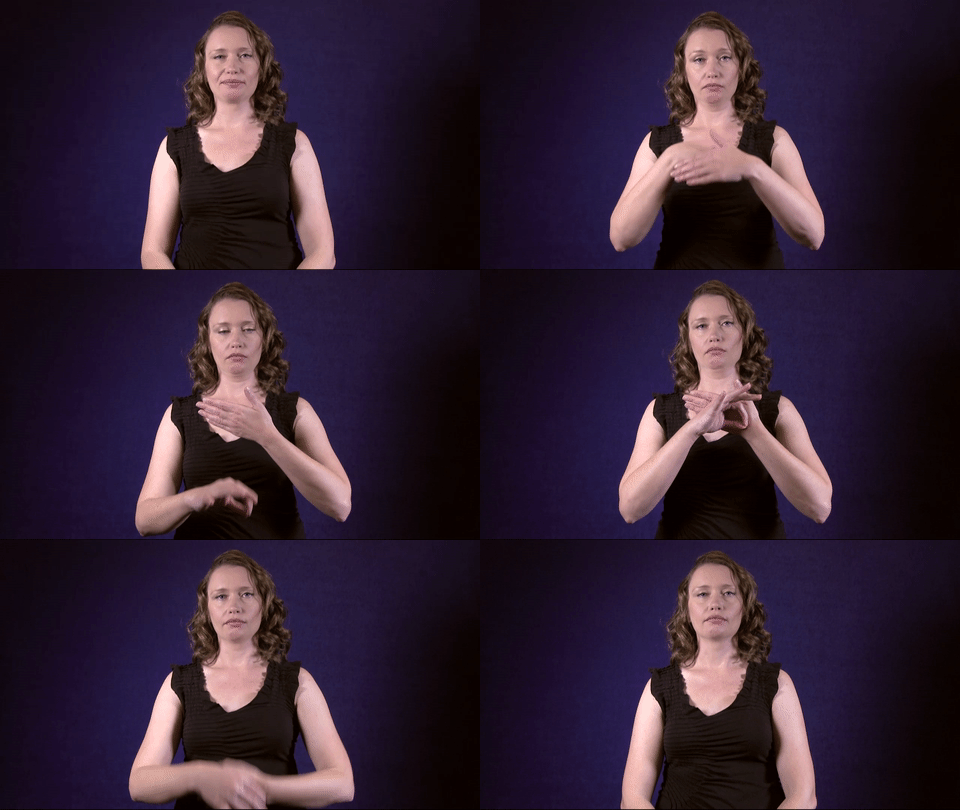
Definition: A distinctive mark on the skin present from birth.
Sign for BIRTHMARK in ASL

Practice Activities:
Start by practicing the sign for BIRTHMARK in ASL in front of a mirror. Focus on your handshape, location, and facial expression. Repetition is key, so sign it slowly five times, then increase your speed while still maintaining clarity.
Next, use the sign for BIRTHMARK in ASL in short phrases. Try describing yourself or others with sentences like “I have a birthmark on my leg” or “She has a birthmark on her face.” Sign these phrases while imagining pointing to the specific part of the body to help you internalize the concept.
Use storytelling to make the sign more memorable. Create a short story about a person born with a special birthmark that makes them unique. As you sign, act out the story with clear transitions and movements, using body shifting and eye gaze for different characters.
Practice with a partner by taking turns asking and answering questions using the sign for BIRTHMARK in ASL. For example, ask “Do you have a birthmark?” or “Where is your birthmark?” Your partner can respond with a location and size, encouraging a natural and expressive conversation.
For visual recognition, watch videos of fluent signers using the sign in context. Pause after each use of the sign and try producing it yourself. Mimic their facial expressions and pacing to better match natural signing flow.
Draw or point to pictures of people and describe where their birthmarks are using the correct sign. This helps link language to visual features, reinforcing the location aspect of the sign for BIRTHMARK in ASL.
Lastly, record yourself signing the word in isolation and within a sentence. Review the video to self-assess and look for areas to improve, paying attention to accuracy and expression.
Cultural Context:
In American Sign Language, the sign for birthmark in ASL might not be widely standardized, as signs can vary depending on context, region, and community. For Deaf individuals, expressing unique body features like a birthmark is often done through descriptive signs, classifiers, and pointing. Because ASL is a visual language, the shape, size, and location of a birthmark can be shown directly on the body while signing.
The sign for birthmark in ASL may be a combination of signs like “birth” and “mark” or a visual classifier to indicate the spot on the skin. This makes it essential to understand the cultural relevance of how Deaf people describe their bodies and personal characteristics. Unlike spoken language, ASL allows for spatial and visual details to play a central role in communication.
In Deaf culture, describing physical traits including a birthmark is done respectfully and often with precision. When used in casual conversation, the sign for birthmark in ASL is typically accompanied by pointing to the exact area on the body where the mark appears. This interaction reflects the directness and visual clarity that is intrinsic to ASL communication.
Descriptive signs like the sign for birthmark in ASL help people connect, share personal experiences, and identify distinguishing features. For example, when introducing someone, it’s common to mention notable characteristics, such as a birthmark, hairstyle, or type of clothing. This cultural practice highlights how physical identifiers support accessibility and connection in Deaf communities.
Regional variation also plays a role in how signs like the sign for birthmark in ASL are expressed. While one community might use combined classifiers, another might have a locally recognized sign for the term. Because ASL evolves over time—and across locations—it’s important to stay open to shifting and diverse sign usage.
The visual and spatial nature of ASL gives users the flexibility to modify a sign like birthmark depending on context. For instance, a sign may be adapted to indicate a small circular mark on the arm versus a large patch on the back. These nuanced expressions reflect just how dynamic the sign for birthmark in ASL can be.
Within Deaf spaces, greater emphasis is placed on visual learning and storytelling, which is where signs like birthmark come alive. Describing a childhood story, someone might show where a birthmark was located to make the memory more vivid. The sign supports storytelling and enriches connection in community settings.
When learning the sign for birthmark in ASL, it’s helpful to watch how native signers use
Extended Definition:
The sign for birthmark in ASL is a visual representation used in American Sign Language to describe a naturally occurring skin mark present from birth. This sign is typically expressed by combining the sign for “birth” and “mark,” creating a compound sign that conveys the same meaning in a natural, fluid motion familiar to fluent ASL users.
To perform the sign for birthmark in ASL, signers often use an open hand to indicate a general location on the body, followed by a gesture similar to “mark” or “spot.” The exact movement may vary slightly depending on the location of the birthmark being described. Some people may personalize the sign by pointing to the specific area on the body and then making the sign for “mark” to clarify the reference.
As with many ASL signs, context is an important part of communication. When discussing a birthmark, context such as color, size, and location can be added through facial expressions and spatial referencing. Descriptions using additional signs like “big,” “small,” or “light” and “dark” can be integrated to describe the birthmark more accurately .
The sign for birthmark in ASL is useful in many everyday conversations, including doctor appointments, classroom discussions, or describing someone’s features. It’s especially important in settings that require precise medical or personal descriptions, such as during health assessments or storytelling. For ASL users, having a clear and consistent way to express what a birthmark is helps maintain clarity in both formal and casual communication.
Parents and educators working with deaf or hard-of-hearing children may use this sign to help kids become comfortable discussing their unique physical traits. Birthmarks are common, and having the vocabulary to talk about them in ASL can support body positivity and self-awareness. It also helps bridge communication gaps and supports confidence while navigating real-world conversations.
Online ASL video resources and sign language dictionaries often include visual demonstrations of the sign for birthmark in ASL. These visual resources help learners grasp subtle handshapes, movement, and facial expressions that might otherwise be confusing when written out. Watching fluent signers model this expression can greatly improve understanding .
Because American Sign Language is dynamic and constantly evolving, the sign for a term like birthmark may have slight variations depending on region, age group, or personal signing style. While one standard method exists, it’s common for native signers to adapt signs naturally in response to conversational needs. Learning these variations through community interaction can enrich your ASL fluency.
Synonyms: blemish, mole, skin spot, beauty mark, nevus
Educational resources: Find related learning materials in our course bank!
Want more? Check out some of our popular learning activities on the homepage!
Need to look up a sign? Use our highly rated dictionary: https://aslinteractive.com/best-asl-dictionary/
Follow us on tiktok: https://www.tiktok.com/@aslinteractive. More social media links at the bottom of this page!
Long-tail Keywords: What is the ASL sign for birthmark, How do you sign birthmark in American Sign Language, ASL sign for birthmark
Categories:
tags: Appearance, Describing Features, Body Markings, Language Learning, Health
Parameters
*Handshape*:
The handshape for the sign for BIRTHMARK in ASL typically uses a flat open hand or index finger, depending on the location and representation of the birthmark. The hand may touch or lightly brush against an area of the skin to indicate a mark that has been present from birth.
In the sign for BIRTHMARK in ASL, the fingers remain relaxed while forming a natural handshape, allowing for subtle movement on the skin’s surface. This sign often relies on facial expression to help clarify whether it’s a unique discoloration, shape, or texture. ️
*Palm Orientation*:
The palm orientation for the sign for BIRTHMARK in ASL typically begins with the dominant hand in an open “5” shape, palm facing the location on the body where the birthmark is being indicated—commonly the arm, face, or chest area. The palm may gently tap or circle the area to show the mark’s presence.
In some variations of the sign for BIRTHMARK in ASL, the palm may face inward toward the signer, particularly if the signer is indicating a personal mark. Hand movement is deliberate and specific to suggest visibility or uniqueness.
*Location*:
The sign for BIRTHMARK in ASL typically takes place on the location of the actual birthmark on the body. The signer points or touches the area of the birthmark and may combine this with the sign for BIRTH followed by a gesture indicating a spot or mark.
This sign uses a spatial reference to indicate the specific location of the birthmark, often incorporating fingerspelling for clarity. When explaining the sign for BIRTHMARK in ASL, it’s common to see it demonstrated on the cheek, arm, hand, or another visible place.
*Movement*:
To show the sign for birthmark in ASL, start by using your dominant hand in a flat “B” handshape and place it gently on your chest, cheek, or wherever the birthmark is located. Tap the spot once or twice to indicate a specific location on the body. Some variations may add a small circular rubbing motion to suggest the mark. The movement is minimal and context-driven for the sign for birthmark in ASL.
*Non-Manual Signals*:
When using the sign for BIRTHMARK in ASL, the facial expression should remain neutral or slightly inquisitive, depending on context. A relaxed gaze or soft, curious eyebrow movement helps convey that the sign refers to a natural and benign feature.
Because the sign for BIRTHMARK in ASL might differ depending on location or individual variation, maintain appropriate eye contact while signing to ensure clarity. Your mouth may remain still or form a subtle “mark” shape to further support meaning.
*Prosody, Dominant/Non-Dominant Hand*:
The dominant hand uses the index finger to point to a specific area of the body where the birthmark is located, often the face, arm, or neck. The movement is typically small and precise, as if to mark a spot. The non-dominant hand is usually inactive.
To clarify the sign for birthmark in ASL, fingerspell B-I-R-T-H-M-A-R-K either before or after pointing to the location. Prosodic emphasis is placed on the clarity of location and the fingerspelling. Use facial expressions to show that it’s a natural feature of the skin.
Tips for Beginners:
When learning the sign for BIRTHMARK in ASL, it’s important to remember that this sign often varies based on regional usage and personal preferences. Since there isn’t a standardized sign used universally for this concept, many signers choose to describe the area of the birthmark combined with descriptive adjectives, or use fingerspelling for clarity. It’s helpful for beginners to first learn how to fingerspell the word B-I-R-T-H-M-A-R-K clearly and fluidly.
One common way to show the sign for BIRTHMARK in ASL is by pointing to the location on the body paired with the sign for SPOT or STAIN. Be sure to match facial expressions and body language to reflect whether it’s a natural mark or a noticeable discoloration. Practicing with a mirror is a great way to ensure your non-manual signals (NMS) are matching the meaning you want to express.
Avoid overly complex signs or making assumptions about a standard version of the sign for BIRTHMARK in ASL. Instead, focus on being clear, whether through modifying existing signs or using fingerspelling. Remember that context helps — if you explain it’s a unique skin mark or use the sign within a full sentence, your meaning will likely come across naturally to fluent signers.
A good tip is to ask Deaf community members how they personally express this concept or observe how it comes up in conversation. This exposure can build your confidence and ensure your signing aligns with what is actually used in natural signing environments. Don’t be afraid to clarify with, “How do *you* sign BIRTHMARK?”
Lastly, be patient with yourself. The sign for BIRTHMARK in ASL may not have a universally accepted version, so flexibility and clarity are key. Keep practicing fingerspelling and creative modifications to express this idea naturally
Connections to Other topics:
The sign for BIRTHMARK in ASL connects closely with vocabulary related to skin, body features, and medical conditions. Since a birthmark is a distinguishing trait present from birth, the sign often references the body location and adds contextual emphasis. This sign is functionally related to signs for SCAR, BRUISE, and RASH, which all involve markings or changes on the skin and can help clarify differences in medical or descriptive conversations.
In compound or descriptive use, the sign for BIRTHMARK in ASL may be combined with body location indicators to increase clarity. For example, a signer may use a sign for ARM or FACE followed by BIRTHMARK to convey where the mark is. This practice aligns with common ASL structure, placing location first, then the descriptive feature, which mimics the natural use of space in the language.
The sign for BIRTHMARK in ASL can also lead to useful discussions about how medical or inherited traits are communicated in ASL. It provides a gateway to related terms like GENETIC or HEREDITARY, which are useful in both casual and healthcare contexts. When discussing visible medical differences, ASL users might compare BIRTHMARK to MOLE or DISCOLORATION, which share visual or descriptive semantics.
Facial expressions and classifiers enhance the sign’s use. For instance, if a birthmark has a particular size or shape, classifiers can be used to show those characteristics. The classifier approach also brings up connections to signs such as SPOT and STAIN, which may be metaphorically similar when visualizing features on the body.
Culturally, the sign for BIRTHMARK in ASL supports discussions around identity and physical uniqueness, making it relevant in areas like storytelling, family trees, and self-introductions. In educational and medical interpretering, this sign ensures accurate communication about congenital features. Understanding the nuances of this sign strengthens overall fluency and comprehension when discussing health, the body, and personal characteristics.
Summary:
The sign for BIRTHMARK in ASL is not standardized across all users, as regional and personal variations frequently appear depending on the context and the person using it. Often, Deaf individuals may point to a specific area on the body, such as an arm or face, and combine classifiers to indicate the shape, location, or prominence of the mark. In more direct communication, users may fingerspell the word B-I-R-T-H-M-A-R-K followed by a description of the type of mark.
Facial expressions and contextual clues are important when expressing the sign for BIRTHMARK in ASL. Since ASL uses space and visual modality to convey meaning, signers might show the precise place on their body where the birthmark exists, using directional gestures or touch. If the birthmark is distinctive, the signer may use size classifiers or textures like rough, light, or large to further illustrate.
Sometimes the sign for BIRTHMARK in ASL incorporates aspects of the sign for BIRTH along with signs for SPOT or MARK, depending on the communication setting. If a person has a very prominent birthmark, the signer might exaggerate its size using both flipped open hands to indicate width or draw its shape in the air. In storytelling or identification, the presence of a birthmark can carry cultural or identity-based relevance.
Birthmarks in the Deaf community can symbolize a personal trait or a unique identifier, especially in visual cultures where physical characteristics are used to tell individuals apart. When someone has a unique birthmark, other Deaf individuals may describe that person using the location and description of the birthmark as a linguistic device. Therefore, the sign for BIRTHMARK in ASL can have both literal meaning and an implicit role in personal narratives.
Describing unidentified medical features or skin markings in ASL often involves using non-manual signals like facial expression to mark whether the description is neutral, curious, or concerned. Since birthmarks are usually harmless, signers generally have a neutral or affectionate expression. This is different from signing symptoms related to diseases, where the signer might add a worried expression or signs like HURT or DOCTOR.
In applied linguistics, using classifiers and spatial referencing when signing birthmarks reflects the strong visual-spatial grammar of ASL. Rather than having one generic sign, the language embraces flexibility, allowing signers to depict the birthmark’s shape and location visually. This differs from English, which primarily uses static vocabulary and syntax.
The sign for BIRTHMARK in ASL emphasizes descriptive classifiers over single-set vocabulary. Classifiers allow the signer to show exact location, and signs like SPOT or AREA can be combined, while using fingers to trace across the area of the skin. Texture indicators like smooth, blotchy (using repetitive tapping motions), or raised (moving fingers up vertically) help characterize the mark with visual precision.
Medical and culturally based contexts can influence how the sign for BIRTHMARK in ASL is articulated. In a clinical or educational setting, a more formal or fingerspelled version may be used to ensure accuracy. In contrast, a casual signing environment permits more fluid classifier incorporation and personalized expression of meaning.
Because birthmarks often have strong visual identifiers, ASL naturally incorporates them into description-heavy sentence structures. For example, one might sign “MY COUSIN, (classifier shows shoulder), HAVE BIRTHMARK, DARK COLOR” to clearly establish identity. This supports ASL’s emphasis on topic-comment syntax and foregrounding relevant visual information.
The versatility of the sign for BIRTHMARK in ASL showcases the adaptability of the language to depict real-world visual features. ASL users regularly modify signs to fit the specifics of the case. A small freckle-size birthmark might be indicated with a light tap of the index finger, while a larger port-wine stain may require a broader gesture using the full palm.
ASL is rich in iconicity, and the sign for BIRTHMARK in ASL demonstrates this through its visual mimicking of the real-world referent. Rather than assign an abstract or arbitrary handshape, the signer can illustrate what the birthmark looks like, underlining the strength of ASL in portraying physical features. This supports learning for both Deaf children and second-language users.
Second language learners might find the flexible nature of the sign for BIRTHMARK in ASL both challenging and instructive, as it introduces them to the use of non-standardized, classifier-rich constructs. Learning how to describe physical features of the body using space, motion, and shape pushes L2 learners to think visually. It reinforces the difference between gestural description and fixed lexical borrowing.
In some narratives, a birthmark becomes a central element in personal or cultural storytelling among the Deaf community. It may feature in origin stories, jokes, folk tales, or horror stories. Therefore, the sign for BIRTHMARK in ASL might carry a blend of linguistic, metaphorical, and visual weight, deepening the storytelling component of the language.
The ambiguity
Want more? Check out some of our popular learning activities!
ASL Interactive Resources
ASLInteractive YouTube Channel
Follow us on tiktok: @aslinteractive.com
Follow us on Instagram: aslinteractive
Facebook page: aslinteractive
Facebook group: aslinteractive
LInkedIn: ASL Interactive LLC
Twitter: @ASL_interactive
*Some information on this page is AI-generated. AI can make mistakes. Please check the information.


Responses