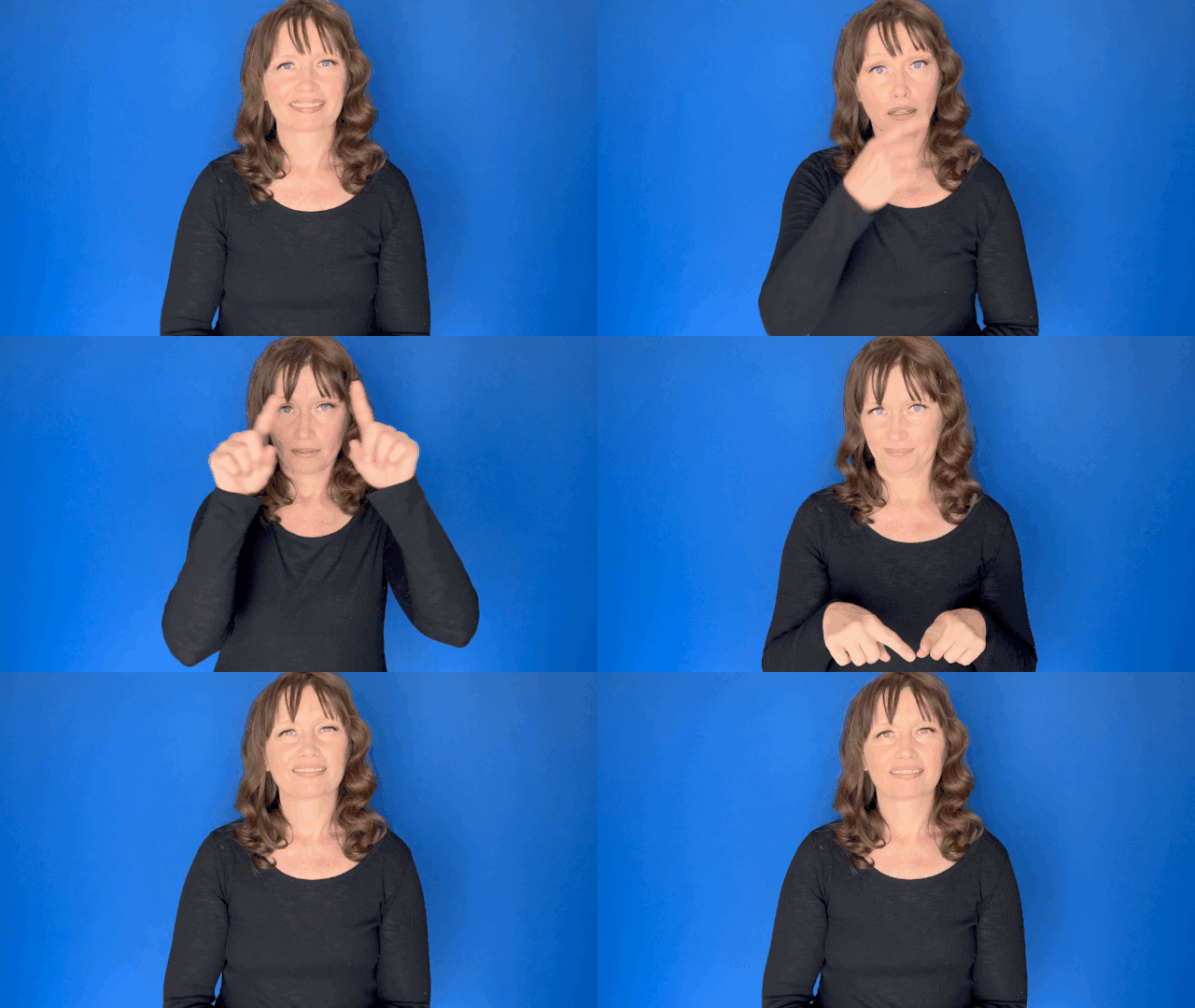
Definition: A surface for writing or drawing with chalk (first instance).
Sign for BLACKBOARD 1 in ASL

Practice Activities:
Begin your practice with the sign for BLACKBOARD 1 in ASL by isolating the sign itself. Stand in front of a mirror and repeat the sign several times while watching your handshape and movement. Make sure the direction and palm orientation are correct, and check consistency across repetitions.
Create flashcards with the sign for BLACKBOARD 1 in ASL on one side and an image of a classroom or actual blackboard on the other. Use these cards to test recognition and production. Try signing without looking at the card after just a few viewings for memory reinforcement.
Next, string the sign into context by practicing simple sentences. For example, sign “teacher write on blackboard” or “students watch blackboard.” Use the sign with common classroom-related vocabulary to build fluency. Record yourself and watch the playback to identify areas that need improvement.
In a storytelling activity, imagine you are describing your classroom to a deaf classmate. Explain where the blackboard is, what is on it, and who uses it. Use the sign for BLACKBOARD 1 in ASL when needed, adding in facial expressions and non-manual markers for realism. Practice this short narrative aloud or with a study partner.
Partner activities can enhance learning by offering feedback. One person can ask questions like “What is on the blackboard?” and the other can respond with a signed answer that includes the sign for BLACKBOARD 1 in ASL. Switch roles to develop expressive and receptive skills equally.
For advanced practice, create a short skit where someone is teaching a lesson using a blackboard. Act out writing on the blackboard and referencing it while maintaining the flow of ASL grammar. This helps reinforce real-world usage and improve fluidity in conversation.
Cultural Context:
The sign for BLACKBOARD 1 in ASL represents more than just a common classroom item. It reflects the historical and cultural significance of education within the Deaf community, especially in earlier times when blackboards were essential learning tools. Understanding the sign for BLACKBOARD 1 in ASL helps us appreciate how Deaf education has evolved with changing visual tools and technologies.
Traditionally, blackboards were central to schoolrooms, serving as a shared space for visual instruction. For Deaf students, the visual layout and use of space on the blackboard were critical to learning and communication. The sign for BLACKBOARD 1 in ASL echoes this essential function, tying language to an object that played a large role in accessible teaching.
The ASL sign for BLACKBOARD 1 is widely recognized within educational contexts. Before whiteboards and digital screens became the norm, blackboards allowed teachers to reach students using bold writing styles that conveyed clear visual information. Knowing the sign for BLACKBOARD 1 in ASL reminds signers of the importance of visibility and clarity in Deaf education.
Within Deaf culture, visual learning is more than a preference—it is a necessity. The blackboard served this need in a powerful way. The sign for BLACKBOARD 1 in ASL connects to memories and shared experiences for many Deaf adults who remember classrooms where blackboards were constantly in use.
The use of blackboards also intersects with larger societal changes, including the push for bilingual-bicultural education and Deaf teachers leading their own classrooms. When using the sign for BLACKBOARD 1 in ASL, signers may also recognize the role that blackboards played in allowing full participation through visual learning methods. This made it easier for students to follow along and participate equally.
Even as teaching methods evolve, learning the sign for BLACKBOARD 1 in ASL helps preserve the legacy of Deaf education. It serves as a symbol of how education has traditionally adapted to meet the visual needs of the community. For signers, this sign represents more than just a physical object; it reflects a core part of Deaf history.
When viewed within its cultural context, the sign for BLACKBOARD 1 in ASL becomes more meaningful. It shows how physical classroom tools have long supported language development and community interaction. The blackboard wasn’t just functional—it was a space for connection, learning, and communication.
The strong cultural ties to schooling make the sign for BLACKBOARD 1 in ASL an important entry in any ASL dictionary. As blackboards slowly disappear from modern classrooms, keeping
Extended Definition:
The sign for BLACKBOARD 1 in ASL is a visual representation used to describe a traditional blackboard commonly found in classrooms before the widespread use of whiteboards and smartboards. This sign captures the concept of a large, dark writing surface used by teachers or presenters to write information with chalk. While the term may feel dated in some educational settings, it’s still useful in conversation, especially when discussing past experiences or historical topics related to education.
To express the sign for BLACKBOARD 1 in ASL, signers typically use gestures that reflect the rectangular shape or mimicking writing on the surface. This version of the sign focuses more on the physical representation rather than on modern, digital equivalents. It’s often used when you want to refer directly to a blackboard, setting it apart from whiteboards or other kinds of writable surfaces.
ASL remains a visual and spatial language, and context plays an important role in interpretation. The sign for BLACKBOARD 1 in ASL might involve using classifiers or specific handshapes that suggest a surface used for writing. It can vary regionally, but this version remains recognizable by many in the Deaf and signing communities.
In terms of usage, the sign appears when telling stories about school days, teaching experiences, or traditional classroom equipment. A signer might use it in a narrative about a lesson on fractions or a spelling bee done using that old familiar blackboard. Learning it is helpful not just to identify objects, but to bring specific time periods and classrooms to life in storytelling.
When creating educational content in ASL, familiarity with terms like the sign for BLACKBOARD 1 in ASL helps maintain authenticity and cultural relevance. Signing this concept accurately ensures clear and effective communication when teaching or describing older school environments. It also enriches vocabulary for interpreters, educators, and students using ASL regularly.
While classrooms may now favor whiteboards or smartboards, the blackboard remains a symbol of traditional education in many cultures. Knowing how to express this specific concept in ASL provides historical clarity and context, especially when comparing past and present teaching tools. It also supports learning environments where both Deaf and hearing individuals can connect through shared school-related memories.
The sign for BLACKBOARD 1 in ASL stands as a piece of educational history captured in visual language. Whether you’re sharing an old teaching method, discussing classroom setups, or translating educational materials from past decades, using this sign creates authenticity. Integrating it in your ASL skills keeps communication vivid and accurate, especially for older generations
Synonyms: chalkboard, writing board, slate, school board, classroom board
Educational resources: Find related learning materials in our course bank!
Want more? Check out some of our popular learning activities on the homepage!
Need to look up a sign? Use our highly rated dictionary: https://aslinteractive.com/best-asl-dictionary/
Follow us on tiktok: https://www.tiktok.com/@aslinteractive. More social media links at the bottom of this page!
Long-tail Keywords: what is the sign for blackboard in ASL, how do you sign blackboard in ASL, ASL sign for blackboard
Categories:
tags: blackboard in American Sign Language, blackboard ASL meaning, how to sign blackboard in ASL, ASL blackboard sign, blackboard sign language translation
Parameters
*Handshape*:
The handshape for the sign for BLACKBOARD 1 in ASL starts with the dominant hand in a flat B-handshape, fingers together and extended, palm facing down. This hand moves across the top portion of the non-dominant hand, which is also in a flat B-handshape, creating a surface-like motion to represent the concept of a board.
For the second part of the sign for BLACKBOARD 1 in ASL, the dominant index finger points toward the palm of the non-dominant flat hand, as if writing or drawing on a chalkboard. These handshapes work together to illustrate both the physical object and its use, combining visual and conceptual elements effectively ✍.
*Palm Orientation*:
For the sign for BLACKBOARD 1 in ASL, the palm orientation is mostly inward toward the signer’s body. When mimicking the shape of a board or surface, both hands may move in a horizontal or vertical motion as if drawing or outlining the edges.
During the depiction of the writing motion, the dominant hand’s palm typically faces down, mimicking the act of writing on a surface ✍️. Overall, palm orientation shifts depending on the segment of the sign being performed but generally maintains clear visual representation of a blackboard.
*Location*:
The sign for BLACKBOARD 1 in ASL is typically produced in the neutral space in front of the torso, slightly below chest level. Both hands move in a horizontal motion, creating the visual of writing or referencing a board.
This location helps clearly convey the concept of a classroom setting, aligning with how a blackboard is used. The neutral space ensures the sign for BLACKBOARD 1 in ASL remains visible and distinct for clear communication. ️
*Movement*:
The sign for BLACKBOARD 1 in ASL begins with the dominant hand in a flat “B” handshape, palm facing in, brushing across the forehead from one side to the other as if mimicking the motion of chalk on a blackboard. Then transition to using both flat hands, palms facing the body, moving outward in a horizontal motion across the chest area.
These movements represent writing on and referencing a classroom blackboard. The sign for BLACKBOARD 1 in ASL clearly combines elements of the signs for “black” and “board,” effectively conveying the concept visually in a concise sequence ️ .
*Non-Manual Signals*:
When using the sign for BLACKBOARD 1 in ASL, the facial expression should remain neutral or slightly focused, depending on the context in which you’re describing it. Slight eyebrow raise can indicate clarification if you’re distinguishing a blackboard from a whiteboard or another type of board. ♂️
Maintain eye contact with your conversation partner and keep a calm mouth posture—neither exaggerated movement nor mouthing is necessary. This reinforces the clarity and intent behind the sign for BLACKBOARD 1 in ASL.
*Prosody, Dominant/Non-Dominant Hand*:
The sign for BLACKBOARD 1 in ASL uses the dominant hand to mimic the motion of writing or drawing across an imaginary board. Typically, the dominant hand moves across the flat surface represented by the non-dominant palm, which is held upright like a board.
This gesture illustrates the surface of a blackboard while simulating chalk use, which visually conveys the meaning clearly. The sign for BLACKBOARD 1 in ASL combines familiar school-related imagery and directional movement, making it easy to recognize. ️ ️
Tips for Beginners:
When learning the sign for BLACKBOARD 1 in ASL, it’s helpful to break it down into two parts: the sign for “black” and the sign for “board.” Most commonly, this involves first making the sign for “black” by running your dominant index finger across your forehead. Then follow up by miming the sides of a square or rectangle in the air, showing the shape of a board. Practicing this combination slowly and deliberately at first will help develop muscle memory and confidence.
One common mistake beginners make with the sign for BLACKBOARD 1 in ASL is not clearly separating the two parts. Make sure the “black” portion is located on the forehead and the movement is clean, while the “board” outlining is done slightly in front of your torso using both hands. Try to avoid blending the motions too closely together, which can lead to confusion or misinterpretation.
Keep in mind that your facial expressions and body posture also contribute to the clarity of your signing. Keep your face relaxed but intentional, and use consistent eye gaze during both parts of the sign for BLACKBOARD 1 in ASL. A mirror or video recording can assist you in observing your precision and improving over time .
Practice with others when possible ✋. Getting real-time feedback will help you correct any awkward or unclear aspects of your signing. If you’re studying solo, watch trusted ASL video dictionaries or certified instructors to see proper usage of the sign for BLACKBOARD 1 in ASL in natural conversation settings.
Finally, be patient with yourself. Like learning any language, mastering the sign for BLACKBOARD 1 in ASL takes time, repetition, and attention to detail. Celebrate small improvements and stay consistent in your practice sessions ✨.
Connections to Other topics:
The sign for BLACKBOARD 1 in ASL connects directly to concepts involving education, classroom settings, and traditional teaching tools. It is commonly used within the context of school discussions and helps build vocabulary around typical classroom objects. The structure of the sign draws upon the signs for BLACK and BOARD, which can be broken down individually for deeper understanding.
The sign for BLACK forms part of several compound signs, such as BLACK CAT, BLACK PEOPLE, and BLACK COFFEE. Learning these connections helps show how descriptive signs can be built in layers. Similarly, BOARD is used in other combinations like WHITEBOARD, BILLBOARD, or BULLETIN BOARD, showing how generalized terms like BOARD extend to various contexts.
Understanding the sign for BLACKBOARD 1 in ASL also strengthens a student’s grasp of spatial referencing in terms of object placement. When describing a classroom, a signer can indicate where the blackboard is in relation to desks, windows, or a teacher, incorporating sign space effectively. This adds realism and helps improve storytelling skills in ASL narratives .
In longer sentences or educational discussions, the sign for BLACKBOARD 1 in ASL might appear alongside SCHOOL, TEACH, WRITE, or ERASE. This illustrates how signs can form visual syntax that mimics sentence structure and supports fluent communication. Reduplicating or modifying the sign depending on context showcases how classifier handshapes can evolve the basic sign.
From a cultural perspective, using the sign for BLACKBOARD 1 in ASL can prompt discussion about how classroom tools have shifted over time, from blackboards to whiteboards and digital screens. These changes are often mirrored in evolving signs or in the use of fingerspelling for newer terms. Exploring these evolutions gives learners a deeper sense of linguistic adaptability in ASL.
Summary:
The sign for BLACKBOARD 1 in ASL is conceptually iconic, drawing from the familiar image of chalk writing on a traditional classroom board. It typically begins with a gesture simulating a person holding a piece of chalk and writing on a surface and may include a wiping motion that mimics erasing a chalkboard.
This sign uses both spatial awareness and classifier elements, combining body space with directional movements to represent the rectangular surface of a blackboard. The dominant hand may move across the palm or within a horizontal space in front of the signer, establishing physical boundaries of the board.
In some variants, it includes a compound sign that involves the sign for BLACK followed by BOARD, reinforcing the descriptive nature of the object. The sign for BLACK usually involves the dominant index finger brushing the forehead, while BOARD can include a palm-out gesture showing its wide rectangular shape.
The sign for BLACKBOARD 1 in ASL holds strong cultural resonance, especially in the context of American public education. Before the widespread adoption of whiteboards and smartboards, blackboards were iconic symbols of learning, instruction, and classroom interaction.
Its usage echoes an era where oral and signed instructions relied heavily on the visual aid of chalk inscriptions. The sign also indirectly brings up memories of teachers, students, and even disciplinary practices like writing lines repeatedly on the board.
In Deaf culture, blackboards carry connotations of visual learning and accessibility. The clear visual contrast of white chalk on a black surface made it easier for Deaf students to follow instructions in classrooms that may not have had advanced visual tools.
Deaf education historically leaned heavily on blackboards as key tools for communicating academic material, especially before widespread adoption of interpreter services. This makes the sign for BLACKBOARD 1 in ASL historically significant in the context of bilingual-bicultural pedagogy.
The sign’s form reflects a blend of iconicity and metaphor, a hallmark of ASL’s visual grammar. It’s not simply a mimetic gesture; it employs classifiers and spatial channeling that represent both object and function.
When used in ASL text or storytelling, this sign is often accompanied by facial expressions that clarify context, such as whether one is referring to cleaning the board, writing on it, or revealing information posted there. Facial grammar enhances specific activities associated with the blackboard.
The syntactic structure of the sign for BLACKBOARD 1 in ASL aligns with broader ASL parameters, including movement, handshape, palm orientation, and non-manual signals. Understanding this structure helps make the sign intuitive for fluent users and learners alike.
The handshapes involved in this sign depend on the specific variation but usually include flat hands or index-pointer configurations. These handshapes adhere closely to the object’s form and reinforce the rectangular layout of a standard classroom blackboard.
As educational tools have evolved, so have potential ASL descriptors. The sign for BLACKBOARD 1 in ASL is sometimes contrasted with signs for WHITEBOARD or SMARTBOARD, highlighting how visual linguistics track technological change.
Although obsolete in some classrooms, blackboards hold nostalgia and represent a shared cultural reference across generations. In ASL storytelling or historical reference, the sign often evokes specific timeframes, especially for elders in the Deaf community.
Linguistically, the sign for BLACKBOARD 1 in ASL captures the interplay between lexical signs and classifiers. The sign can be altered through modifications in location, repetition, and intensity of movement to depict action such as writing, erasing, or tapping the board.
Applied linguistics recognizes the pedagogical importance of such signs in early classroom environments. Teachers using ASL often rely on these visual structures in classroom discourse, whether they’re deaf or hearing.
For example, a Deaf teacher might use the sign to gain students’ attention, introduce a new topic, or prompt visual focus toward the front of the classroom. This enriches group learning dynamics and models the physical integration of language and space.
Variations of the sign may occur depending on regional dialects or generational shifts in sign usage. ASL is not monolithic, and while BLACKBOARD 1 is understood broadly, nuances in hand motion or sequence may differ across communities.
In informal contexts, people might fingerspell the word BLACKBOARD altogether rather than favor the compound or iconic format. This often happens when discussing nuanced versions of the board type or when precision is required in technical settings.
Frameworks from visual semiotics help analyze signs like BLACKBOARD 1 as part of broader symbolic systems. The blackboard doesn’t merely represent a physical object but conveys educational processes, instruction, attention, and knowledge transfer.
When animated in narrative or descriptive signing, the blackboard can become a metaphor for memory, planning, or even authority. It has a symbolic weight in ASL that parallels its figurative use in English-language metaphors like “start with a clean slate.”
Signed poetry and ASL narratives often leverage BLACKBOARD 1 as a spatial motif. For example, a storyteller may use the board space to list ideas, structure a plot,
Want more? Check out some of our popular learning activities!
ASL Interactive Resources
ASLInteractive YouTube Channel
Follow us on tiktok: @aslinteractive.com
Follow us on Instagram: aslinteractive
Facebook page: aslinteractive
Facebook group: aslinteractive
LInkedIn: ASL Interactive LLC
Twitter: @ASL_interactive
*Some information on this page is AI-generated. AI can make mistakes. Please check the information.


Responses