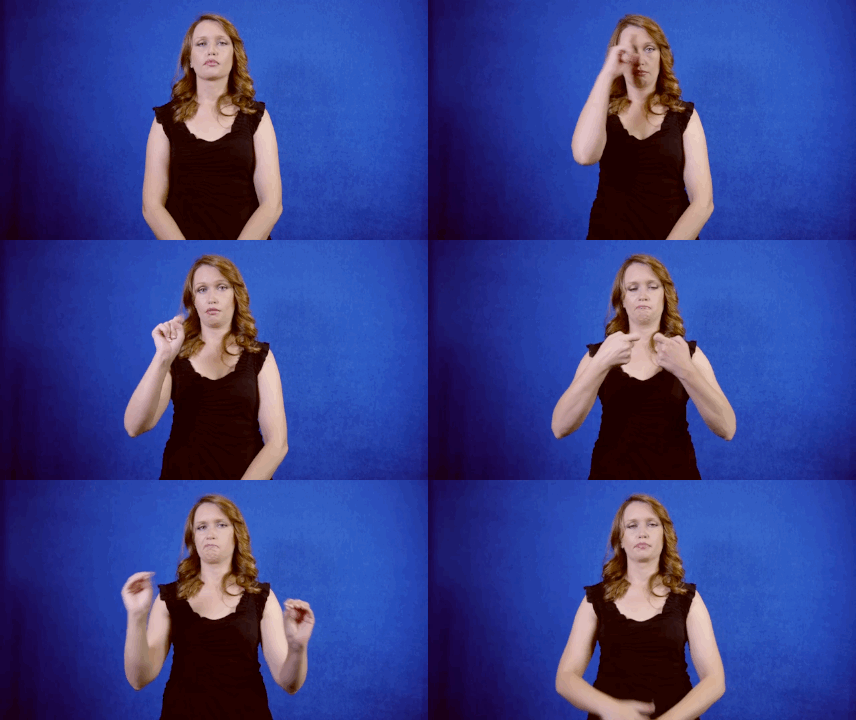
Sign for BLACKOUT in ASL | ⬛ ASL Dictionary

Definition: A temporary loss of consciousness.

Sign for BLACKOUT in ASL

YouTube player

Practice Activities:

To practice the sign for BLACKOUT in ASL, start by isolating the sign and repeating it in front of a mirror. Focus on handshape, movement, and facial expressions. Practice using it with both dominant and non-dominant hands to increase fluency.

Create short sentences such as “The city had a blackout” or “I was reading when the blackout happened.” Sign each sentence slowly, then at a more conversational pace. This will help integrate the sign for BLACKOUT in ASL into your expressive signing with better fluidity.

Use storytelling prompts like retelling a time when your home lost power. Include context like what you were doing, the time of day, and your reaction. This gives you the chance to use the sign for BLACKOUT in ASL naturally throughout your story.

Practice role-playing exercises with a partner. One person asks, “What happened during the storm?” and the other responds using the sign. Alternate roles and expand responses to involve more details and signs, such as describing lighting candles or using a flashlight.

Watch short videos or create flashcards that include the word blackout in a sentence. After watching, replicate the sentence and sign it without looking. This helps reinforce comprehension and proper usage.

Set a timer to sign scenarios quickly. For example, explain why a blackout happened, who was affected, and what you did. Try to do this in one minute using the sign for BLACKOUT in ASL multiple times for practice.

Finally, challenge yourself to sign an entire paragraph about blackout safety tips. Talk about having batteries ready, using lanterns, or avoiding elevators. This allows for repeated use of the sign while building thematic vocabulary around it.

Cultural Context:

The sign for blackout in ASL carries both literal and cultural meanings, depending on the context. In American Sign Language, this sign can refer to a power outage or losing consciousness, and how it’s signed may vary with these different interpretations.

Culturally, the sign for blackout in ASL is often used in discussions about emergency preparedness. Deaf individuals rely heavily on visual information, so when a blackout happens, it affects not just lights but key communication systems. Ensuring access to alerts and safety instructions through visual or tactile means becomes essential.

In storytelling and shared experiences within the Deaf community, blackout scenarios appear in humorous, dramatic, or cautionary tales. The sign for blackout in ASL is one that often comes up during group conversations about natural disasters, unexpected outages, or even theater performances where the lights suddenly go out.

In medical or wellness contexts, the same sign or a variation can represent fainting or passing out. In this case, the sign for blackout in ASL shifts toward depicting a loss of consciousness, helping differentiate between electrical disruptions and health-related issues. Understanding the difference helps in interpreting signs accurately in situational conversations.

Theatrical settings use the term blackout to refer to darkened stages or scripted pauses in lighting. Deaf performers and ASL interpreters often work in environments where timing and light cues are important, so being familiar with the sign for blackout in ASL aligns with understanding stage directions and performance art.

Historical contexts also shape the use of this sign. For example, during wartime or disaster drills, the term blackout refers to lights being deliberately turned off for safety. Deaf communities have developed visual strategies for communication during these periods, and the sign for blackout in ASL is part of that survival vocabulary.

The sign for blackout in ASL can also be important in conversations about accessibility. Technological blackouts or government-imposed internet shutdowns limit access to vital information. In such discussions, using the ASL sign effectively highlights concerns about equitable communication access for Deaf people.

Whether used in daily dialogue, storytelling, emergency planning, or performing arts, the sign for blackout in ASL reflects the visual and situational richness of Deaf culture. It’s a vocabulary term rooted in real-life experiences and adapted to various narratives and environments.

Deaf students often learn the sign for blackout in ASL early on, especially when practicing situational language skills. Teachers incorporate it into lessons about weather, emergency drills, and health. It serves not just as a linguistic tool but as a bridge into broader awareness

Extended Definition:

The sign for blackout in ASL can refer to different contexts depending on the situation. Most commonly, it can describe a power outage where all electricity or lights go out. It can also refer to losing consciousness or memory, like fainting or blacking out during a medical episode or trauma.

In American Sign Language, context matters when choosing the right sign. To sign blackout related to a power outage, you usually sign “lights” and then use a gesture that shows the lights going off suddenly. This is often shown by flattening the dominant hand and moving it downward as if covering the light. This is distinct from the medical or personal version of a blackout.

When referring to fainting or losing consciousness, the sign for blackout in ASL often combines FACE and FAINT or MIND and LOSE. This version uses facial expression to indicate disorientation or collapse, which adds important nuance. Without context, the sign could be misunderstood, so facial grammar and surrounding signs help clarify the meaning.

The facial expression used with the sign is very important for correct understanding. If signing about an electrical blackout, a surprised or annoyed expression is appropriate. For medical-related blackouts, a weak or vacant look will help show the meaning. ASL relies heavily on non-manual markers to support meaning.

Another version of signing blackout in ASL involves gesturing light going out or vision fading. Some signers use classifiers to show surroundings getting darker. This form is especially common when describing scenes in storytelling, such as a blackout during a storm or a dramatic fainting spell.

The sign for blackout in ASL can also be linked to cultural or historical usage. In storytelling, teaching, or even theater, dramatic blackouts are used to transition between scenes. ASL users might describe these blackout moments with a visual fade-out demonstrated by moving hands over the eyes or gesturing darkness spreading.

Some regions or individual signers may use slightly different versions, which can be influenced by their local Deaf community. Regional dialects affect how people sign different concepts, including the sign for blackout. Still, most native ASL users will understand the intended meaning as long as context and classifiers support the sign.

Role-shifting can also help add clarity to the sign for blackout in ASL. When describing someone passing out, role-shifting into the character allows you to act out the blackout. This helps capture the full visual and gestural nature of how ASL expresses complex ideas.

When teaching students how to sign blackout in ASL,

Synonyms: power outage, electrical failure, loss of electricity, power cut, grid failure

Educational resources: Find related learning materials in our course bank!

Want more? Check out some of our popular learning activities on the homepage!

Need to look up a sign? Use our highly rated dictionary: https://aslinteractive.com/best-asl-dictionary/

Follow us on tiktok: https://www.tiktok.com/@aslinteractive. More social media links at the bottom of this page!

Long-tail Keywords: what is the sign for blackout in ASL, how do you sign blackout in ASL, how to say blackout in American Sign Language

Categories:

tags: Colors, Events, Negation, Language Learning, Actions

Parameters

*Handshape*:

The handshape used in the sign for BLACKOUT in ASL typically begins with the dominant hand in a flat hand (B-handshape), palm facing towards the face or slightly downward. The non-dominant hand often mirrors this with the same flat B-handshape.

To show the concept of a sudden loss of light or consciousness, the hands may shift into an S-handshape, closing quickly to indicate darkness. This transition enhances the visual meaning behind the sign for BLACKOUT in ASL .

*Palm Orientation*:

In the sign for BLACKOUT in ASL, the palm orientation plays an essential role in conveying the meaning clearly. Typically, the dominant hand starts palm-forward and then flips inward toward the face or turns downward in front of the forehead, symbolizing the action of “blacking out” or losing power. This inward or downward rotation helps visually depict the sudden absence of light or consciousness in the sign for BLACKOUT in ASL .

*Location*:

The sign for BLACKOUT in ASL is typically produced in the neutral space directly in front of the face. It starts with one hand open and palm facing the face, then closes quickly into a flat “O” or closed hand, as if the light or vision is being shut off.

This sign occurs at head level, using subtle facial expressions to enhance the meaning. The location near the face is symbolic, representing the sudden loss of visibility or power signified by the sign for BLACKOUT in ASL.

*Movement*:

To show the sign for BLACKOUT in ASL, begin with your dominant hand in a bent five-handshape, palm facing forward, held near your forehead. Move the hand downward in front of the face while changing to an “O” handshape, as if something is being shut off or going dark.

This gesture mimics the concept of lights going out suddenly. The sign for BLACKOUT in ASL effectively captures the transition from light to darkness, a typical feature of a blackout ️.

*Non-Manual Signals*:

Eyebrows are typically furrowed to convey confusion, panic, or concern when using the sign for BLACKOUT in ASL, especially when referring to an unexpected loss of power. The eyes may squint slightly, and the mouth may form a tight or flat line to match the seriousness or surprise of the event.

Head movement is usually abrupt or slightly tilted to one side, indicating shock or sudden change. These non-manual signals help emphasize the meaning and emotional context behind the sign for BLACKOUT in ASL.

*Prosody, Dominant/Non-Dominant Hand*:

The sign for BLACKOUT in ASL typically uses the dominant hand to mimic the effect of lights going out. Start by holding both hands open, palms forward in front of your face. Then quickly close them into fists and bring them down slightly, as if the light suddenly disappears. Facial expression plays a key role in showing the suddenness or severity of the blackout. The sign for BLACKOUT in ASL may also involve a brief pause to emphasize the dramatic change.

Tips for Beginners:

When learning the sign for BLACKOUT in ASL, it’s important to first distinguish whether you’re referring to a power outage or a loss of consciousness, as context can slightly shift how it’s expressed. Generally, you’ll use a combination of the signs for “black” and “out,” or at times describe the scenario using classifiers or facial expressions to clarify meaning. Make sure to observe and mimic native signers when possible to pick up on nuanced context clues.

A common pitfall is not using enough facial expression or emotional context. For example, if you’re describing a power outage, a slight look of surprise or frustration can complement the sign and make your meaning clearer. But if you mean someone fainted, you’ll want to adjust your facial expression to reflect concern or urgency. The clarity of your non-manual markers (like facial expression) can completely change the meaning of the sign for BLACKOUT in ASL.

Another tip is to ensure your hand placement is correct when transitioning between “black” and “out.” When you’re signing multiple concepts quickly, it’s easy to rush or blur transitions. Practicing smooth but distinct transitions between handshapes, and making sure your palm orientation is accurate for “out,” will go a long way toward fluency.

When fingerspelling is involved, such as in some regional variations where BLACKOUT is fingerspelled, make sure you don’t drop letters or distort the handshapes. Keep your hand steady and at eye level for readability. Practicing short fingerspelled words daily will help improve your speed and clarity over time.

Use mirrors or videos to review your signing. This will help you identify any sloppy movements or unclear expressions. Staying consistent with practice and seeking feedback from fluent signers—or a tutor—is the best way to gain confidence with the sign for BLACKOUT in ASL.

Connections to Other topics:

The sign for BLACKOUT in ASL is often linked to concepts involving loss of power, vision, or consciousness, depending on context. This sign connects naturally with vocabulary related to emergencies, such as POWER-OUTAGE, ELECTRICITY, and LIGHTS-OFF. Each of these signs helps build comprehension around situational and environmental changes, making conversations about accidents, natural disasters, or health-related topics more specific.

In medical and health discussions, the sign for BLACKOUT in ASL might be tied into signs like FAINT, FALL, or DIZZY when describing someone losing consciousness. These compound connections allow signers to depict sequences of events clearly—an important tool for both storytelling and conveying urgency in real-world scenarios. These links give learners a chance to expand beyond basic vocabulary into more complex narrative and descriptive structures.

In the context of stage and theatrical terms, the sign for BLACKOUT in ASL may also connect to STAGE, CURTAIN, or INTERMISSION, especially when explaining what happens between scenes. This relationship helps performers and technicians discuss specific moments in a show or rehearsal with precision. Learning this sign along with related signs can be helpful for Deaf individuals involved in performing arts or tech crews.

Metaphorically, the sign for BLACKOUT in ASL can be extended or combined with signs like MIND-BLANK or FORGET, especially in comedy or casual discourse. These flexible applications show how compound ideas in ASL are used creatively to reflect spoken idioms or expressions. The ability to generalize or specialize the sign based on context truly highlights ASL’s rich visual nuance.

Working with compound expressions like COMPLETE BLACKOUT, COMMUNICATION BLACKOUT, or MEMORY BLACKOUT introduces learners to how modifying or pairing signs adds clarity. These examples teach how broad and nuanced the language can be, and how combining core signs can reflect precise meanings in many types of conversations.

Summary:

The sign for BLACKOUT in ASL typically reflects the sudden loss of light or consciousness. It may be conveyed visually by emphasizing darkness or blankness overtaking a space, depending on context.

When referring to an electrical blackout, the sign often involves a motion where hands move downward or over the eyes, indicating lights turning off. For medical or psychological meanings, like fainting or losing consciousness, a different gesture involving a closing motion to the facial area may be used.

Context is key in determining how the sign for BLACKOUT in ASL is produced. Facial expressions and body shifts often help express whether it’s a physical, emotional, or environmental blackout.

If describing a power failure, native signers might integrate the sign for LIGHT followed by clasping or “cutting” motions. In some cases, the sign resembles the sign for DARK, emphasizing the visual outcome.

For emotional or psychological blackouts, signers may use gestures reflecting mental emptiness, such as a blank face combined with a drooping hand. These interpretations rely heavily on classifiers and non-manual markers.

In storytelling or conversation, the sign for BLACKOUT in ASL can evoke intensity or drama. This contributes to the engagement value and expressiveness characteristic of ASL narratives.

The visual and spatial features of ASL allow BLACKOUT to be described dynamically. Signers may spatially illustrate a room becoming dark or enact the moment of fainting.

Sign fluency often hinges on cultural familiarity, especially with expressions used in theatrical or medical contexts. ASL’s structure supports nuanced meanings through movement, duration, and intensity.

Culturally, blackouts have historical and emotional associations. In Deaf culture, power outages may affect technology used for safety or communication, adding emotional depth to the sign.

Emotionally charged blackouts such as traumatic memory loss may require a customized expression using signs like FORGET or MIND-BLANK. This modifies the basic approach to the sign for BLACKOUT in ASL.

This flexibility showcases the rich visual metaphors embedded in ASL. Conceptually accurate rather than literal word-for-word translations guide how meaning is structured.

In performance art or Deaf theater, the sign for BLACKOUT in ASL may symbolize the end of a scene, often paired with a gesture for LIGHTS-OFF. Timing and rhythm can enhance this storytelling element.

Grammatically, the sign functions as a verb or noun depending on sentence placement. Classifiers denoting the body or room help indicate what is experiencing the blackout.

Applied linguistics studies note how visual-spatial languages like ASL handle abstract events. BLACKOUT gets mapped through visible metaphors, matching English equivalents in meaning, not form.

The sign is not static—regional, generational, and personal variations influence its production. Some use a closed hand near the forehead to show losing consciousness, others emphasize environmental darkness.

Related signs include FAINT, DARK, LOSE-CONSCIOUSNESS, and POWER-OUT. Each carries its own nuance but can overlap based on usage.

The sign for BLACKOUT in ASL deepens when combined with other descriptive signs. Examples include “SUDDEN” or “TOTAL” to amplify the impact visually and semantically.

During power outages, Deaf individuals often rely on emergency lights or visual alarms. Describing such blackouts involves both the sign’s semantics and cultural knowledge of access needs.

Signers adjust for formality and context. A casual reference to a blackout in conversation might simplify the gesture, while a professional setting would invite more precision and clarity.

The facial expression is essential. A furrowed brow, wide eyes, or closed eyes help distinguish between accidental blackouts and intentional darkness.

Broadly, BLACKOUT connects with topics such as health, safety, and environmental change in Deaf discourse. Its sign reflects community experience and adaptation to sudden sensory change.

ASL linguistics research often explores metaphorical use of space for mental states. BLACKOUT when implying memory loss uses spatial emptiness or gestures indicating a “shutting down” mind.

Such embodiments make ASL exceptionally expressive. The sign for BLACKOUT in ASL isn’t just a word—it’s a narrative in motion, integrating emotion, context, and visual storytelling.

Engaging this sign in dialogue means watching for more than the handshape. Location, palm orientation, and supporter signs all affect how it is perceived and understood.

When signing about theatrical blackouts, performers frequently link the sign with the show context. It becomes a stylized part of Deaf stage language and choreography.

The sign also appears in medical ASL communication. Nurses and doctors trained in ASL may use variations indicating the cause of the blackout, such as dehydration or hitting the head.

Tech-based blackouts involve layering signs like COMPUTER or INTERNET with BLACKOUT. These compound constructions reveal ASL’s efficiency and adaptability.

Linguistic anthropology shows how ASL evolves with societal needs. As technology and medicine advance, signs like BLACKOUT adapt in both form and meaning.

Language contact is important too. English influence sometimes causes fingers

Want more? Check out some of our popular learning activities!

ASL Interactive Resources

ASLInteractive YouTube Channel

Follow us on tiktok: @aslinteractive.com

Follow us on Instagram: aslinteractive

Facebook page: aslinteractive

Facebook group: aslinteractive

LInkedIn: ASL Interactive LLC

Twitter: @ASL_interactive

*Some information on this page is AI-generated. AI can make mistakes. Please check the information.

Sign for BLACKOUT in ASL

Responses