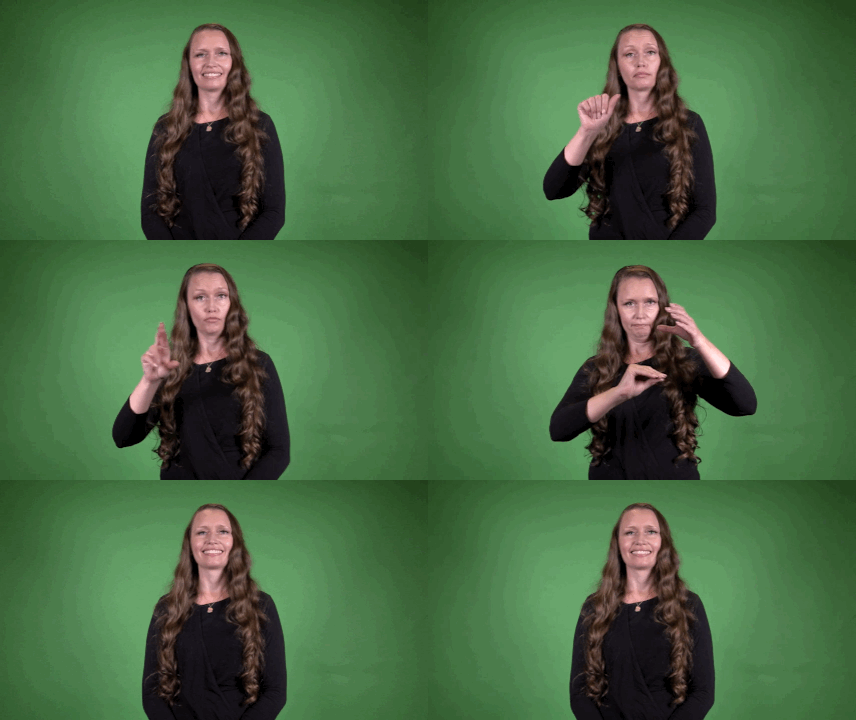
Definition: “Bladder empty” in ASL refers to the act of using American Sign Language to express the need to urinate or indicate that the bladder is void of urine, often represented with specific signs for “bladder” and “empty.”
Sign for BLADDER EMPTY in ASL

Practice Activities:
To begin practicing the sign for bladder empty in ASL, start with isolated repetition in front of a mirror. Watch your facial expressions and handshape to ensure clarity. Use a short pause before producing the sign to simulate thinking and make it feel more natural in conversation.
Create a daily routine using simple phrases. Say things like “I need the restroom, bladder empty” or “Doctor asked me, bladder empty or full?” Use these short interactions to get comfortable signing efficiently. Incorporate common time indicators like “yesterday,” “now,” or “soon” to build fluency.
Try storytelling by imagining different scenarios where someone might need to explain their condition. For example, pretend to be at a doctor’s appointment and sign a short story: “This morning, I drank lots of water. Thirty minutes later, bladder empty.” Practice this with variations using different times of day or situations such as before bed or after taking medication.
Partner up with another learner to role-play situations such as hospital check-ins, discussing side effects, or preparing for medical tests. One person can act as a nurse or doctor, asking yes-or-no questions like “Bladder empty?” and the other responds with the appropriate sign and added context.
Challenge yourself with a category game where you describe bodily functions or conditions and incorporate the sign for bladder empty in ASL where appropriate. Try combining it with other medical signs like “urine,” “full,” or “catheter.” Using this in both questions and answers is a great way to reinforce understanding.
Use a timer and sign bladder empty quickly but clearly in response to cues. This helps build quick recall. End your practice by signing how you’re feeling physically to a practice buddy or teacher, using the sign for bladder empty in ASL naturally as part of the conversation.
Cultural Context:
Understanding the sign for bladder empty in ASL is essential for both fluent signers and learners. In American Sign Language, health and bodily functions are often expressed clearly and directly, encouraging open communication in both personal and medical settings. The sign for bladder empty in ASL helps users talk about physical states without discomfort or confusion.
This sign often comes up during doctor visits or when discussing health concerns. In the Deaf community, access to accurate and respectful signs related to the body allows individuals to navigate sensitive topics with dignity. Using the sign for bladder empty in ASL ensures efficient communication that supports autonomy and wellness.
Bladder-related signs carry both practical and cultural significance. The sign for bladder empty in ASL not only describes a physical sensation but also helps people express needs in a timely way. Whether in casual conversation or medical contexts, having this sign readily available promotes inclusive interactions for Deaf individuals.
Deaf culture values clear, expressive language, especially when it comes to bodily needs. The sign for bladder empty in ASL empowers signers to communicate feelings of urgency or relief. This functionality is particularly important in schools, workspaces, or environments where quick access to restrooms matters.
Children, adults, and elders in the Deaf community all benefit from learning how to use the sign for bladder empty in ASL. It’s commonly used in health education and by interpreters in clinical environments. It helps bridge communication gaps and supports patient advocacy.
Using the correct sign for bladder empty in ASL is also a sign of cultural competence. It shows respect for the Deaf community’s language and values. Teachers and interpreters often include it in lessons to support fluency in real-life settings.
The visual nature of ASL allows for precise communication about bodily functions, which might be awkward or uncomfortable to express in spoken languages. The sign for bladder empty in ASL gives users a straightforward, culturally accepted way to express a basic human need. It encourages honest and timely conversations.
Deaf individuals rely on accurate bodily signs when they advocate for healthcare support. For example, using the sign for bladder empty in ASL allows for quick communication in urgent scenarios. This improves interactions with healthcare professionals, emergency personnel, and caregivers.
Parents and caregivers also use the sign for bladder empty in ASL when teaching kids about hygiene or potty training. The sign makes it easier for children to signal their needs even before they fully develop speech or fluent signing. It adds a key tool to the daily communication of Deaf and hearing families.
Including the sign for bladder
Extended Definition:
The sign for bladder empty in ASL is an essential part of communicating about medical needs, bathroom routines, and basic bodily functions within the Deaf and hard-of-hearing communities. This sign can be helpful for both everyday conversations and medical dialogues where it’s crucial to describe sensations related to the bladder or urinary system.
To express the concept of an empty bladder in American Sign Language, signers typically combine elements that represent both bladder and the idea of emptiness. The bladder is often signed in the area of the lower abdomen using a curved handshape to indicate the organ, while the sign for empty can involve a gesture that signifies the absence or completion of contents. These signs are often produced in a smooth, fluid motion to show that the bladder is now empty.
This sign phrase can be especially useful in settings such as doctor’s appointments, hospitals, caregiving situations, or when communicating with young children learning to express physical needs. The sign for bladder empty in ASL helps avoid misunderstanding and allows for accurate communication regarding bodily functions. It can also be useful for caregivers or healthcare providers working with non-verbal patients who use ASL as their primary form of communication.
Depending on region or context, there can be slight variations in how individuals sign bladder and empty together. Just like spoken language, ASL can vary slightly by community, so it’s always best to observe and adapt to the signer’s regional preferences. However, the core concept remains consistent and easily understandable once the basic components are learned.
Understanding the sign for bladder empty in ASL also plays a role in potty training and supporting independence in children who are Deaf or hard of hearing. Caregivers and educators often use this sign to help children recognize when they need to use the restroom and how their body feels before and after. In adult settings, such as with elderly patients or those with medical conditions, this sign makes it easier to discuss personal hygiene and urinary health without embarrassment.
For interpreters, learning this sign phrase is important when working in medical or caregiving environments. It provides a non-verbal, visual way to communicate internal body sensations and helps reduce anxiety for ASL users who may find it awkward or difficult to describe such feelings. Reinforcing the ability to sign concepts like bladder empty in ASL can significantly improve quality of care and daily comfort.
In online discussions and video content related to health and wellness in the Deaf community, the sign for bladder empty in ASL is commonly demonstrated by native users. These visual resources emphasize the importance of clarity and consistency
Synonyms: urinate, pee, void the bladder, pass urine, relieve yourself
Educational resources: Find related learning materials in our course bank!
Want more? Check out some of our popular learning activities on the homepage!
Need to look up a sign? Use our highly rated dictionary: https://aslinteractive.com/best-asl-dictionary/
Follow us on tiktok: https://www.tiktok.com/@aslinteractive. More social media links at the bottom of this page!
Long-tail Keywords: what is the sign for bladder empty in asl, how to sign bladder empty in asl, bladder empty in american sign language
Categories:
tags: Facilities and other locations/needs, Everyday activities, Verbs, Commands, Health-related actions
Parameters
*Handshape*:
The handshape for the sign for BLADDER EMPTY in ASL typically uses a loose, open dominant hand formed into a curved “5” or “claw” shape. The hand starts near the lower abdomen area, representing the location of the bladder, and moves slightly outward or downward, mimicking the release of fluid.
This curved “5” handshape reflects the sensation of emptiness and release, aligning with the meaning of the sign for BLADDER EMPTY in ASL . The movement paired with this handshape effectively conveys the concept of evacuation or emptiness, which is central to the sign for BLADDER EMPTY in ASL.
*Palm Orientation*:
For the sign for BLADDER EMPTY in ASL, the palm orientation generally starts with the dominant hand in a closed or slightly open “5” handshape placed over the lower abdomen. The palm is typically facing inward toward the body to represent the bladder area.
As the movement signifies the concept of “empty,” the hand may shift slightly forward or downward while the palm remains inward or turns slightly downward. In the context of the sign for BLADDER EMPTY in ASL, this palm orientation helps convey the internal release motion.
*Location*:
The location for the sign for bladder empty in ASL is typically near the lower abdomen area, reflecting the anatomical position of the bladder. The dominant hand starts slightly below the stomach, often mid-torso, and moves downward or away from the body to indicate the concept of emptying.
This area emphasizes the internal nature of bladder functions. The sign for bladder empty in ASL often uses facial expressions and movement direction to reinforce the context of release or voiding.
*Movement*:
The sign for bladder empty in ASL starts with the dominant hand in a “U” handshape placed near the lower abdomen, symbolizing the bladder area. The hand then moves slightly forward and downward with a flicking motion, as if showing the release or evacuation of liquid.
This movement reflects the concept of something being emptied from the bladder. The sign for bladder empty in ASL combines body placement and directional motion to emphasize that the bladder is no longer full.
*Non-Manual Signals*:
When performing the sign for bladder empty in ASL, the signer typically adopts a slightly tense facial expression, as if anticipating urgency or slight discomfort. The eyebrows may be mildly furrowed, and the mouth forms a tight, focused line or a slight grimace to convey the need for urgency or relief.
To add clarity to the sign for bladder empty in ASL, eye gaze may shift downward momentarily to simulate a personal connection to the body’s lower region. A quick head nod or slight lean forward can emphasize immediacy or indicate a recent or necessary action of emptying the bladder.
*Prosody, Dominant/Non-Dominant Hand*:
The sign for bladder empty in ASL uses the dominant hand in a loose “5” or open handshape placed near the lower abdomen, mimicking the location of the bladder. The dominant hand then moves slightly downward or releases outward with a relaxed flicking motion, indicating the concept of emptying. The non-dominant hand is not used.
This movement represents the anatomical function and helps convey the meaning visually. The sign for bladder empty in ASL relies on facial expressions to show completion, often accompanied by a relieved or neutral expression to clarify the context.
Tips for Beginners:
When learning the sign for BLADDER EMPTY in ASL, it’s helpful for beginners to focus on both the clarity of movement and context of use. This sign typically involves a gesture that relates to the lower abdominal area, indicating the bladder, combined with a motion that represents the feeling or action of being empty. Be mindful not to exaggerate or perform the sign too subtly—accuracy matters to convey the right meaning.
Placement is essential. For the sign for BLADDER EMPTY in ASL to be understood clearly, your hand should move in a way that naturally connects to the area being addressed, generally around the lower torso. Over time, consistent practice in front of a mirror can help build muscle memory and fluidity.
Beginners often forget to pair the sign with appropriate facial expressions. When indicating something like an urgent need to urinate or relief from having just gone, showing that emotion on your face helps reinforce the concept. Try to match your non-manual signals with the intensity or urgency of the event being signed.
Timing and rhythm are also important. Don’t rush the sequence or break the movement into choppy segments. The sign should look smooth and deliberate, flowing naturally from the sign for bladder to the sign for empty.
Remember that classifiers can occasionally be used in addition to the basic sign for more advanced learners. However, keep it simple when starting out. Repetition and using the sign in real-life dialogues or role-play situations will deepen retention.
Lastly, don’t be afraid to ask for feedback from native signers or instructors. Videotaping yourself can also be a great way to catch inconsistencies. With steady practice and attention to detail, the sign for BLADDER EMPTY in ASL will become an easy and accurate part of your vocabulary.
Connections to Other topics:
The sign for BLADDER EMPTY in ASL is closely related to signs used in medical and health contexts. It commonly appears during conversations about bodily functions, doctor visits, or instructions for self-care. This sign shares similarities with signs for URINE and BATHROOM, making it part of a family of health-related vocabulary often used by interpreters in clinics and hospitals .
Learning the sign for BLADDER EMPTY in ASL can enhance discussions around physical comfort or discomfort, enabling users to express needs clearly in private or urgent situations. It’s helpful to understand this sign in relation to EMPTY, which also appears in other phrases like EMPTY STOMACH or EMPTY CUP. Combining signs like FEEL with BLADDER EMPTY creates descriptive statements such as FEEL NEED BLADDER EMPTY, useful in medical interpreting or daily communication.
This keyword phrase is also connected to bodily awareness, which is essential vocabulary for caregivers, parents, and educators who support children or clients with sensory processing or developmental needs. Signs like BLADDER FULL, NEED BATHROOM, or GO TOILET often appear in tandem with the sign for BLADDER EMPTY in ASL during structured bathroom routines.
In contexts involving aging or disability, being able to accurately and respectfully express bladder status is key. This sign also appears in health education settings, such as discussions about hydration or symptoms of urinary conditions. It may be integrated into compound sentence structures that use time concepts, like EVERY MORNING or BEFORE SLEEP, to show routine.
Interpreters may also use the sign for BLADDER EMPTY in ASL during group workshops or support groups focused on wellness, preparing learners to manage and discuss personal needs with dignity. As part of a broader system of self-care signs, this phrase supports autonomy and clarity in communication.
Summary:
The sign for BLADDER EMPTY in ASL combines concepts of internal body organs with physical sensations. It’s often expressed through a sign for “urinate,” followed by a motion that may suggest completion or emptiness. ASL does not always have one-to-one representations for medical terms but instead uses descriptive concepts.
To sign this phrase, one typically uses a flat hand placed near the lower abdominal area to represent the bladder. The hand may slightly move outward or flick away to indicate emptiness or relief. The movement can vary depending on whether you are describing the physical sensation or a diagnostic context.
Bladder as a component of anatomy is usually best expressed through classifiers or specified through fingerspelling when necessary. In many cases, signs for internal organs are not independently standardized but constructed through context. This reflects ASL’s highly visual and conceptual structure, rather than fixed vocabulary.
An important note about the sign for BLADDER EMPTY in ASL is how the concept is shaped by cultural and practical contexts. For instance, the phrase may appear in medical settings, especially with Deaf individuals discussing urinary tract health, dialysis, or incontinence. In such contexts, the sign may rely on shared understanding of bodily functions rather than technical names.
Within casual settings, the sign for BLADDER EMPTY in ASL can be conveyed with humor or urgency. Deaf children might exaggerate the motion or facial expression to indicate an urgent need to go to the restroom. Facial expressions carry considerable weight in ASL and help indicate whether the sign is literal or exaggerated for comedic or social effect.
The sign also links to related physiological signs like PEE, URINE, TOILET, and FULL. PEE is often signed with an initialized handshape for “P,” usually shaken slightly downward from the abdomen. When contrasting FULL and EMPTY in reference to the bladder, directional movement becomes key—rising arc movements may suggest fullness, while downward or flicking motions suggest emptiness.
ASL’s use of space in this area is especially noteworthy. The abdominal area becomes a locus for signs about digestion, bladder control, and menstrual cycles. This spatial mapping is logical in ASL linguistics, reflecting iconicity, where signs visually correlate with their referents.
Some signs used in conjunction with the sign for BLADDER EMPTY in ASL may include MEDICINE, BATHROOM, DOCTOR, and TEST. MEDICINE is typically a dominant hand formed in a modified “F” or “THUMB” configuration, tapping the non-dominant palm. These signs may form strings of medical explanations in clinical ASL discourse.
In linguistics, the sign for BLADDER EMPTY in ASL illuminates how compound ideas are built. Since ASL allows compounds to describe internal states or processes, users may combine URINATE and FINISH or USE-BATHROOM and FEEL-RELIEF to get the concept across. These compounding strategies are rooted in the agglutinative nature of ASL.
Applied linguistics shows us how Deaf medical interpreters standardize terms like BLADDER, which may lack common usage among laypeople. Fingerspelling often plays a major role here in building health literacy. The lack of standardized signs for many internal body parts causes medical interpreters to lean more heavily on classifiers and context.
Eye gaze, indexation, and body shifts also contribute meaningfully to the sign for BLADDER EMPTY in ASL. A slight gaze downward toward the abdomen combined with appropriate nonmanual markers (facial expressions indicating relief, urgency, or discomfort) creates a full picture for the receiver. This makes the communication immersive and immediate.
The sign for BLADDER EMPTY in ASL intersects with bodily autonomy and self-care. Being able to describe elimination accurately helps in hospital, caregiving, and educational contexts. Deaf individuals discussing their bladder function can better advocate for themselves using this sign structure.
Grammatically, this phrase operates like any ASL predicate, with the topicalization of time, location, or symptoms preceding it. For example: “YESTERDAY, I BATHROOM GO, BLADDER EMPTY QUICK.” Time comes first, centered around symptoms or action. This reflects the head-final structure often seen in ASL syntax.
It’s vital to note regional variation. Some ASL users prefer to fingerspell B-L-A-D-D-E-R, then sign related actions. Others simply rely on more universally understood gestures like NEED PEE or I URINATE, followed by FINISHED. These choices show how flexible and adaptive ASL can be depending on the audience.
Especially for children or language learners, the concept is often taught visually using dolls or diagrams that show organs. In this way, instruction in the sign for BLADDER EMPTY in ASL becomes part of a broader anatomy and health education curriculum, often supplemented with visuals and props.
ASL classifiers can support this topic as well. For showing the release of fluid or the concept of something held in a container being released,
Want more? Check out some of our popular learning activities!
ASL Interactive Resources
ASLInteractive YouTube Channel
Follow us on tiktok: @aslinteractive.com
Follow us on Instagram: aslinteractive
Facebook page: aslinteractive
Facebook group: aslinteractive
LInkedIn: ASL Interactive LLC
Twitter: @ASL_interactive
*Some information on this page is AI-generated. AI can make mistakes. Please check the information.


Responses