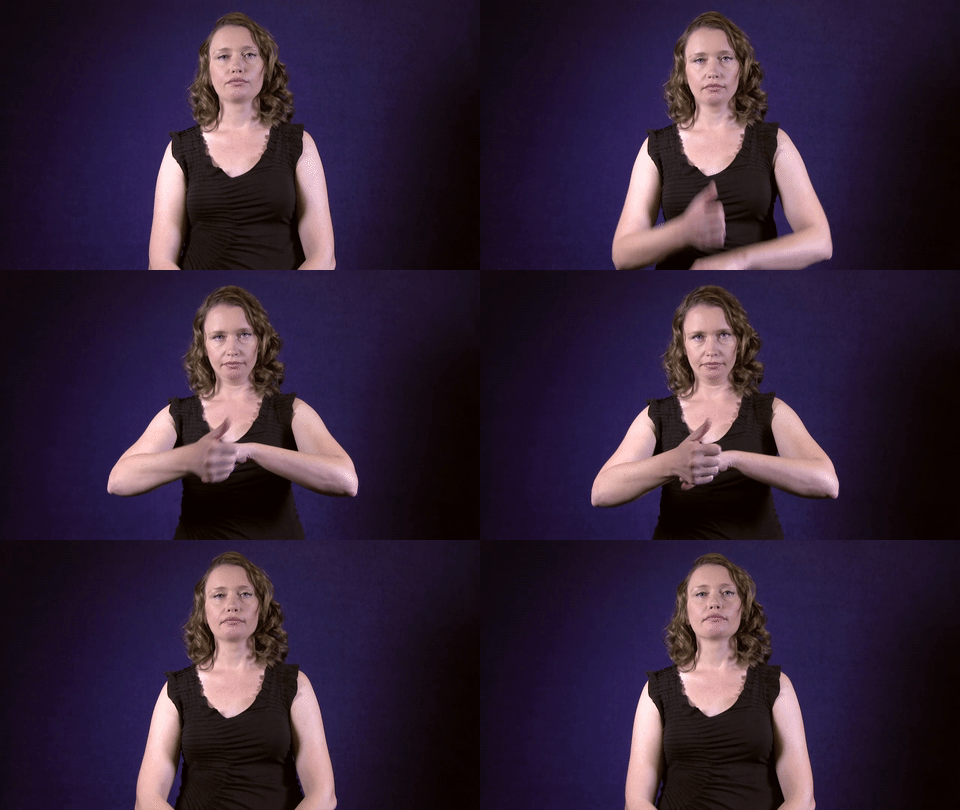
Definition: To assign responsibility for a fault.
Sign for BLAME in ASL

Practice Activities:
Start by practicing the sign for BLAME in ASL in front of a mirror. Focus on handshape, palm orientation, and facial expression. Since this sign often carries emotion, exaggerate your non-manual markers to convey blame or accusation convincingly.
Next, create a list of simple sentences that include the word “blame.” Sign the full sentence slowly, such as: “Don’t blame me,” “She blamed him,” and “Who is to blame?” Repeat each sentence multiple times, emphasizing the movement and clarity of the sign for BLAME in ASL.
Pair up with a practice partner and take turns playing out short scenes where one person blames the other for something minor, like forgetting homework or spilling something. Each person should use expressive body language and the appropriate ASL grammar. After each scene, discuss how clearly the sign for BLAME in ASL was conveyed.
Try a storytelling prompt using the theme of misunderstanding or conflict. Tell a story about a time when someone was wrongly blamed. Include as many descriptive signs as possible and incorporate the sign for BLAME in ASL at key points in the narrative. This helps reinforce both vocabulary and expressive skills.
Watch ASL videos or short skits that use the sign for BLAME in ASL and copy their sentence structure and expressions. Pause after each segment and mimic what you see. Pay attention to when and how the sign is used, especially in emotionally charged dialogues.
Play a signing game like charades with a twist. Have different scenarios written on slips of paper where blame is assigned. Sign out the scene using the sign for BLAME in ASL and let others guess the situation. This is a fun way to build fluency and confidence.
Finally, record yourself signing a short argument or explanation and play it back. Evaluate whether your use of the sign for BLAME in ASL is clear and matches your intended emotional tone.
Cultural Context:
In American Sign Language, the sign for BLAME in ASL holds both literal and cultural meaning within the Deaf community. It’s not just about indicating fault, but about expressing accountability in a way that aligns with Deaf values around clear communication and shared understanding.
The sign for BLAME in ASL can vary slightly based on region, but it usually involves a directional motion that reflects who is blaming whom. Directionality in ASL is an important linguistic feature that adds clarity and efficiency to conversations, especially when emotions like blame are involved.
Understanding the sign for BLAME in ASL also means understanding how blame is viewed in Deaf culture. Blame can be a serious allegation, and the community tends to value open, honest discussions that clear up misunderstandings rather than point fingers unnecessarily. The sign communicates not just fault, but responsibility, which is a significant cultural nuance.
When learning the sign for BLAME in ASL, it’s useful to observe how facial expressions shape the tone and intensity of the message. Because ASL relies so heavily on non-manual markers, using the correct facial expression helps express whether the blame is serious, playful, or sarcastic.
Using the sign for BLAME in ASL in everyday conversation should be done with cultural sensitivity. In the Deaf community, direct communication is highly valued. That means people often prefer to address issues head-on rather than avoid talking about conflict. Using this sign appropriately can help maintain that cultural value of openness.
ASL learners sometimes misinterpret the sign for BLAME in ASL as solely negative, but in cultural context, it can also be constructive. It can open a dialogue, identify problems, and help people in the community find resolution. This use aligns with the Deaf community’s emphasis on clarity, truthfulness, and shared responsibility.
Historical influences have shaped how blame and accountability are discussed within the Deaf community. Experiences with discrimination and misunderstanding from the hearing world have deepened the value of mutual respect and responsibility. Using the sign for BLAME in ASL effectively acknowledges that cultural history.
When you learn the sign for BLAME in ASL, you’re also learning how communication dynamics work in Deaf culture. This includes standing up for oneself or others when something goes wrong, without escalating conflict unnecessarily. It’s about mutual respect and understanding.
Context is everything in ASL. The sign for BLAME in ASL can change meaning depending on surrounding signs and the signing space. That makes learning it in realistic cultural scenarios important—not just memorizing the hand movement.
Whether you’re using
Extended Definition:
The sign for blame in ASL refers to the concept of holding someone responsible for a mistake, fault, or negative outcome. In American Sign Language, this sign captures the essence of pointing to someone as the cause of an issue. It’s often used in conversations where accountability or responsibility is a focus.
To perform the sign for blame in ASL, the dominant hand forms the letter A in the ASL alphabet and moves forward from behind the flat non-dominant hand, which represents the person being blamed. This motion symbolizes pushing the responsibility onto someone else. Facial expressions, especially those showing frustration or disapproval, often accompany this sign to give it emotional context.
Blame is a common concept in both casual and serious conversations. The ability to express this idea clearly in ASL helps make communication about disagreements, misunderstandings, or criticisms more precise. Knowing this sign also broadens the ASL user’s vocabulary related to emotions and social dynamics.
When using the sign for blame in ASL, it’s essential to be mindful of the context. The way blame is communicated can be accusatory or descriptive, depending on the situation and tone. This makes it especially important to support the sign with appropriate gestures and facial expressions to match the intention.
Learning how to sign blame also gives insight into how ASL handles abstract ideas. While blame is not a physical action you can see, ASL makes it visible through hand movements and expressions. This is a great example of how rich and expressive American Sign Language can be when discussing complex emotional or social issues.
Some regional variations may exist for the sign for blame in ASL. Signers from different parts of the country may use slightly different handshapes or motions. However, the general concept remains consistent and understandable across most ASL communities.
It’s worth noting that signs like blame can take on additional meanings depending on the context. In some situations, it can mean accuse or fault, and understanding these subtle differences helps in becoming a more fluent and thoughtful ASL communicator. Positioning, movement, and expression all play key roles in distinguishing these related meanings.
You may come across this sign during storytelling, emotional conversations, or discussions about conflict resolution. It’s a useful addition to any ASL vocabulary list aimed at improving both everyday speech and deeper, more nuanced conversations. The sign for blame in ASL makes it easier to participate in meaningful dialogues about responsibility and cause and effect.
For ASL students and interpreters, mastering the sign for blame in ASL helps build confidence in interpreting emotional
Synonyms: fault, accuse, charge, hold responsible, criticize
Educational resources: Find related learning materials in our course bank!
Want more? Check out some of our popular learning activities on the homepage!
Need to look up a sign? Use our highly rated dictionary: https://aslinteractive.com/best-asl-dictionary/
Follow us on tiktok: https://www.tiktok.com/@aslinteractive. More social media links at the bottom of this page!
Long-tail Keywords: what is the sign for blame in asl, how do you sign blame in asl, what is blame in american sign language
Categories:
tags: Verbs, Commands, Emotions, Negation, Everyday Activities
Parameters
*Handshape*:
The handshape for the sign for blame in ASL typically uses the dominant hand in an “A” handshape . The thumb is extended while the fingers are curled into the palm, resembling a fist with the thumb out.
In the sign for blame in ASL, this “A” hand is placed on the back of the opposite shoulder and then moved forward in a short, deliberate motion. This movement reinforces the action of placing responsibility or fault on someone.
*Palm Orientation*:
The palm orientation for the sign for BLAME in ASL typically faces inward toward the signer’s body. The dominant hand uses a flat “B” or open handshape, and it pushes slightly forward against the back of the non-dominant hand or shoulder, depending on variation.
This gesture reflects the concept of directing fault or responsibility. In the sign for BLAME in ASL, keeping the palm inward emphasizes the directional nature of assigning blame from one person to another.
*Location*:
The sign for blame in ASL is typically produced at the upper chest area, just below the shoulder on the dominant side of the body. The hand moves forward from this central location, emphasizing the personal nature of the concept.
Maintaining the sign close to the body helps reinforce the accusatory tone of the sign for blame in ASL. This placement ensures clarity and aligns with the emotional context of assigning responsibility.
*Movement*:
The sign for blame in ASL begins with the dominant hand forming an open or bent “B” handshape. Position the hand near the shoulder with the fingers pointing forward.
Move the hand forward in a small, firm motion toward the chest or shoulder area of the person being blamed. The movement may be accompanied by a slight facial expression showing disapproval or accusation. The sign for blame in ASL conveys the act of assigning fault clearly through its directional movement.
*Non-Manual Signals*:
The non-manual signals for the sign for BLAME in ASL often include a stern or disapproving facial expression. Eyebrows may be slightly furrowed, and the mouth might form a tight line or slight scowl to reflect judgment or accusation.
Body posture can also lean slightly forward to assert the idea of placing responsibility. These expressions and physical cues are key to conveying the emotion behind the sign for BLAME in ASL.
*Prosody, Dominant/Non-Dominant Hand*:
The sign for BLAME in ASL uses the dominant hand in an open B-handshape. Start with the dominant hand resting on the back of the non-dominant shoulder and swipe forward forcefully, as if pushing the fault onto someone. The non-dominant hand remains still, acting as the passive base.
Facial expression plays a key role in the sign for BLAME in ASL, often showing disapproval or accusation. The motion is quick and direct, emphasizing responsibility or fault.
Tips for Beginners:
When learning the sign for BLAME in ASL, it’s important to focus on proper hand placement and movement. This sign typically uses the dominant hand in a flat “B” handshape. The motion involves pushing the palm toward the back of the non-dominant hand, which is vertical in front of the body. Make sure the movement is deliberate but not too stiff to maintain the natural flow of the sign.
One good tip for the sign for BLAME in ASL is to maintain a consistent facial expression that matches the context. A mild scolding or accusatory expression adds meaning and emotional nuance. Overemphasizing the face or looking too playful can confuse the message in more serious conversations.
Beginners sometimes struggle with where exactly to make contact. To avoid this, practice the placement of your dominant hand behind and lightly touching the back of the non-dominant hand. It’s a gentle tap — not a slap — so precision matters more than force.
Watch your speed when signing. Many learners rush through the sign for BLAME in ASL, making it unclear or mistaken for something else. Practice slowly and then naturally increase speed with accuracy. Stay mindful about maintaining the correct “B” handshape throughout the motion.
A helpful exercise is to record yourself so you can evaluate whether your handshapes and positioning are consistent each time. You can also mimic native ASL users by watching sign videos or attending a Deaf event. Exposure to the sign in conversation helps reinforce when and how to use it appropriately.
Lastly, be patient with yourself. Mastering the sign for BLAME in ASL is achievable with steady practice and attention to detail. Stay confident and open to feedback, and always double-check the clarity of your sign during real-life use.
Connections to Other topics:
The sign for BLAME in ASL shares conceptual links with signs such as ACCUSE, RESPONSIBILITY, and FAULT. These signs interact based on how people assign accountability in a situation. The location and directionality of the sign for BLAME often suggest who is being held responsible, creating shared motion patterns with point-of-view or directional verbs common in ASL grammar.
In contextual use, the sign for BLAME is often incorporated in complex expressions such as SELF-BLAME or BLAME-THEM, which combine personal pronouns with the base sign. These compound ideas maintain the structure of ASL while expanding meaning, demonstrating how grammatical and spatial relationships evolve from a core concept. Directionality again plays a key role in these phrases, allowing signers to use body orientation to visually represent the assignment of guilt.
The sign for BLAME also connects to affective expression in ASL, aligning with signs like SHAME and GUILT. These signs form a semantic grouping where facial expressions, particularly eyebrows and mouth shape, contribute to the tone and emotional impact. Emphasis on expression helps distinguish between a light blame and a serious accusation, giving learners an insight into the emotional range embedded in ASL vocabulary.
When discussing narratives, the sign for BLAME can be paired with timeline indicators such as PAST, NOW, or FUTURE to clarify events and assign responsibility clearly. This is particularly useful in storytelling and formal discourse, where cause-and-effect relationships must be clearly visualized. The sign functions as a bridge to deeper conversation topics in both casual and structured dialogue.
Additionally, the sign for BLAME in ASL frequently appears in legal and interpersonal communication, linking it to terminology used in conflict resolution and debate. It supports the understanding of abstract judgment themes, helping learners grasp how ASL conveys not just actions, but perspectives and assessments of those actions. This sign opens doors to exploring ethical nuance and social interactions in ASL fluently.
Summary:
The sign for BLAME in ASL typically uses the dominant hand in an open flat-B shape. Start by placing your non-dominant hand in front, palm down, and brush the flat-B hand forward off the back of the non-dominant hand.
This movement mimics the idea of “placing fault” onto someone else. The non-dominant hand serves as a metaphorical target while the dominant hand assigns the fault.
The physicality of this sign reflects how certain emotions and concepts are embodied in ASL. Instead of only a spoken word, the body participates in expressing accountability or fault.
In ASL, the direction and placement of this sign may be modified to indicate who is being blamed. Blame can be assigned from one person to another by changing the orientation or direction of the sign.
ASL is a spatial language, and directionality plays a large role in conveying relationships. That makes the sign for BLAME in ASL adaptable and expressive for complex sentence structures.
Culturally, blame is an impactful concept that can carry emotional weight in Deaf communities, just as in hearing cultures. Expressing who is at fault requires precision and nuance, which this sign can convey.
The sign often appears in discussions about responsibility, mistakes, or conflict resolution. It may be used in narratives, observational storytelling, or personal disclosures.
Context is crucial when using the sign for BLAME in ASL. Depending on facial expressions and sentence structure, the same sign can relate to anger, guilt, or even sarcasm.
Facial expression in ASL heightens the impact of a sign. A stern expression adds weight to the blame, whereas a confused or innocent face might express being wrongly accused.
The sign is often used with complementary signs like WRONG, RESPONSIBILITY, or ACCUSE. These enrich the narrative by expanding on the nuances of fault and accountability.
Blame as a concept is related to power dynamics, social inclusion, and group cohesion. In Deaf culture, these dimensions are navigated with both linguistic clarity and social sensitivity.
Signers learn not just how to produce signs, but also when and how to use them. Usage of the sign for BLAME in ASL might differ based on age, regional variation, or communicative intent.
Linguistically, the sign is an excellent example of classifier integration. Though not a formal classifier, its modified direction and movement suggest agent and action in a visual structure.
The sign for BLAME in ASL does not require the use of classifiers but benefits from the use of indexing. You can index the person being blamed for emphasis and clarity.
Pointing to a person previously established in conversation allows you to clarify the target. This demonstrates how signs integrate with broader grammatical frameworks in ASL.
Applied linguistics studies how language reflects cultural values. The way the sign for BLAME in ASL is used provides insight into community norms around accountability.
Gestural languages such as ASL capture nuances like shifting blame or deflecting responsibility more naturally in some ways than spoken languages. Physical space allows more expressiveness.
ASL users might choose between various strategies to show evolving blame throughout a conversation. For example, changing where the “blame” gesture is aimed helps track who the signer is talking about.
Teaching this sign in classrooms focuses on more than handshape and motion. Students are guided to understand how blame fits into social interaction and emotional communication.
The repetition of this sign in structured drills helps reinforce motor patterns. However, understanding the social value of blame is key to appropriate usage.
Children who learn the sign for BLAME in ASL early often link it to experiences of conflict. Parents and educators use the sign in lessons about behavior, apologies, and fairness.
In Deaf cinema or visual storytelling, the sign plays an expressive role. Its sharp movement and potential facial expressions make it compelling for dramatic scenes.
In ASL literature, blame is a powerful motif. The sign’s physical shape and directional specificity support metaphor and narrative development.
The semantic field for BLAME includes signs like FAULT, SCAPEGOAT (usually fingerspelled), and GUILT. Each contributes to distinct shades of meaning.
For those acquiring ASL as a second language, this particular sign reveals a lot about how ASL conveys abstract concepts. Unlike purely visual representations, BLAME shows symbolic extension of gesture.
Cross-linguistically, signs for abstract ethics like blame often bear cultural influence. In ASL, the imagery implies a tangible transfer of responsibility or wrongdoing.
The presence of pointing, natural handshape, and rhythmic motion in the sign for BLAME in ASL make it efficient within discourse. It can be signed swiftly yet understood clearly.
In interpreting work, blame has to be rendered with sensitivity. Translating from spoken discourses like blame-shifting or being blamed wrongfully requires clear sign selection and emotional accuracy.
Professional interpreters may enhance the primary sign with expressive body posture or facial cues. This provides depth and clarity for Deaf audiences receiving the message.
Emotionally,
Want more? Check out some of our popular learning activities!
ASL Interactive Resources
ASLInteractive YouTube Channel
Follow us on tiktok: @aslinteractive.com
Follow us on Instagram: aslinteractive
Facebook page: aslinteractive
Facebook group: aslinteractive
LInkedIn: ASL Interactive LLC
Twitter: @ASL_interactive
*Some information on this page is AI-generated. AI can make mistakes. Please check the information.


Responses