Sign for BLENDER in ASL | 🍹 ASL Dictionary

Definition: A kitchen appliance for mixing ingredients.

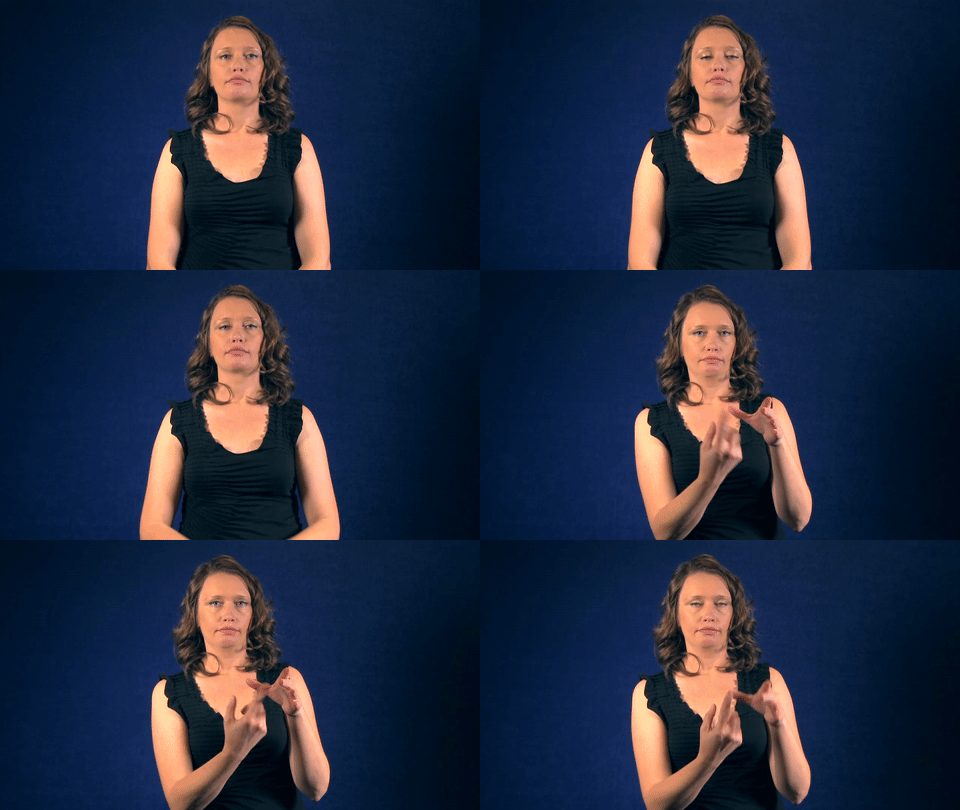
Sign for BLENDER in ASL

YouTube player

Practice Activities:

To build muscle memory and confidence with the sign for BLENDER in ASL, begin by practicing the sign in isolation. Stand in front of a mirror and repeat the sign slowly five to ten times, focusing on handshape, movement, and facial expressions. Gradually increase your speed as you become more comfortable and accurate.

Create flashcards with different kitchen appliances on them, including the sign for BLENDER in ASL. Shuffle the cards and sign each appliance as you draw it. This helps strengthen your ability to distinguish the sign in context and builds vocabulary related to home and kitchen themes.

Try using the sign in simple sentences such as “I use a blender every morning,” or “The blender is loud.” Practice translating these sentences from English to ASL and vice versa. This reinforces grammar structure while deepening your fluency with the sign for BLENDER in ASL.

Work with a partner to role-play a cooking situation. One partner gives signed instructions like “Add fruit,” or “Now use the blender,” while the other performs the actions. Keep the scenario playful, such as making a smoothie or preparing soup, to make the activity engaging and memorable.

Describe a morning routine and include the blender in your storytelling. For instance, you might sign about making breakfast where you use fruit, yogurt, and the blender. Pay attention to sequencing signs and use appropriate non-manual markers to show order and action.

Watch signed videos about cooking or kitchen setups and identify when the sign appears. Pause the video and mimic the sign for BLENDER in ASL for extra practice. Over time, you’ll boost your receptive skills and gain exposure to native usage.

These varied activities will help learners internalize and confidently use the sign for BLENDER in ASL in both structured and spontaneous conversations.

Cultural Context:

Understanding the sign for BLENDER in ASL requires more than just learning hand movements—it also involves appreciating how everyday appliances are expressed visually within Deaf culture. In American Sign Language, signs for common household items often reflect their function or physical appearance, and the sign for BLENDER in ASL is no exception.

Deaf culture emphasizes clear and effective visual communication. The sign for BLENDER in ASL typically mimics the motion or outline of how a blender operates. This connection to visual function makes it easier for Deaf individuals to immediately understand the object being referenced without needing to hear its name.

In family homes and educational settings where ASL is used, children learn functional vocabulary such as the sign for BLENDER in ASL through daily interaction and context. They see a blender being used to make smoothies, soups, or sauces and match that activity with the appropriate sign. This reinforces their understanding of the word’s meaning within real-life experiences.

The use of modern kitchen appliances in signed conversations has evolved as technology becomes more common in Deaf households. The sign for BLENDER in ASL has adapted to include variations that reflect different types of blenders, such as handheld or countertop models. This reflects the richness of ASL, where signs are often updated and modified to stay relevant in a changing world.

Within Deaf communities, sharing recipes and cooking methods is often done through visual storytelling. Instead of written instruction, many rely on video guides using ASL. The sign for BLENDER in ASL plays a key role in these videos when describing ingredients preparation, blending instructions, or equipment needed in the kitchen. It enhances the clarity of message and helps foster social connections around food and culture.

In Deaf-friendly cooking classes or community events, participants use the sign for BLENDER in ASL to discuss recipes and ingredients. These signs facilitate inclusive communication and allow everyone to participate equally—even when talking about the latest kitchen gadgets or cooking techniques. For many, using and understanding these signs builds a stronger sense of community and cultural identity.

Social media has also played a role in spreading awareness of signs like the sign for BLENDER in ASL. Influencers and educators frequently create ASL content that includes everyday terms and objects seen around the home. Viewing these videos provides visual reinforcement for learners and makes it easier to remember the sign through practical, real-world application.

In Deaf households, assigning chores or discussing daily routines often includes signs for household tools. Being able to use the sign for BLENDER in ASL allows everyone to communicate in a smooth

Extended Definition:

The sign for blender in ASL is a descriptive sign that mimics the motion of a blender’s blades spinning. To sign blender, both hands are commonly used to show the rotating movement inside a container. This action helps convey the concept of blending or mixing, much like a kitchen blender does when preparing smoothies or soups.

When teaching the sign for blender in ASL, it’s important to show how the hands move in a circular or rotating way. Some signers also include a base hand to represent the jar or container, while the other hand moves around it to mimic blending. This helps make the sign more iconic and easy to understand, especially for visual learners.

American Sign Language often uses classifiers or descriptive techniques for appliances, and the sign for blender is no exception. Since not all kitchen gadgets have one specific sign, many are described through basic handshapes and movements that suggest their function. The sign for blender in ASL fits this pattern by using motion to represent the typical action of blending ingredients.

In everyday conversations, especially in cooking contexts, using the sign for blender in ASL helps clarify the meaning quickly. For people who use ASL to share recipes or explain food prep, this sign becomes incredibly useful. It’s commonly used in deaf cooking classes, kitchen tutorials, and food-related content across social media.

Learning the sign for blender in ASL can also improve vocabulary related to kitchen tools. It pairs well with other signs like mix, chop, and cook. These signs together provide a full picture of the steps needed in meal preparation. Practicing them together can make conversations about cooking more fun and expressive.

Context is key when signing blender. If you’re teaching someone, make sure they understand it’s not just for any spinning motion—it’s the specific function of a blender that’s being shown. Reinforcing this can help avoid confusion with other signs that show turning or rotating.

When creating ASL content online, especially in videos or tutorials, including the sign for blender in ASL can engage more viewers. Emojis like can make content more fun, especially when used to show smoothie ingredients. This makes it easier for learners to connect the sign with its real-world use.

Kids learning ASL often enjoy signs like blender because they involve movement and imagination. Acting out the sign can feel like playing, which supports memory and enjoyment. In classrooms, this can be paired with pretend cooking or storytime activities that include food preparation.

Sharing the sign for blender in

Synonyms: mixer, food processor, liquidizer, emulsifier, liquefier

Educational resources: Find related learning materials in our course bank!

Want more? Check out some of our popular learning activities on the homepage!

Need to look up a sign? Use our highly rated dictionary: https://aslinteractive.com/best-asl-dictionary/

Follow us on tiktok: https://www.tiktok.com/@aslinteractive. More social media links at the bottom of this page!

Long-tail Keywords: what is the ASL sign for blender, how to sign blender in American Sign Language, what is the correct sign for blender in ASL

Categories:

tags: Objects, Kitchen, Appliances, Everyday activities, Language learning

Parameters

*Handshape*:

The handshape for the sign for BLENDER in ASL typically involves both hands forming the “S” handshape, with fists closed. The dominant hand rotates on top of the non-dominant hand in a small circular motion, simulating the rotating blades inside a blender .

This motion helps convey the mechanical blending action clearly. The sign for BLENDER in ASL uses simple yet descriptive handshapes to visually represent the function of a blender.

*Palm Orientation*:

For the sign for BLENDER in ASL, both hands typically face each other with palms oriented inward, fingers loosely curved as if holding the base and top of a blender. The dominant hand may twist slightly as if turning a blender blade or mimicking its motion.

In the sign for BLENDER in ASL, the fluid wrist motion gives the impression of blending. The palms remain facing each other, shifting slightly depending on the blend movement being mimicked.

*Location*:

The sign for BLENDER in ASL is typically made in the neutral space in front of the torso or chest area. Both hands are held in loose fists or modified “S” handshapes, rotating next to or on top of each other to mimic the blades of a blender.

This neutral space provides clear visibility and natural positioning for the sign for BLENDER in ASL. It allows easy demonstration of the circular motion and mechanical concept of a blender’s function.

*Movement*:

To show the sign for blender in ASL, begin with both hands in the “S” handshape facing each other near chest level. Rotate both fists in opposite circular motions, simulating the motion of blender blades swirling. This movement reflects the blades mixing ingredients inside a blender.

The motion may be repeated with a small bounce to emphasize blending action. The sign for blender in ASL visually represents the appliance’s function, helping convey the concept clearly.

*Non-Manual Signals*:

When using the sign for BLENDER in ASL, facial expressions should reflect the action of blending—slightly wide eyes and a mild focus in the brows to show concentration. A subtle pursing of the lips, as if mimicking the effort or noise of blending, can add clarity to the meaning .

The sign for BLENDER in ASL benefits from a neutral or slightly inquisitive head tilt, especially when describing how the appliance works. Keeping your expression engaged helps emphasize the function rather than just the object.

*Prosody, Dominant/Non-Dominant Hand*:

The sign for BLENDER in ASL uses both hands to mimic the function of a blender. The non-dominant hand remains still, palm facing inward and fingers slightly curved, representing the base or container. The dominant hand, shaped like a “C” or loose claw, circles above the non-dominant hand as if blending ingredients, with a slight twisting motion. This portrays the mixing action of the appliance.

The sign for BLENDER in ASL captures the tool’s motion clearly, using prosody to emphasize the blending effect. Movements are small and controlled, reflecting the machine’s function, and the rhythm depicts the consistent work of a typical kitchen blender .

Tips for Beginners:

When learning the sign for BLENDER in ASL, it’s essential to first visualize how a blender functions. Think about the sharp blades spinning around inside a container. This imagery helps in making your sign more accurate and meaningful. Use both hands to mimic the swirling motion, typically with your dominant hand on top of the non-dominant hand, imitating blending. Keep your fingers slightly curved to suggest a circular base.

Beginners often make the mistake of moving their hands too stiffly. A blender works with a fluid spinning motion, and your sign should reflect that. Practice your handshapes in front of a mirror to see if your motion appears natural and smooth. Overexaggerating the sign or signifying too slowly may make the sign awkward or confusing. Aim for a relaxed but deliberate pace.

To improve muscle memory for the sign for BLENDER in ASL, repeat it during conversations involving food, cooking, or kitchen appliances. You’ll get more comfortable if you associate it with real-life contexts. Rehearsing the sign while talking about making smoothies or recipes that need pureeing can help reinforce usage.

Watch native signers or trusted ASL resources online to compare your sign. Every motion in ASL has a specific purpose, and those slight variations can change the meaning or clarity. The sign for BLENDER in ASL should be distinctly different from signs like MIX or STIR, even if the concepts are somewhat related. Being aware of those boundaries helps avoid confusion.

Lastly, be patient with your learning curve. Mastering signs like the sign for BLENDER in ASL takes time and mindful repetition. Record yourself signing, review it, and adjust your movements. With diligence and mindful practice, your precision and confidence will increase .

sign for BLENDER in ASL, blender in American Sign Language, how to sign blender in ASL, ASL kitchen appliance signs, learn ASL for cooking

Connections to Other topics:

The sign for BLENDER in ASL connects closely with kitchen and appliance vocabulary, making it important for practical daily conversation. It is often used in contexts involving cooking, recipes, or smoothie-making, and pairs naturally with signs like MIX, LIQUID, FRUIT, or ICE. Learners can benefit from exploring the group of kitchen appliance signs like TOASTER, OVEN, and MICROWAVE, as these often use similar movement patterns that imply a machine or electrical device.

Understanding the sign for BLENDER in ASL can also reinforce concepts related to motion and transformation. The repetitive circular hand movements mimic the mechanical action of a blender, establishing a visual link to signs like STIR, SHAKE, or GRIND. These movement-based signs often serve to show what an object does, which is a key pattern in many ASL classifiers and depiction techniques.

This sign also encourages learners to explore compound ASL signs used in cooking sequences such as FRUIT + BLENDER for smoothie or MILK + BLENDER for milkshake. These combinations support more complex sentence building and convey sequential actions in a recipe or food preparation explanation. The concept of action-based machine use can lead learners toward discussing tools or gadgets using classifiers, like CL:1 for cords or CL:3 for mechanical parts.

From a linguistic perspective, learning the sign for BLENDER in ASL gives insight into how abstract actions are embodied into visual-spatial forms. This deepens understanding when transitioning to abstract signs like IDEA BLEND or COMBINE, which are metaphorically derived. Interpreters and ASL users can build on this by applying similar motion cues to describe figurative ideas or emotional mixing, expanding the expressive range.

In storytelling, especially with children or instructional settings, the sign for BLENDER in ASL helps bring scenes to life. Including signs representing kitchen noises, textures, and sequence of actions enriches the storytelling process. Learners can build sign fluency by incorporating it into practice dialogues around daily routines or food preparation narratives .

Summary:

The sign for BLENDER in ASL typically involves both hands mimicking a circular motion, resembling the spinning blades inside a blender. It often begins with hands held in front of the body, slightly apart, and fingertips pointing towards each other. The hands rotate in opposite directions to imitate the blending action.

Some variations of the sign may include a preparatory movement, symbolizing placing ingredients into a blender. This is followed by the characteristic circular motion. These visual cues allow the signer to depict the object’s use within real-life context, emphasizing ASL’s pictorial features.

Function is an important part of how ASL signs are conceptualized. Instead of focusing just on how a blender looks, the sign for BLENDER in ASL highlights what a blender does—mixing contents in a circular motion. This fits into ASL’s tendency to represent actions and processes over static descriptions.

In some dialectal versions of ASL, particularly in technical or culinary settings, the fingerspelled loan sign B-L-E-N-D-E-R might be used for specificity. This fingerspelled variant can accompany or even supplement the iconic sign. Context typically determines which version is most appropriate.

The sign for BLENDER in ASL falls into the category of classifier-built signs, especially when expanded to show function. Classifiers can also represent tools or devices and demonstrate how they are manipulated by people. Signers can use these classifiers to expand on the basic sign and even narrate how a recipe is made using a blender.

Grammatically, the sign for BLENDER in ASL can appear as a noun, indicating the object, or as a verb in discussions about food prep processes. This makes it versatile in a variety of sentence structures. Because ASL doesn’t require word-for-word translations, the sign might be positioned depending on sentence topic and focus.

In Deaf culture, cooking activities often include rich visual communication, and equipment like blenders becomes an expressive part of this environment. The sign for BLENDER in ASL can evoke shared experiences of family events, cooking together, or even learning culinary skills in Deaf education institutions. These cultural memories reinforce the sign’s significance beyond its mechanical meaning.

Within conversations about healthy living, smoothies, or home cooking, the sign for BLENDER in ASL might increase in frequency. This shows how signs grow in everyday relevance as lifestyle trends evolve. Media portrayal of cooking shows and recipes in ASL videos contribute to this visibility, giving the sign further cultural weight.

The process nature of the sign enables it to blend fluidly into narratives or instructional signing, often accompanied by facial expressions and body language emphasizing noises or effort of blending. ASL storytellers may use tempo, rhythm, and exaggeration during the sign to illustrate speed or kitchen drama. This dynamic range shows the language’s theatrical quality.

For linguistic analysis, this sign represents how ASL leverages iconicity—a sign’s visual similarity to what it represents. The circular movement mimics the function of a blender, ensuring ease of learning and memory retention. Iconicity supports both receptive and expressive learning, especially for visual learners, which is crucial in Deaf education.

Applied linguistically, the sign occupies a useful space in vocational training including culinary arts education for Deaf individuals. Its visual clarity makes it ideal for demonstration videos and cooking tutorials in ASL. Industry-specific vocabulary like this extends vocabulary domains for learners and bridges general language skills with technical or career-based fluency.

Other signs related to the sign for BLENDER in ASL might include signs for MIX, STIR, POUR, or CUP. These help to build sequences in cooking or food preparation. Many food-related ASL signs derive from either the action of interacting with the food or the tool used, showing ASL’s action-based vocabulary development.

In ASL morphology, the sign for BLENDER in ASL is considered an iconic lexical item, but it can be modified or elaborated with size and directionality. By widening the hand motion or quickening the speed, a signer can indicate a large or powerful blender. These aspects add semantic layers to the basic sign.

In both classroom and home environments, ASL learners at early stages might find the sign easy to imitate due to its transparency. Teachers often engage children or beginner learners with signs related to familiar appliances as they evoke real-life experiences. This makes the sign a useful teaching tool.

Parents and educators might employ the sign when teaching about safety in the kitchen. That can pair the sign for BLENDER in ASL with cautionary signs such as SHARP or HOT. Combining signs constructs rich visual lessons that are easy to understand and retain.

The evolution of the sign may also depend on regional variation, as with many ASL signs. In some parts of the U.S., especially in Deaf institutions with culinary programs, there may be a more stylized or technical version used for clarity. These variations show ASL’s dynamic and community-specific nature.

Technology continues to impact ASL vocabulary as new kitchen gadgets emerge. Signs for AIR FRYER

Want more? Check out some of our popular learning activities!

ASL Interactive Resources

ASLInteractive YouTube Channel

Follow us on tiktok: @aslinteractive.com

Follow us on Instagram: aslinteractive

Facebook page: aslinteractive

Facebook group: aslinteractive

LInkedIn: ASL Interactive LLC

Twitter: @ASL_interactive

*Some information on this page is AI-generated. AI can make mistakes. Please check the information.

Sign for BLENDER in ASL

Responses