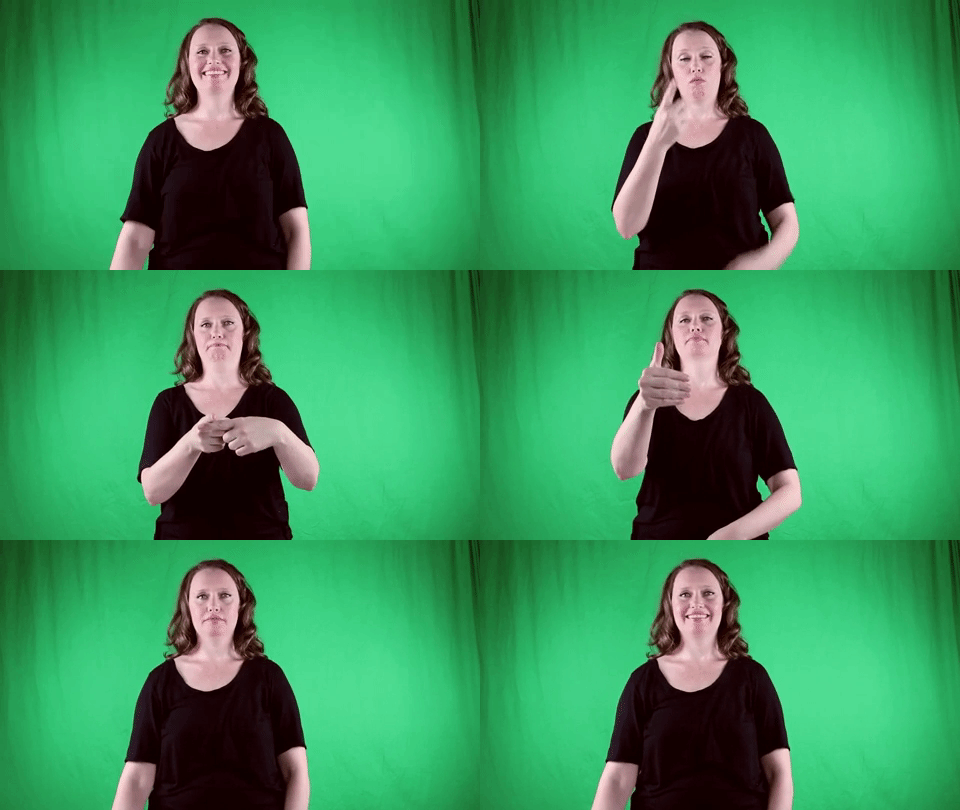
Definition: A short distance away.
Sign for BLOCK-AWAY in ASL

Practice Activities:
To practice the sign for BLOCK-AWAY in ASL, begin with repetition drills. Stand in front of a mirror and execute the sign slowly and clearly, focusing on each part of the movement and handshape. Pay close attention to the directionality involved, as this is key to conveying the correct meaning.
Once you’re comfortable with the sign in isolation, incorporate it into short phrases. Try using the sign for BLOCK-AWAY in ASL with simple subjects like “dog,” “child,” or “ball” to develop your fluency. For example, sign “The dog BLOCK-AWAY the ball” to illustrate a simple deflection or redirection action.
Contextual practice is important for deep learning. Create five short sentences that include events where blocking something away makes sense, such as stopping a ball, fending off negative energy, or preventing a fall. Sign each sentence with proper facial expressions and pacing, then try them again with slight variations to increase flexibility.
Storybuilding exercises can strengthen your narrative skills. Come up with a mini-story where you or a character has to block something unexpected away—such as protecting someone from a flying object or stopping a door from slamming. Use the sign for BLOCK-AWAY in ASL in the climax of your story to reinforce its emotional and physical impact.
For partner practice, take turns acting out short scenarios while the other person watches and identifies the use of the sign for BLOCK-AWAY in ASL. Switch roles and provide feedback on clarity and smoothness.
Use real-life contexts like sports or martial arts to incorporate the concept of blocking away. Watch brief video clips, pause, and describe what’s happening using the sign. Visual aids and imagined interactions help make the sign more meaningful and intuitive.
Cultural Context:
The sign for BLOCK-AWAY in ASL is a powerful expression often used in conversations involving social dynamics, personal boundaries, or even sports terminology. In Deaf culture, where visual language conveys nuance and emotion, signing BLOCK-AWAY accurately communicates the act of keeping something or someone at a distance.
The sign for BLOCK-AWAY in ASL is commonly seen when someone describes avoiding negativity or rejecting bad energy. In everyday social settings, Deaf individuals might use this sign when talking about blocking someone on social media or keeping a toxic person out of their life. It aligns with a broader cultural emphasis on emotional clarity and personal space.
In sports conversations, especially in games like basketball or volleyball, the sign for BLOCK-AWAY in ASL can convey an action where a player deflects the ball or prevents an opponent from scoring. The physical motion of the sign mirrors the real-world action, making it immediately clear to the viewer. This visual parallel adds depth to storytelling and game analysis in signed conversations.
Parents, teachers, or community leaders might use the sign for BLOCK-AWAY in ASL when advising someone to distance themselves from peer pressure or a harmful environment. It’s a sign that has grown more common as awareness of mental health and emotional boundaries increases. It becomes a tool for emphasizing respect for oneself and others.
In digital spaces, the concept of blocking is widespread, and the sign for BLOCK-AWAY in ASL reflects that cultural relevance. Deaf users on platforms like TikTok, Instagram, or Facebook often use this sign within videos or live chats to share stories about online interactions or relationships. It connects the digital world to real-life expression through sign language.
Movies and TV shows involving Deaf characters also show the sign for BLOCK-AWAY in ASL to indicate moments of decision or change. The sign may appear during a pivotal scene where a character chooses to walk away from a situation. Its quick yet firm movement conveys emotional resolve, resonating with viewers familiar with ASL.
In educational settings, the sign for BLOCK-AWAY in ASL is taught not just as vocabulary, but also as a way to discuss themes like conflict resolution and emotional safety. Sign language teachers emphasize the use of facial expressions and body language alongside the sign to ensure the meaning is clearly portrayed. It enhances visual storytelling and encourages deeper understanding.
For Deaf individuals who navigate both signing and mainstream hearing spaces, the sign for BLOCK-AWAY in ASL becomes a valuable symbol of empowerment. It gives people an immediate way to express very human experiences such as distancing
Extended Definition:
The sign for BLOCK-AWAY in ASL is used to communicate the idea of physically or metaphorically pushing something or someone away. This concept can apply to blocking an object, a person, or even an emotional reaction like pushing away unwanted feelings. It’s a versatile sign that can appear in both casual and more serious conversations, depending on the context.
In American Sign Language, the sign for BLOCK-AWAY in ASL often involves movement that shows stopping or redirecting something from coming closer. The motion is usually outward and firm, to visually convey the idea of obstruction followed by removal. Facial expressions play an essential role in enhancing the meaning, helping clearly express if the block is out of frustration, anger, or calm detachment.
This sign can be used during interactions where someone wants to express boundaries or limitations. For example, someone might use the sign for BLOCK-AWAY in ASL when discussing standing up to someone who is being disrespectful or harmful. It’s also useful in describing sports actions, like a player blocking another and moving them away from the goal.
Children can use the sign when setting personal space boundaries during play or arguments. In classroom settings, teachers might employ this sign to illustrate stopping negative behavior or redirecting focus to a positive direction. The sign provides a visual and direct way to show cause and reaction, making it perfect for storytelling and role-play.
The sign for BLOCK-AWAY in ASL may be adapted slightly depending on the signer’s style, region, or context. However, the general movement and positioning stay consistent to ensure clarity. As with many ASL signs, understanding the surrounding conversation helps provide cues to the exact meaning.
Non-verbal cues like body shift, eye gaze, and intensity of movement add layers of meaning to this particular sign. A gentle motion might suggest a casual “no thanks,” while a sharp motion can clearly express rejection or defense. Mastering these subtle differences ensures your use of the sign for BLOCK-AWAY in ASL is both effective and natural.
You can combine this sign with other ASL vocabulary to create full sentences or express complex situations. For example, pairing it with signs like “friend,” “idea,” or “problem” can show blocking away a relationship, thought, or issue. This flexibility makes the sign for BLOCK-AWAY in ASL an excellent addition to your signing vocabulary.
When learning this sign, it’s helpful to watch native signers or ASL instructors demonstrate its proper use. Practicing in front of a mirror can also help refine
Synonyms: block, obstruct, impede, hinder, barricade
Educational resources: Find related learning materials in our course bank!
Want more? Check out some of our popular learning activities on the homepage!
Need to look up a sign? Use our highly rated dictionary: https://aslinteractive.com/best-asl-dictionary/
Follow us on tiktok: https://www.tiktok.com/@aslinteractive. More social media links at the bottom of this page!
Long-tail Keywords: what is the sign for block-away in ASL, how do you sign block-away in ASL, block-away in American Sign Language
Categories:
tags: Commands, Actions, Language Learning, Everyday Activities, Classroom Picture
Parameters
*Handshape*:
The handshape for the sign for BLOCK-AWAY in ASL starts with both hands in open flat handshapes, commonly referred to as “B” hands. The palms face each other as they build a visual wall or obstruction.
To complete the movement, one hand pushes outward in a forceful motion, symbolizing the block being moved or pushed away. This dynamic handshape combination effectively conveys the concept behind the sign for BLOCK-AWAY in ASL .
*Palm Orientation*:
The palm orientation for the sign for BLOCK-AWAY in ASL begins with the dominant hand in a flat “B” handshape, palm facing inward toward the non-dominant side. As the movement progresses, the palm flips outward, facing away from the body to show the motion of blocking and then pushing away.
This shifting palm orientation helps convey the directional force behind the action in the sign for BLOCK-AWAY in ASL, enhancing its visual clarity and impact.
*Location*:
The sign for BLOCK-AWAY in ASL is typically produced in the neutral space directly in front of the upper torso, slightly away from the body. Hands are brought together at chest level, then move outward to indicate deflection or obstruction followed by separation, showing something is being blocked and sent away.
This spatial movement in front of the body is key to visually conveying the meaning of the sign for BLOCK-AWAY in ASL. Make sure to maintain a consistent location to ensure clarity and accurate interpretation.
*Movement*:
To sign the sign for BLOCK-AWAY in ASL, begin with both hands open and slightly curved, palms facing inward toward each other. Position the dominant hand near your chest and the non-dominant hand further out in front. Push the dominant hand forward in a quick, forceful motion so it hits or nearly touches the non-dominant hand and pushes it away from the body .
This action simulates the idea of blocking something and forcing it to move or deflect away from you. The sign for BLOCK-AWAY in ASL carries a directional emphasis as the hands move away from the signer to indicate distance or deflection.
*Non-Manual Signals*:
When signing the sign for BLOCK-AWAY in ASL, the facial expression should show resistance or determination. Eyebrows may be slightly furrowed and lips can be pursed to emphasize the physical action of blocking something forcefully away from the body.
Head movement often leans slightly back during the motion to reinforce the defensive action. Eye gaze usually follows the direction of the pushing motion to support the spatial meaning in the sign for BLOCK-AWAY in ASL.
*Prosody, Dominant/Non-Dominant Hand*:
The sign for BLOCK-AWAY in ASL uses the dominant hand in a flat B-handshape facing outward, palm out. The non-dominant hand also forms a B-handshape and faces inward, palm toward the body. Both hands move away from each other horizontally, pushing outward as if physically blocking something from approaching.
The motion should be firm but not aggressive, reinforcing the concept of deflecting or stopping access. Eyebrows may furrow for emphasis. The sign for BLOCK-AWAY in ASL often includes a slight shoulder movement to signify the resistance or denial of entry.
Tips for Beginners:
When learning the sign for BLOCK-AWAY in ASL, it’s important to start with understanding its context. This phrase typically implies a physical obstruction being pushed or moved away from someone or something. Use both hands in a pushing motion, starting close to your body and pushing forward and slightly outward. Make sure the movement is deliberate and the handshape remains open and firm.
Focus on the directionality of the motion when practicing the sign for BLOCK-AWAY in ASL. The extension of the gesture symbolizes distance or separation, and that should come across clearly. Beginners often mistake this motion for similar directional signs, so take the time to distinguish each one by focusing on both the angle and speed.
Facial expressions are key in enhancing clarity. If you’re expressing a forceful or emotional block away, your eyebrows might be furrowed or your mouth could show tension. Using the appropriate non-manual markers makes the sign visually stronger and more expressive. Practicing in front of a mirror can help you evaluate both your hand movements and your expressions.
A common drawback for beginners is rushing the movement. A rushed sign can look sloppy and lose its intended meaning. Slow down and exaggerate a bit when you’re first learning. Once your positioning and motion are more automatic, you can begin to refine it for smooth and natural communication.
Another helpful strategy is watching native signers or ASL teachers regularly use the sign for BLOCK-AWAY in ASL in conversation. Try recreating the motions in sync with a video. Repetition, especially with accurate models, is essential for achieving muscle memory . Importantly, pair your practice with real-life application—use the sign during ASL chats or in sentences.
Remember, signs like the sign for BLOCK-AWAY in ASL may vary slightly based on regional or situational usage, so stay curious and receptive to feedback from fluent users .
Connections to Other topics:
The sign for BLOCK-AWAY in ASL connects closely with directional signs and spatial classifiers, which are central to the grammar of ASL. This concept often involves depicting movement away from a space or person, making it useful in a wide variety of sentence structures. It can represent both literal and figurative ideas, such as physically blocking someone or emotionally distancing oneself.
It also shares characteristics with other blocking or movement-based signs like STOP, PUSH-ASIDE, and DEFLATE. These signs often use similar handshapes and directionality to convey a disruption or change in course. Understanding these associations can help learners recognize patterns in ASL and build vocabulary more intuitively.
BLOCK-AWAY is often used in compound ideas, such as in sports contexts like BLOCK-AWAY-BALL or in conflict situations such as BLOCK-AWAY-ARGUMENT. These compound signs are visually descriptive, and their components combine smoothly. This kind of blending reinforces how ASL relies heavily on conceptual layering rather than linear word order.
This sign is also semantically tied to notions of rejection and boundary-setting, similar to REJECT, AVOID, or DEFLECT. These signs often appear in narratives where personal or social distance is a key theme. Recognizing these relational meanings in the sign for BLOCK-AWAY in ASL increases fluency by allowing users to express subtle emotional shifts physically.
The sign’s movement away from the signer or another person also highlights the spatial nature of ASL. It orients the focus on where things are happening, which is vital in stories, explanations, or even casual conversation. Because ASL is visual and scoped in space, signs like BLOCK-AWAY reflect how interactions unfold within that three-dimensional space.
In learning the sign for BLOCK-AWAY in ASL, students also become equipped to use visual metaphors common in the language. From social boundaries to physical movement, this sign’s use crosses into many areas of human interaction, making it a versatile and rich addition to any signer’s vocabulary.
Summary:
The sign for BLOCK-AWAY in ASL blends directional language and spatial referencing to communicate obstruction or prevention from a distance. Typically, it involves the dominant hand in a flat-B shape pushing outward as if encountering an invisible wall, representing a clear barrier.
This sign uses spatial movement to suggest not just blocking, but doing so at a distance. The sign often references something not physically close but still being obstructed–as in keeping someone or something from gaining access.
The sign aligns with the classifier approaches in ASL, where handshape, location, and movement construct meaning. BLOCK-AWAY evokes a sense of physicality even when describing abstract concepts like preventing an idea or influence.
Grammatically, the sign for BLOCK-AWAY in ASL often operates as a verb. It can be adapted for tense, intensity, and direction, depending on the signer’s use of space and facial expression.
Facial grammar plays a key role—an intense expression may indicate a strict or emotionally charged block. A neutral face may suggest a routine or impersonal action, such as security procedures or automated restrictions.
The sign is related to signs such as STOP, BARRIER, and PREVENT. But BLOCK-AWAY adds the dimension of redirecting or resisting something not immediately present, emphasizing exclusion and interpersonal dynamics.
This sign carries cultural significance, especially in conversations around identity, privacy, or emotional boundaries. In the Deaf community, clarity and ethical communication are highly valued; BLOCK-AWAY may metaphorically signal disconnection or conscious disengagement.
Deaf culture emphasizes inclusion and social balance. When the sign for BLOCK-AWAY in ASL is used, it may carry the social weight of deliberate detachment, which is significant in contexts like confronting discrimination or establishing safe boundaries.
The sign is a part of spatial grammar in ASL, where relationship and proximity are indicated through physical space. BLOCK-AWAY is typically signed away from the body, underscoring its spatial metaphor.
There is a linguistic parallel to prepositional concepts in English, such as “blocked from” or “kept away.” Yet in ASL, these relations are seamlessly embedded within the sign’s space and movement.
Applied linguistics ties in through the analysis of discourse and pragmatics. The sign for BLOCK-AWAY in ASL regularly appears in narratives where context must define who is blocking and who is being blocked.
In storytelling, the signer might place a person in signing space, then perform BLOCK-AWAY towards them. This creates a visual, nuanced way to explain social exclusion or protective barriers.
The sign supports ASL’s three-dimensional affordance. It is not confined to the linearity of spoken language, allowing richer expression through simultaneous channels like facial expression and directional movement.
It also links to cognitive linguistics, where meaning is constructed not just by lexical items but through embodiment and space. BLOCK-AWAY demonstrates how physical gestures can embody abstract concepts such as restraint or censorship.
In educational or psychological settings, BLOCK-AWAY may be used to discuss concepts like emotional boundaries or coping mechanisms. Its metaphorical richness serves diverse discussions, extending well beyond its literal interpretation.
The sign can symbolize shutting off access, whether physical, emotional, or conceptual. This makes it useful in therapy, social commentary, and interpersonal communication.
Variation exists, including how far the hand moves when signing BLOCK-AWAY. A more vigorous extension may suggest forceful rejection or blocking of serious threats.
In regional variation, some signers may pair this sign with an intensified facial expression or double movement. These subtleties reflect regional, individual, or situational nuances.
From a technological or social media context, the sign for BLOCK-AWAY in ASL gains modern relevance. It may be used to describe actions such as blocking someone online or denying digital access, a prime example of language evolution.
As new technologies emerge, existing signs adapt to encompass new meanings. BLOCK-AWAY now bridges both traditional and online realms of interaction.
In interpreting settings, precise use of the sign for BLOCK-AWAY in ASL is crucial. Misinterpretation can alter meaning dramatically—turning a defensive action into one of animosity or vice versa.
Interpreters must be sensitive to prosodic features in the original message. The sign may require modulation to reflect sarcasm, seriousness, or neutrality based on speaker intent.
In poetry and performance art, BLOCK-AWAY can be magnified for dramatic impact. Paired with freeze frames, it can depict emotional separation or unforgettable moments of defiance.
ASL literature often expands simple signs like BLOCK-AWAY into visual metaphors. A signer might BLOCK-AWAY a memory, a toxic figure, or even a past version of self.
Sociolinguistic analysis shows that signs like BLOCK-AWAY express power dynamics. Who blocks whom, and why, reveals underlying relationship structures within a narrative.
BLOCK-AWAY interacts with discourse strategies involving conflict management or resolution in ASL communication. Its clarity provides a respectful but direct way to establish limits.
Children learning ASL can
Want more? Check out some of our popular learning activities!
ASL Interactive Resources
ASLInteractive YouTube Channel
Follow us on tiktok: @aslinteractive.com
Follow us on Instagram: aslinteractive
Facebook page: aslinteractive
Facebook group: aslinteractive
LInkedIn: ASL Interactive LLC
Twitter: @ASL_interactive
*Some information on this page is AI-generated. AI can make mistakes. Please check the information.


Responses