Sign for BLOUSE in ASL | 👕 ASL Dictionary

Definition: A woman’s shirt.

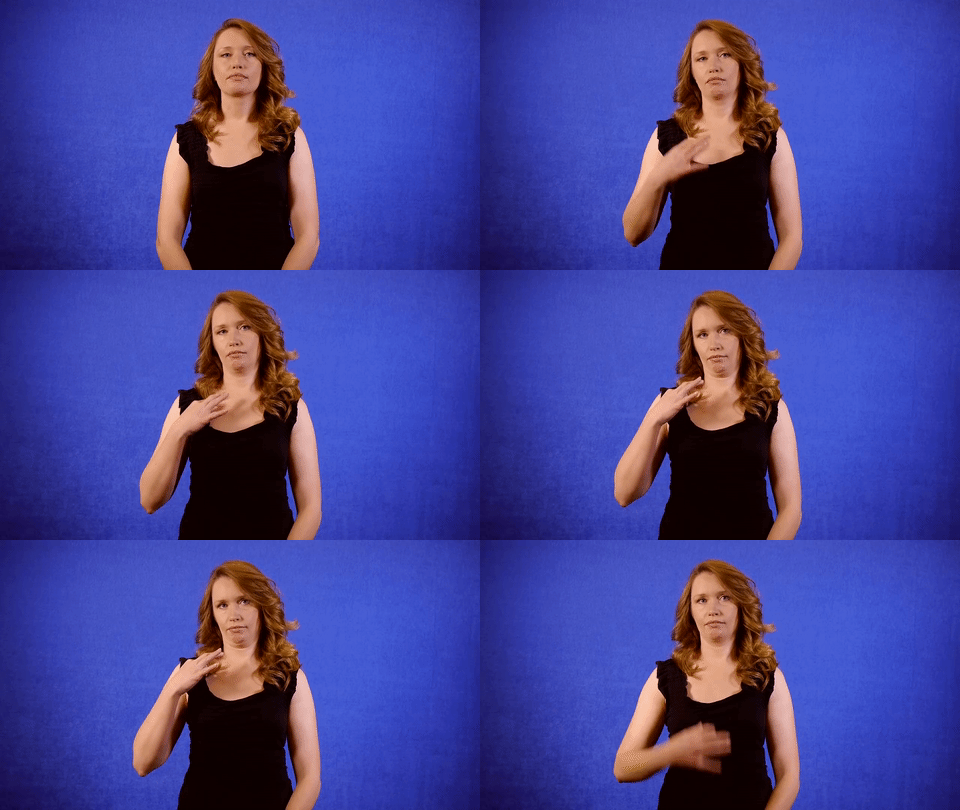
Sign for BLOUSE in ASL

YouTube player

Practice Activities:

To practice the sign for BLOUSE in ASL, begin by mastering the basic movement. Stand in front of a mirror and practice the sign in isolation until the motion feels natural. Focus on the handshape, location, and movement to ensure you are clearly representing the sign. Repeat the sign several times while saying the word silently to strengthen muscle memory.

Next, incorporate the sign for BLOUSE in ASL into short phrases. Start with simple examples such as “I wear a blouse” or “Her blouse is red.” Sign each sentence slowly and clearly, then increase your speed as confidence builds. You can vary the practice by using different colors, patterns, or types of blouses in the sentence, such as “The blue blouse is pretty” or “My friend bought a new blouse.”

Try using storytelling prompts to add context to your practice. For example, describe what someone wore to a party, including the sign for BLOUSE in ASL. You might say, “She came to the dinner wearing a sparkly blouse and black pants.” This helps build fluency by combining multiple signs related to clothing and events.

Engage in partner activities where one person describes an outfit using sign while the other guesses or selects the described blouse from a group of pictures. You can also play a dress-up game by signing which clothing item you are putting on, emphasizing the sign for BLOUSE in ASL.

Use flashcards with outfits or wardrobe items and sign each one as you reveal it. End the session by creating a short skit or dialogue where characters discuss their clothes, ensuring multiple uses of the sign for BLOUSE in ASL appear naturally in conversation. These varied activities reinforce understanding, confidence, and help make the sign a comfortable part of your expressive vocabulary.

Cultural Context:

Understanding the sign for BLOUSE in ASL goes beyond a simple fashion item. In Deaf culture, clothing signs like this one are essential tools for clear and respectful communication, representing more than just wardrobe choices—they reflect identity and individual expression.

The sign for BLOUSE in ASL is commonly used in everyday conversations, especially when describing clothing, shopping preferences, or personal style. In the Deaf community, being able to describe what someone is wearing, including specific items like a blouse, helps with visual storytelling and context in social settings.

American Sign Language is rich with descriptive classifiers and visual cues, and the sign for BLOUSE in ASL often includes shape and location on the body to show where and how the blouse fits. This visual detail helps signers express more than just the word; it conveys the blouse’s appearance, making communication more vivid and complete.

Cultural norms in the Deaf community also emphasize the importance of clear, respectful communication. Using the correct sign for articles of clothing like a blouse shows awareness and cultural sensitivity. It’s especially important in educational settings and interpreting work, where accurate expression of clothing terms improves understanding and professionalism.

The sign for BLOUSE in ASL can change slightly depending on regional dialects or whether someone is signing formally or casually. Just like spoken languages, ASL has regional variations, and cultural context helps users recognize these differences while fostering mutual understanding.

Fashion plays a role in identity and self-expression, and knowing how to sign specific clothing items empowers Deaf individuals to share their style choices freely. Whether in a retail environment, describing an outfit for work, or in a classroom, using the sign for BLOUSE in ASL supports clear and inclusive interactions.

In social media content, fashion blogs, or influencer videos within the Deaf community, the sign for BLOUSE in ASL appears regularly. By blending ASL with mainstream culture, Deaf creators help bridge communication gaps and allow greater social integration and representation.

Understanding how to use the sign for BLOUSE in ASL also benefits interpreters and learners of ASL. Mastery of clothing vocabulary increases fluency and allows for more nuanced translations when interpreting conversations that reference outfits or style choices.

In community events, Deaf theater, or performances, costumes often feature prominently, so knowing how to describe them accurately, including specific terms like blouse, adds richness to storytelling. The correct use of the sign for BLOUSE in ASL enhances visual clarity and supports the artistic intention.

By highlighting the sign for BLOUSE in ASL, we recognize the deep

Extended Definition:

The sign for blouse in ASL is a common vocabulary word in American Sign Language, especially when discussing clothing, fashion, or daily routines. This sign plays an important role when describing what someone is wearing or planning to wear. It typically appears during conversations about outfits, shopping trips, or when explaining laundry and wardrobe preferences.

To produce the sign for blouse in ASL, you’ll use both hands to trace the sides of an imaginary loose-fitting woman’s upper garment, typically from the shoulders outward. The motion gives the visual sense of a blouse being puffed out from the chest. It captures the flowing or more structured design of a traditional blouse, which often distinguishes it from a T-shirt or shirt in both English and American Sign Language contexts.

Understanding the sign for blouse in ASL helps build essential vocabulary for casual conversations and fashion-related signing. Since clothing is such a fundamental part of daily communication, this sign is useful across many different social and professional settings. Deaf and hard-of-hearing individuals frequently include clothing signs as part of their basic sign vocabulary, and blouse is no exception.

This sign also serves a valuable role in ASL classes for beginners and intermediate learners. Teachers often introduce clothing signs like the sign for blouse in ASL while teaching lessons on self-description, weather, seasonal attire, and daily routines. Visual learners usually find this vocabulary word memorable due to the expressive handshape and movement associated with clothing.

It’s important to note cultural context, too. The word blouse might specifically refer to a style of woman’s clothing in English, but in ASL, the sign conveys this idea more visually through shape and fit. As a result, context plays a key role in choosing whether to use the sign for blouse in ASL or to use a more general sign for shirt or top depending on the conversation.

When talking about shopping, dressing habits, fashion trends, or personal style, learners and fluent signers alike often incorporate the sign for blouse in ASL. It’s commonly used onsite in clothing stores where visual communication is needed, and during video calls when describing what someone is wearing. In these interactions, clarity in visual description becomes extra important, which is where this sign proves especially helpful.

Learning how to recognize and produce this sign correctly helps foster better communication and helps build visual language fluency. Like many ASL vocabulary terms, the sign for blouse in ASL emphasizes how gesture, facial expression, and body language combine to create meaning. Practicing and reinforcing this sign in various contexts will support retention and fluency

Synonyms: shirt, top, tunic, pullover, chemise

Educational resources: Find related learning materials in our course bank!

Want more? Check out some of our popular learning activities on the homepage!

Need to look up a sign? Use our highly rated dictionary: https://aslinteractive.com/best-asl-dictionary/

Follow us on tiktok: https://www.tiktok.com/@aslinteractive. More social media links at the bottom of this page!

Long-tail Keywords: what is the sign for blouse in ASL, how do you sign blouse in American Sign Language, ASL sign for blouse

Categories:

tags: Clothing, Language Learning, Everyday Activities, Appearance, Describing Residence

Parameters

*Handshape*:

The handshape for the sign for BLOUSE in ASL uses relaxed open hands with fingers slightly curved, resembling the shape of a blouse. Both hands begin near the shoulders and move down and slightly inward, tracing the outline of a blouse or sleeves.

This gesture highlights the garment’s placement on the upper body. The sign for BLOUSE in ASL effectively mimics the way a blouse is worn and emphasizes its typical shoulder-to-waist coverage.

*Palm Orientation*:

In the sign for BLOUSE in ASL, both hands begin near the upper chest or collarbone area. The palm orientation starts with the palms facing inward toward the body, as if grasping the edges of an invisible blouse fabric.

As the hands move outward and slightly downward, the palms maintain their inward facing position. This palm orientation helps visually represent the outline and shape of a blouse, making the sign for BLOUSE in ASL visually descriptive and intuitive .

*Location*:

The sign for BLOUSE in ASL is produced near the upper chest and shoulder area, reflecting where a blouse would naturally sit on the body. Both hands start near the sides of the chest and move outward, mimicking the shape or outline of a blouse.

This location helps visually anchor the meaning of the sign for BLOUSE in ASL, making it intuitive and easy to remember. The movement around the shoulders strengthens the connection to the garment.

*Movement*:

To perform the sign for BLOUSE in ASL, begin by placing both hands near your shoulders, palms facing down with fingers slightly curved as if grabbing fabric. Pull your hands slightly outward and downward, mimicking the action of adjusting or fluffing a blouse at the shoulders.

The sign for BLOUSE in ASL visually represents the puffed sleeves or tailored top part of a blouse. This movement helps convey the specific garment being depicted, differentiating it from similar clothing signs like “shirt” or “jacket” .

*Non-Manual Signals*:

When performing the sign for BLOUSE in ASL, the facial expression should remain neutral or pleasant. Slight eyebrow movement may occur if the sign is part of a question or sentence requiring clarification. Maintain eye contact with your conversation partner to support clear communication. The non-manual signals complement the movement of the hands to fully convey the meaning of the sign for BLOUSE in ASL without overwhelming the viewer.

*Prosody, Dominant/Non-Dominant Hand*:

The dominant and non-dominant hands both play a role in the sign for BLOUSE in ASL. Using a relaxed “5” handshape on each hand, the signer starts by lightly touching the fingertips near the upper chest on each side, mimicking where a blouse would sit. Then, the hands move downward and slightly outward, tracing the outline of the blouse. This sign visually reflects the shape and drape of the clothing, making the sign for BLOUSE in ASL iconic and intuitive.

Tips for Beginners:

When learning the sign for BLOUSE in ASL, it’s important to be mindful of location and hand movement. The sign typically mimics the motion of putting on a blouse—starting near the shoulders and curving slightly outward. Practicing this smoothly and in front of a mirror can help ensure your motion looks natural and expressive .

Keep your hands relaxed and use your face to show nuance when appropriate. Even though this is a straightforward sign, adding a slight smile or neutral expression helps it feel more conversational. If your movements look stiff, the sign may not be as easily understood.

One common mistake beginners make with the sign for BLOUSE in ASL is confusing it with similar signs like SHIRT. Watch for the orientation of your hands and be sure you’re signing near the correct part of your torso. BLOUSE tends to be broader and slightly more downward, while SHIRT often involves a small pinch at the chest.

Focus on differentiating the movement. In the sign for BLOUSE in ASL, you’re showing how a blouse would go over your shoulders, implying more coverage and a looser fit than a shirt. Don’t rush through the motion, as that can make the sign too vague or resemble another concept.

Practice the sign in context, such as by incorporating it into a sentence about shopping, dressing, or describing clothing styles. This helps build confidence using it in real-life conversations. Watching fluent signers model the sign in videos or live conversations can also enhance your memory and accuracy .

Finally, don’t be afraid to ask for feedback. Signing with others and getting gentle corrections is often the fastest way to improve. The more you use the sign for BLOUSE in ASL in everyday examples, the more natural it feels.

Connections to Other topics:

The sign for BLOUSE in ASL connects closely to signs related to clothing in general, such as SHIRT, DRESS, JACKET, and CLOTHES. Learners often benefit from grouping signs that describe garments, as this helps them identify common elements in handshape, location, and movement. BLOUSE typically involves a movement that highlights the cut or shape of the garment, often mimicking how a blouse fits or hangs on the body.

This sign also shares conceptual space with gender-specific or formal clothing signs like SKIRT and TIE. In context, the sign for BLOUSE in ASL might be used more frequently in conversations that touch on fashion, dressing appropriately, or preparing for an event. For example, a compound phrase such as NICE BLOUSE might pair the sign nicely with the sign for NICE, reinforcing descriptive and evaluative language.

Understanding the distinction between the sign for BLOUSE in ASL and signs like SHIRT or SWEATER helps learners deepen their skills in choosing precise vocabulary in context. These differences are not only lexical but also cultural, as clothing can signal formality, professionalism, or even personality in Deaf culture just as in hearing contexts. Using the correct sign, instead of fingerspelling every detail, shows both fluency and cultural awareness.

Some signs for clothing also share classifiers and can shift into iconic or classifier representations depending on the context. For instance, if discussing several articles of clothing laid out before a trip, a signer might use classifiers to indicate general positioning or shape, after signing BLOUSE for a specific item.

Additionally, when storytelling or describing a character, the sign for BLOUSE in ASL can be accompanied by facial expressions and other descriptors to show fabric type or emotional tone. This links the sign to broader narrative and descriptive structures within ASL, making it not only a vocabulary item but a tool of expression as well .

Summary:

The sign for BLOUSE in ASL is both visually descriptive and culturally rooted in how clothing is represented in Deaf culture. It commonly mimics the motion of putting on or adjusting a loose-fitting woman’s top, capturing the essence of the garment’s style.

This sign typically begins with both hands open near the shoulders, palms facing down or slightly backward, and then moves downward along the chest. The hands often curve slightly outward at the wrists to suggest the spatial shape of a blouse’s fabric and sleeves.

The motion conveys not only the act of putting on a blouse but also highlights the garment’s flowing, typically feminine cut. This reinforces how ASL uses iconic representation, allowing visual analogy to play a key role in understanding.

In Deaf culture, clothing signs often center on functionality and visibility. Clothing is a deeply expressive topic, and the sign for BLOUSE in ASL fits into that broader theme of showing rather than telling.

Many ASL signs for clothing items reflect their form or use. For example, the signs for SHIRT, DRESS, or JACKET utilize similar body reference points and pantomimic qualities, parallel to the sign for BLOUSE in ASL.

The gender dimension of the blouse is linguistically significant. While not always strictly gendered, this sign carries implied associations with femininity due to how clothing is culturally framed in both hearing and Deaf communities.

Grammatically, the sign functions like a noun, and it often pairs with classifiers or descriptive signs in ASL to elaborate on color, style, or fit. A signer might use BLOUSE in ASL followed by a sign for RED or LONG-SLEEVED, creating a descriptive sequence.

The sign’s placement in ASL syntax follows typical noun-adjective or noun-descriptive structures. This aligns with the visual-spatial nature of signed languages, where context and depiction happen in real time.

From a linguistic standpoint, the sign represents an iconic and partially mimetic approach common in ASL vocabulary. Language learners can deduce the meaning through movement and location, which supports visual learning mechanisms inherent to sign language acquisition.

Applied linguistics sees value in using signs like BLOUSE in ASL to teach language categories, promote vocabulary growth, and enhance retention. Because it is easy to associate the motion with the concept, it offers intuitive access for learners.

It’s interesting to note that regional and generational differences may slightly alter how this sign is performed. Some older signers may use a variation that emphasizes neckline or sleeve features more directly.

Like many clothing-related signs, BLOUSE connects to broader identity themes. In ASL discourse, signs for garments can carry connotations of formality, gender roles, and even time period, all expressed visually.

Interpreters must be aware that the sign for BLOUSE in ASL may lose meaning if it’s signed too generically in a fast-paced conversation. Careful embodiment of the gesture ensures accuracy and avoids confusion with SHIRT or DRESS.

When combined with classifiers, the blouse’s material or embellishments can also be described. For example, showing a frilly blouse might involve finger fluttering to indicate lace or texture, expanding beyond the primary sign itself.

Some bilingual environments may see fingerspelling used for blouse, especially when referring to specific brands or catching someone’s attention to a unique type of blouse. This reinforces the versatility of ASL.

The sign for BLOUSE in ASL also interfaces with Deaf fashion events, where expressive clothing and signs intersect. In such settings, the sign may be exaggerated or stylized for clearer performance and visual impact .

ASL poetry that involves clothing often turns simple garment signs into metaphors for self-expression, empowerment, or restriction. A blouse in such contexts might symbolize tradition or femininity, depending on the narrative.

Within storytelling, this sign can help establish characters. For example, when signing a story featuring different personalities, clothing signs like BLOUSE in ASL contribute to character identity and visual clarity.

From a teaching perspective, introducing students to the sign through real clothing or visual aids strengthens semantic mapping. A physical blouse reinforces the shape and motion involved in the sign.

In Deaf children’s literature, the sign might be paired with matching illustrations or puppet-based visuals to help young learners incorporate vocabulary into their language banks

Learners of ASL benefit from practicing the sign in context, such as describing someone’s outfit or role-playing a shopping scenario. Doing so makes the sign meaningful and situates it in practical, communicative use.

Many ASL users incorporate facial expressions when signing BLOUSE, especially when emphasizing beauty, distaste, or surprise at the design. These expressions add an emotional layer to the otherwise lexical item.

Cultural awareness also includes understanding when and how certain clothing signs are appropriate. Some communities are more conservative, while others embrace expressive signing and detail about clothing styles.

The sign can also be part of more casual or flirtatious body language, depending on context. Signing BLOUSE while describing someone might carry tones of

Want more? Check out some of our popular learning activities!

ASL Interactive Resources

ASLInteractive YouTube Channel

Follow us on tiktok: @aslinteractive.com

Follow us on Instagram: aslinteractive

Facebook page: aslinteractive

Facebook group: aslinteractive

LInkedIn: ASL Interactive LLC

Twitter: @ASL_interactive

*Some information on this page is AI-generated. AI can make mistakes. Please check the information.

Sign for BLOUSE in ASL

Responses