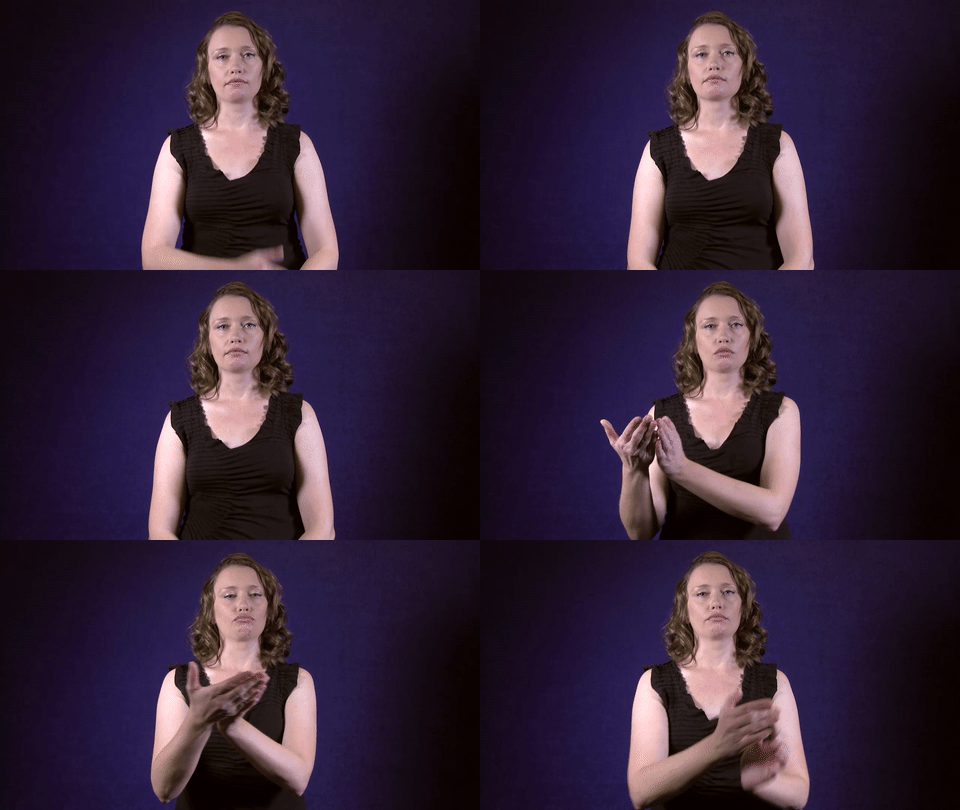
Definition: To travel by boat from one place to another.
Sign for BOAT FROM TO in ASL

Practice Activities:
Start your practice by signing the sign for BOAT FROM TO in ASL slowly and clearly in front of a mirror. Use your hands to show the movement of a small boat traveling from one point to another, emphasizing the direction of travel. Repeat this action several times while visualizing different scenarios where a boat moves from one place to another.
Next, create simple example sentences using the sign for BOAT FROM TO in ASL. For example, sign: “BOAT FROM FLORIDA TO BAHAMAS” or “BOAT FROM HARBOR TO ISLAND.” Focus on incorporating appropriate facial expressions and directional movement. Practicing with a partner can help you see if your directions and signs are clear.
Set up a role-play activity with a friend where one person gives travel instructions involving a boat route, and the other acts it out or signs it back. You could act out stories like taking a boat from a city to a beach or from a port to a fishing spot. Try changing locations each time to keep the practice dynamic.
Use storytelling as a creative way to practice. Develop a short story involving a journey by boat that requires signing multiple locations. For example, tell a story about going on a vacation cruise, making stops at different islands—perfect for using the sign for BOAT FROM TO in ASL multiple times with different place names.
Record videos of yourself signing about boat trips, then watch to check for clarity in handshape, direction, and fluidity. You can also label places on a map and describe how a boat travels between them using the sign for BOAT FROM TO in ASL. This builds spatial awareness and strengthens directional signing.
Cultural Context:
In American Sign Language, the sign for BOAT FROM TO in ASL captures a very specific concept related to movement and direction involving a boat. This phrase is used when describing travel or transport by boat from one place to another. It focuses on the motion and transition rather than just the idea of a boat.
The sign for BOAT FROM TO in ASL is most commonly used in storytelling, casual conversation, and when giving or asking for directions. Deaf signers often use this phrase to explain where a boat has come from and where it is heading. The movement within the sign itself mirrors the concept of travel, which is deeply tied to the visual nature of ASL .
In Deaf culture, clear communication of direction and movement is important, especially when involving transportation or places. The sign for BOAT FROM TO in ASL allows signers to describe journeys across water with precision. It adds richness to discussions about travel and storytelling experiences involving boats or ferry rides.
This phrase also becomes relevant in conversations about vacations, geography, and history. For example, someone might explain how they traveled by boat from the mainland to an island. The sign for BOAT FROM TO in ASL helps express these ideas in a visually intuitive way ️.
In many types of visual storytelling within Deaf communities, transportation signs are frequently used to show sequence and narrative. The sign for BOAT FROM TO in ASL is used to create fluid transitions in signed stories and signed performances. Its use helps maintain clarity and timing that align with the nature of moving from one place to another.
Cultural events and daily life also introduce contexts for this sign. In areas where boat travel is common, such as islands or coastal cities, the sign for BOAT FROM TO in ASL becomes part of everyday vocabulary. Whether you’re talking about a fishing trip, a ferry commute, or a scenic tour, this phrase allows the conversation to flow smoothly.
Because ASL is a spatial language, signs like BOAT FROM TO help establish directionality and reference points in conversations. The signer sets up two locations in space—one for where the boat came from, and one for where it is going. This mimics the real-world concept, making it easy to understand and visualize .
It’s also a practical sign for teaching geography or educational content in Deaf classrooms. Educators often use the sign for BOAT FROM TO in ASL when explaining historical migrations, exploration, or weather events impacting marine travel. It helps
Extended Definition:
The sign for BOAT FROM TO in ASL is a directional verb phrase that combines the sign for “boat” with the motion showing “from” one location and “to” another. This sign helps express travel or movement via a boat between two specific places or points. It’s useful when sharing stories, giving directions, or describing travel in conversational ASL.
To make the sign for BOAT FROM TO in ASL, you start by showing the concept of a boat using both hands cupped together in front of you to resemble the shape of a boat. Then you add directional movement, typically moving your hands in an arc or straight line from one point to another, depending on the context. The direction of your motion matters and helps the viewer understand the starting point and destination.
This directional quality is important in ASL for showing movement from one place to another, especially with transportation signs like boat, car, or airplane. The sign for BOAT FROM TO in ASL changes slightly depending on where the subject is coming from and where they are going. That physical movement reflects the abstract idea of travel direction.
Facial expressions and body positioning are key. You might shift your shoulders to indicate where the starting and ending locations are. This adds clarity and shows who or what is involved in the motion. ASL uses space to effectively communicate grammar, so understanding this part of the sign for BOAT FROM TO in ASL is essential.
Using this sign in a sentence can look like someone signing “I boat from Miami to Key West” or “The boat went from the island to the shore.” In both examples, the direction your hands move and whether you mouth any location names supports the meaning. Specific location signs can also be included before or after the directional boat sign to provide detail.
This is not the same as signing “boat,” “from,” and “to” separately. In ASL, signs often change based on context, and BOAT FROM TO becomes a single flowing sign that conveys the entire idea. When learning signs like this, it’s important to practice the directionality and watch native signers for fluidity.
The sign for BOAT FROM TO in ASL is perfect for conversations about travel, tourism, and even storytelling. It works well in casual and formal settings, wherever you need to describe where a boat came from and where it’s going. Teachers often use this sign to help students learn about transportation or to describe scenes in stories.
In Deaf culture and within storytelling traditions,
Synonyms: boat, vessel, ship, watercraft, craft
Educational resources: Find related learning materials in our course bank!
Want more? Check out some of our popular learning activities on the homepage!
Need to look up a sign? Use our highly rated dictionary: https://aslinteractive.com/best-asl-dictionary/
Follow us on tiktok: https://www.tiktok.com/@aslinteractive. More social media links at the bottom of this page!
Long-tail Keywords: what is the ASL sign for boat, how do you sign boat in American Sign Language, sign language for boat
Categories:
tags: transportation, activities, verbs, travel, language learning
Parameters
*Handshape*:
The handshape for the sign for BOAT FROM TO in ASL uses both hands in a cupped position, similar to forming the shape of a small boat. The fingertips and thumbs of each hand touch, creating a rounded container-like space between the palms.
This setup symbolizes a boat’s hull. When signing the full phrase, transitions for FROM and TO may include directional changes with index fingers to show movement. The handshape remains consistent to keep the meaning of the sign for BOAT FROM TO in ASL clear and visually descriptive.
*Palm Orientation*:
For the sign for BOAT FROM TO in ASL, the palm orientation changes slightly depending on the exact structure of the expression. In the BOAT sign, both hands are cupped and face slightly upward, as if holding a small object or mimicking the shape of a boat drifting on water. For FROM and TO, the dominant hand changes direction and the fingers may point forward or inward depending on the direction being conveyed .
Throughout the sign for BOAT FROM TO in ASL, the palm orientation is critical in showing directional movement. The FROM sign typically starts with an index finger touching the other index and pulling away, with palms inward, while TO indicates forward motion, often with the palm facing away or downward depending on context ➡️.
*Location*:
The sign for BOAT FROM TO in ASL is articulated in the neutral space in front of the torso. The movement begins near the center of the body and flows outward, often involving directional gestures to indicate movement from one point to another. This neutral signing area allows clear visibility and precise directionality, which is essential in showing the travel concept in the sign for BOAT FROM TO in ASL.
*Movement*:
To show the sign for BOAT FROM TO in ASL, start with both hands in a cupped shape (like holding water) near the front of your torso to indicate a boat. Move your hands forward gently in a slight bobbing motion to mimic the movement of a boat on water.
Next, for FROM TO, use your dominant hand in an “X” handshape at the tip of the non-dominant index finger extended, then pull it away and change it to point forward. This combination expresses movement from one place to another, completing the sign for BOAT FROM TO in ASL .
*Non-Manual Signals*:
When signing the Sign for BOAT FROM TO in ASL, the eyebrows remain neutral and relaxed throughout, signaling a declarative or descriptive tone. The eyes follow the movement of the hands as the sign travels in space to show directionality from one point to another, simulating the journey of a boat.
Slight head tilts or shifts may occur to match the direction indicated by FROM and TO, enhancing spatial referencing. Facial expression should remain clear and engaged to support the concept of movement and transition in the Sign for BOAT FROM TO in ASL .
*Prosody, Dominant/Non-Dominant Hand*:
The sign for BOAT FROM TO in ASL uses both hands to represent a small vessel and directionality of movement. The dominant hand joins the non-dominant to form a cupped shape, mimicking the hull of a boat . To indicate “from” and “to,” the dominant hand breaks away in a gentle forward motion, showing travel.
This movement demonstrates the concept of transitioning from one location to another. The sign for BOAT FROM TO in ASL incorporates prosody by emphasizing the starting point with a slight pause and directional shift.
Tips for Beginners:
When learning the sign for BOAT FROM TO in ASL, it’s helpful to think of each concept separately before combining them fluidly into a phrase. Start by practicing the individual signs for BOAT, FROM, and TO, ensuring that each one is clear and distinct. Once you’re confident in each sign, practice stringing them together in a smooth sequence without rushing.
Consistency in handshapes and direction is key when using directional signs like FROM and TO. Make sure both hands reflect the path of movement correctly—FROM indicates where something originates, and TO points to the destination. For the sign for BOAT FROM TO in ASL, your hands should give the visual impression of something traveling from one point to another.
A common mistake beginners make is blending FROM and TO into one motion or signing them in reverse order. Remember, spatial grammar matters in ASL, so preserve the left-to-right (or right-to-left) path you’ve established, depending on the context. If you’re talking about a boat going from point A to point B, match your signing space accordingly.
Another helpful tip is to exaggerate the signs a bit when you’re first learning. Making your motions slightly larger can help ensure each sign is distinguishable within the phrase. As you become more advanced, your signing will naturally become smoother and slightly more compact.
Facial expressions can add context to the sign for BOAT FROM TO in ASL. A slight head turn in the direction of the TO sign or an inquisitive look when asking about directions helps clarify the meaning. Don’t underestimate the role of non-manual markers in communicating intention or emotion.
Practice with real-world examples. Try asking a friend, “Did the boat go from Tampa to Key West?” Sign it using the correct order to reinforce the phrase structure. Regular repetition will boost your confidence over time .
long-tail keywords: sign for BOAT FROM TO in ASL, how to sign BOAT FROM TO in ASL, American Sign Language BOAT FROM TO, ASL travel phrases, directional signs in ASL, ASL for boat going from place to place
Connections to Other topics:
The sign for BOAT FROM TO in ASL showcases how spatial referencing and directional movement can convey detailed meaning without adding extra signs. This concept is foundational in ASL, where indicating directionality helps express subjects, objects, and transitions succinctly. It draws strong parallels to directional verbs, which also rely on the signer’s use of space.
This sign can be connected to travel-related vocabulary in ASL, including signs like AIRPLANE, TRAIN, and DRIVE. These signs often use a similar forward or sweeping motion to illustrate movement or journeys across space. The sign for BOAT FROM TO in ASL aligns with this pattern and emphasizes how ASL visually represents transportation and directional flow.
Understanding the sign for BOAT FROM TO in ASL also supports mastery of transitions in storytelling. In narratives, the use of FROM and TO can show the passage of time, changes in location, or shifts in topic. When combining these signs with classifier structures, learners can better depict boats sailing from one point to another across a visual “map” in space.
Compound signs can emerge naturally when talking about modes of transportation and their destinations. For example, combining the sign for BOAT with CITY or HOME illustrates where the journey begins or ends. This encourages learners to think holistically about how signs relate spatially and temporally.
The concept also opens the door to understanding how ASL handles prepositions and place relationships. FROM and TO are not signed as separate spoken-English prepositions but instead conveyed through movement, blending grammar and meaning into a single gesture. This deepens comprehension for learners who are transitioning from English-based thinking to ASL’s visual grammar.
Finally, incorporating the sign for BOAT FROM TO in ASL connects with sequencing and timeline development in ASL, such as describing vacation plans, shipping routes, or boat races . It reinforces ASL’s unique ability to link motion, purpose, and place in a fluid, accessible manner.
Summary:
The sign for BOAT FROM TO in ASL is a nuanced combination of classifiers and directional movement that reflects how American Sign Language uses space and spatial referencing to communicate complex ideas. The sign often incorporates a cupped handshape resembling a boat, and the directional “from” and “to” elements are indicated through movement between specific spatial locations. It’s not just a string of signs; it’s a spatial sentence in itself.
Directional verbs in ASL are central to constructing meaning for location-based transitions. The sign for BOAT FROM TO in ASL utilizes the “from” and “to” signs in combination with the boat classifier to chart a visual journey, often dependent on established referent points in the signing space. Eye gaze and head tilt may accompany this expression for additional clarity and emphasis.
The word “boat” can be signed using a two-handed movement where the palms meet, slightly curved, and move forward like a vessel gliding across water. The directionality of “from” to “to” then traces a path for the vessel. This allows signers to express literal and metaphorical movement between two locations.
When you sign BOAT FROM TO in ASL, it’s not merely about transportation—it’s about storytelling. Boats in many sign narratives convey ideas of migration, exploration, and even emotional transitions. This layered meaning is often retained due to the richness of ASL’s visual modality.
Culturally, boats often hold deep symbolic meanings. In Deaf storytelling and ASL poetry, a boat can reflect transition, journey, and emotional voyage. When coupled with “from” and “to” indicators, this builds an immersive, visual path for the viewer to follow, enhancing narrative depth and engagement.
The sign for FROM involves a dominant hand in a bent “X” shape pulling away from an extended index finger on the non-dominant hand. This creates the sense of departure or origin. Meanwhile, TO typically uses pointing or a directional shift in palm orientation toward a spatial location or an established signer referent.
In ASL grammar, location is critical. The sign for BOAT FROM TO in ASL relies on role-shifting and referential usage within signing space to clarify where the boat begins and ends its journey. This introduces grammatical layering, indicating the importance of time-space indexing in ASL communication.
Unlike linear spoken language, ASL arranges signs in a 3D format, using sign location, movement arcs, and palm orientation to express temporal and spatial relationships. The sign for BOAT FROM TO in ASL exemplifies this, as the signer must set up points in space that represent the departure and arrival.
Verbs like “go” and “come” are modified directionally in ASL with similar spatial techniques. Compared to spoken language that relies heavily on prepositions, ASL uses sign trajectory. This aligns with cognitive linguistics theories that interpret language as embodied and tied to spatial reasoning.
The boat classifier, often resembling a “cup” made with both hands, embodies form and function. It indexes the concept of “boat” but can also reflect type and size based on handshape and signer intention. For example, a large flat hand may suggest a ferry, while smaller cupped hands might reflect a kayak.
Linguistically, the classifier in the sign for BOAT FROM TO in ASL connects iconography with abstraction. While showing what a boat looks like, the sign also acts metaphorically, symbolizing the journey between two mental or emotional states—not just geographic ones. ASL lets narrative and movement co-exist.
Applied linguistics research on ASL shows that these layered gestures aren’t arbitrary. They’re rooted in cognitive mapping and visual-spatial logic. The sign for BOAT FROM TO in ASL is a prime example of conceptual blending—combining vehicle, direction, and destination into one fluid event.
Syntax in ASL supports rearrangement for emphasis. For instance, a signer may establish TO first to emphasize a desired destination before showing FROM. This mirrors topic-comment structure common in ASL, offering flexible ways to express movement narratives.
Sequence and timing are critical. When using the sign for BOAT FROM TO in ASL, a signer might pause slightly between FROM and TO to suggest distance or emotional weight. Nonmanual markers such as facial expressions indicate urgency, tranquility, or passion, depending on context.
Signers can also adapt this structure to teach location-based vocabulary. Educational settings use the sign for BOAT FROM TO in ASL to introduce children to the concepts of origin and destination—building early narratives with rich visual support.
The sign connects with related signs like TRAVEL, JOURNEY, and GO. By contrasting these, students and observers learn how classifiers and spatial references can express similar concepts with fine distinctions. This reinforces the idea that ASL offers multiple ways to depict movement.
For interpreters, understanding how the sign for BOAT FROM TO in ASL shifts depending on register and content is crucial. In formal interpreting, the fluidity of directional indexing must
Want more? Check out some of our popular learning activities!
ASL Interactive Resources
ASLInteractive YouTube Channel
Follow us on tiktok: @aslinteractive.com
Follow us on Instagram: aslinteractive
Facebook page: aslinteractive
Facebook group: aslinteractive
LInkedIn: ASL Interactive LLC
Twitter: @ASL_interactive
*Some information on this page is AI-generated. AI can make mistakes. Please check the information.


Responses